
BuddhistCatholicContemplativeEvangelicalGeneral ChristianHinduJewishLatter-day SaintMuslimNew VisionsProgressive Christian
Beliefs
- Buddhist
- Catholic
- Contemplative
- Evangelical
- General Christian
- Hindu
- Jewish
- Latter-day Saint
- More Voices
- Muslim
- New Visions
- Pagan
- Progressive Christian
Topics
- Religion News
- Food and Religion
- Sports and Religion
- Religious Art
- Religious Music and Entertainment
- Religious Events
- History and Religion
- Style and Religion
- Politics and Religion
- Women in Religion
- Recreation Outdoors and Religion
- Business Finance and Religion
- Careers Workplace and Religion
- Education and Religion
- Family Parenting and Religion
- Health Fitness and Religion
- Home and Religion
- Relationships and Religion
- Technology and Religion
- Travel and Religion
Columnists
- Buddhist Columnists
- Business Finance and Religion Columnists
- Careers Workplace and Religion Columnists
- Catholic Columnists
- Contemplative Columnists
- Education and Religion Columnists
- Evangelists Columnists
- Family Parenting and Religion Columnists
- General Christian Columnists
- Health Fitness and Religion Columnists
- Hindu Columnists
- History and Religion Columnists
- Home and Religion Columnists
- Jewish Columnists
- More Voices Columnists
- Latter Day Columnists
- Muslim Columnists
- New Visions Columnists
- Nonreligious Columnists
- Pagan Columnists
- Politics and Religion Columnists
- Progressive Columnists
- Recreation Outdoors and Religion Columnists
- Relationships and Religion Columnists
- Religion News Columnists
- Religious Art Columnists
- Religious Events Columnists
- Religious Music and Entertainment Columnists
- Sports and Religion Columnists
- Style and Religion Columnists
- Technology and Religion Columnists
- Travel and Religion Columnists
- Women in Religion Columnists
Resource Library
- 2026 Calendar
- Library of World Religions
- The 100 Most Holy Places on Earth
- Patheos Answers
- Podcasts
- Videos
- Faith Leaders Database
- Anglican Episcopalian
- Bahai
- Baptist
- Buddhism
- Christianity
- Confucianism
- Eastern Orthodoxy
- Hinduism
- Holiness and Pentecostal
- ISKCON
- Islam
- Judaism
- Lutheran
- Methodist
- The Church of Jesus Christ of Latter-day Saints
- New Age
- Paganism
- Presbytarian and Reformed
- Protestantism
- Religion Behind the Scenes
- Roman Catholic
- Scientology
- Shia Islam
- Sikhism
- Sufism
- Sunni Islam
- Taoism
- Zen
- See all religions
Research Tools
 Ad-Free & Subscriber Log-In Subscription Support
Ad-Free & Subscriber Log-In Subscription Support
Follow Patheos 

- Trending:
- Forgiveness
- |
- Marriage
- |
- Consciousness
- |
- Death Penalty
- |
- Election
- |
- Halloween

- Home
- Catholic
- Historica Apocrypha, Episode 2: The Gospel of Marcion
Historica Apocrypha, Episode 2: The Gospel of Marcion
Last updated on: August 31, 2026 at 3:48 am by Gabriel Blanchard
Historica Apocrypha, Episode 2: The Gospel of Marcion 2026-08-31T03:48:16-04:00 Gabriel Blanchard
Patheos Explore the world's faith through different perspectives on religion and spirituality! Patheos has the views of the prevalent religions and spiritualities of the world.

Who’s Afraid of Marcion of Sinope?
On last week’s premier “episode” of Historica Apocrypha, we discussed the Gnostic heresies. We recounted some things they were, a few things they weren’t, and (most importantly) why nobody in the world except me is allowed, legally, to call anything “Gnostic” any more. This week, I’d like to zero in on a related but much more specific topic: a modern attempt to reconstruct a specific Gnostic text that’s been lost for many centuries. That text is called the Gospel of Marcion.
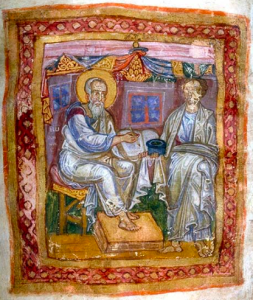
An 11th-c. illumination depicting St. John on
the left and, possibly, Marcion on the right,
now housed at Morgan Library and Museum
in New York City.
It is only fair to note up front that all surviving sources we have on Marcion’s life and teachings are hostile. These sources include the following:
- St. Justin Martyr, proto-orthodox Christian apologist. Born ca. 90-100, converted ca. 110-130?, died ca. 165. Contemporary with Marcion; active in Syria, Asia, and Rome. Relevant work: Ἀπολογία Πρώτη ὑπὲρ Χριστιανῶν [Apologia Prōtē Hüper Christianōn], “First Defense of Christians,” a.k.a. the First Apology of Justin Martyr, containing a passing reference to Marcion. (St. Justin also wrote a full-length treatise addressing Marcionism, but this has been lost.)
- St. Irenæus of Lyons, proto-orthodox Christian bishop and apologist. Born ca. 145 or earlier in Smyrna (modern Izmir, Turkey), raised Christian, died ca. 200? Born shortly before the date-range estimated for Marcion’s death (ca. 150-160); active in Asia, Lugdunum (modern Lyon) in eastern Gaul, and Rome; mentored by St. Polycarp, a student of St. John the Apostle. Relevant work: Ἔλεγχος καὶ Ἀνατροπὴ τῆς Ψευδωνύμου Γνώσεως [Elenchos kai Anatropē tēs Pseudōnümou Gnōseōs], “Refutation and Capsizing of So-Called Knowledge,” a.k.a. Against Heresies, addressing Marcionism and other forms of Gnosticism.
- St. Clement of Alexandria, proto-orthodox Christian catechist. Born ca. 147, converted at some time before 180, died ca. 215? Born shortly before the date-range estimated for Marcion’s death; active in Egypt, Greece, Palestine, Anatolia, and possibly Syria and/or Cappadocia. Relevant work: Στρώματα [Strōmata], “Patchwork,” or more loosely “Miscellanies,” which asserts that Marcionites cannot be martyrs due to their alienation from God the Father.
- Tertullian, proto-orthodox Christian apologist. Born ca. 155, converted in 197 or 198, died ca. 220. Born around or shortly after Marcion’s death; active in Āfrica (modern Tunisia and coastal Libya). Relevant works: Adversus Marciōnem Librī V, “Five Volumes Against Marcion,” addressing Marcionism in particular, and Dē Carne Christī, “The Flesh of Christ,” addressing Docetic heresies in general (including the Marcionite Church).
- Hippolytus of Rome, proto-orthodox Christian priest and apologist. Born ca. 165, upbringing unclear, died ca. 235. Born around or shortly after Marcion’s death; active in Rome and possibly elsewhere. Key work: Φιλοσοφούμενα ή Κατὰ Πασῶν Αἱρέσεων Ἔλεγχος [Filosofoumena hē Kata Pasōn Haireseōn Elenchos], “Studies in the Refutation of All Sects,” a.k.a. Refutation of All Heresies, addressing Marcionism and other forms of Gnosticism.1
- Celsus, pagan philosopher. Born ca. 130-150?, died ca. 200-230?. Possible overlap with Marcion’s life unclear; possibly active in Rome. Relevant work: Λόγος Ἀληθής [Logos Alēthēs], “True Word,” a general anti-Christian polemic which did not distinguish between proto-orthodox Christians and Gnostics. (This work does not survive independently or complete, but only in extracts quoted by Origen.)
- Origen of Alexandria, proto-orthodox Christian scholar and apologist. Born in 185 or 186, raised Christian, died in 252 or 253. Born about 20-30 years after Marcion’s death; active in Egypt, Palestine, Petræa, Syria, Cappadocia, Bithynia, Athens, and Rome. Relevant works: Κατὰ Κέλσου [Kata Kelsou], “Against Celsus,” a.k.a. Contrā Celsum, which preserves the pertinent remarks of Celsus about Marcion; there is also at least one passing reference that appears to be to Marcion in the surviving portions of Origen’s commentary on Matthew.
- Eusebius of Cæsarea, Arian Christian bishop and historian. Born ca. 260-265, possibly raised Christian, died 339. Active in Palestine and Constantinople, possibly elsewhere. Relevant works: Ecclesiastical History, the first important history of Christianity, written under Constantine.
- [Anonymous proto-orthodox author, formerly known as “pseudo-Origen”—no biographical details known.] Relevant works: Dē Rēctā in Deum Fide [“The Right Faith in God”], a.k.a. the Dialogue of Adamantius, a dialogue between an orthodox Christian and at least five Gnostic opponents, the first two of whom are Marcionites.
- St. Epiphanius of Salamis, orthodox Christian monk and bishop. Born ca. 310-320, either raised Christian or converted young, died in 403. Long postdated Marcion. Active in Palestine, Egypt, and Cyprus. Relevant work: Πανάριον [Panarion], “Breadbasket,” a.k.a. Against Heresies (not to be confused with St. Irenæus’ work of the same nickname), addressing many Christian heresies and other schools of thought Epiphanius saw as inherently anti-Christian.

Sumela Monastery (now a museum) in the Pontic
Mountains, east and a little inland from Sinope,
Marcion’s birthplace.2 Photo by Bjørn Christian
Tørrissen, used via a CC BY-SA 3.0 license (source).

Now, being hostile doesn’t make a historical source unusable. After all, not all dislike is unreasonable! Besides, just because you don’t like someone doesn’t mean you’ll tell lies about them. But it might mean that; and even if you didn’t, your dislike could make you too careless or credulous regarding them. So, hostile sources always need to be taken with a grain of salt, at least. With that in mind, let’s push on.
Marcion and the Bible
Marcionism was an early form of Gnosticism, and a pretty unusual one. Its founder, Marcion of Sinope2 (a city in the region of Pontus, now part of Turkey’s northern coast) lived in the first half of the second century; he was a second- or third-generation Christian, if accounts that describe him as the son of a bishop are reliable. We don’t have very firm dates for his life, but we know that in the year 144, the reigning Bishop of Rome excommunicated him for heresy.3 Thereafter, he returned to Anatolia and set up his own Marcionite Church, with its own creed and clergy and canon. Many Gnostic sects were a bit flash-in-the-pan, but the Marcionites hung on for a surprisingly long time, long enough that we have a few descriptions of them from Muslim scholars.4 They seem to have gone extinct by the turn of the last millennium.
About that canon. Marcion is the first person in Christian history that we know of to advocate a definite canon of the New Testament. That he was the first on record is not all that surprising—the Church had only existed for a little over a hundred years in 144. Moreover, the definition of the New Testament canon was attended by far less controversy than one might think,5 especially given some of the things we did fight about. Still, this would obviously be crucial for all subsequent development of the faith. Hence, and although his own canon was rejected, Marcion is sometimes honored by historians of the faith as the inspirer of the canon, if only because the proto-orthodox “party” in the Church needed to be able to answer Marcionites with something concrete.
But why was Marcion’s canon rejected? Was it all stuff he made up? The conventional answer, derived from the sources mentioned above, is that Marcion’s canon was rejected because it was controlled by his theology, and this theology rejected … well, most of the Bible. The Marcionites believed that the deity represented in the Hebrew Bible—the stern, matter-creating, sexual-reproduction-enjoining one—was obviously a completely different being from the benevolent and compassionate God of the New Testament, who sent Jesus. So, eighty percent of the Christian Bible goes, right off the bat. Jesus in turn appointed an apostle, but on Marcion’s showing, only one: Paul. So all the writings that weren’t by Paul were out too.7
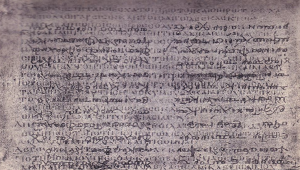
Part of a folio of the Codex Ephræmi Rescriptus,
a palimpsest copy of the Bible dating probably
to the early or mid-fifth century.
That’s slightly awkward, though, as it doesn’t really leave you with any picture of the Jesus all this is ostensibly about. Hmm. Luke was a close associate of Paul’s, and his Gospel could be seen as Pauline, even if he didn’t write it; so, Marcion set about trimming out all the obviously interpolated stuff, the parts implying Jesus had a real body and that real body was Jewish. Hey presto, out of that trimming process came this golden ca—I mean, the result was the Gospel of Marcion.
So the Marcionite canon looked like this (but, you know, in Greek):
- Gospel of Marcion ≈ †Gospel of Luke (?)
- †Letter to the Galatians
- †First Letter to the Corinthians
- †Second Letter to the Corinthians
- †Letter to the Romans
- †First Letter to the Thessalonians
- †Second Letter to the Thessalonians
- Letter to the Laodiceans ≈ †Letter to the Ephesians (?)
- †Letter to the Colossians
- †Letter to the Philippians
- †Letter to Philemon
(The obelus †, or “dagger,” represents the fact that the Marcionite versions of these works reputedly differed from the versions considered genuine by proto-orthodox Christians. It’s not certain if “Laodiceans” was a version of Ephesians, but we do seem to have mislaid a real Pauline letter to the church at Laodicea somewhen or other, and many early manuscripts of Ephesians include no city in the opening address.)
It would be interesting to be able to read the Gospel of Marcion. Quotations from it do survive in some of the polemical works mentioned above, and a few scholars have attempted, strictly conjecturally, to reconstruct it. However, given the overlap of the Gospel of Marcion with Luke (making Marcion presumptively superfluous) and the heretical motives of its composition (making it presumptively untrustworthy), the mainstream Church did nothing to preserve this work, and it has been lost beyond reasonable hope of recovery. … Or has it?
The Manuscript Book mural (1896) by John
Alexander White, located in the Thomas Jefferson
Building of the Library of Congress.
Photo taken by Carol Highsmith (2007).
Yes. Yes, it has. Reconstructions are fine, but they are still not the same thi-, … sorry. Let me try again.
Anyway, About This Thing I Hate (Just, So Much)
So, haha, speaking of hostile sources! I really don’t like the project I’m about to relate to you, gentle reader. I think it sounds quite, quite stupid, for reasons which I’ll give as we go through it. It is therefore of great importance to take my description with a grain of salt! And for any clever-dicks out there who feel that this is such a proof of my honesty, it excuses you from actually taking what I say with a grain of salt: [brightly smiling while shaking head “no”] Wrong answer. That is absolutely not how this works. If the recurring problem of plagiarism and fraud in both professional academia and among amateur content creators has taught us nothing else, it’s that “not bothering to check” is how you really give “a recurring problem of plagiarism and fraud” a nice firm footing.
Ahem. Let’s proceed.
Dr. Andrew Henry’s YouTube channel, Religion for Breakfast—which I’ve generally found to be pretty solid—released an episode, something over a year ago now, about certain ongoing attempts to reconstruct the Gospel of Marcion. (The text below comes from the YouTube transcript, which I corrected against a rewatch of the video essay itself. As I’ll be referring to a great deal of this while also quoting other sources, to help maintain clarity throughout, I’ve put quotations from Dr. Henry in green, though paragraph breaks are of necessity my own introductions.)
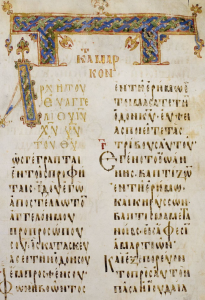
The beginning of Mark in the Codex Boreëlianus,
a late 9th- or 10th-c. uncial manuscript of the
canonical gospels.
The traditional scholarly position actually aligns with early Christian apologists like Irenæus, arguing that Marcion’s gospel was a later, abridged version of the Gospel of Luke … Scholars have also generally assumed that Marcion’s gospel is irretrievably lost. … However, throughout the last decade, over a dozen scholars have started arguing the opposite—that Marcion’s gospel is a provably earlier version of Luke, that the canonical Luke was a major rewrite and expansion of Marcion’s gospel, and we can recover its contents through a painstaking restoration process … This would be absolutely huge for the study of the New Testament …
So how can we reconstruct Marcion’s gospel? … Scholars working on this reconstruction rely on several types of evidence: first, quotations and paraphrases of Marcion’s gospel from his opponents. … Another key source of evidence … are variants found in the surviving manuscripts of Luke. … The goal is to uncover clues about what Marcion’s gospel might have looked like by tracing the evolution of Luke‘s text and finding points where they might overlap. …
Scholars’ reconstructions … of Marcion’s gospel … were difficult to compare, because every scholar took an idiosyncratic approach …, making them hard to read and almost impossible to correlate … Dr. Mark Bilby essentially engineered a cipher to turn these editions into mutually consistent digital data, doing so in a series of peer-reviewed journal articles—so now it’s possible, for the first time in history, to get a statistical handle on the scholarship and see just how much scholars disagree both at a granular and aggregate level. While the first major Greek reconstruction by the scholar August Hahn … is over 14,000 words long, the scholar Adolf von Harnack’s influential work is only 4300 words long, and the scholar Jason BeDuhn’s version is 7200 words long. That’s a huge amount of disagreement … Dr. Mark Bilby set out to normalize this data using custom rules to transform all the different reconstructions into consistent data types. This allows researchers to identify patterns and filter out biases to provide a more objective approach to reconstructing Marcion’s gospel …
I want to pause here to say that creating this software, this way of handling inconsistent documents about a single topic in a systematic way, sounds brilliant. For all my complaints, I am more than impressed by the technology itself, I’m genuinely excited to think of other possible applications, and people like Dr. Mark Bilby and Lance Lotharp (at the time a grad student in statistics at Columbia, mentioned a little later on) absolutely deserve recognition for this.
It is also worth emphasizing something I think a lot of people might miss here. What’s being examined and interrelated here are scholarly reconstructions of the Gospel of Marcion, created with more or less sound techniques, and at greater or lesser degrees of confidence. That’s not the same thing as actually having a copy of the historical text that really existed: what it is is scholars’ best guess. This is not to accuse the scholars who set up this project, nor Dr. Andrew Henry, of misleading anybody; they never so much as hinted that they were doing anything else. Rather, I highlight this because I think it’s exactly the kind of fact that tends to get lost in the shuffle when people like Dr. Henry (or even small fry like myself) try to popularize scholarship.8
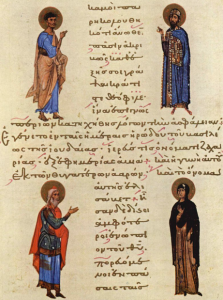
A folio (11th c.) from a Byzantine manuscript
of the Gospel of Luke.
Into the Weeds
Here’s one example: Dr Bilby found that the word “people” the Greek λαός [laos]9 occurs thirty-six times in the canonical Gospel of Luke, but it occurs only one time in witnesses of Marcion’s gospel. This would be a highly unusual statistical distribution if Marcion’s gospel and Luke have the same author—like, what are the chances that Marcion holding a copy of Luke and armed with his scissors would only snip out the word “people” so many times—but this would be a predictable distribution if canonical Luke is a later writing and expansion of Marcion’s gospel. To drive this point even further, the canonical Gospel of Luke … is meant to be read together with the Acts of the Apostles … This same word λαός appears forty-eight times in the book of Acts but only occurs fourteen times in Matthew and two times in Mark. This suggests there may have been an earlier version of Luke that lacked the heavy use of the word “people,” and that the canonical books of Luke and Acts that we have today represent a later editorial expansion by an editor that used that word a lot.
Okay, we gotta stop again now, because no, it doesn’t suggest that. It is consistent with that theory. But consistency, by itself, does not constitute support. This is weird and counter-intuitive for a lot of people, since inconsistency does constitute evidence against a theory; doesn’t it follow that the opposite of inconsistency would have the opposite effect? Well—no.
Aristotle’s most important work (I’m saying it. Come at me, Thomists) was the Organon, or roughly “The Toolbox.” This was a six-part manual of logic. It begins not by teaching the student how to build syllogisms or spot fallacies, but by teaching them how to define words—because if you can’t nail those down, then everything else in your argument is going to be built on sand.
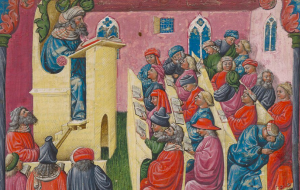
Aristotle Lectures to Students (late 14th c.),
by Lawrence of Voltolina. Incidentally:
whatever became of the rich profusion of hats
students apparently used to wear?
In the Categories, the first book in the Organon, Aristotle explains one part of learning to define words as learning to recognize the different kinds of opposites a word can have. Start with a simple example: light and dark are opposites. So far, so good. If you have a particular sense of humor, you might think that Aristotle’s next point will be that light and heavy are also opposites, but that isn’t what he’s getting at, and not just because that particular double meaning isn’t there in Greek. Rather, there is a different opposite in that light and not-light are opposites.10 A subtler example would be the many “opposites” of man: God, animal, woman, men, elf, ghost, machine, boy, angel, nature, coward, extraterrestrial, and there are probably more.
What does this have to do with the quoted claim above about the lost Gospel of Marcion? First, the opposite of inconsistency, which is “evidence against” an idea, is not support (“evidence for”). Rather, the opposite of inconsistency is consistency: translated into evidential terms, the opposite of “evidence against” is “no evidence against.” That’s not support, because most of the time, you can come up with an arbitrarily large number of theories about any question that are consistent with the evidence available. The ol’ brain-in-a-vat theory is, by design, compatible with basically every kind and degree of evidence that can exist. You need to have a stronger, more limiting relationship than that between your specific view of something and the available evidence for it, to be able to claim that that evidence actively favors your view.

I’m mildly astonished this 1952 movie poster
not only exists, but is something I have a
pretext to incorporate into a discussion of the
history of Christian doctrine.
Let’s now that drive the point further. To review, the claim was (skipping the ellipses for readability):
The word “people,” λαός, occurs 36 times in Luke, but only one time in witnesses of Marcion’s gospel. This would be a highly unusual statistical distribution if Marcion’s gospel and Luke have the same author. To drive this point even further, Luke is meant to be read together with Acts. Λαός appears 48 times in Acts, but only 14 times in Matthew and 2 times in Mark. This suggests there may have been an earlier version of Luke that lacked the heavy use of the word “people,” and that the books of Luke and Acts we have today represent a later expansion by an editor that used that word a lot.
The problems with this statement are two. Problem number one is, the implication in the citation of Matthew and Mark is that we could and should expect the three Synoptic Gospels to have similar vocabulary. That’s possible; there is absolutely no reason it must be true. Hence, finding that it doesn’t happen to be suggests nothing.
Conjuring the Gospel of Marcion‘s Ghost
And problem number two is that all reconstructions of the Gospel of Marcion are precisely that: reconstructions. A reconstruction is a dreadfully rickety object. In 1959, the Principal of Westcott House, an Anglican theological college, invited C. S. Lewis to address his students on the topic of Biblical criticism. He shared the following—and bear in mind, this is about the more modest task of accounting for the history of texts we actually do possess, not the harder one of determining the contents of those we don’t:
All this sort of criticism attempts to reconstruct the genesis of the texts it studies; what vanished documents its author used, when and where he wrote, with what purposes, under what influences … This is done with immense erudition and great ingenuity. And at first sight it is very convincing. …
What forearms me against all these Reconstructions is the fact that I have seen it all from the other end of the stick. I have watched reviewers reconstructing the genesis of my own books in just this way. … Most of [any review of a book] is taken up with imaginary histories of the process by which you wrote it. The very terms which the reviewers use in praising or dispraising often imply such a history. They praise a passage as “spontaneous” and censure another as “labored” … My impression is that in the whole of my experience not one of these guesses has on any one point been right; that the method shows a record of 100 per cent. failure. You would expect that by mere chance they would hit as often as they miss. … I can’t remember a single hit. …
Now this surely ought to give us pause. The reconstruction of the history of a text, when the text is ancient, sounds very convincing. But one is after all sailing by dead reckoning; the results cannot be checked by fact. In order to decide how reliable the method is, what more could you ask for than to be shown an instance where the same method is at work and we have facts to check it by? Well, that is what I have done. And we find that, when this check is available, we find that the results are either always, or else nearly always, wrong.11
It’s a very minor point, I also couldn’t help but be grimly amused by this passing observation during my rewatch:
[W]hen compared with canonical Luke, Marcion’s gospel has very low frequencies of personal names, place names, chronological terms, emotional terms, and architectural details.
I am surely biased; but to me, that sounds not unlike what might result if someone, say, took a pair of scissors to Luke and cut out a bunch of stuff, maybe with a special focus on trying to make it all sound less Jewish.
There’s Such a Thing As Taking Too Many Grains of Salt

A view of the Dead Sea from Masada at sunrise.
Photo (2005 or earlier) by Grauesel, used via
a CC BY-SA 3.0 license (source).

So let’s return to the hypothetical scissor-wielding Marcion. Was he an ideologically-driven editor cutting out stuff from the Gospel of Luke that did not align with his theology? Scholars like Jason BeDuhn came along and were like, “Wait a minute, this doesn’t add up.” In 2012, BeDuhn published the article The Myth of Marcion as Redactor which challenged the traditional narrative that Marcion deliberately edited the Gospel of Luke to fit his agenda. BeDuhn argued that this assumption lacks substantial evidence and more reflects the polemical opinions of Marcion’s opponents than historical reality. Instead, BeDuhn argues that Marcion transmitted the texts largely as he found them, and that this shorter version of Luke represents an earlier textual tradition rather than a deliberate revision.
One of Dr BeDuhn’s key points is the shaky foundation of the ideological editor theory. This theory mostly relies on the testimony of guys like Tertullian, Irenaeus, and Epiphanius, who were writing decades if not centuries after Marcion. … To quote Dr BeDuhn, “None of them knew anything about the state of the relevant texts in Marcion’s time; therefore, their testimony on this question is wholly without merit. These accusations often assumed that the versions of Luke and Paul’s letters in their own communities were the original ones, and that Marcion’s versions were the corruptions.” In other words, Tertullian accused Marcion of chopping down Luke, but really what he is saying is that Marcion retrospectively appeared to have chopped down the version of Luke that Tertullian was using … But Tertullian’s assumptions ignores the fluidity of Christian texts in the mid-second century. … [M]any gospels and many forms of those gospels were circulating at the time … So for example Marcion’s version of the book of Romans apparently didn’t have the final two chapters (chapters 15 and 16), but there are manuscripts of Romans that are also missing those chapters. The fact that a shorter version of Romans was circulating suggests that these differences predate Marcion …
I was glad to find “The Myth of Marcion as Redactor” available without a paywall here (I’m as broke as I’ve been since I was seventeen). I was less glad to find that, unless I’ve misread it pretty appallingly, this is BeDuhn’s only key point. Again, it’s reasonable to point out possible or indeed probable bias in a witness’s testimony. But there is a difference between that and the fallacy known as “poisoning the well.” And if and when the entire substance of your argument is that a source is biased, you may have exceeded “taking things with a grain of salt,” and just filled the well with seawater. Even if we took Dr. BeDuhn’s thesis as it stands, with no further analysis, the summary that the conventional view “doesn’t add up” just isn’t true (though that was not BeDuhn’s own summary of his thesis). BeDuhn appears to have offered no positive evidence for the view he’s adopting: at most, he has made room for his view, by emphasizing the hostility of orthodox sources to Marcion. Which, okay, there’s nothing inherently wrong with that; but presenting “there’s room to take an alternate view” as if some kind of inconsistency has been exposed in the conventional view, which is not what happened, is going to mislead the audience (even if unintentionally).
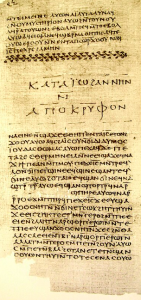
The first leaf of a copy of the Gospel of
Thomas from the “Nag Hammadi library.”
Obviously, it is true that the patristic sources were strongly anti-Marcion. Is it, perhaps, possible that the reason they disliked him so much was because he did at least some of the stuff they said he did? Not all accusations of wrongdoing are the fruit of a dislike that’s come out of nowhere and needs to invent justifications for itself. Some are; some are not. And it’s not that hard to believe in a partisan interpreter who a corrupt version of a Biblical text—by which I mean, it isn’t hard for the Marcion revisionists to believe this: because the theory that Marcion’s version of Luke was the older one casts every Church Father who criticized Marcion in the role of “partisan interpreter who prefers a corrupted text to the real one.” If nothing else, the traditional view has the advantages of (a) Ockham’s razor and (b) most to all of the material evidence we actually possess. Do those facts really count for nothing with all these Biblical scholars?
But, as long as we’re talking about who had what biases and who was in a position to know this or that, let’s talk about another proto-orthodox apologist from that list near the beginning. We may be struck by the fact that, in his article as in Dr. Henry’s video essay, BeDuhn’s line of argument focuses overwhelmingly on Tertullian and, to a lesser extent, St. Epiphanius. To attack these sources is, to my mind, quite reasonable. The former was a fiery apologist prone to letting his mouth run away with him; the latter admitted in his volume on heresy that he was criticizing and condemning at least one other group (the disciples of Origen) without actually reading their work, so I’ll certainly make no defense of the Bishop of Salamis either. But I do want to stick up for somebody else: the “grand-disciple,” so to speak, of John through his disciple Polycarp, Irenæus, the second Bishop of Lyon.
BeDuhn’s article almost ignores St. Irenæus of Lyon. He names the apologist a few times in passing, giving just two brief quotes from him (counting a footnote), and barely engaging him directly at all. Throughout, he implies that Irenæus’ testimony can be essentially folded in with Tertullian’s. Irenæus did also write anti-Gnostic polemics, taking substantially the view of Marcion that Tertullian did, but BeDuhn’s claim (p. 24) that he, like Tertullian, was “of a couple generations later than Marcion,” which is a bit of a stretch. We don’t know exactly when Irenæus was born or exactly when Marcion died, so Irenæus can’t be confirmed beyond doubt as at all contemporary with Marcion; however, given when he became Bishop of Lyon, we can say that he was likely born before Marcion’s death—it’s even possible he reached adulthood before Marcion was excommunicated. He was in any case appreciably older and closer to the facts than Tertullian was. As a native of Smyrna, Irenæus also had closer ties to Anatolia, which was Marcion’s main base of operations, than Tertullian had. And oh yeah, Irenæus was confirmed to be a highly reliable witness to the views of the Gnosics he criticized, by the discoveries made in 1945 at Nag Hammadi—a fact Dr. BeDuhn admits, as far as I saw, nowhere in his article.
Of Whether the Ancients Could Think of Things, Without Us There to Help
The particulars aside, this indulges in a trope in New Testament studies which I find thoroughly obnoxious. As far as I can tell, the implied claim here is that proto-orthodox apologists who lived only decades after Marcion, some of whose lives may even have overlapped with his, were for some reason powerless to do any kind of research in their own day, and didn’t know anything about how books worked in the ancient world, that they lived in. All this, in contrast … with us? What?
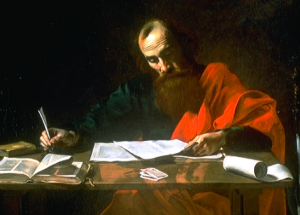
Saint Paul Writing His Epistles (c. 1620),
by Valentin de Boulogne.
I’m by no means taking view of, uh, “patristic maximalism” I guess?—where everything any orthodox Church Father says must be presumed free of error (until and unless ironclad, irrefutable proof that it’s wrong has been produced). There are Christians, and Catholics in particular, who do that; I’m not interested in it. By all means come after St. Epiphanius as not knowing what he’s talking about. But if this is the line of reasoning you want to raise against Hippolytus? Irenæus? Justin Martyr, an actual contemporary of Marcion? That is ludicrous. You don’t need to be a patristic maximalist to see that this trope makes no sense! If a time-traveler from 3900 CE dropped in on us today and casually informed us
- that only a single-digit percentage of twenty-first century media was still available in the fortieth century and several entire technologies and genres were either obsolete or lost, but also
- that fortieth-century scholars understood our media far better than we do, and our opinions about media created in the forties, fifties, and sixties are all worthless because we weren’t there—
I mean, wouldn’t you laugh in their faces? Who has better access to near-contemporary sources about Marcion: us, or the second- and third-century proto-orthodox apologists? Even men as late as Origen could conceivably have spoken with people who knew Marcion personally. They didn’t have to rely exclusively on the slender percentage of sources available to us when investigating Marcion.
And this does include differing manuscripts of Biblical texts. Ancient scholars were not innocent of the fact that a document might have divergent textual traditions. That’s the entire reason St. Jerome was commissioned to create the Vulgate in the fifth century, and the problem was not a novel discovery then. Divergent textual traditions were known to the scribes who made the Dead Sea Scrolls, which we know because they copied them out! Of course this kind of thing was familiar to authors in the second and third centuries CE—and we’re supposed to accept the claim that “their testimony on this question is wholly without merit” because “None of them knew anything about the state of the relevant texts in Marcion’s time”? What a load of garbage!
The Test
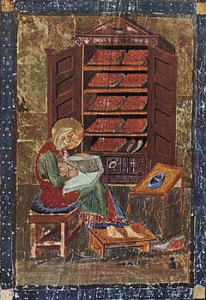
Miniature (8th c.) of Ezra the Scribe from
the Codex Amiatus, the earliest complete copy
of the Vulgate.
There’s more to be said on this subject. For instance, there’s the fact that in the ancient world, where books were so much more labor-intensive and time-consuming to make, subsequent editions or revisions of a work were apt to be epitomes, summaries—meaning that being shorter can actually be an indication that a document is later, not earlier, and being longer can be a sign that a document is older and more original rather than a later elaboration.12 Or there’s the fact that, given when Marcion lived, it had not (by historical standards) been that long since the original documents of the New Testament were written, so that it’s on the cards Marcion was less inheriting than responsible for the “fluidity” of second-century copies of these works. There’s also the fact that the hypothetical contents of the Gospel of Marcion are hardly above the charge of ideological bias themselves: they seem to align with Hellenistic anti-Semitism, and since apparently an appreciable amount of uniquely Lucan material wasn’t present, and Luke relies heavily on testimony that could only have originated with Christian women (like chapters 1-2), it sounds like it’d also align with Hellenist sexism. But this post is already very long and very late, so I’d like to wrap it up with a practical test that can be applied to the project I’ve been criticizing—one that can afford highly useful information about it, even if everything else I’ve said here is wrong.
The techniques these men (Dr. Bilby, Dr. BeDuhn, et al.) are using to reconstruct the Gospel of Marcion, and to demonstrate that it is, in fact, an earlier recension of what was later redrafted as the Gospel of Luke, can be tested. The procedure is simple: they need only take a book which, although we have it complete in the present day, is not known to themselves through more than scattered quotations and descriptions, and use the identical techniques to predict the text of that book. If they are able to do so accurately, down to individual vocabulary selections—since that is the level of precision that, for instance, the argument involving the word λαός professes—then their assertions are pretty hard to quarrel with. Anything less, and they ought to scale their claims back, to whatever that “less” will reasonably sustain.
Footnotes
1To be precisely accurate, it is the book itself that is the source here: whether Hippolytus of Rome was the book’s author is disputed.
2Generally pronounced mär-sē-øn, sĭn-ø-pē. Note that it is generally accepted, but not certain, that Marcion was born in Sinope.
3This could be viewed as an early example of {papal supremacy in the universal Church} {false self-aggrandizement on the part of the papacy} (cross out the phrase that does not apply). But really, it was probably just a function of the fact that Marcion had come to Rome in the 130s to participate in the life of the Church there, even making a sizable donation to its coffers. Nonetheless, by 144, St. Pius I apparently felt he had to resort to the most drastic of the Church’s correctives.
4As you’ll recall, Islam began in the 620s; the start of the Islamic Golden Age (when Muslim scholars began to be plentiful, though they had existed before then) is conventionally dated to the 780s. This means the Marcionite Church lasted for something like six hundred years at least.
5The New Testament canon as we know it was first defined in writing by St. Athanasius, in a circular letter in the mid-fourth century—not, repeat: not, at the First Council of Nicæa. However, his list likely set forth a consensus that was already moderately secure at least. Among proto-orthodox Christians, the evangels (the Four Gospels and Acts) and most of the epistles were received pretty promptly. There was a little doubt over the non-Pauline epistles, and over Revelation, but the Paulines (including the Pastorals), I Peter, and I John seem to have been recognized as soon as they were widely known. Conversely, very few books were seriously considered yet failed to make the grade. (Theologians or groups that revered writings of this class did exist, yes, but they tended to be fringe. Possibly the only work which really was an “edge case” was the Apocalypse of Peter, referenced by the late-second-century Muratorian Canon as Scripture, though even then it is noted as disputed.) In other words, while the impression you’d likely take away from pop media is that the formation of the New Testament was a sort of Hobbesian war, and only got stamped out by the Christian Roman emperors for political advantage, the truth is almost exactly the opposite—there were few to no real cases of any book “almost” being declared Scripture but getting shoved out at the last second, nor of the reverse.6
6“Did you watch last night’s episode of ‘Popular Reality Show‘? No? Yeah? You missed a good one, man, you missed—a—good one. They were kickin’ people off left and right, and like, some people got kicked on, and uh …”
7Marcion also rejected the Pastoral Epistles, i.e. I Timothy, II Timothy, and Titus; for what reason is not known. This can be marshaled as part of the argument that these letters are not actually by Paul, a theory largely favored by modern scholars. (The letters of Ephesians, Colossians, and II Thessalonians are also disputed, albeit less so than the Pastorals.) It’s also possible Marcion found the theology of the Pastorals uncongenial for one reason or another. If so, and if he was as unscrupulous about corrupting texts as his opponents asserted, one might have expected him to tamper with these as he reportedly tampered with the nine or ten letters he did accept. Perhaps they were so intolerably unlike what he wished the Marcionite Church to be, doctrinally or structurally or both, that there was (from his perspective) no point in trying to “salvage” them; perhaps he believed they were forgeries; perhaps he simply wasn’t acquainted with them.
8This is not an argument against popularizing scholarship! Popularizing scholarship isn’t far from being the point of this blog nowadays. But every attempt to do a thing has characteristic risks that come with it, and I’m of the opinion that this is a risk that attends popularization.
9I place this transcription in black instead of green because it is an addition of mine to the transcript of Dr. Henry’s video, rather than an abbreviation or summary of anything in it. This may be overkill, but, given my annoyance with the project in question, I’m trying to err on the side of scrupulosity about attributing nothing to the people I’m critiquing that they did not actually say.
10In technical language, light and dark are contrary opposites—opposite extremes, as it were—whereas light and not-light are negative opposites, which are more like logical opposites. There are also relative opposites, which are opposites only in terms of one another (e.g., half of something is the relative opposite of twice as much of that thing—but you aren’t going to just find “a half” lying around, because abstract things like numbers are not independently tangible). Lastly there are privative opposites, which, to be honest, I have a hard time explaining! but I took a crack at it a couple years ago here.
11C. S. Lewis, “Modern Theology and Biblical Criticism,” published posthumously in 1967 in the collection The Seeing Eye by Random House.
12That said, this is a difficult rule to apply cleanly, because, while it’s true at the macro-level, it’s also true that at the level of individual sentences, longer readings are often later ones. (This is true for a mixture of reasons, one of them being that scribes were prone to expanding shorter, more cryptic sentences into slightly longer, clearer ones.)
Previous Post
August 22, 2026
Historica Apocrypha, Episode 1: What Was Gnosticism?
Next Post
September 3, 2026 Who Really Wrote the Gospel of Matthew?
Recent Comments
"On the contrary, such a proclamation, among the Aztecs or Maya, would be disastrously misunderstood. ..."
The Gospel of John: The Bread ..."
"Many thanks for your scholarly study on the Cleansing of the Ten Lepers in the ..."
The Cleansing of the Ten Lepers
"Four Last Things: not the video game, but Death, Judgment, Heaven and Hell.Momento mori. Remember, ..."
"I am going by the time that these sayings began to be converted into written ..."
Are Our Bibles in the Wrong ..."
Browse Our Archives
Select a Category abuse antifascism art bad Catholic celibacy chastity Church crucifixion culture war eros forgiveness gay gender homophobia ikons language liturgy peace poems politics Pope Francis prayer pro-life race recommendations reform repentance review sacraments saints satire scandal schism scripture sex suffering theology Uncategorized violence
Select a Month October 2026 September 2026 August 2026 July 2026 June 2026 May 2026 April 2026 March 2026 February 2026 January 2026 December 2025 November 2025 October 2025 September 2025 August 2025 July 2025 June 2025 May 2025 April 2025 March 2025 February 2025 January 2025 December 2024 November 2024 October 2024 September 2024 August 2024 July 2024 June 2024 May 2024 April 2024 March 2024 February 2024 January 2024 December 2023 November 2023 October 2023 September 2023 August 2023 July 2023 June 2023 May 2023 April 2023 March 2023 February 2023 January 2023 December 2022 November 2022 October 2022 September 2022 August 2022 July 2022 June 2022 May 2022 April 2022 March 2022 February 2022 January 2022 December 2021 November 2021 October 2021 September 2021 August 2021 July 2021 June 2021 May 2021 April 2021 March 2021 February 2021 January 2021 December 2020 November 2020 October 2020 September 2020 August 2020 July 2020 June 2020 May 2020 April 2020 March 2020 February 2020 January 2020 December 2019 November 2019 October 2019 September 2019 August 2019 July 2019
Follow Us!
TAKE THE
Religious Wisdom Quiz
In which garden did Jesus pray before His arrest?
Select your answer to see how you score.
Gethsemane Golgotha Eden Paradise
Related posts from Mudblood Catholic

The Sermon on the Mount, Part I: Matthew...

The Gospel of Matthew: Christ and Antichrist

John the Baptist and the Winnowing Fork: Matthew...

The Gospel of Matthew: The Coventry Carol
TRENDING AT PATHEOS Catholic

Emotion in Early Christianity by Andrew Crislip
Andrew Crislip’s Emotion in Early Christianity examines an often overlooked dimension of...

16 Spiritual Touchstones for a More Grounded Life
After decades of spiritual study, here are 16 principles I try...

Catholic Evangelization: Sharing Your Faith Every Day
Welcome back to the Graceful Awakening mini-series called, “From Faith to Mission.” ...

The Pillar of the Boatmen: the Ancient Monument...
The Pillar of the Boatmen is a Romano-Gaulish sculpture that dates from...

In one sense walking into Westminster Abbey is like walking down the...

'Super Scam Me' Exposes AI Jon Bon Jovi...
Leslie Pickett believed she was in a relationship with Jon Bon Jovi....
view all Catholic blogs
What Are Your Thoughts?leave a comment
Ad-Free & Subscriber Log-In Subscription Support
- About Us
- 2026 Calendar
- Videos
- Podcasts
- Library of World Religions
- Faith In Media Tracker
- Advertise With Us
- Write for Us
- Privacy Policy
- Terms of Service
- Do Not Sell My Data
- Contact Us
- Radiant Digital
- Manage Newsletter Subscriptions
- Unsubscribe From Notifications
- Sitemap
Copyright 2008-2026, Patheos. All rights reserved.
Subscription Support Ad-Free & Subscriber Log-In
Follow Patheos