
BuddhistCatholicContemplativeEvangelicalGeneral ChristianHinduJewishLatter-day SaintMuslimNew VisionsProgressive Christian
Beliefs
- Buddhist
- Catholic
- Contemplative
- Evangelical
- General Christian
- Hindu
- Jewish
- Latter-day Saint
- More Voices
- Muslim
- New Visions
- Pagan
- Progressive Christian
Topics
- Religion News
- Food and Religion
- Sports and Religion
- Religious Art
- Religious Music and Entertainment
- Religious Events
- History and Religion
- Style and Religion
- Politics and Religion
- Women in Religion
- Recreation Outdoors and Religion
- Business Finance and Religion
- Careers Workplace and Religion
- Education and Religion
- Family Parenting and Religion
- Health Fitness and Religion
- Home and Religion
- Relationships and Religion
- Technology and Religion
- Travel and Religion
Columnists
- Buddhist Columnists
- Business Finance and Religion Columnists
- Careers Workplace and Religion Columnists
- Catholic Columnists
- Contemplative Columnists
- Education and Religion Columnists
- Evangelists Columnists
- Family Parenting and Religion Columnists
- General Christian Columnists
- Health Fitness and Religion Columnists
- Hindu Columnists
- History and Religion Columnists
- Home and Religion Columnists
- Jewish Columnists
- More Voices Columnists
- Latter Day Columnists
- Muslim Columnists
- New Visions Columnists
- Nonreligious Columnists
- Pagan Columnists
- Politics and Religion Columnists
- Progressive Columnists
- Recreation Outdoors and Religion Columnists
- Relationships and Religion Columnists
- Religion News Columnists
- Religious Art Columnists
- Religious Events Columnists
- Religious Music and Entertainment Columnists
- Sports and Religion Columnists
- Style and Religion Columnists
- Technology and Religion Columnists
- Travel and Religion Columnists
- Women in Religion Columnists
Resource Library
- 2026 Calendar
- Library of World Religions
- The 100 Most Holy Places on Earth
- Patheos Answers
- Podcasts
- Videos
- Faith Leaders Database
- Anglican Episcopalian
- Bahai
- Baptist
- Buddhism
- Christianity
- Confucianism
- Eastern Orthodoxy
- Hinduism
- Holiness and Pentecostal
- ISKCON
- Islam
- Judaism
- Lutheran
- Methodist
- The Church of Jesus Christ of Latter-day Saints
- New Age
- Paganism
- Presbytarian and Reformed
- Protestantism
- Religion Behind the Scenes
- Roman Catholic
- Scientology
- Shia Islam
- Sikhism
- Sufism
- Sunni Islam
- Taoism
- Zen
- See all religions
Research Tools
 Ad-Free & Subscriber Log-In Subscription Support
Ad-Free & Subscriber Log-In Subscription Support
Follow Patheos 

- Trending:
- Forgiveness
- |
- Marriage
- |
- Consciousness
- |
- Death Penalty
- |
- Election
- |
- Halloween

- Home
- Catholic
- Historica Apocrypha, Episode 1: What Was Gnosticism?
Historica Apocrypha, Episode 1: What Was Gnosticism?
Last updated on: August 24, 2026 at 1:08 pm by Gabriel Blanchard
Historica Apocrypha, Episode 1: What Was Gnosticism? 2026-08-24T13:08:00-04:00 Gabriel Blanchard
Patheos Explore the world's faith through different perspectives on religion and spirituality! Patheos has the views of the prevalent religions and spiritualities of the world.
Introducing:

—the “Hidden History” Series!
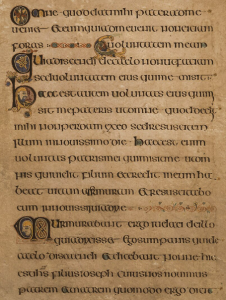
A folio from the Book of Kells (c. 800),
one of the most celebrated examples
of Hiberno-Saxon manuscript art,
written in a beautiful uncial hand.
Of the Mistresses of Charles Brown
With John complete and Matthew on the way, I felt like some variety here on the blog. Besides the Greek and Latin languages, one of the big focuses of Classics (the field I got my degree in) is ancient history, so my thoughts turned that way.
Given when Christianity was founded, the period from, say, c. 150 BCE to c. 200 CE is broadly relevant to its birth and early development. A lot happened—in philosophy, in language, in religion, in politics—that the first several generations of Christians were reacting to. That said, it isn’t always easy to tie these things to a specific chapter-and-verse reference in the Bible. It’s a bit like how the technology we use to predict the weather has dramatically altered our daily lives: we talk about the weather and the forecast all the time, yet most of us hardly ever talk about barometers or Lidar or atomic clocks. (Finding openings to do so must be tough for weather-tech enthusiasts; as a man of severely niche interests myself, my heart goes out to you.)
I hope to balance that out a little in the Historica Apocrypha series. The title is a slight misnomer: the stuff I’ll be sharing is not really “hidden,” any more than the Deuterocanonical books were ever “hidden.” But it’s stuff that isn’t common knowledge, for one reason or another. This could cover anything from the evolution of the Roman class system, to the techniques and materials of ancient bookmaking, to the standard diets of the Mediterranean: topics that have a bearing on New Testament studies, but may not be directly part of it in every case. I’m especially hoping to correct popular misconceptions about these centuries—the tail end of the Hellenistic period and the first couple centuries of the Empire. A lot of nonsense gets talked about all of history; it so happens, Classical Antiquity is getting some limelight at the moment, so hopefully, promoting better information now will go a tad further than usual. (It’s rightly said that a lie can travel around the world while the truth is still putting on pants, so every little boost helps.)

So! Without further ado, let’s get to it.
EDIT: When I first published this (Saturday night [8/22/2026], right before midnight), it had a number of gaffes: in particular, some of the footnotes were mislabeled, and the section on Manichæism wasn’t finished! I have updated and corrected the post throughout. —Post revisions finalized at approx. 1:10 p.m., 8/24/2026.
Historica Apocrypha
Episode 1. Gnosticism
Speaking of things that are related to the New Testament but not properly part of it, that brings us to our subject for Historica Apocrypha‘s series début: the ancient religion known as Gnosticism. (Which, I mean—you knew that. You read the title.)
I’ve had a bee in my bonnet about this for a while. On one level, I find Gnosticism extremely interesting. When its myths are treated as myths (i.e., interpreted according to the literary rules appropriate to myth as a genre), they sometimes contain genuine psychological insights. More than that, when Gnostic doctrines are treated simply as stories, they can be great fun; the “lowest common denominator” Gnostic cosmology and salvation narrative would make a great video game or TTRPG.
That said, there’s a different level on which I find Gnosticism shockingly annoying, in three distinct ways. This first is its faults: it’s a real dorks’ heresy, with awful implications all over.
In fairness to Gnosticism, the second way is that it’s got some insufferable fans and promoters. I’m talking about people like Edward Crowley,1 the original “look at me spelling magic with a k” guy; or Madame Edgy herself, Helena Blavatsky, foundress of the Theosophical Society—whose logo, to give you the idea, is this white-people-Buddhist2 hot nonsense:
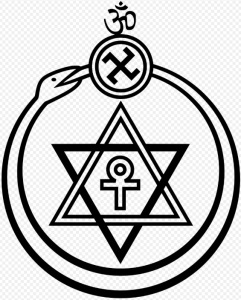
Ancient Egyptian polytheism and Jainism
and Judaism and Hinduism and alchemy
all pretty much say the same stuff
of symbolism: avoided, good job I guess?
Half the time, the main or only thing these people seem to know about Gnosticism is that the Church in antiquity declared it heretical. So it must be smart and interesting and something THEY DON’T WANT YOU TO KNOW, etc.
But there’s still that third way. See, there’s a level where I’m kind of annoyed on Gnosticism’s behalf? This is because Gnosticism is one of those things that tends to get rediscovered-except-not-really every few decades. I’m not talking about archæological finds, like the discovery of the Nag Hammadi Library in 1945 (which was as important for the scholarly study of Gnosticism as the Dead Sea Scrolls were for the study of the Hebrew Bible). I’m talking about when ideas, or at least the words for them, get ripped out of context and used as tools by people who don’t care about the truth. During the “anti-woke” discourse of the last several years, “Gnosticism” was seized upon by some of the Right’s most incurious-yet-loud exponents; obviously, they decided that “wokeness”—another term they didn’t understand or care about—was “the new Gnosticism.” And why not? No one wants to learn another thing ever; ew! Far more efficient to discover eternal recurrence (again) and realize that actually all the views you don’t like are mystically the same as each other.
I’ve been describing the current non-interest in Gnosticism on the political Right, but this isn’t the first time something like this has happened. There are now, and long have been, Christian theologians and apologists who are equally eager to scrape whatever they don’t like into a big box labeled “Gnostic Stuff,” so trans people, or Lutherans, or guitars at Mass, can all be “Gnostic” now—as if that sheds any light at all on what’s wrong with doing a gender, or Protestant theology, or hot lixx in church. It’s so lazy. Worse, it threatens to spoil the word for people who actually want to use language for its purpose: to communicate. Misuse a word too much, and you risk making it incapable of conveying meaning.
That, and I’d have thought the question What’s wrong with hot lixx in church? was its own best answer.
So, Who Were the Gnostics? Where Did They Come From? And Why Did the Church Suppress the Gnostic Gospels?
In order, the answers are:
- The Gnostics were a bunch of Christian-tinged pseuds who really wanted to impress Plutarch ‘n’ friends.
- They came from the Mediterranean basin—often, Alexandria (the capital of woo-woo in antiquity).
- The Church eventually suppressed (ish) the Gnostic Gospels because they were trash-tier fanfic.
That felt nice to write, for me. However, it probably didn’t feel terribly informative to you, dear reader, which is because it wasn’t. I’ll start again.
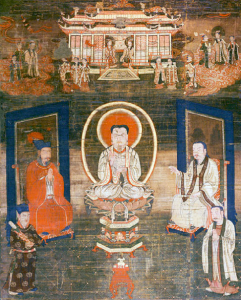
Upper part of the Sacred Scroll of the King of
the Underworld (13th c.), a Chinese painting
thought to be by a devotee of Manichæism,
a highly successful variety of Gnosticism.
Gnosticisms
Gnosticism was a web of syncretic semi-Christian, or para-Christian, religious movements. They mostly existed during the second and third centuries CE; most Gnostic sects died out after that, or lingered only for another century or so. (That said, there were exceptions. One Gnostic school, Mandæism, took root in southern Iraq, and has persisted to the present.)
I said above that Gnosticism is a dorks’ heresy. This maybe isn’t strictly true, but not for the reason you might think. It’s not an insulting nickname bestowed by outsiders or anything like that: γνῶσις [gnōsis] was a normal word for “knowledge,” and γνωστικός [gnōstikos] was a normal adjective.
The actual issue is that Gnosticism was not one thing. It’s a fair umbrella term, but it can suggest a cohesion among the movements it describes which really wasn’t there. No central authority, either written or institutional, defined it. It was more that the Gnosticisms, plural, were heresies.3 And they were many. The Gnostic schools were eternally multiplying by division, and frequently both contradicted and plagiarized each other. You had your Basilideans, your Encratites, your Ophites, your Sethians, your Bardesanites, your Cainites, your Carpocratians—though I guess it’s unfair to put it like that; you personally didn’t have them. (Or maybe you did. I don’t know what you do with your time.) The authors of the Catholic Encyclopedia of 1917 put it thus in their entry on Gnosticism:4
A collective name for a large number of greatly-varying and pantheistic-idealistic sects, which flourished from some time before the Christian Era down to the fifth century. While borrowing the phraseology and some of the tenets of Christianity, [they] held matter and the whole universe [to be] a depravation5 of the Deity, and taught the ultimate end of all being to be the overcoming of the grossness of matter and the return to the Parent-Spirit, inaugurated and facilitated by the appearance of some God-sent Savior. However unsatisfactory this definition may be, the wild confusion of Gnostic systems will hardly allow of another. Many scholars, moreover, would hold that every attempt to give a generic description of Gnostic sects is labor lost.
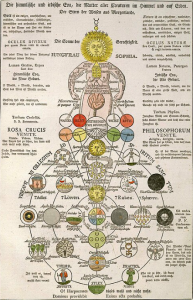
A diagram of Sophia, or Wisdom, from Geheime
Figuren der Rosenkreuzer [The Secret Symbols of
the Rosicrucians] (1785); Rosicrucianism had ties
to Gnosticism via alchemy.
This isn’t to say the term Gnosticism is meaningless. There were plenty of frequent Gnostic tropes: a Christian tinge is usually there, and you can expect long genealogies of divine emanations, spirit-matter dualism, and a love of terms like archon and sophia. But about the only consistent trope is the concept of “salvation through knowledge”—which is about as hopelessly vague and open-ended as it sounds!
A useful analogy: what does it mean to call something New Age? It does mean something. You know—counterculture, make love not war, the Age of Aquarius, yoga, flower children, free love, ESP, karma, stop the war, summer of love, angel-channeling, vegans, chakras, a fourth slogan with the word “love” in it, all that kind of thing. But that’s more of a vibe than a system. You pick up a feel for the vibe from exposure, but there’s probably no single New Age thing that contains every New Age element, and probably no one of them is present in every New Age thing. It’s much the same with Gnosticism. You’ll find varieties that are monist rather than dualist, or don’t include Jesus in their narrative, or accept idol-worship, or observe kashrut; you have to catch the scent of Gnostic air.
“Weak and Beggarly Elements”
So what were these tropes odorizing the Gnostic atmosphere? I’ll highlight seven.
I. Spirit-Matter Dualism.
“The spiritual,” as such, was often treated as ipso facto good by Gnostics, and the material as inherently bad, or at least as inferior and negligible. This especially tended to be true of the spirit as contrasted with the body. This is one of the most common elements among the beliefs of Gnostic sects—so much so that it’s often treated as if it were interchangeable with Gnosticism.
II. An Ascetic Moral Code—Usually.
Due to the trope above, Gnostics frequently embraced a moral code that saw various austerities—celibacy, vegetarianism, not drinking alcohol, self-inflicted pain—not just as a school of self-discipline, but as inherently good and desirable. The Marcionite Church here (a Gnostic tradition that survived into the early days of Islam) is of note: it forbade sexual intercourse, even between married couples, for full members of the community.
That said, some Gnostics inverted this. After all, if matter is broadly “a bad thing” and the body is matter, it’s at least as logical to do whatever you want with the body (which you’re hoping to shed forever anyway) as it is to practice self-discipline by means of it.
III. Complex Theogonies From a Non-Creative Deity.
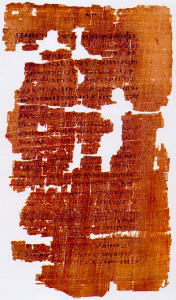
The first folio of the Codex Tchacos (late 3rd
or early 4th c.), the only surviving manuscript
copy of the Gospel of Judas, one of the
(so-called) Gnostic Gospels.
Most schools of Gnosticism have a pantheon of divine-ish emanations, often named Æons.6 It’s not always clear whether these should be regarded as polytheistic systems, or something closer to a one-God-plus-angels setup, or forms of pantheism. Exactly how many there are and what they are called also varies. Thirty is a popular number, and certain names do recur in many Gnostic theogonies: Sophia is a huge favorite, and popular entities include Aletheia, Ennoea, Nous, and Anthropos, among others.6
You’ll notice the word there was “emanation,” not “creature.” The difference is key. These exalted spirits, mmm, came forth from God or “the One” or whatever, without exactly being created. See, bizarre though this may sound today, “creating things” was seen by the Gnostics (and some contemporary philosophers) as, metaphysically, sort of … crass? It was therefore a ludicrous, impious thing to attribute to the highest deity.
But, descend through the grades of emanations far enough and, in the words of the Anglican Fr. Charles Bigg, you’ll eventually come “to one who, while powerful enough to create, is silly enough not to see that creation is wrong.”7 This emanation—the Demiurge, a term from Plato’s Timæus (δημιουργός [dēmiourgos], “craftsman”)—is the one that made the material world. Depending on the Gnostic “denomination,” the Demiurge might or might not be actively malicious: an evil Demiurge seems to have been the more common idea, but some Gnostics believed he had repented, and/or believed he was incompetent but not malicious. Stranger still, the Demiurge might or might not even know about the entities ontologically above him.
IV. Astral Powers Hostile to Man.
Ah, the Archons (ἄρχοντες [archontes] “rulers, princes”)—malevolent spirits inhabiting the planets. In many versions of Gnosticism, the Archons were companions and/or creations of the Demiurge. Their function was to see that spirits which had been trapped in on earth in bodies stayed trapped, and to arrest attempts by any disembodied spirits to escape.8 It may not be a coïncidence that Gnosticism began to bloom during the golden age of Hellenistic astrology (the system which still appears in Western newspapers), when even the highfalutin Stoics were gung-ho for it. This probably helped reinforce this element of Gnosticism from without, so to speak.
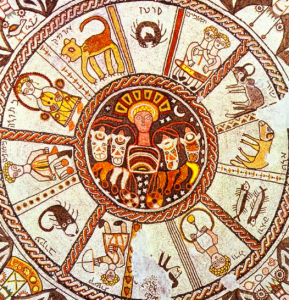
Depiction of the zodiac (6th c.) from
Beyt Alfa synagogue in northern Israel.
V. Salvation by Secret Knowledge.
This is the gnosis from which the Gnosticisms take their name. Naturally, different groups had different versions: among some sects, their own doctrines as such were the crucial secrets. Others taught that there were specific magical passwords which the souls had to use to force the Archons aside, allowing the Gnostic’s spirit to complete its post-mortem ascent back to God. (Are you starting to see why I think this would make a great game?) Whatever its precise character, this gnosis was often attributed to whatever savior-figure the sect recognized—more on him below. When this savior-figure was Jesus, the professed gnosis was usually attributed to one of the Apostles.
VI. A Discarnate Christ as Savior—Usually.
About that savior-figure. It’s often Jesus—or rather, it’s often Christ, and Christ is connected with Jesus, somehow. Not by genuine Incarnation! that would be icky. Gnostic theologies of Christ tend to be either Docetic or Adoptionist, explained below. Like the point above about asceticism, this one is especially prone to being tweaked. The only extant Gnostic religion, Mandæism, considers Yahya (John the Baptist) its founder and something approaching a messiah; it views Jesus as a Mandæan apostate.
-
- Docetism (from δοκέω [dokeō] “to seem”) taught that the apparent human form of Jesus was an illusion or disguise the Christ-spirit employed to enter material creation on the sly, without opposition from the Archons.
- Adoptionism taught that the Christ-spirit rested upon Jesus, but only as of a certain point in his life. His baptism was a favorite choice. Adoptionist Christologies typically also posit that this Christ-spirit departed before the Passion began, since the noblest divinity is above suffering and crucifixion is beneath its dignity. (Somehow, the Gnostics decided that calling God a wuss with something to prove is A Compliment, Actually.)
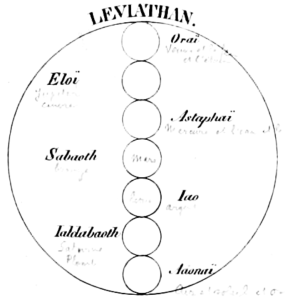
A 19th-c. reconstruction of part of the Gnostic
Ophite Diagrams. Here we see the names of
the seven chief Archons: Orai, Eloi, Astaphai,
Sabaoth, Iao, Ialdabaoth, and Adonai.
VII. Esoteric Interpretations of Scripture—Usually.
Finally, those schools that went all-in on the “Christian-tinged” part needed to do something with the Hebrew Bible. I mean, this book openly presents God as the Creator of matter, it says he enjoined sexual reproduction upon mankind, it seems almost to equate knowledge with evil rather than good in Genesis 2-3, it associates his worship with vulgarities like animal sacrifice, and much more that was offensive to Gnostic sensibilities. There were groups like the Marcionite Church that took the obvious approach, simply ditching the Hebrew Bible; surprisingly, though, this was not the usual strategy. Instead, they interpreted it through a layer of allegorizations that strongly gives “program on the History Channel about ‘Bible codes.'”
Thus, a Gnostic interpretation of Genesis 3 might go like this. The text’s “God”—as in, the Lord our God—is the Demiurge. Because of reasons, he has trapped some stranded fragments of a fallen Æon in human bodies, those of Adam and Eve. (Why and how could an Æon, ostensibly a pure spiritual emanation of the divine, do something as blatantly materialistic as break into fragments, you ask? This, too, is because of reasons.) Another uncorrupted Æon, perhaps Sophia, has taken pity on these fragments and plans to free them from the material universe. Sophia therefore enters Eden in the form of the serpent, prompting humanity to eat of the Tree of Knowledge (eh? eh?), and thus begin to escape the blind tyranny of the Demiurge. This is not enough to actually effect redemption yet, but it puts humanity in the position in which the Logos (acting as Sophia’s ally, if not on her orders) will be able to descend upon Jesus. He shall be the hylic vessel through whom the crucial magical passwords that break the power of the Archons will be transmitted to the elect; they can then use them to ascend out of the material universe and be reunited with the Divine Abyss, which is a,,, totally normal thing to call God the Father, sure.
This is by no means the whole Gnostic panoply. I’ve said little to nothing about the fatalistic idea of election many Gnostics subscribed to, or the doctrine of metempsychosis (which is how you’re supposed to pronounce “reïncarnation” in front of the Pythagorean books), or their dabbling in magic. But this is plenty for a sketch.
Who’s Who
The following are just three noteworthy figures in and schools of Gnosticism. Bear in mind, a lot of the information here comes mainly from sources that are hostile to, and significantly later in date than, what they are discussing; it’s best to treat these accounts as tentative.
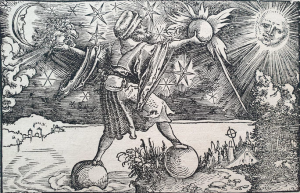
• Valentinus, ?-c. 155?, founder of Valentinianism.
Valentinianism was one of the most elaborated, widespread forms of Gnosticism while it lasted. Its founder Valentinus came from Egypt. He traveled to Rome during the pontificate of St. Hyginus I (who reigned from about 136 to about 140), and saw considerable social and institutional success there; he was reputedly a gifted teacher and preacher. By some accounts, he even entertained serious hopes of being elected pope after Hyginus was martyred. It seems uncertain exactly when Valentinus definitely embraced heresy. He was finally anathematized by St. Pius I around 155, possibly only after his death. In any case, Valentinus dreamt up a pantheon of thirty Æons—an Ogdoad9 that sired a Decad that sired a Dodecad: 8 + 10 + 12 = 30—all arranged in syzygies, or pairings of a “masculine” Æon with a “feminine” counterpart capable of further emanations together. (Of course nothing about this seems reminiscent of Egyptian or Semitic polytheism in any way, how can you even ask that.) The interweaving of these entities and their falls and repentances form the substance of Valentinian theology. Valentinianism “classic” was popular in the eastern Mediterranean for centuries, only really declining from the late fourth century, while to the west, a slightly different form arose, named Marcosianism after its founder, a certain Marcus the Magician.
However good Valentinus may have been at sounding Christian earlier on, this talent seems to have faded from the Valentinians. Surviving scraps of their liturgical texts, like the baptismal formula below, sound, shall we say, fishy:
In the name of the unknown Father of all, by Aletheia [Truth], the Mother of all, by the name which descended upon Jesus.
Like … come on guys. “In the name of the Father, and of the Son, and of the Holy Ghost” is really not as hard to get right as you’re making it. This Valentinian formula is attested in St. Irenæus’ Against Heresies, written around 180, which spends a good chunk of its word-count on this form of Gnosticism. There used to be some understandable doubt about whether to trust Irenæus for information on this, given he’s an openly hostile source. One of the indirect results of the discoveries at Nag Hammadi in 1945, which unearthed a trove of Gnostic writings in the Egyptian desert, was to confirm that St. Irenæus had been both honest and quite accurate in his description of Gnostic theologies!
**• Marcion of Sinope,**10 c. 85-c. 160, founder of the Marcionite Church.
Marcion was reputedly the son of a Christian bishop from Pontus on the northeastern coast of modern Turkey. In the late 130s, he traveled to Rome, where he made an impressive donation to the church there: 200,000 sesterces, an amount which I gather would come to something like $350 million today. Regardless, Marcion’s stay in Rome was shorter and less accomplished than that of Valentinus. In 144, he was excommunicated, and his 200,000 sesterces were returned.
At this, Marcion decided not only to take his ball and go home, but to found his own church that’s way better. He taught that, of the Apostles, only the ministry of Paul was genuine, and that the deity depicted in the Old Testament could not be the same as the deity of the New. He codified his own canon of Scripture, consisting in one gospel (reputedly a mangled version of Luke—St. Luke’s authority was treated more or less as an extension of St. Paul’s in the ancient Churh) and ten Pauline epistles (no Pastorals, and in place of Ephesians his had an epistle “to the Laodiceans,” though this may be the same work re-titled). Marcion denied the appalling, the wounding idea that Jesus was a Jewish Messiah; he also enjoined pescetarianism and teetotalism upon his church, and utterly forbade sexual intercourse among his followers, since this led to—shudder—childbirth, which trapped yet more spirits in the material universe. Marcionism proved to be a relatively hardy type of Gnosticism, lasting until well after the conversion of the Empire to Christianity.
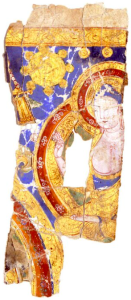
Manichæan depiction of the Buddha (10th c.)
from the ruins of the city of Gaochang in
Xinjiang, northwestern China.
**• Mani of Ctesiphon,**10 216-274, founder of the Manichæan Church.
Born in Mesopotamia, Mani was raised as a member of a sect called the Elkesaites, a Jewish-Christian-Gnostic sect from Sasanian Persia. He started his career as a prophet in his mid-twenties, styling himself “an apostle of Jesus Christ.” This may have evolved: mature Manichæism is held to syncretize Jewish, Christian, Gnostic, Zoroastrian, and Buddhist elements (among others!), and Mani himself apparently claimed later on to be the reïncarnation of Zoroaster, the Buddha, and Jesus, which would seem to make being one of Jesus’ apostles a little redundant. Thanks to the placement of the Sasanian Empire, this allowed Manichæism to spread remarkably far in a short time; in fact, for a few centuries, from Late Antiquity to the High Middle Ages, Manichæism achieved the status of a world religion, with its greatest strongholds in Central Asia. Mani’s teachings had less influence west of the Euphrates, but it’s widely known that St. Augustine was a Manichee for ten years before converting to the Christian religion.
The Manichees accented the dualism trope, explaining evil by denying the omnipotence of God (or “the Father of Greatness”): rather, he was locked in conflict with an equal but evil power. Rather unusually, they did make the Father of Greatness the creator, and in fact posited many creations. In the process of these creations, light particles had become trapped in material vessels of many kinds, and the disciples of the religion sought to free them. Manichæism also had an elaborate ecclesiastical structure, with two basic categories, the Elect and the Hearers: Hearers participated in the church, but had not taken the vows that bound the Elect. These included abstaining from alcohol and meat, and also from harvesting plant food—killing plants was still killing, so the Hearers would commit this “sin” for the Elect, who would then interceded for the Hearers. (I guess if the good deity isn’t omnipotent, you really could be put in a position where you have no choice but to make your followers do evil on your behalf? Since apparently God literally forbids that you fix your own cucumber sandwich.)
Gnosticism Today
Several Medieval groups were accused of being revivals of Gnosticism. The Cathars are the most notorious; there may be some truth to this, though it’s difficult to say for certain. A few modern groups have claimed to take up the mantle of the Gnostics. All are without historical connection to any Gnostic group from the ancient world—they’re likelier to have ties to ceremonial magic than anything else. (Of the Gnosticisms dating to Classical Antiquity, the Manichees held on the longest, surviving until the fourteenth century and perhaps longer. However, they were ravaged by the Black Death, which was promptly followed by a severe persecution in Ming China. The faith went underground, and seems gradually to have been absorbed into certain forms of Chinese Buddhism.)
A lot of sources about Gnosticism have been lost, including that Gospel of Marcion I alluded to above. About that …
TO BE CONTINUED
Footnotes
1“Edward” was the name given at birth to occultist Aleister Crowley, “the wickedest man in the world” (sure, buddy), who also styled himself “666” (ooh! tell me, I’m on tenterhooks, are you anti- or pro-Christ?). Crowley’s middle name really was Alexander, so I suppose he was entitled to use that in place of his forename, but I was unable to discover why he preferred to Scotchify it as Aleister, as it doesn’t seem like the Scots language or people ever did him any particular injury.
2As we are on an internet, I should say in so many words that I don’t mean a white person couldn’t be or become a sincere, competent Buddhist. That happens all the time. What I do mean is, first, that there’s a reason “twenty-something urban liberal Caucasians who’ve gotten really into Buddhist stuff lately” do not have a reputation as insightful exponents of the tradition; and second, that this answers an odd quality in Mrs. Blavatsky herself—namely, that her spiritual views were oddly generic and bland for such a gifted liar.
3Or, more strictly, they could be heresies. Some types of Gnosticism were definitely trying to be Christian, like the Bardesanites. Others, such as the Mandæan faith, were so alien to anything the word “Christian” has ever meant that trying to understand them as Christian heresies doesn’t really make any sense, and it’s clearer to approach them as distinct religions
4Thank you kindly to the staff who run the site New Advent for making this work available (and easily searchable!) online. I’ve abridged the quotation a little; it can be found here, in the second and third paragraphs right near the top.
5This word should not be confused with deprivation. Rather, deprivation relates to deprived the same way depravation relates to depraved.
6The Greek that lies behind these terms is as follows.
• Æon: αἰών, “age, world, era.”
• Aletheia: ἀλήθεια, “truth, fact.”
• Anthropos: ἄνθρωπος, “man, human being, person.”
• Ennoea: ἔννοια, “thought, intention, design.”
• Nous: νοῦς, “mind, intelligence.”
• Sophia: σοφία, “sense, good judgment; wisdom.”
7This quote comes originally from Fr. Bigg’s 1909 volume Origins of Christianity; however, I know it only via Charles Williams’ book The Descent of the Dove, where it occurs in the first chapter (on p. 23 of the 2002 paperback put out by Regent College Publishing).
8The controversial doctrine of the ærial toll-houses is speculated by some to be of Gnostic origin. This doctrine, embraced by some Eastern Orthodox and rejected by others, states that after death, in seeking to ascend into heaven, the Christian soul encounters various demons that accuse it of sins and try (sometimes with success) to drag it down into hell. At any rate, I find myself in agreement with the late Fr. Seraphim Rose that the idea of the ærial toll-houses does not sound at all like the Western doctrine of Purgatory, and that the two ideas are probably not related. (The bizarre yet endearing 1999 Western Purgatory could have escaped my principal critique of it, if it had only called itself The Ærial Toll-Houses. I do recognize that such a title would probably be even worse for marketing purposes than I have to imagine the title Purgatory was.)
9I have absolutely no idea why, but two Greek numerical terms—hebdomad, from ἑπτά [hepta] “seven,” and ogdoad, from ὀκτώ [oktō] “eight”—show the same phonetic change: a pair of unvoiced medial plosives (-pt- and –kt-) in the cardinal numbers are shifted to their voiced counterparts in the corresponding quantitative adjectives (-bd– and –gd-). As far as I know, only these terms do this: πέντε [pente] “five” does not yield a *pendad, but the regular pentad; neither does ἕξ [hex] “six” give us a *hegzad or a *hegdad, but a hectad, with no voicing of the medial consonants. Even other derivatives of ἑπτά and ὀκτώ do not feature it.
10I should point out, there’s discourse about whether Marcion and his following “count” as Gnostics, and the same is true of Mani and the Manichees. I have kept them in for convenience, but certain distinctions are conspicuous. Marcion’s doctrines were just as unorthodox as any form of Gnosticism by Christian standards, but he based them on (his version of) the New Testament, not on ostensible secret traditions handed on from the Apostles on the sly; moreover, he did not go in for allegorical interpretations of the Bible. This actually set him apart both from most Gnostics and from proto-orthodox Christianity. As for Mani, the reasons for dividing him from the Gnostics are partly historical (he comes after the principal waves of Gnosticism within the Roman Empire), and perhaps partly due to the strong Indic element among the sources of Manichæism, an element broadly absent from conventional Gnosticism.
Previous Post
August 13, 2026
Breakfast With the Risen Jesus: John 21
Next Post
August 31, 2026 Historica Apocrypha, Episode 2: The Gospel of Marcion
Recent Comments
"On the contrary, such a proclamation, among the Aztecs or Maya, would be disastrously misunderstood. ..."
The Gospel of John: The Bread ..."
"Many thanks for your scholarly study on the Cleansing of the Ten Lepers in the ..."
The Cleansing of the Ten Lepers
"Four Last Things: not the video game, but Death, Judgment, Heaven and Hell.Momento mori. Remember, ..."
"I am going by the time that these sayings began to be converted into written ..."
Are Our Bibles in the Wrong ..."
Browse Our Archives
Select a Category abuse antifascism art bad Catholic celibacy chastity Church crucifixion culture war eros forgiveness gay gender homophobia ikons language liturgy peace poems politics Pope Francis prayer pro-life race recommendations reform repentance review sacraments saints satire scandal schism scripture sex suffering theology Uncategorized violence
Select a Month October 2026 September 2026 August 2026 July 2026 June 2026 May 2026 April 2026 March 2026 February 2026 January 2026 December 2025 November 2025 October 2025 September 2025 August 2025 July 2025 June 2025 May 2025 April 2025 March 2025 February 2025 January 2025 December 2024 November 2024 October 2024 September 2024 August 2024 July 2024 June 2024 May 2024 April 2024 March 2024 February 2024 January 2024 December 2023 November 2023 October 2023 September 2023 August 2023 July 2023 June 2023 May 2023 April 2023 March 2023 February 2023 January 2023 December 2022 November 2022 October 2022 September 2022 August 2022 July 2022 June 2022 May 2022 April 2022 March 2022 February 2022 January 2022 December 2021 November 2021 October 2021 September 2021 August 2021 July 2021 June 2021 May 2021 April 2021 March 2021 February 2021 January 2021 December 2020 November 2020 October 2020 September 2020 August 2020 July 2020 June 2020 May 2020 April 2020 March 2020 February 2020 January 2020 December 2019 November 2019 October 2019 September 2019 August 2019 July 2019
Follow Us!
TAKE THE
Religious Wisdom Quiz
How old was Noah when flood began?
Select your answer to see how you score.
450 years 550 years 600 years 500 years
Related posts from Mudblood Catholic

The Sermon on the Mount, Part I: Matthew...

The Gospel of Matthew: Christ and Antichrist

John the Baptist and the Winnowing Fork: Matthew...

The Gospel of Matthew: The Coventry Carol
TRENDING AT PATHEOS Catholic

Top Three Anti-Catholic Lies About Catholicism
This is my initial transcript for the video, "THE 3 WORST...

Pope Leo Celebrates Mass for Nurses & Docs...
I don't have any idea how he did it, but Pope Leo...

The Sermon on the Mount, Part I: Matthew...
The Sermon on the Mount, Part I (Matthew 4:12-5:12) St. Matthew moves...

What's up from Crossway: Reviewing some of their latest A few weeks...

Janie Learns the Way of the Cross: A...
Teaching children about Jesus' Passion can be challenging. Many parents and educators...

Looking For Good Catholic Writing - October 2026
He alone extends the heavens, and he walks upon the waves of...
view all Catholic blogs
What Are Your Thoughts?leave a comment
Ad-Free & Subscriber Log-In Subscription Support
- About Us
- 2026 Calendar
- Videos
- Podcasts
- Library of World Religions
- Faith In Media Tracker
- Advertise With Us
- Write for Us
- Privacy Policy
- Terms of Service
- Do Not Sell My Data
- Contact Us
- Radiant Digital
- Manage Newsletter Subscriptions
- Unsubscribe From Notifications
- Sitemap
Copyright 2008-2026, Patheos. All rights reserved.
Subscription Support Ad-Free & Subscriber Log-In
Follow Patheos