
BuddhistCatholicContemplativeEvangelicalGeneral ChristianHinduJewishLatter-day SaintMuslimNew VisionsProgressive Christian
Beliefs
- Buddhist
- Catholic
- Contemplative
- Evangelical
- General Christian
- Hindu
- Jewish
- Latter-day Saint
- More Voices
- Muslim
- New Visions
- Pagan
- Progressive Christian
Topics
- Religion News
- Food and Religion
- Sports and Religion
- Religious Art
- Religious Music and Entertainment
- Religious Events
- History and Religion
- Style and Religion
- Politics and Religion
- Women in Religion
- Recreation Outdoors and Religion
- Business Finance and Religion
- Careers Workplace and Religion
- Education and Religion
- Family Parenting and Religion
- Health Fitness and Religion
- Home and Religion
- Relationships and Religion
- Technology and Religion
- Travel and Religion
Columnists
- Buddhist Columnists
- Business Finance and Religion Columnists
- Careers Workplace and Religion Columnists
- Catholic Columnists
- Contemplative Columnists
- Education and Religion Columnists
- Evangelists Columnists
- Family Parenting and Religion Columnists
- General Christian Columnists
- Health Fitness and Religion Columnists
- Hindu Columnists
- History and Religion Columnists
- Home and Religion Columnists
- Jewish Columnists
- More Voices Columnists
- Latter Day Columnists
- Muslim Columnists
- New Visions Columnists
- Nonreligious Columnists
- Pagan Columnists
- Politics and Religion Columnists
- Progressive Columnists
- Recreation Outdoors and Religion Columnists
- Relationships and Religion Columnists
- Religion News Columnists
- Religious Art Columnists
- Religious Events Columnists
- Religious Music and Entertainment Columnists
- Sports and Religion Columnists
- Style and Religion Columnists
- Technology and Religion Columnists
- Travel and Religion Columnists
- Women in Religion Columnists
Resource Library
- 2026 Calendar
- Library of World Religions
- The 100 Most Holy Places on Earth
- Patheos Answers
- Podcasts
- Videos
- Faith Leaders Database
- Anglican Episcopalian
- Bahai
- Baptist
- Buddhism
- Christianity
- Confucianism
- Eastern Orthodoxy
- Hinduism
- Holiness and Pentecostal
- ISKCON
- Islam
- Judaism
- Lutheran
- Methodist
- The Church of Jesus Christ of Latter-day Saints
- New Age
- Paganism
- Presbytarian and Reformed
- Protestantism
- Religion Behind the Scenes
- Roman Catholic
- Scientology
- Shia Islam
- Sikhism
- Sufism
- Sunni Islam
- Taoism
- Zen
- See all religions
Research Tools
 Ad-Free & Subscriber Log-In Subscription Support
Ad-Free & Subscriber Log-In Subscription Support
Follow Patheos 

- Trending:
- Forgiveness
- |
- Marriage
- |
- Consciousness
- |
- Death Penalty
- |
- Election
- |
- Halloween

- Home
- Catholic
- The Gospel of John: The New Torah, Part III
The Gospel of John: The New Torah, Part III
Last updated on: July 2, 2026 at 5:13 am by Gabriel Blanchard
The Gospel of John: The New Torah, Part III 2026-07-02T05:13:50-04:00 Gabriel Blanchard
Patheos Explore the world's faith through different perspectives on religion and spirituality! Patheos has the views of the prevalent religions and spiritualities of the world.
The Gospel of John: The New Torah, Part III (John 15:18-17:26)
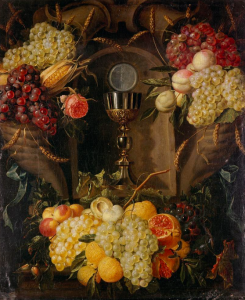
Allegory of the Eucharist (c. 1650-1680),
by Alexander Coosemans.
Here, in the latter half of the Upper Room Discourse, the theme turns a corner. Up to this point, the Lord has spoken primarily of obedience to his command of love, his own unity with God the Father by his own obedient love, and of the unity the Apostles must have with him through obedient love in the Paraclete. All this is, so to speak, independent or internal instruction. With 15:18, he begins to discuss confrontation between the Apostles and “the world”—not as in the phrase God so loved the world*, but as in the phrase* Love not the world nor the things in the world*. Given the imminence of the Crucifixion (which the Eleven still do not understand is coming, and will not understand until both it and the Resurrection have taken place), this preparation in advance for resistance and persecution is more than timely.*
The passage known as “the high priestly prayer,” which occupies the whole of chapter 17, follows. As far as I can tell, it takes this name simply from the fact that it is an intercessory prayer, intercession being the essential job of the priest; why this text especially should be the high priestly prayer, I’m not sure, save perhaps that it is immediately before the sacrifice which ratified the covenant that he mediates.
As in last week’s post, due to the length of the passage involved, the RSV’s form of the text appears here in small typeface; a few of the textual notes, those with a more technical than devotional interest, have been placed in small type as well. (I considered splitting this into two posts, but I had so few textual notes on 15:18-16:33 that it felt silly to do so.)
John 15:18-17:26, RSV-CE
“If the world hates you, know that it has hated me before it hated you. If you were of the world, the world would love its own; but because you are not of the world, but I chose you out of the world, therefore the world hates you. Remember the word that I said to you, ‘A servant is not greater than his master.’ If they persecuted me, they will persecute you; if they kept my word, they will keep yours also. But all this they will do to you on my account, because they do not know him who sent me. If I had not come and spoken to them, they would not have sin; but now they have no excuse for their sin. He who hates me hates my Father also. If I had not done among them the works which no one else did, they would not have sin; but now they have seen and hated both me and my Father. It is to fulfill the word that is written in their law, ‘They hated me without a cause.’ But when the Counselor comes, whom I shall send to you from the Father, even the Spirit of truth, who proceeds from the Father, he will bear witness to me; and you also are witnesses, because you have been with me from the beginning.
“I have said all this to you to keep you from falling away. They will put you out of the synagogues; indeed, the hour is coming when whoever kills you will think he is offering service to God. And they will do this because they have not known the Father, nor me. But I have said these things to you, that when their hour comes you may remember that I told you of them.
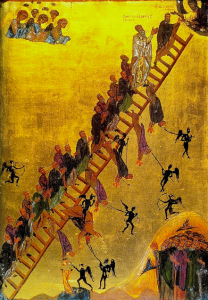
The Ladder of Divine Ascent (12th c.), ikon
written at St. Catherine’s Monastery on
Mount Sinai, Egypt.
“I did not say these things to you from the beginning, because I was with you. But now I am going to him who sent me; yet none of you asks me, ‘Where are you going?’ But because I have said these things to you, sorrow has filled your hearts. Nevertheless I tell you the truth: it is to your advantage that I go away, for if I do not go away, the Counselor will not come to you; but if I go, I will send him to you.a And when he comes, he will convince the world of sin and of righteousness and of judgment: of sin, because they do not believe in me; of righteousness, because I go to the Father, and you will see me no more; of judgment, because the ruler of this world is judged.
“I have yet many things to say to you, but you cannot bear them now. When the Spirit of truth comes, he will guide you into all the truth; for he will not speak on his own authority, but whatever he hears he will speak, and he will declare to you the things that are to come. He will glorify me, for he will take what is mine and declare it to you. All that the Father has is mine; therefore I said that he will take what is mine and declare it to you.
“A little while, and you will see me no more; again a little while, and you will see me.” Some of his disciples said to one another, “What is this that he says to us, ‘A little while, and you will not see me, and again a little while, and you will see me’; and, ‘because I go to the Father’?” They said, “What does he mean by ‘a little while’? We do not know what he means.” Jesus knew that they wanted to ask him; so he said to them, “Is this what you are asking yourselves, what I meant by saying, ‘A little while, and you will not see me, and again a little while, and you will see me’? Truly, truly, I say to you, you will weep and lament, but the world will rejoice; you will be sorrowful, but your sorrow will turn into joy. When a woman is in travail she has sorrow, because her hour has come; but when she is delivered of the child, she no longer remembers the anguish, for joy that a child is born into the world. So you have sorrow now, but I will see you again and your hearts will rejoice, and no one will take your joy from you. In that day you will ask nothing of me. Truly, truly, I say to you, if you ask anything of the Father, he will give it to you in my name. Hitherto you have asked nothing in my name; ask, and you will receive, that your joy may be full.
“I have said this to you in figures; the hour is coming when I shall no longer speak to you in figures but tell you plainly of the Father.b In that day you will ask in my name; and I do not say to you that I shall pray the Father for you; for the Father himself loves you, because you have loved me and have believed that I came from the Father. I came from the Father and have come into the world; again, I am leaving the world and going to the Father.”
His disciples said, “Ah, now you are speaking plainly, not in any figure! Now we know that you know all things, and need none to question you; by this we believe that you came from God.” Jesus answered them, “Do you now believe? The hour is coming, indeed it has come, when you will be scattered, every man to his home, and will leave me alone; yet I am not alone, for the Father is with me. I have said this to you, that in me you may have peace. In the world you have tribulation; but be of good cheer, I have overcome the world.”
When Jesus had spoken these words, he lifted up his eyes to heaven and said, “Father, the hour has come;c glorify thy Son that the Son may glorify thee, since thou hast given him power over all flesh, to give eternal life to all whom thou hast given him. And this is eternal life, that they know thee the only true God, and Jesus Christ whom thou hast sent. I glorified thee on earth, having accomplishedd the work which thou gavest me to do; and now, Father, glorify thou me in thy own presence with the glory which I had with thee before the world was made.
“I have manifested thy name to the men whom thou gavest me out of the world; thine they were, and thou gavest them to me, and they have kept thy word. Now they know that everything that thou hast given me is from thee; for I have given them the words which thou gavest me, and they have received them and know in truth that I came from thee; and they have believed that thou didst send me. I am praying for them; I am not praying for the world but for those whom thou hast given me, for they are thine; all mine are thine, and thine are mine, and I am glorified in them. And now I am no more in the world, but they are in the world, and I am coming to thee.e Holy Father, keep them in thy name, which thou hast given me, that they may be one, even as we are one.e While I was with them, I kept them in thy name, which thou hast given me; I have guarded them, and none of them is lost but the son of perdition, that the scripture might be fulfilled. But now I am coming to thee; and these things I speak in the world, that they may have my joy fulfilled in themselves. I have given them thy word; and the world has hated them because they are not of the world, even as I am not of the world.e I do not pray that thou shouldst take them out of the world, but that thou shouldst keep them from the evil one. They are not of the world, even as I am not of the world.e Sanctify them in the truth; thy word is truth. As thou didst send me into the world, so I have sent them into the world.f And for their sake I consecrate myself, that they also may be consecrated in truth.
“I do not pray for these only, but also for those who believe in me through their word, that they may all be one; even as thou, Father, art in me, and I in thee, that they also may be in us, so that the world may believe that thou hast sent me. The glory which thou hast given me I have given to them, that they may be one even as we are one, I in them and thou in me, that they may become perfectly one,d so that the world may know that thou hast sent me and hast loved them even as thou hast loved me.g Father, I desire that they also, whom thou hast given me, may be with me where I am, to behold my glory which thou hast given me in thy love for me before the foundation of the world. O righteous Father, the world has not known thee, but I have known thee; and these know that thou hast sent me. I made known to them thy name, and I will make it known, that the love with which thou hast loved meg may be in them, and I in them.”

John 15:18-17:26, my translation
“If the world hates you, know that it hated me before you. If you were from the world, the world would love its own; yet because you are not from the world, but I have selected you from the world, because of this the world hates you. Remember the word which I told you: ‘A slave is not greater than his master’; if they have chased me, they will also chase you; if they observed my word, they will also observe yours. But they will do all these things to you for the sake of my name, because they do not know the one who dispatched me. If I had not come and spoken to them, they would not have sin; now, they have no pretense about their sin. The one who hates me also hates my Father. If I had not done works among them which no one else has done, they would not have sin; now, they have both seen and hated me and my Father. But in order that the word written in their law might be fulfilled, that ‘They have hated me freely.’ Whenever the Advocate comes, whom I will dispatch to you from the Father, the Spirit of truth who journeys forth from the Father, this one will witness about me; and you will witness, because from the beginning, you are with me.
“I have told you these things in order that you should not be tripped up. They will disfellowship you; moreover, hour is coming that everyone who kills you will esteem it worship brought forward to God. And they will do these things, because they have not known my Father, nor me. But I have told you these things in order that whenever their hour should come, you may remember them, that I told you. I did not tell you these things from beginning, because I was with you. Yet now, I am going off to him who dispatched me, and none of you asks me: ‘Where are you going off to?’ But because I have told you these things, grief has filled your hearts. But I tell you the truth, it benefits you that I am going away. For unless I go away, the Advocate will not come to you; but if I journey off, I will dispatch It to you.a And that one, coming, will rebuke the world about sins and about righteousness and about judgment: about sins, indeed, that they do not have faith in me; about righteousness also, because I am going off to the Father and you will no longer behold me; and about judgment, because the prince of this world is judged. I still have many things to say to you, but you cannot carry them off at the moment; whenever that one comes, the Spirit of truth, he will guide you into all truth, for he will not speak from himself, but such things as he hears he will say, and will announce coming things to you. He will glorify me, because he will take of [what is] mine and announce it to you. All things which the Father has are mine; this is why I said that he will take of [what is] mine and announce it to you. A little, and you will no longer behold me, and again a little, and you will see me.”
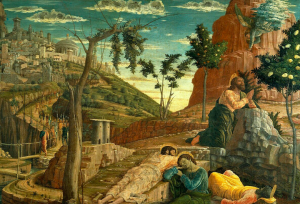
Agony in the Garden (1459), by Andrea Mantegna.
Then his students began saying to each other: “What is this which he is telling us—’A little and you will not behold me, and again a little and you will see me’? Or ‘Because I am going off to the Father’? So they were saying, “What is this which he terms ‘a little’? We do not know what he is saying.”
Yeshua recognized that they wanted to ask him, and he said to them: “Are you researching among yourselves about this, that I said ‘A little, and you will no longer behold me, and again a little, and you will see me’? ‘Amin, ‘amin, I tell you that you will cry and lament, but the world will rejoice; you will be grieved, but your grief will become joy. Whenever a woman bears she has grief, because her hour has come; yet whenever the little child is born, she no longer remembers the pressure because of the joy that a person has come into the world. So you too now have grief; yet I will see you again, and your heart will rejoice, and no one will take your joy away from you. And on that day, you will not ask me nothing; ‘amin, ‘amin, I tell you, if you will ask the Father anything, he will give [it] to you in my name. Until this moment, you have not asked nothing in my name; ask and you will get, in order that your joy may be fulfilled. These things, I have told you in parables; hour is coming when I will not speak to you in parables, but will report openly to youb about the Father; for he, the Father, loves you, because you have loved me and have had faith in me that I came forth from God. I came forth from the Father and have come into the world; again I quit the world and I am journeying to the Father.”
His students said, “Look, now you are speaking openly, and telling no parable. Now we know that you know everything and have no need that anyone inquire of you; in this we have faith that you came forth from God.”
Yeshua responded to them, “You have faith at this moment? Look, hour is coming and has come in order that each [of you] be scattered to his own and you quit me alone; but I am not alone, because the Father is with me. I have told you these things in order that you should have peace in me; in the world you have pressure, but take courage—I have gotten victory over the world.”
Yeshua said these things, and lifting up his eyes to heaven, he spoke: “Father, the hour has come.c Glorify your Son, in order that the Son may glorify you, just as you gave him authority over all flesh, in order that he may give age-long life to all whom you have given him. This is that age-long life: that they may know you, the only true God, and Anointed Yeshua, whom you sent. I have glorified you upon earth, having endedd the work which you have given me in order that I should do it: and now, glorify me, Father, from the glory which I had from you before the being of the world.

“I manifested your name to the people whom you have given me from the world. They were yours and you have given them to me, and they have kept your word. Now they have known that everything which you have given me is from you; because the message which you gave me, I have given to them, and they took [it] and have known truly that it came forth from you, and they have had faith that you sent me. I pray about them; I do not ask about the world, but about those whom you have given me, that are yours—and all mine are yours and yours mine, and I have been glorified in them. And I am no longer in the world, but they are in the world, and I am coming to you.e Holy Father, keep them in your name which you gave me, in order that they should be one, just as we are.e When I was among them, I kept them in your name which you gave me, and guarded them, and none of them is destroyed except the son of destruction, in order that the Writ might be fulfilled. Now I am coming to you, and I am saying these things in the world in order that they may have my joy fulfilled in themselves. I gave your word to them, and the world hated them because they are not of the world, just as I am not of the world.e I do not pray in order that you would lift them out of the world, but in order that you should keep them from the oppressor. They are not of the world just as I am not of the world.e Hallow them in the truth; your word is truth. Just as you sent me into the world, I too sent them into the world;f and for their sakes, I hallow myself, in order that they may be and be led in truth.
“I am not praying about these alone, but about those who have faith in me because of their word, in order that they may all be one, just as you, Father, are in me and I in you, in order that they too may be in us, in order that the world may have faith that you sent me. And I have given them the glory which you gave to me, in order that they may be one just as we [are] one, I in them and you in me, in order that they may be ended in one,d in order that the world may know that you sent me and love them just as you love me.g Father, [anyone] whom you gave me, I want that where I am, he too may be with me, that he may behold my glory which you gave me, because you loved me before world’s founding. Just Father, the world also does not recognize you, yet I recognize you, and these [men] recognize that you sent me, and I have made your name known to them and will make [it] known, in order that the love with which you love meg may be in them, and I in them.
Textual Notes
a. it is to your advantage that I go away, for if I do not go away, the Counselor will not come to you; but if I go, I will send him to you/it benefits you that I am going away. For unless I go away, the Advocate will not come to you; but if I journey off, I will dispatch It to you | συμφέρει ὑμῖν ἵνα ἐγὼ ἀπέλθω. ἐὰν γὰρ μὴ ἀπέλθω, ὁ παράκλητος οὐ μὴ ἔλθῃ πρὸς ὑμᾶς· ἐὰν δὲ πορευθῶ, πέμψω αὐτὸν πρὸς ὑμᾶς [sümferei hümin hina egō apelthō, ean gar mē apelthō, ho Paraklētos ou mē elthē pros hümas: ean de poreuthō, pempsō auton pros hümas]: This statement—especially when considered alongside the standard Christian belief that the Holy Ghost descended upon Yeshua, and indeed that his miracles and preaching were the fruit of the Holy Ghost’s activity—prompts an awkward question: why can’t the Paraclete just come anyway? How is Christ’s departure necessary? Is the City of God “not big enough for the both of them,” or something?
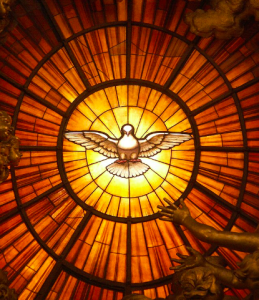
I am not certain that the following is a correct explanation, but it seems to me like it is. I’m drawing on a book called The Mind of the Maker by Dorothy L. Sayers, a novelist and playwright of the last century who was a friend of C. S. Lewis and Charles Williams. She there explains the Christian doctrine of the Trinity in terms of the artistic process, particularly that of writing, as the most familiar process to herself. (I’ve had to shorten her argument brutally; I hope I can persuade at least some of my audience actually to read chapter three of the book in question, which explains her thesis more thoroughly and elegantly.)
Sayers identifies three aspects of the creation of a book, which she calls the work’s Idea, Energy, and Power. The Idea is the unconscious1 father-concept of the work in question; the Energy is the conscious process of writing; and the Power is what flows back to the writer’s mind and makes him or her the reader of his or her own book. Each of these corresponds to the Persons of the Trinity: the Father (who is revealed in the Son) to the Idea, the Son (who does nothing but the will of the Father) to the Energy, and the Holy Ghost (who proceeds from the Father and the Son) to the Power. Only the author of the book experiences the Idea or the Energy directly; the Power is the form of the completed book that can be shared.
The thing is, this pentecostal outpouring of Power—in mundane terms, the publication of the book—does necessitate that the Energy be finished at some point. That, of course, is a theme we have already seen emerge in this discourse. The Advocate cannot “take what is mine and explain it to you” if “what is mine” is still in flux. Even when publishing installments in a series, an entire installment needs to be ready to hit the press in one go. Accordingly, if this artistic analogy illuminates the doctrine of the Trinity in this respect, the Church genuinely cannot be empowered by the Paraclete to be the terrestrial Body of Christ, unless he first ascends into heaven.
b. I have said this to you in figures; the hour is coming when I shall no longer speak to you in figures but tell you plainly of the Father/These things, I have told you in parables; hour is coming when I will not speak to you in parables, but will report openly to you about the Father | Ταῦτα ἐν παροιμίαις λελάληκα ὑμῖν· ἔρχεται ὥρα ὅτε οὐκέτι ἐν παροιμίαις λαλήσω ὑμῖν ἀλλὰ παρρησίᾳ περὶ τοῦ πατρὸς ἀπαγγελῶ ὑμῖν [tauta en paroimiais lelalēka hümin: erchetai hōra hote ouketi en paroimiais lalēsō hümin alla parrēsia peri tou patros apangelō hümin]: As in note a, this phrase prompts a question: why is the Lord saying that he will soon speak plainly about the Father if (as I’ve been maintaining) his teaching function is now over? I am less sure of the interpretation of this phrase than I am of my take in note a, but I believe this too refers to the clarifying and elaborating role of the Paraclete.

Temperance holding an hourglass, from the Alle-
goria ed Effetti del Buono e del Cattivo Governo
[Allegory on the Effects of Good and Bad
Government] (1338), by Ambrogio Lorenzetti.
c. the hour has come | ἐλήλυθεν ἡ ὥρα [elēlüthen hē hōra]: Contrast this with his reply to his Mother in 2:4. Now, addressing his Father, Christ states that his “hour” (so often spoken of earlier in the Gospel as imminent) has at last arrived.
d. accomplished … become perfectly one/ended … be ended in one | τελειώσας … τετελειωμένοι εἰς ἕν [teleiōsas … teteleiōmenoi eis hen]: The words τελειώσας and τετελειωμένοι are both ultimately derived from the Greek term τέλος [telos], which means “end” in most of the same senses as the English word, but especially two: the closing, cessation, or limit of something; and the goal, aim, or purpose of something.
e. now I am no more in the world, but they are in the world … that they may be one, even as we are one … they are not of the world, even as I am not of the world … They are not of the world, even as I am not of the world/And I am no longer in the world, but they are in the world, and I am coming to you … in order that they should be one, just as we are … they are not of the world, just as I am not of the world … They are not of the world just as I am not of the world | καὶ οὐκέτι εἰμὶ ἐν τῷ κόσμῳ, καὶ αὐτοὶ ἐν τῷ κόσμῳ εἰσίν, κἀγὼ πρὸς σὲ ἔρχομαι … ἵνα ὦσιν ἓν καθὼς ἡμεῖς … οὐκ εἰσὶν ἐκ τοῦ κόσμου καθὼς ἐγὼ οὐκ εἰμὶ ἐκ τοῦ κόσμου … ἐκ τοῦ κόσμου οὐκ εἰσὶν καθὼς ἐγὼ οὐκ εἰμὶ ἐκ τοῦ κόσμου [kai ouketi eimi en tō kosmō, kai autoi en tō kosmō eisin, kagō pros se erchomai … hina ōsin hen kathōs hēmeis … ouk eisin ek tou kosmou kathōs egō ouk eimi ek tou kosmou … ek tou kosmou ouk eisin kathōs egō ouk eimi ek tou kosmou]: Each of these clauses lays greater and greater stress upon the identification of the Church with Christ. This is a doctrine we often miss today, or approach only with reluctance—and in a sense, rightly so. The sins and crimes that stain the history of Christianity had barely begun when Judas collected his thirty silver pieces. (It’s become a running, rueful joke on Catholic Twitter to talk about his wits or greed or both in insisting on collecting the money for betraying Christ, then conclude with “unlike the rest of us who do it for free.”) The full humanity of the Church is a reality that we cannot escape except by denying the evidence of our eyes and ears; there is a reason that triumphalism is not only an error,2 but a laughingstock.
Yet this can leave us prone to forgetting the other nature of the Church, which coëxists with that humanity “without confusion, without change, without division, without separation.”3 It is accordingly necessary, from time to time, to recollect that the Church coinheres with the Lord as the body does with the soul. Of particular interest in these verses is the repeated assertion that the Apostles themselves are “not of the world”—which, if true, can only be a divine gift to them, since we see clearly that they were not only in but of the world when Christ first found them, here and there in chapter 1. This again aligns with the only possible solution to the implicit problem posed to us back in 13:31-35; if we are to act in God’s stead and especially to love as he loves, we must (in the words of St. Peter) be made “partakers of the divine nature,” and St. John has handily provided us with indications of how that’s meant to take place as well.
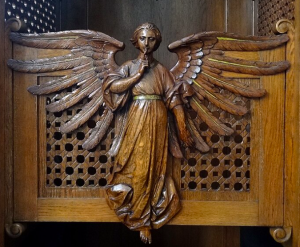
An angel on a confessional in a Warsaw church.
Photo by Ivonna Nowicka, used via
a CC BY-SA 4.0 license (source).

f. As thou didst send me into the world, so I have sent them into the world/Just as you sent me into the world, I too sent them into the world | καθὼς ἐμὲ ἀπέστειλας εἰς τὸν κόσμον, κἀγὼ ἀπέστειλα αὐτοὺς εἰς τὸν κόσμον [kathōs eme apesteilas eis ton kosmon, kagō apesteila autous eis ton kosmon]: Unlike the Synoptics, John does not depict the mission of the Twelve (nor that of the Seventy, related only in Luke) during the ministry of Yeshua. The author’s view of the apostolic office is as high as the other three evangelists—possibly even higher, in light of this very discourse; nonetheless, their appointment as his representatives and training as his apprentices is hardly touched upon until after the Resurrection. 20:21-23 will show them receiving a gift of the Holy Ghost that is clearly quite distinct from the descent depicted in Acts 2, but until that point, the Apostles do next to nothing in the Fourth Gospel, narratively speaking (with the exception of Yudah Ysh-Qriyoth).
g. and hast loved them even as thou hast loved me … the love with which thou hast loved them/and love them just as you love me … the love with which you love me | καὶ ἠγάπησας αὐτοὺς καθὼς ἐμὲ ἠγάπησας … ἡ ἀγάπη ἣν ἠγάπησάς με [kai ēgapēsas autous kathōs eme ēgapēsas … hē agapē hēn ēgapēsas me]: Here, I’ve gone outside my usual translation of the Greek verbs here, which are technically called aorists. We don’t have a precise equivalent to the aorist in English: it isn’t exactly a tense (which tells you when a verb’s action takes place), but is more like an aspect (which tells you the completeness of a verb’s action—e.g., an imperfective verb’s action is in progress but unfinished, while a perfective verb’s action is complete, and a gnomic verb’s action is recurring or characteristic). The emphasis in an aorist verb is on the singularity or unity of the act in question. Accordingly, it’s frequently most convenient to translate it with a preterite, a simple past; there are also a few places in which a present perfective is the best option. The contexts in which an aorist can be usefully translated as a simple present verb in English, which is what I’ve done here, are rare, but they do occur.
Footnotes
1The distinction between Idea and Energy may seem like an arbitrary device invented by Sayers in order to make the creative process a serviceable analogue for the Trinity. However, she addresses this in the chapter already cited:
“The writer cannot even be conscious of his Idea except by the working of the Energy which formulates it to himself. That being so, how can we know that the Idea itself has any real existence apart from the Energy? Very strangely; by the fact that the Energy itself is conscious of referring all its acts to an existing and complete whole. In theological terms, the Son does the will of the Father. Every choice of an episode, or a phrase, or a word is made to conform to a pattern of the entire book, which is revealed by that choice as already existing. This truth, which is difficult to convey in explanation, is quite clear and obvious in experience. It manifests itself plainly enough when the writer says or thinks: ‘That is, or is not, the right phrase’—meaning that it is a phrase which does or does not correspond to the reality of the Idea.”
2At least, to whatever extent we can meaningfully refer to any attitude as “an error.”
3This series of phrases is from the Definition of Chalcedon, and originally described the Incarnation. That Definition, alongside a handful of other pertinent documents from around the same period, can be found at this link.
Previous Post
June 25, 2026
The Gospel of John: The New Torah, Part II
Next Post

July 9, 2026 The Gospel of John: The Dark Grasps the Light
Recent Comments
"On the contrary, such a proclamation, among the Aztecs or Maya, would be disastrously misunderstood. ..."
The Gospel of John: The Bread ..."
"Many thanks for your scholarly study on the Cleansing of the Ten Lepers in the ..."
The Cleansing of the Ten Lepers
"Four Last Things: not the video game, but Death, Judgment, Heaven and Hell.Momento mori. Remember, ..."
"I am going by the time that these sayings began to be converted into written ..."
Are Our Bibles in the Wrong ..."
Browse Our Archives
Select a Category abuse antifascism art bad Catholic celibacy chastity Church crucifixion culture war eros forgiveness gay gender homophobia ikons language liturgy peace poems politics Pope Francis prayer pro-life race recommendations reform repentance review sacraments saints satire scandal schism scripture sex suffering theology Uncategorized violence
Select a Month October 2026 September 2026 August 2026 July 2026 June 2026 May 2026 April 2026 March 2026 February 2026 January 2026 December 2025 November 2025 October 2025 September 2025 August 2025 July 2025 June 2025 May 2025 April 2025 March 2025 February 2025 January 2025 December 2024 November 2024 October 2024 September 2024 August 2024 July 2024 June 2024 May 2024 April 2024 March 2024 February 2024 January 2024 December 2023 November 2023 October 2023 September 2023 August 2023 July 2023 June 2023 May 2023 April 2023 March 2023 February 2023 January 2023 December 2022 November 2022 October 2022 September 2022 August 2022 July 2022 June 2022 May 2022 April 2022 March 2022 February 2022 January 2022 December 2021 November 2021 October 2021 September 2021 August 2021 July 2021 June 2021 May 2021 April 2021 March 2021 February 2021 January 2021 December 2020 November 2020 October 2020 September 2020 August 2020 July 2020 June 2020 May 2020 April 2020 March 2020 February 2020 January 2020 December 2019 November 2019 October 2019 September 2019 August 2019 July 2019
Follow Us!
TAKE THE
Religious Wisdom Quiz
What did David take from Saul's camp while he was sleeping?
Select your answer to see how you score.
Crown and robe Sword and scroll A sack of gold Spear and water jug
Related posts from Mudblood Catholic

The Sermon on the Mount, Part I: Matthew...

The Gospel of Matthew: Christ and Antichrist

John the Baptist and the Winnowing Fork: Matthew...

The Gospel of Matthew: The Coventry Carol
TRENDING AT PATHEOS Catholic

The Problem with False Prophets
Miller’s Station UMC| 10/18/26| Anchor Verse: Jeremiah 23: 1, 9-23 I...

Emotion in Early Christianity by Andrew Crislip
Andrew Crislip’s Emotion in Early Christianity examines an often overlooked dimension of...

16 Spiritual Touchstones for a More Grounded Life
After decades of spiritual study, here are 16 principles I try...

Catholic Evangelization: Sharing Your Faith Every Day
Welcome back to the Graceful Awakening mini-series called, “From Faith to Mission.” ...

The Pillar of the Boatmen: the Ancient Monument...
The Pillar of the Boatmen is a Romano-Gaulish sculpture that dates from...

In one sense walking into Westminster Abbey is like walking down the...
view all Catholic blogs
What Are Your Thoughts?leave a comment
Ad-Free & Subscriber Log-In Subscription Support
- About Us
- 2026 Calendar
- Videos
- Podcasts
- Library of World Religions
- Faith In Media Tracker
- Advertise With Us
- Write for Us
- Privacy Policy
- Terms of Service
- Do Not Sell My Data
- Contact Us
- Radiant Digital
- Manage Newsletter Subscriptions
- Unsubscribe From Notifications
- Sitemap
Copyright 2008-2026, Patheos. All rights reserved.
Subscription Support Ad-Free & Subscriber Log-In
Follow Patheos