
BuddhistCatholicContemplativeEvangelicalGeneral ChristianHinduJewishLatter-day SaintMuslimNew VisionsProgressive Christian
Beliefs
- Buddhist
- Catholic
- Contemplative
- Evangelical
- General Christian
- Hindu
- Jewish
- Latter-day Saint
- More Voices
- Muslim
- New Visions
- Pagan
- Progressive Christian
Topics
- Religion News
- Food and Religion
- Sports and Religion
- Religious Art
- Religious Music and Entertainment
- Religious Events
- History and Religion
- Style and Religion
- Politics and Religion
- Women in Religion
- Recreation Outdoors and Religion
- Business Finance and Religion
- Careers Workplace and Religion
- Education and Religion
- Family Parenting and Religion
- Health Fitness and Religion
- Home and Religion
- Relationships and Religion
- Technology and Religion
- Travel and Religion
Columnists
- Buddhist Columnists
- Business Finance and Religion Columnists
- Careers Workplace and Religion Columnists
- Catholic Columnists
- Contemplative Columnists
- Education and Religion Columnists
- Evangelists Columnists
- Family Parenting and Religion Columnists
- General Christian Columnists
- Health Fitness and Religion Columnists
- Hindu Columnists
- History and Religion Columnists
- Home and Religion Columnists
- Jewish Columnists
- More Voices Columnists
- Latter Day Columnists
- Muslim Columnists
- New Visions Columnists
- Nonreligious Columnists
- Pagan Columnists
- Politics and Religion Columnists
- Progressive Columnists
- Recreation Outdoors and Religion Columnists
- Relationships and Religion Columnists
- Religion News Columnists
- Religious Art Columnists
- Religious Events Columnists
- Religious Music and Entertainment Columnists
- Sports and Religion Columnists
- Style and Religion Columnists
- Technology and Religion Columnists
- Travel and Religion Columnists
- Women in Religion Columnists
Resource Library
- 2026 Calendar
- Library of World Religions
- The 100 Most Holy Places on Earth
- Patheos Answers
- Podcasts
- Videos
- Faith Leaders Database
- Anglican Episcopalian
- Bahai
- Baptist
- Buddhism
- Christianity
- Confucianism
- Eastern Orthodoxy
- Hinduism
- Holiness and Pentecostal
- ISKCON
- Islam
- Judaism
- Lutheran
- Methodist
- The Church of Jesus Christ of Latter-day Saints
- New Age
- Paganism
- Presbytarian and Reformed
- Protestantism
- Religion Behind the Scenes
- Roman Catholic
- Scientology
- Shia Islam
- Sikhism
- Sufism
- Sunni Islam
- Taoism
- Zen
- See all religions
Research Tools
 Ad-Free & Subscriber Log-In Subscription Support
Ad-Free & Subscriber Log-In Subscription Support
Follow Patheos 

- Trending:
- Forgiveness
- |
- Marriage
- |
- Consciousness
- |
- Death Penalty
- |
- Election
- |
- Halloween

- Home
- Catholic
- The Gospel of John: The Exaltation, Part I
The Gospel of John: The Exaltation, Part I
Last updated on: July 23, 2026 at 9:07 pm by Gabriel Blanchard
The Gospel of John: The Exaltation, Part I 2026-07-23T21:07:40-04:00 Gabriel Blanchard
Patheos Explore the world's faith through different perspectives on religion and spirituality! Patheos has the views of the prevalent religions and spiritualities of the world.
The Gospel of John: The Exaltation, Part I (John 19:16b/17-42)
In the Synoptic Gospels, Yeshua not infrequently tells the Twelve, in the plainest language possible, that he is going to be betrayed and killed and then rise from the dead. These are generally called predictions of the Passion, a term taken from the Latin verb patī “to experience” or “to suffer.” (This is also the root of terms like: compatī “to pity, to be compassionate”; perpetī “to withstand, to endure, to resist courageously”; patiēns “enduring, bearing with”; passīvus “subject to a strong emotion”; patientia “perseverance, longsuffering, steadfastness”; and possibly perpetuus “everlasting, continuous.”)
In the Fourth Gospel, we get the same foresight, but often expressed in more cryptic phrases that, arguably, don’t always draw so clear a line between the contrasting halves of the action in question.
- In 2:19: “‘Break up this shrine and in three days I will raise it’,” immediately pairing Passion with Resurrection.
- In 3:14: “‘Just as Mosheh lifted up the snake in the desert, just so it is necessary that the Son of Man be lifted up, in order that every one who has faith in him should have age-long life’,” not distinguishing the raising-up upon the Cross from the raising-up from the dead, or either of these from the raising-up into heaven.
- In 6:61b-62: “‘Does this trip you up? What then if you beheld the Son of Man going up where he was before?'” Does he mean they would be scandalized by the Passion? Unable to credit the Resurrection? Both?
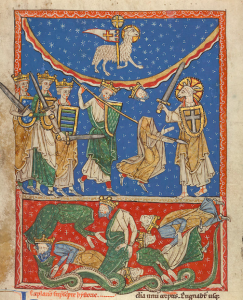
Illumination (c. 1230) of the Lamb defeating
the ten wicked kings of the Apocalypse.
Created to accompany Beatus of Liébana’s
commentary on Revelation.
In fact, there is (I believe) only one place in John where Yeshua predicts his Passion without immediately adding an allusion to the Resurrection or suggesting it by wordplay. It happens to be the one other place where perfumes measured by the pound come up in John*: the beginning of chapter 12, when Miriam of Beyt Anya anoints Christ’s feet. And even this was said during a dinner given in honor of him and the freshly-resurrected Lazarus!*
Now the Exaltation begins: in the first and grimmest sense, the Son of Man is lifted up.
John 19:17-42, RSV-CE
So they took Jesus, and he went out, bearing his own cross, to the place called the place of a skull,a which is called in Hebrew Golgotha. There they crucified him, and with him two others, one on either side, and Jesus between them.b Pilate also wrote a title and put it on the cross; it read, “Jesus of Nazareth, the King of the Jews.” Many of the Jews read this title, for the place where Jesus was crucified was near the city; and it was written in Hebrew, in Latin, and in Greek.c The chief priests of the Jews then said to Pilate, “Do not write, ‘The King of the Jews,’ but, ‘This man said, I am King of the Jews.’”d Pilate answered, “What I have written I have written.”
When the soldiers had crucified Jesus they took his garments and made four parts, one for each soldier; also his tunic. But the tunic was without seam, woven from top to bottom;e so they said to one another, “Let us not tear it, but cast lots for it to see whose it shall be.” This was to fulfill the scripture,
“They parted my garments among them,
and for my clothing they cast lots.”
So the soldiers did this. But standing by the cross of Jesus were his mother, and his mother’s sister, Mary the wife of Clopas, and Mary Magdalene.f When Jesus saw his mother, and the disciple whom he loved standing near, he said to his mother, “Woman, behold, your son!” Then he said to the disciple, “Behold, your mother!” And from that hour the disciple took her to his own home.g
After this Jesus, knowing that all was now finished, said (to fulfill the scripture), “I thirst.” A bowl full of vinegar stood there; so they put a sponge full of the vinegar on hyssoph and held it to his mouth. When Jesus had received the vinegar, he said, “It is finished”; and he bowed his head and gave up his spirit.
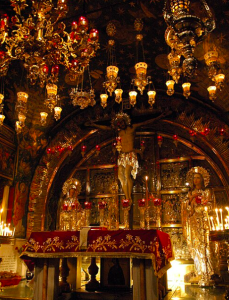
The altar over Golgotha in the Church of the
Holy Sepulcher. Photo by Yerey Maksym
Makkalytyn, used via a CC BY-SA 2.0
license (source).

Since it was the day of Preparation, in order to prevent the bodies from remaining on the cross on the sabbath (for that sabbath was a high day), the Jews asked Pilate that their legs might be broken, and that they might be taken away.i So the soldiers came and broke the legs of the first, and of the other who had been crucified with him; but when they came to Jesus and saw that he was already dead,j they did not break his legs. But one of the soldiers pierced his side with a spear, and at once there came out blood and water.k He who saw it has borne witness—his testimony is true, and he knows that he tells the truth—that you also may believe. For these things took place that the scripture might be fulfilled, “Not a bone of him shall be broken.” And again another scripture says, “They shall look on him whom they have pierced.”
After this Joseph of Arimathea, who was a disciple of Jesus, but secretly, for fear of the Jews,l asked Pilate that he might take away the body of Jesus, and Pilate gave him leave. So he came and took away his body. Nicodemus also, who had at first come to him by night, camel bringing a mixture of myrrh and aloes, about a hundred pounds’ weight. They took the body of Jesus, and bound it in linen cloths with the spices,m as is the burial custom of the Jews. Now in the place where he was crucified there was a garden, and in the garden a new tomb where no one had ever been laid. So because of the Jewish day of Preparation, as the tomb was close at hand, they laid Jesus there.
John 19:16b-42, my translation
Then they took Yeshua away; and, carrying the cross on him, they went out to what’s called Skull Place,a which is termed Gulgoleth in Aramaic, where they crucified him, and two others with him on this side and that, Yeshua in the middle.b Pilatus also wrote a title and put it over the cross; there was written, “Yeshua the Nazarene, the king of the Jews.” So this title was read by many of the Jews, because the place was near the city, where they crucified Yeshua; and it was written in Aramaic, Latin, Greek.c
Then the high priests of the Jews began telling Pilatus, “Don’t write: ‘The king of the Jews,’ but that he said, ‘I am king of the Jews.'”d
Pilatus responded, ” I wrote what I wrote.”
Then the soldiers, when they crucified Yeshua, took his clothes and made four parts, a part for each soldier, and his tunic. The tunic was seamless, woven from the top the whole [way] through;e so they said to each other, “Let’s not tear it, but cast lots about whose it will be”—in order that the Writ would be fulfilled that says: ‘They partitioned my clothes for themselves, and on my clothing they threw dice.’ So this is what the soldiers did. But standing there beside the cross of Yeshua were his mother and his mother’s sister, Chalphai’s Miriam, and Miriam of Migdal.f
Then Yeshua, seeing his mother and the student whom he loved standing by, says to his mother: “Ma’am, look—your son”; moreover, to the student: “Look, your mother.” And from that hour, the student took her for his own.g
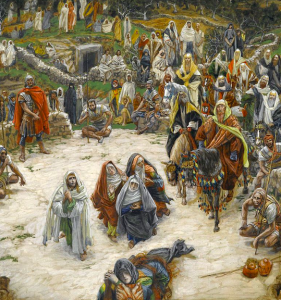
Ce que Voyait Notre-Seigneur sur la Croix
[What Our Lord Saw From the Cross] (c. 1890),
by James Tissot.
After this, Yeshua, seeing that already everything had ended, in order that the Writ might be ended, says: “I’m thirsty.” A vessel full of vinegar was there; so they put a sponge full of the vinegar on a hyssop [stem]h and put it by his mouth. Then, when he took the vinegar, Yeshua said, “It is ended,” and, bowing his head, he gave up his spirit.
Then the Jews, since it was Preparation, in order that the bodies would not stay on the cross on the sabbath, for this day was a great sabbath, asked Pilatus in order that their legs be broken and they be taken away.i So the soldiers came, and they broke the legs of the first and of the other who had been co-crucified with him; but coming to Yeshua, when they saw that he had already died,j they did not break his legs, but one of the soldiers punctured his side with a spear, and straightaway there came out blood and water.k And he who saw this has witnessed to it, and his witness is true, and this [man] knows that he speaks truly, in order that you also may have faith. For these things came about in order that the Writ might be fulfilled: “He did not have his bones broken.” And again, a different Writ says: “They will see whom they pierced through.”
After these things, Yosef of Ramathaim (who was a secret student of Yeshua for fear of the Jews)l asked Pilatus in order that he might take the body of Yeshua; and Pilatus permitted it. So he came and took his body. Nikodemos also came,l who had first come to him by night, bearing a mixture of myrrh and agarwood resin, about a hundred troy pounds. Then they took the body of Yeshua and they bound it in linen strips with the spices,m just as custom to bury is among the Jews. There was a garden in the place where they crucified him, and in the garden a new monument, in which no one had never been put; so there, because of the Preparation of the Jews, because the monument was nearby, they put Yeshua.
Textual Notes
a. the place of a skull, which is called in Hebrew Golgotha/Skull Place, which is termed Gulgoleth in Aramaic | Κρανίου Τόπον, ὃ λέγεται Ἑβραϊστὶ Γολγοθᾶ [Kraniou Topon, ho legetai Hebra’isti Golgotha]: To keep my translation consistent, I have as usual rendered Ἑβραϊστὶ as “Aramaic”; in this case, the term in question, גֻּלְגֹּלֶת [gul’goleth], is in fact Hebrew. It’s possible that the Hebrew term, since it does appear here, was loaned into local Aramaic usage; however, I have no further evidence for this. (Syriac, the prestigious form of Aramaic that had evolved by the second century, had—naturally—its own, related, term for “skull,” ܓ݁ܳܓ݂ܽܘܠܬ݁ܳܐ [gogūltā].1)
b. with him two others, one on either side, and Jesus between them/two others with him on this side and that, Yeshua in the middle | μετ’ αὐτοῦ ἄλλους δύο ἐντεῦθεν καὶ ἐντεῦθεν, μέσον δὲ τὸν Ἰησοῦν [met’ autou allous düo enteuthen kai enteuthen, meson de ton Iēsoun]: The two individuals crucified on either side of the Lord are known by the traditional names Gestas and Dismas, the latter being the “good thief” of Luke 23, and therefore often referred to as Saint Dismas. So far as I can tell, both names are meaningless. That might mean that they were shoddily translated or transliterated from some older source in which they did have significance, or it could mean they’re gibberish. That said, “Dismas” occasionally appears in a more comprehensibly Greek form, such as Demas; this was originally a clipping of the name Demetrius, which in turn derives from Δημήτηρ [Dēmētēr], the Hellenic grain goddess.
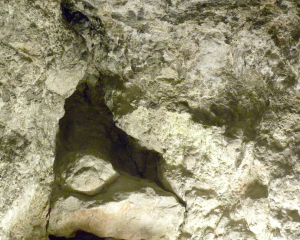
Limestone rock-face beneath the Church of the
Holy Sepulcher, known as the “Tomb of Adam.”
Photo by Mark A. Wilson, Emeritus Professor of
Geology from the College of Wooster, OH.
As for how it got attached to the good thief, the name “Dismas” appears in a piece of apocryphal2 Christian literature called the Acts of Pilate, probably composed in the fifth century. It may incorporate earlier traditions, and seems to have retained or recovered its popularity in the Middle Ages, when it was rechristened the Gospel of Nicodemus. M. R. James—yes, that M. R. James, if that’s what you’re wondering—furnished the English-speaking world with a version of it in his fairly comprehensive 1924 volume The Apocryphal New Testament. Besides the name of St. Dismas, the Acts of Pilate/Gospel of Nicodemus contains an early version of the elaborated story of the Harrowing of Hell.
As one might anticipate, though none of the Gospels tells us which way they were arranged (and only Luke reports that Dismas became sympathetic anyway), Dismas is generally depicted as to the Lord’s right, and Gestas to his left. Whether this was their real-life arrangement or not, it is possible that, since the official charge written on the placard was one of sedition, it seems likely that they were arranged on either side of the Lord as if to seem like his “attendants,” perhaps a tasteless call-back on Pilatus’ part to Yeshua’s retort in 18:36.
c. in Hebrew, in Latin, and in Greek/in Aramaic, Latin, Greek | Ἑβραϊστί, Ῥωμαϊστί, Ἑλληνιστί [Hebra’isti, Rhōma’isti, Hellēnisti]: I have taken Ἑβραϊστί here to mean Aramaic, as it usually does in the New Testament, but it could genuinely mean Hebrew (which was not quite extinct as a mother-tongue at the time). As for Greek, it was the international language of the Mediterranean, and there were native speakers of Greek even among Jews in the Holy Land, so that tracks too.
Latin was never very widely spoken in the eastern Mediterranean, so it may seem odd that it was included. On the other hand, it’d be natural for Pilatus to use what was doubtless his native speech. Moreover, a large Jewish colony lived in Rome at this time, generally thought to number a few tens of thousands. (About thirty years prior, when the will of Herod the Great had been disputed and the arbitration of Augustus sought, I gather we’re told by Josephus3 that eight thousand Roman Jews joined the delegation that had come from Palestine to appeal against Herod Archelaus succeeding his father.) Most of these would have spoken Greek as their first language, but it’s possible a small fraction of them might have been raised speaking Latin. Considering the Jewish cultural emphasis on literacy, many more of them probably spoke, read, and wrote Latin as a second language, and there would be at least some pilgrims from Rome to Yrushalem on any given Passover.
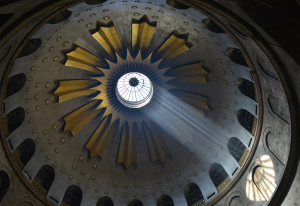
Dome of the Resurrection in the Church of the
Holy Sepulcher. Photo by Radomir Vrbovsky,
used via a CC BY-SA 4.0 license (source).

Incidentally, it is from the Latin form of the title that we get the letters INRI which you occasionally see on crucifixes: they stand for Iēsus Nazarēnus Rēx Iūdæōrum, “Jesus of Nazareth, King of the Jews.” The Greek form yields INBI, which you may see on Orthodox crucifixes; it abbreviates Ἰησοῦς Ναζαρηνός βασιλεύς Ἰουδαίων [Iēsous Nazarēnos Basileus Ioudaiōn], obviously of the same meaning. (As far as I can tell, the genuine Hebrew form, if that was used, would have been יֵשׁוּע הַנוֹצְרִי וְמֶלֶךְ הַיְהוּדִים [Yêshuaȝ ha-Noutz’ry w’Melekh ha-Y’hudhym]. I think the Aramaic equivalent would be יֵשׁוּע נוֹצְרִיָּא וְמַלְכָּא יְהוּדִיָּא [Yêshuaȝ Noutz’riyya’ w’Mal’kâ’ Y’hudhiyyâ’]; however, even to call my knowledge of Aramaic “amateurish” would be far too high a compliment, so, y’know, grain of salt. Either form, put into Roman letters, would most likely be represented as INMI.)
d. The chief priests of the Jews then said to Pilate, “Do not write, ‘The King of the Jews,’ but, ‘This man said, I am King of the Jews.’”/Then the high priests of the Jews began telling Pilatus, “Don’t write: ‘The king of the Jews,’ but that he said, ‘I am king of the Jews.'” | ἔλεγον οὖν τῷ Πιλάτῳ οἱ ἀρχιερεῖς τῶν Ἰουδαίων· Μὴ γράφε· Ὁ βασιλεὺς τῶν Ἰουδαίων, ἀλλ’ ὅτι ἐκεῖνος εἶπεν Βασιλεὺς τῶν Ἰουδαίων εἰμί. [elegon oun tō Pilatō hoi archiereis tōn Ioudaiōn: «mē grafe: ‹ho basileus tōn Ioudaiōn,› all’ hoti ekeinos eipen ‹basileus tōn Ioudaiōn eimi›.»]: We might expect Qayafa’s faction, who were presumably overwhelmingly Sadducees, not to care much about this one way or the other, since the Sadducees viewed the messianic doctrine as an illegitimate innovation, and were frank collaborators with the Herods and with Rome. However, whether they shared it or not, the Sadducees were perfectly aware how important that expectation was to other Jews, especially at a holiday like Pesach: passing a crucified “king of the Jews” on one’s way into Yrushalem would be pretty dispiriting, to say the least (and if the report that the Sadducees were the ones who handed him over to the Romans came out the wrong way, it could make them even more unpopular with the people than they were anyway, maybe even lead to an upheaval in the Sanhedrin). Moreover, out of pedantry or paranoia or both, they probably don’t want any report reaching the emperor’s ears that a genuine claimant to the Jewish throne has been recognized in any way by their leaders.
That said, it’s hardly surprising that Pilatus has no time for any of this. If they’re fussing because they want to keep the door wedged open for a little irredentism further down the road, well, that is decidedly not for Pilatus to encourage; and if they’re trying to prove how loyal they really are to Cæsar, maybe they shouldn’t be so bent on annoying Cæsar’s representative!
e. But the tunic was without seam, woven from top to bottom/The tunic was seamless, woven from the top the whole [way] through | ἦν δὲ ὁ χιτὼν ἄραφος, ἐκ τῶν ἄνωθεν ὑφαντὸς δι’ ὅλου [ēn de ho chitōn arafos, ek tōn anōthen hüfantos di’ holou]: This kind of weaving is more difficult than weaving a simple piece of rectangular fabric, but by no means impossible. I wasn’t able to find any thing useful in the way of visuals for circular weaving, but, for any knitters reading, I did find rather a nice video about knitting “in the round,” as it’s apparently called.
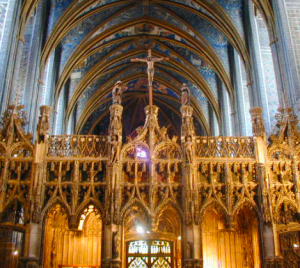
Rood screen of the Cathedral of St. Cecilia in
Albi, France. Photo by Florent, used via
a CC BY 2.0 license (source).

Compare this description of the Lord’s tunic with the instructions for the high priest’s ephod in the Torah:
And you shall make holy garments for Aaron your brother, for glory and for beauty. And you shall speak to all who have ability, whom I have endowed with an able mind, that they make Aaron’s garments to consecrate him for my priesthood. These are the garments which they shall make: a breastpiece, an ephod, a robe, a coat of checker work, a turban, and a girdle; they shall make holy garments for Aaron your brother and his sons to serve me as priests. … And you shall make the robe of the ephod all of blue. It shall have in it an opening for the head, with a woven binding around the opening, like the opening in a garment, that it may not be torn. On its skirts you shall make pomegranates of blue and purple and scarlet stuff, around its skirts, with bells of gold between them … And it shall be upon Aaron when he ministers, and its sound shall be heard when he goes into the holy place before the Lord, and when he comes out, lest he die.
—Exodus 28:2-4, 31-35, emphases mine4
If my interpretation all the way back in the first chapter was correct, then this allusion to the Lord’s seamless tunic is not the first, but the second time he has been implicitly associated with emblems of the high priest. In chapter 1, the text appears to be hinting that Yeshua was baptized on Yom Kippur, the same day on which Qayafa would have been repeatedly immersed in a mikveh for ritual purification, preparatory to entering the Holy of Holies; and on that same day, Qayafa doubtless donned the seamless ephod. Now that we see Yeshua clad in a seamless garment of his own, this detail implies where, metaphyiscally, he is about to go; this is partly why I have called this pericope the first part of “the Exaltation.”
f. his mother, and his mother’s sister, Mary the wife of Clopas, and Mary Magdalene/his mother and his mother’s sister, Chalphai’s Miriam, and Miriam of Migdal | ἡ μήτηρ αὐτοῦ καὶ ἡ ἀδελφὴ τῆς μητρὸς αὐτοῦ, Μαρία ἡ τοῦ Κλωπᾶ καὶ Μαρία ἡ Μαγδαληνή [hē mētēr autou kai hē adelfē tēs mētros autou, Maria hē tou Klōpa kai Maria hē Magdalēnē]: There is debate over whether this sentence is describing four women or three. (Bear in mind that the comma was probably not in use when this Gospel was composed.) If you’re scratching your head about how anyone gets four out of this sentence, or conversely how they get three out of it, they do it like this:
SCHEME A: 1. his mother and 2. his mother’s sister, 3. Chalphai’s Miriam, and 4. Miriam of Migdal.
SCHEME B: 1. his mother and 2. his mother’s sister, Chalphai’s Miriam, and 3. Miriam of Migdal.
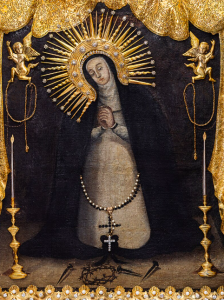
Nuestra Señora de la Soledad de Porta Vaga
[Our Lady of Loneliness of Port Bago], a reputedly
miraculous image of the Mother of God from
Cavite City, on the Philippine island of Luzon.
Both schemes give us three Miriams, but the first gives us an unnamed fourth as the sister of the Mother of God. It may, therefore, seem obvious that Scheme A has to be true, because what kind of weirdos would give two of their daughters the same name? Thing is, the answer to that question is “the kind of weirdos who lived around the Mediterranean Sea in the first century”—giving multiple family members the same name was perfectly normal. Names were not nearly so significant as markers of individuality back then, and indeed, there is a tradition that “Mary of Clopas” was the Virgin’s sister.
g. When Jesus saw his mother, and the disciple whom he loved standing near, he said to his mother, “Woman, behold, your son!” Then he said to the disciple, “Behold, your mother!” And from that hour the disciple took her to his own home./Then Yeshua, seeing his mother and the student whom he loved standing by, says to his mother: “Ma’am, look—your son”; moreover, to the student: “Look, your mother.” And from that hour, the student took her for his own. | Ἰησοῦς οὖν ἰδὼν τὴν μητέρα καὶ τὸν μαθητὴν παρεστῶτα ὃν ἠγάπα λέγει τῇ μητρί· Γύναι, ἴδε ὁ υἱός σου· εἶτα λέγει τῷ μαθητῇ· Ἴδε ἡ μήτηρ σου. καὶ ἀπ’ ἐκείνης τῆς ὥρας ἔλαβεν ὁ μαθητὴς αὐτὴν εἰς τὰ ἴδια. [Iēsous oun idōn tēn mētera kai ton mathētēn parestōta hon ēgapa legei tē mētri: «günai, ide ho huios sou»: eita legei tō mathētē: «ide hē mētēr sou.» kai ap’ ekeinēs tēs hōras elaben ho mathētēs autēn eis ta idia.]: This exchange has at times been marshaled—by me, for example—in the defense of the doctrine of Mary’s perpetual virginity. The argument is that if she had other children, it would have been superfluous and indeed insulting to arrange for her to be cared for by somebody else: ergo, committing her to the care of the Beloved Disciple implies that she had no other (biological) children. However, on reconsideration, I don’t think this analysis works. There are extensive, early traditions that there were other living members of the Holy Kinship well into the mid-first century, and the duty to provide for her as a widow would naturally have devolved on them. This perhaps strengthens the spiritual interpretation which, mmm, “sacerdotalist”5 Christians generally see in this, i.e., the view that this was Christ’s gift of his Mother not only to the Beloved Disciple, but to Christians generally as our Mother. However, I’d prefer to approach that from within the text.
This is the second of exactly two explicit appearances made by Mary in the Fourth Gospel. I specify explicit, because there are also, arguably, a few implied cameos, or significant absences. One comes in the middle of the Bread of Life Discourse in chapter 6, when the crowd ask (v. 42), “Isn’t this Yeshua the son of Yosef, whose father and mother we know?” Another goes all the way back to the prologue itself: this one’s subtler and more debatable, but I believe it’s there.
He was in the world, and the world came to be through him, yet the world did not know him. He came to his own, and his own people did not receive him. Such as did take him, he gave to them authority to become God’s children—to those that had faith in his name, who were not born from blood, nor from the flesh’s will, nor from a man’s will, but from God’s. And the Word became flesh and dwelt among us, and we beheld his glory—glory as of only-begotten from his Father, full of grace and truth; Yochanan witnesses about him …
—John 1:10-15a
It can be held that any invocation of the Incarnation is of itself faintly Marian, but obviously the evangelist does not dwell on her person in these verses. Yet there is a tiny verbal parallel between this passage and this word from the Cross. John 1:11 describes the Logos coming εἰς τὰ ἴδια “to his own”; and εἰς τὰ ἴδια is the exact phrase (which I rendered a little more idiomatically with “for” instead of “to”) that, in 19:27, now describes St. John receiving the Theotokos. Given the universality of the Logos—he is, after all, “the true light, which lights up every person”—I feel this does go some way toward justifying the sacerdotalist interpretation, that his commendation of her to the care of the Beloved was a commendation of her to the love and cherishing of all believers. And, simultaneously, a commendation of all believers to her cherishing love. After all, was anyone less suited to “care for” the Theotokos than St. John, the youngest of the Apostles, as penniless as the rest while also lacking any savings or personal reputation the other, older men might have built up?
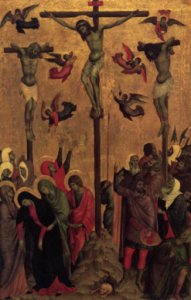
Crucifixion (c. 1315) by Duccio di Buoninsegna.
But let us turn to the other explicit appearance of the Mother of God, the one from chapter 2. That occurred at what then, by her request, became the first miracle of his ministry. Here as there, the Lord addresses his Mother as γύναι: “ma’am,” but literally “woman”; here as there, a vessel stands brimful of the “blood of the grape,” though this wine has soured into vinegar (as if in acknowledgment of the horror it sits beneath). In her first appearance, she served as a model of intercessory prayer, bringing an anxiety to her Son and then leaving it in his hands. The only action she takes afterwards is to point other people to him. But, as if that were not surrender enough—because it’s not—here, she simply does nothing at all. And, here as there, the liturgical themes of the Fourth Gospel are brought to the fore yet again. Mary is again a model of prayer, particularly the kind of prayer called contemplation, whose sole desire is to be in the presence, in the Place.
This praise of inactivity is, for many charitable people, hard to stomach. At a conscious level, there are all sorts of good reasons for this, as complacency (or in theological language, sloth) is one of the most relentless enemies of love. But there can be a subtle species of pride lurking here.
When I was growing up, there seemed to be a general if vague feeling that supplicatory prayer (the kind where we ask for things we want) was in some sense the lowest variety—that adoration, confession of sin, and thanksgiving were more spiritually refined, while supplication was sort of presumptively selfish and, accordingly, immature. There is no doubt supplications of that kind exist! However, we are creations, and creations in constant need of divine grace, so it’s also true that there isn’t really any other kind of prayer. (As C. S. Lewis hilariously remarked in The Four Loves, “It would be a bold and silly creature that came before its Creator with the boast, ‘I’m no beggar. I love you disinterestedly.'”) At least, all prayer is an essentially receptive activity, from the most elementary “making thy requests known to God” to the most exalted contemplative ecstasy. I can’t for the life of me remember where this point comes from, but I once read something touching on the apparition at Lourdes, and the author pointed out the implications of the Mother of God identifying herself to St. Bernadette with the phrase “I am the Immaculate Conception”: it locates who she is wholly in what God has done for her. In this way, it perfectly parallels the Magnificat itself: “Behold, from henceforth all generations shall call me blessed. / For he that is mighty hath done to me great things / and holy is his name.”
h. hyssop/a hyssop [stem] | ὑσσώπῳ [hüssōpō]: The plant known in English as “hyssop,” Hyssopus officinalis, is of no interest to us here, because it doesn’t grow in the Near East. The plant indicated in the Bible is the Origanum syriacum—a plant occasionally known as “Biblical hyssop,” “Syrian oregano” or “Lebanese oregano,” or by the name sometimes used for it in Arabic, za’atar.6 (By a funny coïncidence, though, both H. officinalis and O. syriacum come from the mint family.) O. syriacum is called for in several rituals in the Hebrew Bible: notably, these include the daubing of lamb’s blood on the mantel of a door for Passover, and the rite of purification after contact with a corpse.
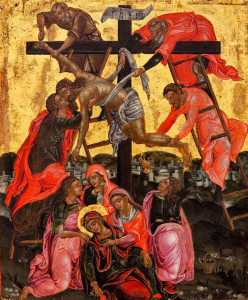
Ikon of the deposition10 of Christ from the Cross
(18th c.), written by Stylianos Stavrakis. Image
made available via a CC BY-SA 4.0 license
(source).

i. the Jews asked Pilate that their legs might be broken, and that they might be taken away/Then the Jews … asked Pilatus in order that their legs be broken and they be taken away | Οἱ οὖν Ἰουδαῖοι … ἠρώτησαν τὸν Πιλᾶτον ἵνα κατεαγῶσιν αὐτῶν τὰ σκέλη καὶ ἀρθῶσιν [hoi oun Ioudaioi … ērōtēsan ton Pilaton hina kateagōsin autōn ta skelē kai arthōsin]: This was a standard method of hastening death by crucifixion. Curiously, it does not seem to be clear why.
- It used to be thought that suffocation was the most common cause of death: the strained, stretched-out position of the arms would (so the reasoning went) make breathing difficult, and require the victim either to hoist themselves by their arms or push themselves up by their legs in order to breathe more fully, which would explain why the leg-breaking tactic would shorten things. However, in the twenty-first century, both studies and surveys of earlier medical literature on crucifixion conducted by Dr. Frederick Zugibe, Dr. David Ball, Dr. Thomas McGovern, and others (handily available here—thank you, Linacre Quarterly!), have pretty securely exploded the suffocation theory. Accordingly, this probably wasn’t the reason for breaking the legs of victims.
- Exposure, hunger, and above all thirst, could kill a victim of crucifixion (and this was one of the contemporary theories for how crucifixion killed people); thirst would probably be the fastest. Leg-breaking would not in itself hasten any of these causes, though in attempting to heal itself, the body would presumably consume even more water, exacerbating its own dehydration and so indirectly hastening death.
- A person who is crucified wouldn’t normally die due to the blood lost from the nail wounds in the hands and feet that fastened them to the cross. (An exception to this would be if one of the nails happened to hit an artery; this could bring about death in a matter of minutes.) That said, it was pretty common for flogging to precede crucifixion, which could mean enough blood loss to cause hypovolemic shock. Given our often-casual use of the term, shock might not sound like something that can kill you, but it absolutely can if not treated immediately;7 and, well, people who are intentionally carrying out a method of execution by torture on you aren’t going to treat you for shock. Perhaps—whether the ancients knew this or not—breaking the legs tended to induce shock in those already crucified but not yet suffering from it.
However it worked, this was likely meant as a mercy killing technique, and it’s fairly natural that representatives of the Sanhedrin would request it. The whole idea of crucifixion was to cause death via prolonged torture, which ran strongly against Jewish sensibilities: not only were measures increasingly taken (in times and places where the Jews were autonomous) to avoid actually applying capital punishment, even when the Torah allowed it, but stoning—the harshest of the traditional methods—was itself ameliorated in practice.
Only in comparatively few instances is the particular mode of death incurred by the commission of a crime prescribed. … The Rabbis argue thus: No death-sentence pronounced in the Bible indefinitely may be construed with severity; on the contrary, it must be interpreted leniently. … The Pentateuchal law (Lev. 19:18) prescribes, “Thou shalt love thy neighbor as thyself”; and the Rabbis maintain that this love must be extended beyond the limits of social intercourse in life, and applied even to the convicted criminal who, “though a sinner, is still thy brother” ([Talmud, Nezikin {Damages,}] §§ Makkot [Lashes] 3:15, Sanhedrin 44a) …
On arriving in the neighborhood of the scaffold … he is given to drink a mixture of wine and olibanum,8 that he may become stupefied and not realize the painful close of his earthly career ([Talmud, Nezikin,] §§ Semachot [Joys] 2:9, Sanhedrin 43a; compare Mark 15:23; contrast Matt. 27:34). … [T]he Pentateuch says, “Thine hand shall be first upon him to put him to death, and afterward the hand of all the people” (Deut. 13:10), and again (17:7), “The hands of the witnesses shall be first upon him to put him to death, and afterward the hands of all the people.” Rabbinic law follows this injunction literally … The convict having been placed on a platform twice his height, one of the witnesses throws him to the ground. If the concussion does not produce instant death, the second witness hurls a heavy stone at his chest; and only when this also proves insufficient to end his misery, the bystanders throw stones at the prostrate body until death ensues …
—The 1906 Jewish Encyclopedia, “Capital Punishment”
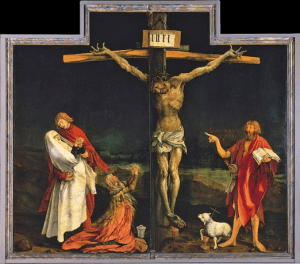
The Isenheim Altarpiece (1516),
by Matthias Grünewald.
j. he was already dead/he had already died | ἤδη αὐτὸν τεθνηκότα [ēdē auton tethnēkota]: The “swoon theory,” one of the attempts to “demythologize” the New Testament narrative, proposes that Yeshua did not really die on the Cross, but merely collapsed, and was subsequently removed from the tomb and nursed back to health by his disciples. Frankly, I find this nearly as hard to believe as the Resurrection, and it has the disadvantage of not being what either Christians or their enemies claimed at the time.
The narrative of Luke implies (22:44) that anxiety had already wracked Yeshua’s system to the point of hematidrosis (rupture of capillary blood vessels, causing blood to mix with sweat). This was followed by a presumably sleepless night spent in the ecclesiastical trials, punctuated according to Matthew (26:67-68) by beatings.
This was then succeeded by a civil examination before Pilatus, a shuttling to and from Herod, and a Roman-style flogging. Most societies at the time used flogging as a criminal penalty (some still do), usually for crimes that did not merit death but sometimes in combination with the death penalty. Jewish rules set forty strokes as an absolute maximum for floggings, and in practice only allowed thirty-nine, as a safeguard against miscounting; the Roman soldiers may have observed this limit, in deference to local custom, but there was no Roman policy requiring them to do so. Frustratingly, I was able to find very little adequately-sourced information about the flagrum, the whip used to administer floggings of this kind—mostly just a million Instagram posts all quoting each other. For whatever it’s worth, the badly-sourced information I could find related that the tails of a flagrum would have metal balls and barbs and pieces of bone woven into them, tearing open the flesh and causing substantial blood loss, and that it was not uncommon for victims to die of flogging alone. This seems at least to align with a passage in Josephus that, while not describing the flagrum in detail, does at least describe a flogging:
[T]here was one Jesus, the son of Ananus … who, four years before the war began, and at a time when the city was in very great peace and prosperity, … began on a sudden to cry aloud, “A voice from the east, a voice from the west, a voice from the four winds, a voice against Jerusalem and the holy house, a voice against the bridegrooms and the brides, and a voice against this whole people!” This was his cry, as he went about by day and by night … Hereupon our rulers … brought him to the Roman procurator, where he was whipped till his bones were laid bare; yet … when Albinus (for he was then our procurator) asked him, Who he was? and whence he came? and why he uttered such words? he made no manner of reply to what he said, but still did not leave off his melancholy ditty, till Albinus took him to be a madman, and dismissed him.
—Flavius Josephus, The Jewish War VI.5, emphasis mine
This of course would have been combined with blood loss from the head due to the crown of thorns, and anyone who’s had one knows head wounds bleed like it’s going out of fashion.
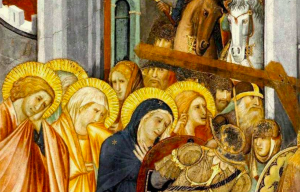
Detail of fresco (1320) by Pietro Lorenzetti
depicting disciples following Christ on
the Via Dolorosa.
Yeshua then got to lug a cross up the hill of Gulgoleth. It’s widely asserted that he probably only had to carry the crossbeam. This was the case for some victims of crucifixion, since living trees frequently substituted for an artificially-made upright stake. Some local tree species in Yrushalem, like the Mount Tabor oak, grow large and sturdy enough to use as stakes for crucifixion, so this is possible; if so, then the Lord was probably “only” carrying a beam weighing around 90 pounds uphill. However, many of the trees that grow in the environs of the Holy City aren’t suitable for the purpose—I mean, just do a Google image search for “olive tree”—and any spring foliage would risk obscuring the placard; accordingly, I think there’s a chance he was carrying a prefabricated cross, which would (by common consensus) weigh something like 300 pounds. Even with the assistance of St. Simon of Cyrene, nothing to shake a hyssop stalk at.
And the prize at the end of all of this was to be nailed to it, naked, in the hot sun, for at least three hours (by the Johannine account), if not twice that (according to the Synoptics). I don’t find it incredible to think that, after having a day like that, a man could very justifiably die about it.
k. blood and water | αἷμα καὶ ὕδωρ [haima kai hüdōr]: This “water” was probably what’s called pleural effusion, a buildup of fluid in the lining of the lungs; this can have a number of distinct causes, one of them being hypovolemic shock (cf. note j above).
l. Joseph of Arimathea, who was a disciple of Jesus, but secretly, for fear of the Jews … Nicodemus also … came/Yosef of Ramathaim (who was a secret student of Yeshua for fear of the Jews) … Nikodemos also came | Ἰωσὴφ ἀπὸ Ἁριμαθαίας, ὢν μαθητὴς τοῦ Ἰησοῦ κεκρυμμένος δὲ διὰ τὸν φόβον τῶν Ἰουδαίων … ἦλθεν δὲ καὶ Νικόδημος [Iōsēf apo Arimathaias, ōn mathētēs tou Iēsou kekrümmenos de dia ton fobon tōn Ioudaiōn … ēlthen de kai Nikodēmos]: St. Joseph of Arimathea is one of the small cast of characters other than the Holy Family, the Twelve, the Magdalene, and the architects of the Passion to appear in all four Gospels. Interestingly, this places a St. Joseph at both “ends” of the life of Christ, and not only by stitching the information from the different Gospels together, but based on the Fourth Gospel alone—the Lord is called “the son of Yosef” once in passing, back in 6:42. (My interpretation of the Greek Ἁριμαθαία as equivalent to the village of Ramathaim is only a guess; I’m not the first person to make the guess, but it remains unconfirmed. Ramathaim was the birthplace of the prophet Samuel, and lay just a little north of Yrushalem.)
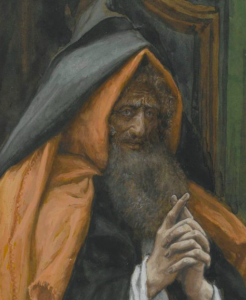
Joseph d’Arimathie [Joseph of Arimathea]
(c. 1890), by James Tissot.
As he has on other topics before now, we here see the evangelist nuancing his attitude to secret discipleship. Back in 12:42-43, he seemed to have nothing but contempt for it: “Nonetheless, many likewise among the princes also had faith in him, but because of the Pryshaya they would not affirm [it], lest they be put out of the assembly, for they loved the glory of people rather than the glory of God.” Yet there is no hint of disapproval of Yosef of Ramathaim, nor of Nikodemos in this, his third and final appearance.
I think the development of Nikodemos’ character over the course of the book is the key here. The nightfall under whose cloak he first came to the Lord was followed by his departure—not to say dismissal—in bewilderment, back in chapter three. The second nightfall was followed, after an interval, by his appearance in chapter seven: subtly but unmistakably, he raises a point that can only be read as an implicit defense of Yeshua, an insistence that he be allowed a hearing. The third nightfall has now come; and finally, along with Yosef of Ramathaim, he proves himself not only willing to tend the body of the dead Savior, but to do so visibly, out in front of everyone.
It might have been easy for St. John, as someone who had lived and worked as an apostle for decades, to sneer at how little Nikodemos and Yosef were risking. Yet on the other hand, they were proving their disinterestedness: after all, what could there possibly be to gain from this work of mercy? There might not be much to lose by doing it—except, of course, “the glory of people”; we may be sure the names of these two were mud with the high priest hereafter. And that, I believe, is the difference. Shame is not the only thing that can prompt a person to conceal their allegiance, but if shame is the reason for the concealment, it is shameful.
m. a mixture of myrrh and aloes, about a hundred pounds’ weight. They took the body of Jesus, and bound it in linen cloths with the spices/a mixture of myrrh and agarwood resin, about a hundred troy pounds. Then they took the body of Yeshua and they bound it in linen strips with the spices | μίγμα σμύρνης καὶ ἀλόης ὡς λίτρας ἑκατόν. ἔλαβον οὖν τὸ σῶμα τοῦ Ἰησοῦ καὶ ἔδησαν αὐτὸ ὀθονίοις μετὰ τῶν ἀρωμάτων [migma smürnēs kai aloēs hōs litras hekaton. elabon oun to sōma tou Iēsou kai edēsan auto othoniois meta tōn arōmatōn]: I chose the rendering “agarwood resin” because ἀλόη here does not mean what we normally mean by “aloe.” When we use that word, we’re usually thinking of certain succulent plants like Aloe vera (true aloe, native to Arabia), Aloe ferox (bitter aloe, an African plant), or the unrelated Agave americana (maguey, nicknamed “American aloe”)—or indeed, the burn-soothing gel. What the Greek here refers to, rather, is a resin obtained from aromatic trees of the genus Aquilaria, which grow chiefly in Southeast Asia. This resin was used in embalming, as was myrrh itself: agarwood is still prized for its sweet scent, and both this and the bitter-scented gum myrrh could be used to counteract the stench of rot.
The text’s unelaborated “spices” might mean several things. Both cinnamon proper and the closely-related cassia, a.k.a. “Chinese cinnamon,” are aromatic and hydrophobic, qualities which would slow decay9 and mask the smell of any that had happened so far. Frankincense, lavender, and spikenard might all be put to use for their aromas as well. However, the Jews did not practice full-blown embalming, so the “spices” probably didn’t include natron or salt.
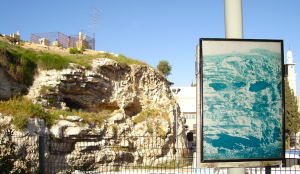
Alternate site for Golgotha, proposed in 1842
by Otto Thenius (image from c. 1900 posted
on neighboring pole). Photo by Footballkickit,
used via a CC BY 3.0 license (source).

Finally, if I’ve done the math right, the “hundred troy pounds” comes to a little more than eighty pounds in the US customary system.
Postscript on the History of the Church of the Holy Sepulcher
The Church of the Holy Sepulcher in Jerusalem is held by most Christians to preserve the sites of the Crucifixion and the Resurrection. (It is referred to as the Holy Sepulcher—or, in archaic sources, St. Sepulcher— in the West, whereas Eastern Christians generally call it the Church of the Resurrection.) Of the Stations of the Cross along the original Via Dolorosa in Jerusalem, the last four, commemorating the Lord’s crucifixion, death, deposition,10 and burial, are all within the basilica.
According to tradition, the sites of Gulgoleth and the nearby tomb of Christ were identified by St. Macarius I, the Bishop of Jerusalem11 from 312 to c, 330. Before his reign, Christianity had been illegal, so obviously no church could be openly built there; however, identification of the site had become necessary because, legally, the city of Jerusalem did not exist from the mid-second to early fourth centuries.
When the First Jewish War began in 66, the Christians of the city fled to Pella, in what is now the extreme northwest of Jordan. They returned after 70, but fled again sixty years later during the Third Jewish War of 132-136, a.k.a. the Bar-Kochba Revolt (or, in some sources, the Second Jewish War). This time they went to Cæsarea Maritima, or “Cæsarea-by-the-Sea,” half an hour’s drive south of modern Haifa. Jerusalem as such was abolished by Emperor Hadrian following the war, and the site was reoccupied by a Roman colony, known as Ælia Capitolina—Ælia in honor of Hadrian’s own Ælian clan, Capitolina in honor of Capitoline Jupiter, to whom a temple was built on Mount Moriah. Jews were permitted entry to Ælia only on Tisha b’Av. A Christian presence there did continue, but hereafter it almost certainly consisted only in Gentile Christians: most of the recorded bishops of the city before 135 had Semitic names, but those after that date all bear Latin or Greek names, with the lone exception of Macarius’ immediate predecessor, Bishop Hermon. Only after Christianity was legalized by Constantine in 313 did the city begin again to be known as Jerusalem, and a church was finally built there.
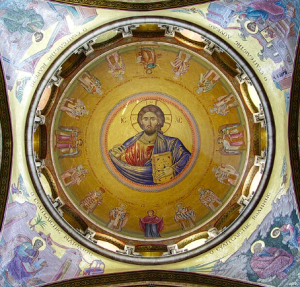
The dome of the katholikon within the Church
of the Holy Sepulcher (under Greek Orthodox
care). Photo by Berthold Werner, used via
a CC BY-SA 3.0 license (source).

This primitive basilica was destroyed during a war with Persia in the seventh century. It was rebuilt sixteen years later by Emperor Heraclius. A mere eight years after that, in 638, Jerusalem fell to the advance of the Rashidun Caliphate, the first Muslim state; however, Caliph Umar ibn al-Khattab, true to his word when the city surrendered, protected the church and the right of Christians to worship in it, and would not allow the site to be turned into a mosque.
Sadly, this détente did not last forever. In 1009, the sixth caliph of the Fatimid dynasty (who was hostile not only to Christians, but to Jews and Sunni Muslims) ordered the destruction of the church as part of a broader campaign against churches and synagogues in his realm. The East Roman Emperors negotiated a restoration of Christian rights and use of the site less than twenty years later, and some new building was done; nonetheless, partly perhaps due to conflicts between the Fatimids and the Seljuq Turks, the footprint of the Heraclian basilica remained in ruins until the First Crusade established the Kingdom of Jerusalem in 1099. The French knights who ran this kingdom proceeded to build a Romanesque church on the site. The celebrated Muslim sultan and chevalier, Saladin, recaptured Jerusalem in 1187, but like Umar he permitted Christians to continue using the church, whether Orthodox or Catholic or Armenian.12
By the sixteenth century, like much of the Near East and the Balkans, the Holy City had fallen under Ottoman control. The Ottomans followed the more typical, more generous Muslim policy toward Christians, and care for the Church of the Holy Sepulcher passed back and forth between the Orthodox and the Franciscans of the Holy Land, a branch of the Franciscan Order specially devoted to the purpose. (The order have a monastery in DC, with a reproduction of the Ædicule—the structure that houses the tomb itself—as well as of the Portiuncula, the first Italian chapel St. Francis himself restored.) In 1808, a fire damaged the church quite badly; renovations took place over the following two years. Another modification took place in 1868, when the church’s dome was replaced with one made of iron.
However, this was among the last alterations to the Church of the Holy Sepulcher that has been permitted by international law, despite the site having changed hands three times since then (it passed from the Ottomans to the British in 1919, from the British to the Jordanians in 1948, and from the Jordanians to the Israelis in 1967). In 1856, one of the numberless Treaties of Paris brought the Crimean War to a close, in which France, Great Britain, the Ottoman Empire, and Sardinia13 had fought Greece and Russia. This Treaty of Paris confirmed, as a matter of international law, a series of decrees the Ottoman sultans had made going as far back as 1757, which forbade any changes to be made to the arrangement of the church except by the consent of all six religious communities represented there: Armenian, Coptic, Ethiopian, Greek, Latin, and Syrian.14 This settlement—which is so strict that it has, for hundreds of years, prevented the movement of a ladder—is known as the Status Quo.
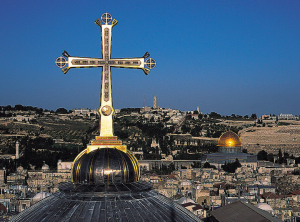
Cross atop the Golgotha dome of the Church of
the Holy Sepulcher. Photo (1996) by Markus Bollen.
Footnotes
1This shows the Syriac word in the Estrangela script, developed for the Syriac form of Aramaic in the first century. (As a reminder, Aramaic is more a language category than a language per se, like Romance.) However, there’s a concealed irony here: the script we normally associate today with Hebrew, also called “square” or “Assyrian” letters, was originally also developed for writing an ancient form of Aramaic! I’m not certain, but I think that if written in the Assyrian script, the Syriac word would appear as גֹגּוּלְתָא.
2Unlike the books sometimes referred to as “apocryphal” that are linked one way or another with the Old Testament, whose recognition does vary a little among communions, basically none of the books typically known as “New Testament apocrypha” have ever been accepted as Scripture by any branch of the Christian faith. Some are pernicious, others less so, and some not at all. On the whole, this set of apocrypha mostly just amount to “New Testament fan-fiction.”
3I say that “I gather we’re told” this because I have not had time to track down the actual reference in Josephus—all I have are quotations offered in this answer from the History Stack Exchange site, which appear to be well-sourced but which I have not been able to go through and verify myself. If I were writing anything more formal than a blog post, I would certainly not settle for such cursory examination as this.
4This indirect allusion may be as close as we come in John to getting a mention of the seventh of the sacred species, i.e. the pomegranate.
5I’m using “sacerdotalist” here as a (very unsatisfactory) antonym for “Protestant.” As far as I know, there is no adjective ready to hand that includes the Assyrian, Catholic, Miaphysite, and Orthodox communions, all of which practice some degree of Marian devotion on terms that most Protestants object to. The term “apostolic” might work, in the sense of professing apostolic succession via ordination—but of course there are Anglican and Lutheran bodies that do profess exactly that, and also it sounds like a rude attempt to beg the question of who has preserved apostolic orthodoxy better. (Granted, the bodies I’ve labeled “sacerdotalist” will also make that claim against Protestants, but that is no reason to do so rudely.)
6This is not always what za’atar means, however; it can also refer to wild thyme or its close relatives, or to a mixture of herbs.
7In the medical sense, shock is inadequate circulation of blood to some or all of the vital organs. It is most often divided into four main types, namely cardiogenic (when there is damage to the heart itself), distributive (when blood flow through the small vessels is abnormal), hypovolemic (when the actual volume of blood in the body is abnormally low), and obstructive (when something is blocking normal circulation to or from the heart). There are a few other types of shock as well; one you’ve likely heard of is anaphylactic shock, a result of an extreme allergic reaction.
8Olibanum: i.e., frankincense. In addition to their aromatic properties, both myrrh and frankincense have been used since ancient times as painkillers: frankincense is an anti-inflammatory, while myrrh works like an opioid.
9The reason organic things rot is not just the second law of thermodynamics, but the activity of microörganisms and insects, both of which (like all terrestrial life) require water to survive. This is why drying works so well as a preservation method, whether for prunes or people.
10Deposition: i.e., the removal of his body from the Cross. This preserves a relatively archaic meaning of the term, derived from its Latin root dēpōnere “to put down, lay aside, set aside; to take down, remove.” (This is closely related to the use of reposition [with a short e] or repose as a description of returning the Blessed Sacrament to a tabernacle after communion or adoration; this comes from repōnere “to put back, return.”)
11Although it is the Holy City of the Christian faith as well as of Judaism, Jerusalem was not elevated to the status of a patriarchate until the Council of Chalcedon in 451, thus completing the ancient “Pentarchy” of Rome, Byzantium, Alexandria, Antioch, and Jerusalem. Before then, it was a bishopric under the governance of Antioch.
12No, “Armenianism” had not become a school of theology. The Armenian Apostolic Church was, and remains, neither Eastern Orthodox nor Catholic. It is part of the Miaphysite tradition, also called Oriental Orthodoxy, which split from the rest of the Church over the Council of Chalcedon’s adoption of a “two-natures” Christology: Miaphysites believe in a single human-divine nature of Christ (though it seems likely that this is a distinction in terminology only, not in the belief the terminologies describe). The Copts of Egypt and the Orthodox Tewahedo Church of Ethiopia are also Miaphysite in doctrine.
13Sardinia used to be a substantially bigger deal in European politics. It’s not a coïncidence that, when the Kingdom of Italy took shape in the late nineteenth century, its royal house came from Sardinia.
14The Armenian, Coptic, Ethiopian, and Syrian Churches mentioned here are all Miaphysite in alignment; cf. footnote 11 above. (There are also Catholic minorities among Armenian and Ethiopian Christians, and Eastern Orthodox majorities among those of Egypt and Syria, but apparently these interests are subsumed by the Latins and Greeks respectively.)
Previous Post
July 16, 2026
The Gospel of John: The Verdict of the Dark
Next Post
July 30, 2026 The Gospel of John: The Exaltation, Part II
Recent Comments
"On the contrary, such a proclamation, among the Aztecs or Maya, would be disastrously misunderstood. ..."
The Gospel of John: The Bread ..."
"Many thanks for your scholarly study on the Cleansing of the Ten Lepers in the ..."
The Cleansing of the Ten Lepers
"Four Last Things: not the video game, but Death, Judgment, Heaven and Hell.Momento mori. Remember, ..."
"I am going by the time that these sayings began to be converted into written ..."
Are Our Bibles in the Wrong ..."
Browse Our Archives
Select a Category abuse antifascism art bad Catholic celibacy chastity Church crucifixion culture war eros forgiveness gay gender homophobia ikons language liturgy peace poems politics Pope Francis prayer pro-life race recommendations reform repentance review sacraments saints satire scandal schism scripture sex suffering theology Uncategorized violence
Select a Month October 2026 September 2026 August 2026 July 2026 June 2026 May 2026 April 2026 March 2026 February 2026 January 2026 December 2025 November 2025 October 2025 September 2025 August 2025 July 2025 June 2025 May 2025 April 2025 March 2025 February 2025 January 2025 December 2024 November 2024 October 2024 September 2024 August 2024 July 2024 June 2024 May 2024 April 2024 March 2024 February 2024 January 2024 December 2023 November 2023 October 2023 September 2023 August 2023 July 2023 June 2023 May 2023 April 2023 March 2023 February 2023 January 2023 December 2022 November 2022 October 2022 September 2022 August 2022 July 2022 June 2022 May 2022 April 2022 March 2022 February 2022 January 2022 December 2021 November 2021 October 2021 September 2021 August 2021 July 2021 June 2021 May 2021 April 2021 March 2021 February 2021 January 2021 December 2020 November 2020 October 2020 September 2020 August 2020 July 2020 June 2020 May 2020 April 2020 March 2020 February 2020 January 2020 December 2019 November 2019 October 2019 September 2019 August 2019 July 2019
Follow Us!
TAKE THE
Religious Wisdom Quiz
"God called to him out of the bush, 'Moses, Moses!' And Moses replied, '_______.'"
Select your answer to see how you score.
Who speaks to me? I hear and obey What is your name? Here I am
Related posts from Mudblood Catholic

The Sermon on the Mount, Part I: Matthew...

The Gospel of Matthew: Christ and Antichrist

John the Baptist and the Winnowing Fork: Matthew...

The Gospel of Matthew: The Coventry Carol
TRENDING AT PATHEOS Catholic

The Problem with False Prophets
Miller’s Station UMC| 10/18/26| Anchor Verse: Jeremiah 23: 1, 9-23 I...

Emotion in Early Christianity by Andrew Crislip
Andrew Crislip’s Emotion in Early Christianity examines an often overlooked dimension of...

16 Spiritual Touchstones for a More Grounded Life
After decades of spiritual study, here are 16 principles I try...

Catholic Evangelization: Sharing Your Faith Every Day
Welcome back to the Graceful Awakening mini-series called, “From Faith to Mission.” ...

The Pillar of the Boatmen: the Ancient Monument...
The Pillar of the Boatmen is a Romano-Gaulish sculpture that dates from...

In one sense walking into Westminster Abbey is like walking down the...
view all Catholic blogs
What Are Your Thoughts?leave a comment
Ad-Free & Subscriber Log-In Subscription Support
- About Us
- 2026 Calendar
- Videos
- Podcasts
- Library of World Religions
- Faith In Media Tracker
- Advertise With Us
- Write for Us
- Privacy Policy
- Terms of Service
- Do Not Sell My Data
- Contact Us
- Radiant Digital
- Manage Newsletter Subscriptions
- Unsubscribe From Notifications
- Sitemap
Copyright 2008-2026, Patheos. All rights reserved.
Subscription Support Ad-Free & Subscriber Log-In
Follow Patheos