
BuddhistCatholicContemplativeEvangelicalGeneral ChristianHinduJewishLatter-day SaintMuslimNew VisionsProgressive Christian
Beliefs
- Buddhist
- Catholic
- Contemplative
- Evangelical
- General Christian
- Hindu
- Jewish
- Latter-day Saint
- More Voices
- Muslim
- New Visions
- Pagan
- Progressive Christian
Topics
- Religion News
- Food and Religion
- Sports and Religion
- Religious Art
- Religious Music and Entertainment
- Religious Events
- History and Religion
- Style and Religion
- Politics and Religion
- Women in Religion
- Recreation Outdoors and Religion
- Business Finance and Religion
- Careers Workplace and Religion
- Education and Religion
- Family Parenting and Religion
- Health Fitness and Religion
- Home and Religion
- Relationships and Religion
- Technology and Religion
- Travel and Religion
Columnists
- Buddhist Columnists
- Business Finance and Religion Columnists
- Careers Workplace and Religion Columnists
- Catholic Columnists
- Contemplative Columnists
- Education and Religion Columnists
- Evangelists Columnists
- Family Parenting and Religion Columnists
- General Christian Columnists
- Health Fitness and Religion Columnists
- Hindu Columnists
- History and Religion Columnists
- Home and Religion Columnists
- Jewish Columnists
- More Voices Columnists
- Latter Day Columnists
- Muslim Columnists
- New Visions Columnists
- Nonreligious Columnists
- Pagan Columnists
- Politics and Religion Columnists
- Progressive Columnists
- Recreation Outdoors and Religion Columnists
- Relationships and Religion Columnists
- Religion News Columnists
- Religious Art Columnists
- Religious Events Columnists
- Religious Music and Entertainment Columnists
- Sports and Religion Columnists
- Style and Religion Columnists
- Technology and Religion Columnists
- Travel and Religion Columnists
- Women in Religion Columnists
Resource Library
- 2026 Calendar
- Library of World Religions
- The 100 Most Holy Places on Earth
- Patheos Answers
- Podcasts
- Videos
- Faith Leaders Database
- Anglican Episcopalian
- Bahai
- Baptist
- Buddhism
- Christianity
- Confucianism
- Eastern Orthodoxy
- Hinduism
- Holiness and Pentecostal
- ISKCON
- Islam
- Judaism
- Lutheran
- Methodist
- The Church of Jesus Christ of Latter-day Saints
- New Age
- Paganism
- Presbytarian and Reformed
- Protestantism
- Religion Behind the Scenes
- Roman Catholic
- Scientology
- Shia Islam
- Sikhism
- Sufism
- Sunni Islam
- Taoism
- Zen
- See all religions
Research Tools
 Ad-Free & Subscriber Log-In Subscription Support
Ad-Free & Subscriber Log-In Subscription Support
Follow Patheos 

- Trending:
- Forgiveness
- |
- Marriage
- |
- Consciousness
- |
- Death Penalty
- |
- Election
- |
- Halloween

- Home
- Catholic
- History and Religion
- The Gospel of John: The Dark Grasps the Light
The Gospel of John: The Dark Grasps the Light
Last updated on: July 10, 2026 at 1:06 pm by Gabriel Blanchard
The Gospel of John: The Dark Grasps the Light 2026-07-10T13:06:36-04:00 Gabriel Blanchard
Patheos Explore the world's faith through different perspectives on religion and spirituality! Patheos has the views of the prevalent religions and spiritualities of the world.
The Gospel of John: The Dark Grasps the Light (John 18:1-27)
In the opening verses of the prologue, the evangelist tells us that “the light appears in the darkness, and the darkness did not grasp it”—I used “grasp” there because the Greek verb, καταλαμβάνω [katalambanō], can have either a literal sense of taking something in your hand, or a metaphoric, intellectual sense (“apprehend” would have been another option). This became a recurring theme throughout the Book of Signs, with Christ quietly slipping away when people were expecting to find him repeatedly: he does so after healing the paralytic at Beyt Hesda, after feeding the five thousand in the Galilee, before coming to Yrushalem for Sukkot, while preaching in the Temple during Sukkot, at the moment when the crowd is about to stone him at the close of Sukkot, and yet again during his pilgrimage to the holy city for Chanukah*; even the transitional material between the Book of Signs and the Book of Glory tells us that “Yeshua said these things, and left and hid himself from them.”*1
But in chapter 18, there is at long last a break in the pattern. The Lord and his disciples go to the Mount of Olives, according to their usual custom; a contingent of soldiers comes there too. No narrative of the agony in Gethsemane appears in John*: we transition, more or less immediately, to the arrest, and pass from there to the ecclesiastical trials before former high priest Chanan ben Set (or Annas) and his son-in-law, acting high priest Yousef ben Qayafa (or Caiaphas).*
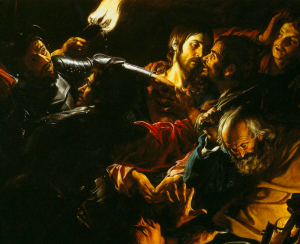
The Taking of Christ (c. 1620), by
Gérard Douffet.
John 18:1-27, RSV-CE
When Jesus had spoken these words, he went forth with his disciples across the Kidron valley, where there was a garden, which he and his disciples entered. Now Judas, who betrayed him, also knew the place; for Jesus often met there with his disciples. So Judas, procuring a band of soldiers and some officers from the chief priests and the Pharisees, went there with lanterns and torches and weapons. Then Jesus, knowing all that was to befall him, came forward and said to them, “Whom do you seek?” They answered him, “Jesus of Nazareth.” Jesus said to them, “I am he.” Judas, who betrayed him, was standing with them. When he said to them, “I am he,” they drew back and fell to the ground. Again he asked them, “Whom do you seek?” And they said, “Jesus of Nazareth.” Jesus answered, “I told you that I am he; so, if you seek me, let these men go.” This was to fulfill the word which he had spoken, “Of those whom thou gavest me I lost not one.” Then Simon Peter, having a sword, drew it and struck the high priest’s slave and cut off his right ear. The slave’s name was Malchus. Jesus said to Peter, “Put your sword into its sheath; shall I not drink the cup which the Father has given me?”
So the band of soldiers and their captain and the officers of the Jews seized Jesus and bound him. First they led him to Annas; for he was the father-in-law of Caiaphas, who was high priest that year. It was Caiaphas who had given counsel to the Jews that it was expedient that one man should die for the people.
Simon Peter followed Jesus, and so did another disciple. As this disciple was known to the high priest, he entered the court of the high priest along with Jesus, while Peter stood outside at the door. So the other disciple, who was known to the high priest, went out and spoke to the maid who kept the door, and brought Peter in. The maid who kept the door said to Peter, “Are not you also one of this man’s disciples?” He said, “I am not.” Now the servants and officers had made a charcoal fire, because it was cold, and they were standing and warming themselves; Peter also was with them, standing and warming himself.
The high priest then questioned Jesus about his disciples and his teaching. Jesus answered him, “I have spoken openly to the world; I have always taught in synagogues and in the temple, where all Jews come together; I have said nothing secretly. Why do you ask me? Ask those who have heard me, what I said to them; they know what I said.” When he had said this, one of the officers standing by struck Jesus with his hand, saying, “Is that how you answer the high priest?” Jesus answered him, “If I have spoken wrongly, bear witness to the wrong; but if I have spoken rightly, why do you strike me?” Annas then sent him bound to Caiaphas the high priest.
Now Simon Peter was standing and warming himself. They said to him, “Are not you also one of his disciples?” He denied it and said, “I am not.” One of the servants of the high priest, a kinsman of the man whose ear Peter had cut off, asked, “Did I not see you in the garden with him?” Peter again denied it; and at once the cock crowed.
John 18:1-27, my translation
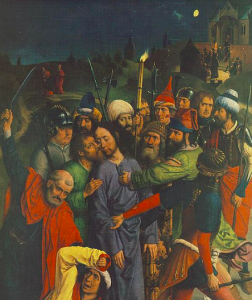
Arrestation du Christ [Arrest of Christ] (c.
1450-1460), by the school of Dieric Bouts.
Having said these things, Yeshua went out with with his students across the gully of the Kidron, where there was a garden, into which he and his students went. Yudah, who gave him over, was also aware of the place, because Yeshua had come together with his students there many times. So Yudah, taking a squadron and attendants from the high priests and the Pryshaya, came there with lanterns and torches and weapons. Then Yeshua, seeing everyone coming out for him, also says to them: “Whom are you searching for?”
They responded to him, “Yeshua the Nazarene.”
He says to them, “I am.” Yudah, who gave him over, was also standing there with them. Then, as he told them “I am,” they backed away and fell on the ground. So he inquired of them again, “Whom are you searching for?”
And they said, “Yeshua the Nazarene.”
Yeshua responded, “I told you that I am; so if you are searching for me, permit these [men] to go away”—in order that the word should be fulfilled which he said, that “Those you have given me, I have not destroyed none of them.”
Then Symeon Rocky, [who] had a sword, drew it and struck the high priest’s slave and cut off his right ear. (The slave’s name was Melekh.)
Then Yeshua told Rocky, “Throw the sword into its sheath; the cup which has been given to me by the Father, am I not drinking it?”
Then the squadron and the lieutenant and the attendants from the Jews seized Yeshua and bound him, and led him to Chanan first; for he was father-in-law to Qayafah, who was high priest that year; it was Qayafah who counseled the Jews that it suited [them for] one person to die for the people.
Symeon Rocky followed Yeshua, and another student. This student was known to the high priest, and went in with Yeshua into the high priest’s courtyard, but Rocky stood outside at the door. Then the other student known to the high priest came out and spoke to the door-ward, led Rocky in. Then the door-ward maid says to Rocky: “Aren’t you also [one] of that person’s students?”
He says, “I am not.”
The slaves and attendants were standing around a charcoal-bed they had made because it was cold, and warming up; Rocky also stood with them and warmed up.
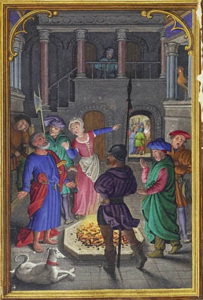
Illumination of St. Peter’s apostasy (c. 1525-
1530) by Simon Bening.
Then the high priest inquired of Yeshua about his students and about his teaching. Yeshua responded to him: “I have spoken openly to the world; I always taught in the assembly and in the Temple, where all the Jews come together, and have said nothing in secret; what are you asking me [for]? Ask those who heard what I said to them; look, they know what I said.”
When he said these things, one of the attendants standing by gave him a slap, saying to Yeshua, “Is that how you respond to the high priest?”
Yeshua responded to hm, “If I have spoken badly, witness about the badness; but if fairly, what are you thrashing me [for]?”
Then Chanan sent him, bound, to Qayafa the high priest.
Symeon Rocky was standing and warming [himself]. Then they said to him, “Aren’t you also of his students?”
He denied it and said: “I am not.”
One of the slaves of the high priest says, being a relative of him whose ear Rocky cut off, “Didn’t I see you in the garden with him?”
Then Rocky denied again; and straightaway, a rooster called.
Textual Notes
**a. the Kidron valley/the gully of the Kidron | τοῦ χειμάρρου τοῦ Κεδρὼν [tou cheimarrou tou Kedrōn]:**The Kidron is the trench that separates Mount Zion (the principal hill on which Jerusalem sits) from Mount Olivet (then directly to the east of the city). I decided on “gully” here as a rendering of χειμάρρους [cheimarrous], which would in hyper-literal terms come out as “winter-flow.” Because of the climate of the Mediterranean littoral, which has hot, dry summers and winters that trend wet rather than cold, there are many wadis (dry river-beds) that see a steady presence of water only in winter; there is just such a wadi at the base of the Kidron valley.
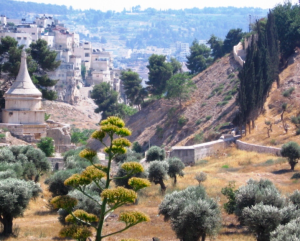
The Kidron Valley today. Photo by Wikimedia
contributor Alzbeta, used via
a CC BY-SA 4.0 license (source).

b. a band/a squadron | τὴν σπεῖραν [tēn speiran]: As far as I can tell, the Greek σπεῖρα [speira] was the quasi-official equivalent of the Latin cohors or cohort. At this time, one cohort was a tenth of a legiō or legion; the size of the legion evolved over Roman history, but an early imperial legion would likely be somewhere around five thousand men in number, or a little more. So if the author here is using the term technically, then Judas brought a company of something close to five hundred soldiers to make this capture.
The ridiculous number alone may be an indication that St. John is not using the term technically! But, if he was, it may be an index of how dangerous the Lord was expected to be—after all, he was a popular messiah and a miracle-worker with a gift for oratory. That he might “come quietly” may be something Qayafa and the rest never seriously considered.
c. they drew back and fell to the ground/they backed away and fell on the ground | ἀπῆλθον εἰς τὰ ὀπίσω καὶ ἔπεσαν χαμαί [apēlthon eis ta opisō kai epesan chamai]: Literally, “they went away to the behind.” This strange reaction, recounted in no other canonical Gospel, appears to be a response to the (implied) use of the divine name, “I am”—which is concealed in most English translations, due to the insertion of “he” into Yeshua’s reply.
Both this and the kiss of Judas, which is recorded in the Synoptics but not in John, may seem puzzling. Why not just come up and, you know, grab Yeshua, a well-known public figure? The answer is at least partly “Because it was nighttime”: recognizing somebody at night is often difficult enough even today, let alone in an age before electric lights were available. It’s also been suggested that perhaps one or more of the Twelve looked especially similar to Christ. St. James the Less and St. Jude both seem to have been relatives of his.
Alright, that perhaps explains the kiss of Judas, but what has it got to do with this? The text itself answers that question: “‘if you are searching for me, permit these men to go away’—in order that the word should be fulfilled which he said, that ‘Those you have given me, I have not destroyed none of them.'” I’ve grown increasingly convinced over the last year or two that one of Yeshua’s principal short-term aims during his Passion was to keep the Eleven safe. Though they did not know it, they were on the cusp of becoming the crucial leaders of the infant Church, and as St. Peter is about to show, they don’t know what’s good for ’em! You’ll notice too that, as soon as the week-long holiday is over and St. Thomas is on the same page as everybody else, he directs them right out of dodge and back to the Galilee. It’ll be about a month before they return for the Ascension, which itself takes place a little outside the holy city; after that, they do stay in Yrushalem but lie low in their old “safe house,” the Upper Room in which they had their clandestine Paskha celebration.
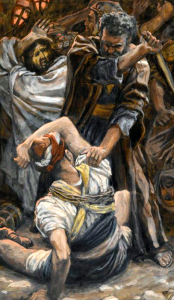
The Ear of Malchus (c. 1890), by James Tissot.
d. Malchus/Melekh | Μάλχος [Malchos]: This name is apparently derived from the Hebrew מֶלֶךְ [melekh], which means “king”—rather an ironic name to give a slave. The fact that this name was apparently known to the evangelist suggests that either Malchus himself or someone closely connected with him (such as a family member or another slave from the same household) went on to become a Christian.
e. the cup | τὸ ποτήριον [to potērion]: The cup is not infrequently a symbol of judgment in the Hebrew Bible. The image recurs a number of times in the prophets, and is very prominent in Psalm 75:
I said unto the fools, “Deal not foolishly:
…..and to the wicked, Lift not up the horn:
Lift not up your horn on high:
…..speak not with a stiff neck.”
For promotion cometh neither from the east, nor from the west,
…..nor from the south.
But God is the judge:
…..he putteth down one, and setteth up another.
For in the hand of the Lord there is a cup, and the wine is red;
…..it is full of mixture; and he poureth out of the same:
but the dregs thereof, all the wicked of the earth shall wring them out,
…..and drink them.
—Vv. 4-8
f. another disciple. As this disciple was known to the high priest/another student. This student was known to the high priest | ἄλλος μαθητής. ὁ δὲ μαθητὴς ἐκεῖνος ἦν γνωστὸς τῷ ἀρχιερεῖ [allos mathētēs. ho de mathētēs ekeinos ēn gnōstos tō archierei]: This is a thoroughly fascinating revelation. If the person who wrote John was indeed, as tradition claims, St. John bar-Zebedee, how on earth was he “known to the high priest”? Was he family? If so, then why was a relative of the high priest—quite possibly of Hasmonean blood in his own right—living in a backwater like the Galilee and working as a fisherman! Or was he maybe some kind of prize student? The Pryshaya ran schools up and down the Holy Land, aiming to ensure that anyone with the brains to study Torah didn’t get excluded by mere circumstance; the author of John does evince a familiarity with Scripture and an interest in the liturgy that make some degree of formal rabbinic training plausible, albeit far from certain.
g. I am not | Οὐκ εἰμί [ouk eimi]: Contrast Peter’s “I am not” as he stands by the fire but metaphorically wavers with Christ’s resolute “I am” and the soldiers’ collapse.
h. I have said nothing secretly/I have said nothing in secret | ἐν κρυπτῷ ἐλάλησα οὐδέν [en krüptō elalēsa ouden]: It is tricky to square this categorical claim with the motif of the “messianic secret” common in the Synoptics—think of how hush-hush the Lord is with the apostles in Mark, especially in chapters 8 and 9. On the other hand, given that John represents his very boldest claims to being “one with the Father” being made in public, indeed in the Temple, it does sound as though whatever the “messianic secret” was, it wasn’t necessarily … secret. Of course, Yeshua telling people that he healed, or demons he cast out, or the Twelve, not to talk about him—that isn’t the same thing as him talking about himself. This again makes me wonder, as in note c above, whether the “messianic secret” was in fact a device to protect the Apostles from making themselves targets, rather than a way of keeping any of his own doctrine clandestine.
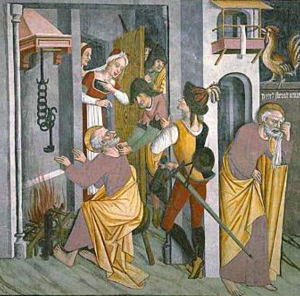
Depiction of St. Peter’s apostasy (15th c.)
from the church of Our Lady of the Fountains
in La Brigue—this one kind of makes it look
like he was thrown out for hogging the fire.
i. Ask those who have heard me, what I said to them; they know what I said/Ask those who heard what I said to them; look, they know what I said | ἐρώτησον τοὺς ἀκηκοότας τί ἐλάλησα αὐτοῖς· ἴδε οὗτοι οἴδασιν ἃ εἶπον ἐγώ [erōtēson tous akēko’otas ti elalēsa autois: ide houtoi oidasin ha eipon egō]: I suspect that this, like several of his earlier remarks, loops into the fact that his didactic or prophetic role is over—everything he is going to say has been said. But the courts of Chanan and Qayafa have proven that they do not and cannot understand him; the only thing they can do now is to consult those whom he taught. Religious authorities generally will, from now on, have to consult the Church to whom, in the Paraclete, the prophetic authority is being transferred.
I think it’s also possible that this contains an implied reprimand to primitive forms of Gnosticism. Gnosticism was a primarily second-century phenomenon (stretching into the third in some varieties), but it had antecedents in the first century, and arguably even earlier. Several Gnostic sects claimed to possess secret traditions handed down from Christ apart from the revelation committed publicly to the Church; the proto-orthodox answer to this, embodied in the writings of men like St. Ignatius of Antioch, St. Irenæus of Lyons, and Origen of Alexandria, was: the sees that everyone knows, as a matter of public record, were actually taught by the Apostles—they know nothing of these traditions; why were they not passed on in these, the most obvious places, by these, the most obvious transmitters?
j. If I have spoken wrongly, bear witness to the wrong; but if I have spoken rightly, why do you strike me?/If I have spoken badly, witness about the badness; but if fairly, what are you thrashing me [for]? | Εἰ κακῶς ἐλάλησα, μαρτύρησον περὶ τοῦ κακοῦ· εἰ δὲ καλῶς, τί με δέρεις; [ei kakōs elalēsa, martürēson peri tou kakou: ei de kalōs, ti me dereis?]: With apologies for the pun, this forms quite a striking contrast with St. Paul’s reply, around twenty years later, to a near-identical provocation:
And Paul, earnestly beholding the council, said, “Men and brethren, I have lived in all good conscience before God until this day.” And the high priest Ananias commanded them that stood by him to smite him on the mouth. Then said Paul unto him, “God shall smite thee, thou whited wall: for sittest thou to judge me after the law, and commandest me to be smitten contrary to the law?” And they that stood by said, “Revilest thou God’s high priest?” Then said Paul, “I wist not, brethren, that he was the high priest: for it is written, ‘Thou shalt not speak evil of the ruler of thy people.'”2, 3
—Acts 23:1-5
There are a handful of hypotheses for understanding these two answers:
- the Lord is right, St. Paul is wrong;
- the Lord is wrong, St. Paul is right;
- they’re both wrong; or
- they’re both right—
that last hypothesis requiring further refinement, in the forms
-
- A) because which response is right varies according to circumstance, and there’s a distinction between these two settings; or
- B) because which response is right is “whichever one you choose to give,” and St. Paul simply preferred the deferential one where the Lord preferred the challenge-by-dilemma.
While they require enumeration for logical completeness, Christians speaking among ourselves may treat hypotheses 2 and 3 as preëmpted! That leaves us with 1, 4A, and 4B. Most Christians would be comparatively reluctant to assume St. Paul was actively in the wrong for replying as he did (especially since he’s quoting Scripture here), so let’s set 1 aside as well, at least momentarily. So, is it 4A, 4B, or somehow both?
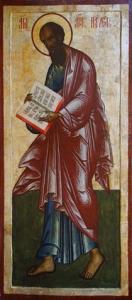
Russian ikon of St. Paul the Apostle (18th c.)
The explanation that first came to my mind—which does, after a fashion, lie at an intersection of A and B—is that Christ and Paul have different goals here. The former is planning to die; Paul, on the other hand, does not seem eager to be martyred (I don’t think we have yet reached the serenely prepared Paul of Philippians or II Timothy5). It is therefore in his interest to, well, find a reason to behave pleasantly, even if he is justified in calling out the high priest for a breach not only of protocol, but of the Torah itself.
… Yet there’s something about that which isn’t quite nice, isn’t there? The idea of an apostle being strategically courteous—I mean, if we were feeling catty, we might call it “v. Eastern” (albeit without camels6), but it doesn’t sound all that saintly, does it? Which brings me back to hypothesis 1, the one we set aside but did not actually dismiss, as you’ll remember. (You’re always remembering things you’ve read here; I like that about you.) There is, to put it mildly, a difference in tone between “What are you thrashing me for?” and “God is going to hit you, [you] whitewashed wall”. The apostle’s reply gets very personal with the invective—which is understandable, even probably excusable, but not the ideal portrait of “love, joy, peace, patience, kindness, goodness, faithfulness, gentleness, self-control: against such things there is no law.”
k. They said to him/Then they said to him | εἶπον οὖν αὐτῷ [eipon oun autō]: The exact text of the accusations bystanders made against Peter here vary from Gospel to Gospel; no doubt accusing questions like this would be tossed from mouth to mouth chaotically.
This does contain a puzzle. Why did St. Peter apostatize? I had the impression when I was younger that people read this simply as an act of fear; on one level, that’s clearly true, but that only prompts the question, Fear of what? Because it doesn’t seem like it’s fear of death, just as such. It may be easy to dismiss his confident statement from back in chapter 13 that he is ready to die for the Lord as naïve bravado—but we actually get hard proof that it wasn’t just that in this very chapter: outnumbered, outgunned, surrounded, he still got as far as slicing off a man’s ear in fighting for his Savior, and it was only Yeshua’s own intervention that stopped him. So what was it?
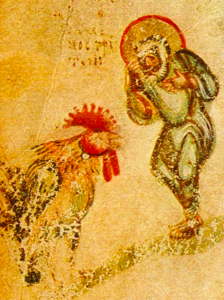
Illumination of St. Peter from the Chludov
Psalter (9th c.)—a rare example of a work
with ikons that survived the Second Icono-
clasm in the Byzantine Empire (814-843).
I have a hunch about this that probably can’t be proven, but which seems to me to fit the facts. Peter clearly could have died for a messiah who was going to win. But dying for a messiah who had apparently decided to lose? The world abounds in great men who are capable of giving their lives up for a cause; yet by and large, even they would be daunted to learn that not only they, but the cause, had to die. That would require a degree of courage that I think only the grace of faith can supply, one that feels superhuman now, though it was not when the world was young.
In C. S. Lewis’s Perelandra, the hero, Ransom, is taken to Venus, which depicted as an aqueous world in which most of the “land” consists in island-like mats of vegetation that literally float atop the surface of the ocean. There is a single piece of fixed land, but the two intelligent aliens native to the planet (an Adam-and-Eve pair called the King and the Queen) have been forbidden by Maleldil, i.e. God, to sleep on it: to do so is their forbidden fruit, as it were. The reason Ransom is sent there is to warn them against a tempter in human shape, who reaches the planet shortly thereafter—or rather, to warn the Queen, for both the hero and the tempter find her in a time when she has been separated from the King. Spoilers for a novel that’s been out for eighty years, but, The Good Guys win this one, and in the final chapter, the two have been reunited, and they and Ransom together have a sort of “debrief”; the Queen speaks the first paragraph of the following, while the rest is the King’s:
“The reason for not yet living on the Fixed Land is now so plain. How could I wish to live there except because it was Fixed? And why should I desire the Fixed except to make sure—to be able on one day to command where I should be the next and what should happen to me? It was to reject the wave—to draw my hands out of Maleldil’s, to say to Him, ‘Not thus, but thus’—to put in our own power what times should roll towards us … as if you gathered fruits together to-day for to-morrow’s eating instead of taking what came. That would have been cold love and feeble trust. And out of it how could we ever have climbed back into love and trust again?”
[…] “We knew little of this while we were young. But after that He showed me in a darkness what was happening to the Queen. And I knew it was possible for her to be undone. And then I saw what had happened in your world, and how your Mother fell and how your Father went with her, doing her no good thereby and bringing the darkness upon all their children. And then it was before me like a thing coming towards my hand … what I should do in like case. There I learned of evil and good, of anguish and joy.”
Ransom had expected the King to relate his decision, but when the King’s voice died away into thoughtful silence he had not the assurance to question him.
“Yes …” said the King, musing. “Though a man were to be torn in two halves … though half of him turned into earth … The living half must still follow Maleldil. For if it also lay down and became earth, what hope would there be for the whole? But while one half lived, through it He might send life back into the other.” Here he paused for a long time, and then spoke again somewhat quickly. “He gave me no assurance. No fixed land. Always one must throw oneself into the wave.”7
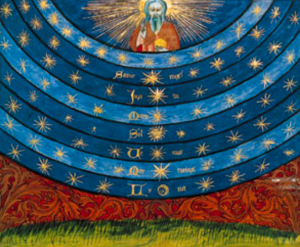
An illumination of the celestial spheres from
Le Livre du Ciel et du Monde [The Book of
Heaven and Earth] (1377), by Nicole Oresme.
Footnotes
1Indeed, if I’ve counted right and not missed any, this makes another heptad, one that I missed during my preliminary overview!—seven times that the Lord conceals himself from those who do not understand him.
2The text St. Paul is quoting comes from Exodus 22:28, “Thou shalt not revile the gods, nor curse the ruler of thy people,” part of a sequence of mostly fairly short commandments that come after the Decalogue. (The expression “the gods” here is probably meant in the same sense which appears in Psalm 82:1, 6.)
3It may seem strange that Paul would be unaware that the high priest was the one giving this order. However, there are at least a couple of possible explanations here. One, which I suspect is the more probable of the two, would be that this was hollowly-polite sarcasm on the apostle’s part—the implication being, he did not recognize the high priest because he commanded something contrary to the Law, while at the same time suggesting by his quotation that he knows the Law better than the high priest does (cf. Matthew 5:20). A second possibility, which is compatible with the first, is that, contrary to the general custom, the high priest was for some reason presiding over the Sanhderin on this occasion. Although nothing is said of this in the New Testament, the head of the Sanhderin was its Nasi or “Prince.” This position was created during a prolonged no-confidence crisis in the early second century BCE, provoked by two successive high priests: Joshua III (?),4 known as Ἰάσων [Iasōn] or “Jason” in Greek, and Menelaus (they reigned from 175-171 BCE and from 171-161 BCE respectively). Both collaborated with Antiochus Epiphanes, the Seleucid monarch who tried to stamp Judaism out, and so provoked the Maccabean Revolt. After the Temple had been reclaimed and Jewish autonomy had been achieved, it was normal for the Nasi to preside over the Sanhedrin, with the assistance of a second-in-command known as the Av Beyt Dyn or “Father of the House of Justice.” The high priest remained a fixed member of the Sanhedrin, but he was only the third in dignity among its members, and would presumably only preside if both senior offices were for the moment unfilled or when both officials were unavailable.
4The name “Joshua” seems to be clear, but the enumeration, III/the Third, is not certain; not every high priest is known by name. There were, however, at least two high priests of this name before “Jason”: one who (according to Josephus) served during the existence of the First Temple, and one who was the first high priest of the Second, mentioned in the books of Zechariah, Haggai, and Ezra.
5Most modern scholars do not consider II Timothy to be an authentic epistle of Paul. I dissent from this particular conclusion, on the grounds that I find the evidence against its authenticity incredibly weak, and the evidence for it far more compelling; I offered a more extended rant on the subject in this post from last autumn.
6Readers who are, justifiably, bewildered by this parenthesis are cordially invited to refer to footnote 1 from this post, which should make everything, eh, as clear as it’s going to get.
7C. S. Lewis, Perelandra, ch. 17.
History and Religion
Previous Post

July 2, 2026
The Gospel of John: The New Torah, Part III
Next Post
July 16, 2026 The Gospel of John: The Verdict of the Dark
Recent Comments
"On the contrary, such a proclamation, among the Aztecs or Maya, would be disastrously misunderstood. ..."
The Gospel of John: The Bread ..."
"Many thanks for your scholarly study on the Cleansing of the Ten Lepers in the ..."
The Cleansing of the Ten Lepers
"Four Last Things: not the video game, but Death, Judgment, Heaven and Hell.Momento mori. Remember, ..."
"I am going by the time that these sayings began to be converted into written ..."
Are Our Bibles in the Wrong ..."
Browse Our Archives
Select a Category abuse antifascism art bad Catholic celibacy chastity Church crucifixion culture war eros forgiveness gay gender homophobia ikons language liturgy peace poems politics Pope Francis prayer pro-life race recommendations reform repentance review sacraments saints satire scandal schism scripture sex suffering theology Uncategorized violence
Select a Month October 2026 September 2026 August 2026 July 2026 June 2026 May 2026 April 2026 March 2026 February 2026 January 2026 December 2025 November 2025 October 2025 September 2025 August 2025 July 2025 June 2025 May 2025 April 2025 March 2025 February 2025 January 2025 December 2024 November 2024 October 2024 September 2024 August 2024 July 2024 June 2024 May 2024 April 2024 March 2024 February 2024 January 2024 December 2023 November 2023 October 2023 September 2023 August 2023 July 2023 June 2023 May 2023 April 2023 March 2023 February 2023 January 2023 December 2022 November 2022 October 2022 September 2022 August 2022 July 2022 June 2022 May 2022 April 2022 March 2022 February 2022 January 2022 December 2021 November 2021 October 2021 September 2021 August 2021 July 2021 June 2021 May 2021 April 2021 March 2021 February 2021 January 2021 December 2020 November 2020 October 2020 September 2020 August 2020 July 2020 June 2020 May 2020 April 2020 March 2020 February 2020 January 2020 December 2019 November 2019 October 2019 September 2019 August 2019 July 2019
Follow Us!
TAKE THE
Religious Wisdom Quiz
Who was the wife of Isaac?
Select your answer to see how you score.
Sarah Rachel Rebekah Leah
Related posts from Mudblood Catholic

The Sermon on the Mount, Part I: Matthew...

The Gospel of Matthew: Christ and Antichrist

John the Baptist and the Winnowing Fork: Matthew...

The Gospel of Matthew: The Coventry Carol
TRENDING AT PATHEOS Catholic

How to Make a Decision When You Can't...
Main point: It’s much more valuable to stay close to God so...

Archdiocese Hosts Military Marriage Retreat in Germany
RASTATT, Germany — The transient military lifestyle, with its frequent deployments and...

Nearly every morning, I make the drive to Detroit with my high-school-age...

The Real AI Story Is Adoption Without Trust
Artificial intelligence has crossed a political threshold. It is no longer a...

A new article, written by Jeff Lindsay and Gale L. Pooley,...

Swimfan: Forgotten Aughts Pleasures
This is a recovery effort. In 2002, My Big Fat Greek Wedding...
view all Catholic blogs
What Are Your Thoughts?leave a comment
Ad-Free & Subscriber Log-In Subscription Support
- About Us
- 2026 Calendar
- Videos
- Podcasts
- Library of World Religions
- Faith In Media Tracker
- Advertise With Us
- Write for Us
- Privacy Policy
- Terms of Service
- Do Not Sell My Data
- Contact Us
- Radiant Digital
- Manage Newsletter Subscriptions
- Unsubscribe From Notifications
- Sitemap
Copyright 2008-2026, Patheos. All rights reserved.
Subscription Support Ad-Free & Subscriber Log-In
Follow Patheos