
BuddhistCatholicContemplativeEvangelicalGeneral ChristianHinduJewishLatter-day SaintMuslimNew VisionsProgressive Christian
Beliefs
- Buddhist
- Catholic
- Contemplative
- Evangelical
- General Christian
- Hindu
- Jewish
- Latter-day Saint
- More Voices
- Muslim
- New Visions
- Pagan
- Progressive Christian
Topics
- Religion News
- Food and Religion
- Sports and Religion
- Religious Art
- Religious Music and Entertainment
- Religious Events
- History and Religion
- Style and Religion
- Politics and Religion
- Women in Religion
- Recreation Outdoors and Religion
- Business Finance and Religion
- Careers Workplace and Religion
- Education and Religion
- Family Parenting and Religion
- Health Fitness and Religion
- Home and Religion
- Relationships and Religion
- Technology and Religion
- Travel and Religion
Columnists
- Buddhist Columnists
- Business Finance and Religion Columnists
- Careers Workplace and Religion Columnists
- Catholic Columnists
- Contemplative Columnists
- Education and Religion Columnists
- Evangelists Columnists
- Family Parenting and Religion Columnists
- General Christian Columnists
- Health Fitness and Religion Columnists
- Hindu Columnists
- History and Religion Columnists
- Home and Religion Columnists
- Jewish Columnists
- More Voices Columnists
- Latter Day Columnists
- Muslim Columnists
- New Visions Columnists
- Nonreligious Columnists
- Pagan Columnists
- Politics and Religion Columnists
- Progressive Columnists
- Recreation Outdoors and Religion Columnists
- Relationships and Religion Columnists
- Religion News Columnists
- Religious Art Columnists
- Religious Events Columnists
- Religious Music and Entertainment Columnists
- Sports and Religion Columnists
- Style and Religion Columnists
- Technology and Religion Columnists
- Travel and Religion Columnists
- Women in Religion Columnists
Resource Library
- 2026 Calendar
- Library of World Religions
- The 100 Most Holy Places on Earth
- Patheos Answers
- Podcasts
- Videos
- Faith Leaders Database
- Anglican Episcopalian
- Bahai
- Baptist
- Buddhism
- Christianity
- Confucianism
- Eastern Orthodoxy
- Hinduism
- Holiness and Pentecostal
- ISKCON
- Islam
- Judaism
- Lutheran
- Methodist
- The Church of Jesus Christ of Latter-day Saints
- New Age
- Paganism
- Presbytarian and Reformed
- Protestantism
- Religion Behind the Scenes
- Roman Catholic
- Scientology
- Shia Islam
- Sikhism
- Sufism
- Sunni Islam
- Taoism
- Zen
- See all religions
Research Tools
 Ad-Free & Subscriber Log-In Subscription Support
Ad-Free & Subscriber Log-In Subscription Support
Follow Patheos 

- Trending:
- Forgiveness
- |
- Marriage
- |
- Consciousness
- |
- Death Penalty
- |
- Election
- |
- Halloween

- Home
- Catholic
- The Gospel of John: The New Torah, Part II
The Gospel of John: The New Torah, Part II
Last updated on: July 1, 2026 at 9:35 pm by Gabriel Blanchard
The Gospel of John: The New Torah, Part II 2026-07-01T21:35:44-04:00 Gabriel Blanchard
Patheos Explore the world's faith through different perspectives on religion and spirituality! Patheos has the views of the prevalent religions and spiritualities of the world.
The Gospel of John: The New Torah, Part II (John 13:36-15:17)
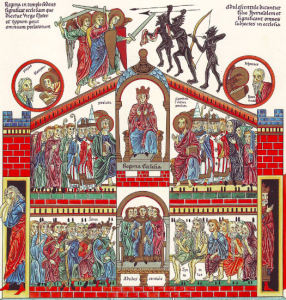
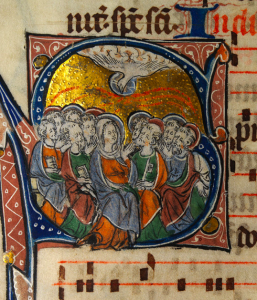
Illumination of the Church (12th c.) from
Herrad of Landsberg’s Hortus Deliciarum
[“Garden of Delights”],
a Medieval encyclopedia.
The Upper Room Discourse—or as I have it, “the New Torah*“—is a mostly-uninterrupted sermon that occupies the last several verses of chapter 131 and all of chapters 14-16, immediately followed by a prayer said by Christ to God the Father in the Apostles’ presence, which chapter 17 consists in. The four brief interruptions are from SS. Peter, Thomas, Philip, and Jude (or in my translation, Rocky, Toma, Philip, and Yudah). The mandatum novum, the capstone upon the greatest and second-greatest commandments, has been set forth in 13:31-35; thereafter, the discourse falls into three principal blocs:*
- Teaching on the Church’s life in the Trinity (13:36-15:17).
- Teaching on the Church’s confrontation with the world (15:18-16:33).
- The Lord’s final prayer over the Church, present and future (17:1-26).
The teaching on the Church’s life in the Trinity is delivered in labyrinthine terms, because the unities it is expressing—while simple from one point of view—are not easily summarized. The Logos has revealed the Father (whom “no one has ever seen”) to the Apostles; now, with that revelation complete, the Apostles are to reveal the Logos*, even in a sense to be the* Logos*, to the world; yet to do this, they need the aid of the Spirit, who will reveal the* Logos among and within the Apostles themselves. The multifarious connections among the different subjects of the discourse are thus not only stated in the content, but illustrated in the forms, of the Fourth Gospel, all its themes and symbols weaving in and out of one another. It is tempting to reach for the words of the Priest of Ungit:
They demand to see such things clearly, as if the gods were no more than letters written in a book. I, King, have dealt with the gods for three generations of men, and I know that they dazzle our eyes and flow in and out of one another like eddies on a river, and nothing that is said clearly can be said truly about them. Holy places are dark places. It is life and strength, not knowledge and words, that we get in them. Holy wisdom is not clear and thin like water, but thick and dark like blood.2
Of course—and thank God—the Priest of Ungit is wrong, as well as right; wrong, in that he imagines knowledge to be somehow opposed to life, or words to strength, and supposes that what dazzles our eyes in God is darkness. It needed St. John of the Cross to articulate that the Dark Night of the Soul is in truth dark only from our point of view, because we are momentarily blinded by the Light.
EDIT—Because the passage being dealt with is so long, I have placed the RSV version of the text (which is provided principally for comparison’s sake, as I don’t want anyone relying solely on my translation) in small type. (Edit made at approx. 11:15 p.m. on 28th June, 2026.)
John 13:36-15:17, RSV-CE
aSimon Peter said to him, “Lord, where are you going?” Jesus answered, “Where I am going you cannot follow me now; but you shall follow afterward.” Peter said to him, “Lord, why cannot I follow you now? I will lay down my life for you.” Jesus answered, “Will you lay down your life for me? Truly, truly, I say to you, the cock will not crow, till you have denied me three times.
“Let not your hearts be troubled; believe in God, believe also in me. In my Father’s house are many rooms; if it were not so, would I have told you that I go to prepare a place for you? And when I go and prepare a place for you, I will come again and will take you to myself, that where I am you may be also. And you know the way where I am going.” Thomas said to him, “Lord, we do not know where you are going; how can we know the way?” Jesus said to him, “I am the way, and the truth, and the life; no one comes to the Father, but by me. If you had known me, you would have known my Father also; henceforth you know him and have seen him.”
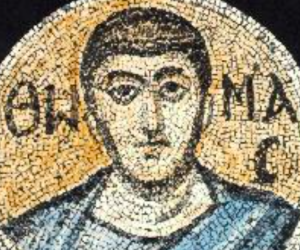
Mosaic of St. Thomas (no provenance given).
Philip said to him, “Lord, show us the Father, and we shall be satisfied.” Jesus said to him, “Have I been with you so long, and yet you do not know me, Philip? He who has seen me has seen the Father; how can you say, ‘Show us the Father’? Do you not believe that I am in the Father and the Father in me? The words that I say to you I do not speak on my own authority; but the Father who dwells in me does his works. Believe me that I am in the Father and the Father in me; or else believe me for the sake of the works themselves.
“Truly, truly, I say to you, he who believes in me will also do the works that I do; and greater works than these will he do, because I go to the Father. Whatever you ask in my name, I will do it, that the Father may be glorified in the Son; if you ask anything in my name, I will do it.b
“If you love me, you will keep my commandments. And I will pray the Father, and he will give you another Counselor,c to be with you for ever, even the Spirit of truth, whom the world cannot receive, because it neither sees him nor knows him; you know him, for he dwells with you, and will be in you.
“I will not leave you desolate; I will come to you. Yet a little while, and the world will see me no more, but you will see me; because I live, you will live also. In that day you will know that I am in my Father, and you in me, and I in you. He who has my commandments and keeps them, he it is who loves me;d and he who loves me will be loved by my Father, and I will love him and manifest myself to him.” Judas (not Iscariot) said to him, “Lord, how is it that you will manifest yourself to us, and not to the world?” Jesus answered him, “If a man loves me, he will keep my word, and my Father will love him, and we will come to him and make our home with him. He who does not love me does not keep my words; and the word which you hear is not mine but the Father’s who sent me.
“These things I have spoken to you, while I am still with you. But the Counselor, the Holy Spirit, whom the Father will send in my name, he will teach you all things, and bring to your remembrance all that I have said to you.e Peace I leave with you; my peace I give to you; not as the world gives do I give to you.f Let not your hearts be troubled, neither let them be afraid. You heard me say to you, ‘I go away, and I will come to you.’ If you loved me, you would have rejoiced, because I go to the Father; for the Father is greater than I. And now I have told you before it takes place, so that when it does take place, you may believe. I will no longer talk much with you, for the ruler of this world is coming. He has no power over me; but I do as the Father has commanded me, so that the world may know that I love the Father. Rise, let us go hence.
“I am the true vine, and my Father is the vinedresser. Every branch of mine that bears no fruit, he takes away, and every branch that does bear fruit he prunes, that it may bear more fruit.g You are already made clean by the word which I have spoken to you. Abide in me, and I in you. As the branch cannot bear fruit by itself, unless it abides in the vine, neither can you, unless you abide in me. I am the vine, you are the branches. He who abides in me, and I in him, he it is that bears much fruit, for apart from me you can do nothing. If a man does not abide in me, he is cast forth as a branch and withers; and the branches are gathered, thrown into the fire and burned. If you abide in me, and my words abide in you, ask whatever you will, and it shall be done for you. By this my Father is glorified, that you bear much fruit, and so prove to be my disciples. As the Father has loved me, so have I loved you; abide in my love. If you keep my commandments, you will abide in my love, just as I have kept my Father’s commandments and abide in his love. These things I have spoken to you, that my joy may be in you, and that your joy may be full.
“This is my commandment, that you love one another as I have loved you. Greater love has no man than this, that a man lay down his life for his friends. You are my friends if you do what I command you. No longer do I call you servants,h for the servant does not know what his master is doing; but I have called you friends, for all that I have heard from my Father I have made known to you. You did not choose me, but I chose you and appointed you that you should go and bear fruit and that your fruit should abide; so that whatever you ask the Father in my name, he may give it to you. This I command you, to love one another.”
John 13:36-15:17, my translation
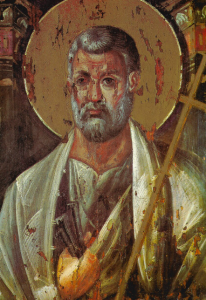
Encaustic ikon of St. Peter (early 6th c.)
aSymeon Rocky says to him, “Where are you going?”
Yeshua responded, “Where I am going you cannot now follow me, but you will follow [me] later.”
Rocky tells him, “Sir, why can I not follow you now? I will put [aside] my life for you.”
Yeshua responds, “Will you put your life [aside] for me? ‘Amin, ‘amin, I tell you, the rooster will not call until you deny me three times. Your heart—be it not agitated; you have faith in God, have faith in me too. In my father’s household there are many abodes; if not, I would hardly have told you that I am journeying to make a place ready for you; and if I will go and make a place ready for you, I will come back and take you along with myself, in order that where I am, you also will be. And where I am going, you know the road.”
Toma says to him: “Sir, we do not know where you are going; how can we know the road?”
Yeshua says to him, “I am the road and truth and life; no one comes to the Father except through me. If you recognize me, you also perceive my Father; from now on, you know him and have seen him.”
Philip says to him, “Sir, show us the Father, and it suffices us.”
Yeshua tells him, “I am with you such a time, and have you not known me, Philip? He who has seen me has seen the Father; how are you saying ‘Show us the Father’? Do you not have faith that I am in the Father and the Father is in me? The message which I tell you I do not speak from myself—the Father staying in me does his works. Have faith that I am in the Father and the Father in me; or if not, have faith because of the works. ‘Amin, ‘amin, I tell you, he who has faith in me, the works which I do, he will do, and he will do greater ones than these, because I am journeying to the Father; and if he asks anything in my name, I will do that, in order that the Father will be glorified in the Son; if you ask something in my name, I will do [it].b
“If you love me, observe my charges; and I will request of the Father, and he will give you another Advocate,c in order that he should be with you into the age—the Spirit of the truth, which the world cannot take, because it does not behold, nor know It; you know It, because he stays beside you, and will be in you. I will not leave you orphans, I am coming to you. A little yet, and the world beholds me no longer, yet you behold me, because I live and you will live. On that day, you will know that I am in my Father and you in me and I in you. He who has my charges and observes them, he loves me;d he who loves me will be loved by my Father, and I will love him and reveal myself to him.
Then Yudah says to him (not Ysh-Qriyot): “Sir, what has happened that you are revealing yourself to us and not the world?”
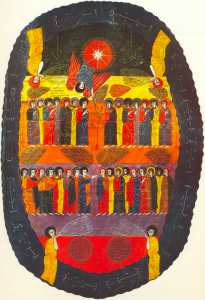
Four angels restrain the four winds while a
fifth seals the elect—an illumination of Reve–
lation 7 from the Facundus manuscript copy
(c. 1047) of Beatus of Liébana’s commentary.
Yeshua tells him in response, “If anyone loves me, he observes my word, and my Father will love him, and we will come to him and make our abode beside him. He who loves me observes my words; and the word which you hear is not mine, but from him who dispatched me, the Father. I have told you these things while staying beside you; but the Advocate, the Holy Spirit which the Father will dispatch in my name, It will teach you everything and remind you of everything which I told you.e I leave you peace, I give you my peace; not just as the world gives do I give to you.f Your heart, it must not be agitated nor cower. You heard what I spoke to you: ‘I am going and I am coming to you.’ If you loved me you would rejoice, because I am journeying to the Father, because my Father is greater than I. And now, I have told you before it happens, in order that whenever it happens, you should have faith.
“I will not talk with you much longer, for the prince of the world is coming; and he has nothing in me, but in order that the world recognizes that I love the Father, and just as the Father charged me, I do just so. Rise, let us go from here.
“I am the true grapevine, and my Father is the farmer: every branch in me that does not bear fruit, he takes it away, and every one that does bear fruit, he cleans, in order that it may bear greater fruit.g Already you are clean, because of the word which I have told you; stay in me, and I in you. Just as a branch cannot bear fruit of itself, except it stays on the grapevine, neither can any of you except you stay in me. I am the grapevine, you the branches. Who stays in me and I in him, this one bears much fruit, because apart from me you cannot do nothing. Except one stays in me, he is thrown outside as a branch and dried out, and they gather them and throw them into the fire and burn [them]. If you stay in me and my message stays in you, if you want something, ask and it will come to be for you; in this my Father is glorified, in order that you should bear much fruit and become my students.
“Just as the Father loved me, I also loved you—stay in my love. If you observe my charges, you stay in my love, just as I have observed my Father’s charges and stay in his love. I have told you these things in order that my joy might be in you, and that joy might be fulfilled. This is my charge, that you love each other, just as I have loved you; no one has better love than this, that one should set [aside] his life for his loved ones. You are my loved ones, if you do the things I am charging you to. No longer do I term you slaves,h because a slave does not know what his lord is doing; I have called you loved ones, because everything which I have heard from my Father, I have made known to you. You did not select me, but I selected you, and I have set you [aside] in order that you may go away and bear fruit and your fruit may stay, in order that whatever you ask the Father in my name, I will give you. I am charging you these things, in order that you may love each other.”
Textual Notes
a. —/—: Suiting his lovable impetuosity, Rocky’s interruption is the first of the four, and only he is allotted an “encore.” The other three questions come from Toma, Philip, and Yuda Tadai. It may be possible to see in this a parallel to a famous midrash about the paschal Haggadah (the text read for the Passover Seder). The mitzvah to explain the Passover ritual to one’s children is given in four distinct passages:
- And it shall come to pass, when ye be come to the land which the LORD will give you, according as he hath promised, that ye shall keep this service. And it shall come to pass, when your children shall say unto you, “What mean ye by this service?” That ye shall say, “It is the sacrifice of the LORD‘s passover, who passed over the houses of the children of Israel in Egypt, when he smote the Egyptians, and delivered our houses.” (Exodus 12:25-27)
- And it shall be when the LORD shall bring thee into the land of the Canaanites … which he sware unto thy fathers to give thee, a land flowing with milk and honey, that thou shalt keep this service in this month. … And thou shalt shew thy son in that day, saying, “This is done because of that which the LORD did unto me when I came forth out of Egypt.” And it shall be for a sign unto thee upon thine hand, and for a memorial between thine eyes, that the LORD‘s law may be in thy mouth: for with a strong hand hath the LORD brought thee out of Egypt. (Exodus 13:5, 8-9)
- Thou shalt set apart unto the LORD all that openeth the matrix, and every firstling that cometh of a beast which thou hast; the males shall be the LORD‘s. And every firstling of an ass thou shalt redeem with a lamb; … and all the firstborn of man among thy children shalt thou redeem. And it shall be when thy son asketh thee in time to come, saying, “What is this?” that thou shalt say unto him, “By strength of hand the LORD brought us out from Egypt, from the house of bondage: and it came to pass, when Pharaoh would hardly let us go, that the LORD slew all the firstborn in the land of Egypt, both the firstborn of man, and the firstborn of beast: therefore I sacrifice to the LORD all that openeth the matrix …; but all the firstborn of my children I redeem.” (Exodus 13:12-15)
- And when thy son asketh thee in time to come, saying, “What mean the testimonies, and the statutes, and the judgments, which the LORD our God hath commanded you?” Then thou shalt say unto thy son, “We were Pharaoh’s bondmen in Egypt; and the LORD brought us out of Egypt with a mighty hand: and the LORD shewed signs and wonders, great and sore, upon Egypt, upon Pharaoh, and upon all his household, before our eyes: and he brought us out from thence … to give us the land which he sware unto our fathers.” (Deuteronomy 6:20-23)
This fourfold repetition is interpreted as applying to four sorts of sons: the wise son; the wicked son; the ignorant or simple-minded son; and the son who does not know how to ask. It would be a stretch to apply these directly to SS. Peter, Thomas, Philip, and Jude Thaddæus; some small parallels are perhaps detectable—e.g., St. Thomas “the Doubter” being the one to pose the second question, or St. Jude, whose nickname may have meant something a little like “Baby John” (see note b on this post), corresponding to the fourth—but I’m far from sure that an exact, point-for-point analogue was intended here in any case.
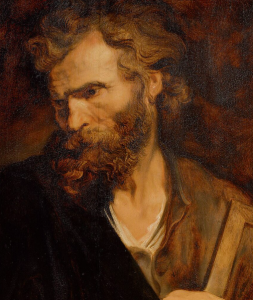
Apostel Judas Thaddäus [The Apostle Jude
Thaddæus] (c. 1620), by Anthonis van Dyck.
b. if you ask anything in my name, I will do it/if you ask something in my name, I will do [it] | ἐάν τι αἰτήσητέ με ἐν τῷ ὀνόματί μου ἐγὼ ποιήσω [ean ti aitēsēte me en tō onomati mou egō poiēsō]: I do not know what this text means. This, and texts just like it (with very minor variations in wording), can be found scattershot in the canonical Gospels, and they certainly appear to be a gargantuan, ridiculous promise that is very easily proven false! What the answer is here, I don’t know; I incline to agree with C. S. Lewis (whom I know I got this from, but can’t recall exactly where—Letters to Malcolm, maybe?) that this is probably addressed to a degree of maturity in faith that most of us never reach in this life, though I also have a strange feeling that that isn’t the whole story here. More than that, I can’t say. But I go out of my way to draw attention to this, because I think it’s particularly important for religious people (who, being people, like easy answers that don’t threaten things they’ve tied their egos to) not to skate over the parts of Scripture that we or others may find difficult and perplexing.
c. Counselor/Advocate | παράκλητον [Paraklēton]: This term is particularly interesting in light of the theology of the devil set forth in Jewish apocalyptic literature, especially but not only the New Testament.
The generic meaning of παράκλητος [paraklētos] was not religious, but secular—literally “one called alongside,” but with the sense “one who helps, one who gives aid.” However, the word could also serve as a technical term for someone serving as “counsel for the defense” in court, as opposed to the “plaintiff” role played by a διάβολος [diabolos], an accuser. Unlike our system, where a defense lawyer is constitutionally guaranteed to all defendants, the norm in ancient Græco-Roman courts (both criminal and civil) was for the defendant to defend themselves. This was originally why learning rhetoric was such a valued art: anyone might be accused of a crime or sued. As far as I understand, a legal advisor was permitted to both parties, but the state wasn’t footing the bill; in other words, you could have one either if you could afford one, or you had a wealthy patron who would cover the cost. Yet in an age when most people were even poorer than most people are now, and when most people were also illiterate and not versed in the law even of their native country, the value of a “paraclete”—a professional, expertly-educated defense lawyer—may have been even higher.
Now we switch gears a little. The divine court is a recurring symbol in the Bible. It emerges in the Prophets:
And he shewed me Joshua the high priest standing before the angel of the LORD, and Satan standing at his right hand to resist him. And the LORD said unto Satan, “The LORD rebuke thee, O Satan; even the LORD that hath chosen Jerusalem rebuke thee: is not this a brand plucked out of the fire?” Now Joshua was clothed with filthy garments, and stood before the angel. And he answered and spake unto those that stood before him, saying, “Take away the filthy garments from him.” And unto him he said, “Behold, I have caused thine iniquity to pass from thee, and I will clothe thee with change of raiment. And I said, ‘Let them set a fair mitre upon his head.'” So they set a fair mitre upon his head, and clothed him with garments. And the angel of the LORD stood by. And the angel of the LORD protested unto Joshua, saying, “Thus saith the LORD of hosts;
“‘If thou wilt walk in my ways,
…and if thou wilt keep my charge,
then thou shalt also judge my house …
—Zechariah 3:1-7
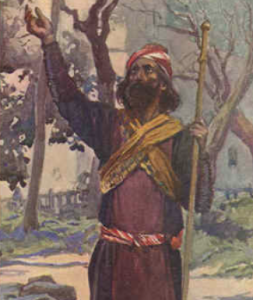
Zechariah as depicted (c. 1900) by James Tissot.
It also appears in the Kethuvim, the Writings. Famously, it’s part of the framing device of Job’s story:
Again there was a day when the sons of God came to present themselves before the LORD, and Satan came also among them … And the LORD said unto Satan, “Hast thou considered my servant Job, that there is none like him in the earth, a perfect and an upright man …? and still he holdeth fast his integrity, although thou movedst me against him, to destroy him without cause.”
And Satan answered the LORD, and said, “Skin for skin, yea, all that a man hath will he give for his life. But put forth thine hand now, and touch his bone and his flesh, and he will curse thee to thy face.”
And the LORD said unto Satan, “Behold, he is in thine hand; but save his life.”
So went Satan forth from the presence of the LORD, and smote Job …
—Job 2:1-7
The judgment of the divine court is specially associated in Judaism with the high holy days, i.e. the ten-day stretch from Rosh ha-Shanah to Yom Kippur inclusive (1-10 Tishrei on the Hebrew calendar): the former is considered the day upon which God decrees whether creation is to continue for another year, with the latter as the day on which this verdict is executed. Readers may recall that, while we lack hard proof, there is some cause to think Christ’s baptism occurred on or around Yom Kippur.
We have already seen the motif of an earthly court repeatedly in John: questionings, witness statements, exhibitions of signs in evidence, appeals to the Written and Oral Law, a refrain of approaching judgment. Now, out of the heavenly blue, we are promised an Advocate: the very Spirit seen by Yochanan the Baptist settling upon the Lord in the shape of a dove, at the beginning of his ministry. This sets up one of the chief themes of the rest of the Upper Room Discourse, a theme that receives its boldest expression in 14:12-13: “He who has faith in me, the works which I do, he will do, and he will do greater ones than these, because I am journeying to the Father; and if he asks anything in my name, I will do that”; in other words, the Apostles are, once the Paraclete comes, going to be Christ to the world in his absence.
d. He who has my commandments and keeps them, he it is who loves me/He who has my charges and observes them, he loves me | ὁ ἔχων τὰς ἐντολάς μου καὶ τηρῶν αὐτὰς ἐκεῖνός ἐστιν ὁ ἀγαπῶν με [ho echōn tas entolas mou kai tērōn autas ekeinos estin ho agapōn me]: This is one of the most consistent, persistent themes in all five of the Johannine books: for St. John, obedience and love are always one.
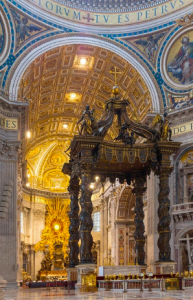
Interior of St. Peter’s Basilica, Rome: St.
Peter’s Baldachin in foreground (1634),
Throne of St. Peter in background (1653),
both by Gian Lorenzo Bernini.
e. he will teach you all things, and bring to your remembrance all that I have said to you/It will teach you everything and remind you of everything which I told you | ἐκεῖνος ὑμᾶς διδάξει πάντα καὶ ὑπομνήσει ὑμᾶς πάντα ἃ εἶπον ὑμῖν [ekeinos hümas didaxei panta kai hüpomnēsei hümas panta ha eipon hümin]: As discussed in the intro to last week’s post, the function of the Paraclete is not to give new revelation, but to unfold and articulate the revelation given in the Anointed. This places the Paraclete, relative to the Logos, in the same position the Logos is in relative to the Father.3 This is especially well exemplified in the repeal of the kashrut or dietary laws, which the earliest generation of Christians—all Torah-observant Jews by either birth or conversion—had of course been keeping. Although the occasion of their repeal is recounted in Acts 10, postdating not only the descent of the Holy Ghost but even the conversion of Paul (generally thought to be anything from two to six years after Pentecost), the basis of that repeal is much older: the Gospel of Mark recounts it in 7:14-23, implicitly placing it somewhere around the middle of Yeshua’s ministry.
f. my peace I give to you; not as the world gives do I give to you/I give you my peace; not just as the world gives do I give to you | εἰρήνην τὴν ἐμὴν δίδωμι ὑμῖν· οὐ καθὼς ὁ κόσμος δίδωσιν ἐγὼ δίδωμι ὑμῖν [eirēnē tēn emēn didōmi hümin: ou kathōs ho kosmos didōsin egō didōmi hümin]: This text reminded me of a poem by William Alexander Percy (1885-1942) that I first encountered in hymn form at my parish. The son of a Mississippi senator, Percy was a Roman Catholic; he adopted his three first cousins once removed after their father’s suicide, one of whom was the better-known author Walker Percy, and his social connections included William Faulkner and Langston Hughes. The poem, like many hymns, is titled for its first line.
They cast their nets in Galilee,
Just off the hills of brown;
Such happy, simple fisher-folk,
Before the Lord came down.
Contented, peaceful fishermen,
Before they ever knew
The peace of God that filled their hearts
Brimful, and broke them too.
Young John, who trimmed the flapping sail,
Homeless in Patmos died.
Peter, who hauled the teeming net,
Head down was crucified.
The peace of God, it is no peace
But strife closed in the sod.
Yet, let us pray for but one thing:
The marv’lous peace of God.

Grapes (source: look at ’em)
g. every branch that does bear fruit he prunes, that it may bear more fruit/every one that does bear fruit, he cleans, in order that it may bear greater fruit | πᾶν τὸ καρπὸν φέρον καθαίρει αὐτὸ ἵνα καρπὸν πλείονα φέρῃ [pan to karpon feron kathairei auto hina karpon pleiona ferē]: This refers to a standard practice in viticulture, i.e. the growing and care of grapevines (I believe it’s still viticulture whether the grapes are intended for winemaking or not). Though we use the specialized term “to prune” for this, Ancient Greek simply used a verb-ified form of its normal adjective “clean,” which was καθαρός [katharos].4 We know pruning as clipping off leaves, branchlets, branches, etc., that are growing in some way that’s apt to hurt the plant as a whole—maybe by ruining its balance in a fragile position, maybe by exposing it to grazing or nesting animals, who knows. For vines, this can also mean clipping off leaves or branchlets that have some sort of viral or bacterial infection, to prevent its spreading to the rest of the plant and from there to neighboring plants.
It’s interesting to me that Christ goes out of his way to state the purpose of this pruning: not just because that’s a normal thing you’d expect to do to any plant to keep it healthy, but “in order that it may bear greater fruit.”
h. No longer do I call you servants/No longer do I term you slaves | οὐκέτι λέγω ὑμᾶς δούλους [ouketi legō hümas doulous]: I used the translation “term” for λέγω, which I ordinarily render as some common speaking verb (say, tell, talk, etc.), because (a) I try to reserve the translations “call” and “name” for certain other verbs, and (b) the link between λέγω and λόγος [logos] “word” seemed to make it appropriate.
Readers may find this verse puzzling: Yeshua has not in fact described his disciples as either servants or slaves, nor addressed them as such, at any point in John. However, this language does emerge occasionally in the Synoptics, which most scholars agree were written earlier than the Fourth Gospel and may have been available to its author; I’ve begun to think he must have read Luke in particular, as subtle parallels keep popping up between the two (e.g., both portray the Mother of God but relate different stories about her, and both touch on the Lazarus family but depict different occasions). Consider:
“Let your loins be girded about, and your lights burning; and ye yourselves like unto men that wait for their lord, when he will return from the wedding; that when he cometh and knocketh, they may open unto him immediately. Blessed are those servants, whom the lord when he cometh shall find watching … Be ye therefore ready also: for the Son of man cometh at an hour when ye think not.”

Then Peter said unto him, “Lord, speakest thou this parable unto us, or even to all?”
And the Lord said, “Who then is that faithful and wise steward, whom his lord shall make ruler over his household, to give them their portion of meat in due season? Blessed is that servant, whom his lord when he cometh shall find so doing. Of a truth I say unto you, that he will make him ruler over all that he hath. But and if that servant say in his heart, ‘My lord delayeth his coming’; and shall begin to beat the menservants and maidens, and to eat and drink, and to be drunken; the lord of that servant will come in a day when he looketh not for him, and at an hour when he is not aware, and will cut him in sunder … And that servant, which knew his lord’s will, and prepared not himself, neither did according to his will, shall be beaten with many stripes. But he that knew not, and did commit things worthy of stripes, shall be beaten with few stripes. For unto whomsoever much is given, of him shall be much required: and to whom men have committed much, of him they will ask the more.”
—Luke 12:35-37, 40-48
Or again,
“Take heed to yourselves: If thy brother trespass against thee, rebuke him; and if he repent, forgive him. And if he trespass against thee seven times in a day, and seven times in a day turn again to thee, saying, I repent; thou shalt forgive him.”
And the apostles said unto the Lord, “Increase our faith.”
And the Lord said, “If ye had faith as a grain of mustard seed, ye might say unto this sycamine tree, ‘Be thou plucked up by the root, and be thou planted in the sea’; and it should obey you. But which of you, having a servant plowing or feeding cattle, will say unto him by and by, when he is come from the field, ‘Go and sit down to meat’? And will not rather say unto him, ‘Make ready wherewith I may sup, and gird thyself, and serve me, till I have eaten and drunken; and afterward thou shalt eat and drink’? Doth he thank that servant because he did the things that were commanded him? I trow not. So likewise ye, when ye shall have done all those things which are commanded you, say, ‘We are unprofitable servants: we have done that which was our duty to do.'”
—Luke 17:3-10
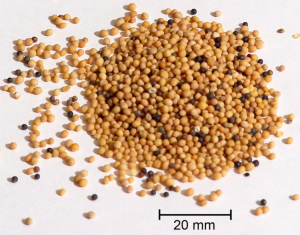
Assorted mustard seeds (20 mm ≈ 0.75 in).
Photo by Novalis, used via
a CC BY-SA 3.0 license (source).

Footnotes
1Alternatively, the Upper Room Discourse may be more broadly defined (or at least more simply referred to) as consisting in chapters 13-17. This groups the teaching from vv. 7-20 with what follows, and the themes are well-suited to place them together; I’ve separated that from this because I’m reading the break in v. 30 as extremely strong, narratively speaking; the episode of the Lord’s last appeal to the traitor and his departure into the book’s third and final night is a much more substantial interruption than any of the questions posed by the Apostles in chs. 13-14 create.
2C. S. Lewis, Till We Have Faces: A Myth Retold, Part I, Chapter Five (p. 50 of the Harvest Books paperback).
3This may superficially appear to settle the old, vexed problem of the Filioque decidedly in the West’s favor. However (and speaking as someone firmly convinced of the truth of the Filioque), the eternal procession of the Holy Ghost must be distinguished from the Holy Ghost’s temporal mission: the former concerns the dependency of His necessary existence, while the latter concerns His activity within the Church in history. This is not splitting hairs, for much the same reason that it’s not splitting hairs to insist on the distinction between the Father eternally begetting the Logos on the one hand, and on the other, the Virgin Mary giving birth on a specifiable date to the Logos incarnate. (My own reasons for being firmly convinced of the Filioque are two. The lesser reason is my belief that the Catholic doctrine of the Petrine office is correct, and the Petrine office has of course “sided with” the doctrine of double procession; this alone would be enough to convince me, but only because I have already accepted that theory of the papacy on other grounds. The greater reason is, I can’t at all see how the Logos is supposed to be the perfect image of the Father, if the Father respires the Holy Ghost but the Logos does not. That sounds to me like the Logos is, rather, an imperfect image of the Father—either unable to respire the Holy Ghost, or forbidden by the Father from doing so.)
4This adjective has a few derivatives in English, like the name of the heretical sect called the Cathars (but, surprisingly, not the name Catherine—which is probably descended from the name of the Greek goddess Hecate, a liminal goddess associated principally with the moon and witchcraft). The most famous of these is one we picked up thanks to Aristotle: catharsis.
Previous Post
June 18, 2026
The Gospel of John: The New Torah, Part I
Next Post

July 2, 2026 The Gospel of John: The New Torah, Part III
Recent Comments
"On the contrary, such a proclamation, among the Aztecs or Maya, would be disastrously misunderstood. ..."
The Gospel of John: The Bread ..."
"Many thanks for your scholarly study on the Cleansing of the Ten Lepers in the ..."
The Cleansing of the Ten Lepers
"Four Last Things: not the video game, but Death, Judgment, Heaven and Hell.Momento mori. Remember, ..."
"I am going by the time that these sayings began to be converted into written ..."
Are Our Bibles in the Wrong ..."
Browse Our Archives
Select a Category abuse antifascism art bad Catholic celibacy chastity Church crucifixion culture war eros forgiveness gay gender homophobia ikons language liturgy peace poems politics Pope Francis prayer pro-life race recommendations reform repentance review sacraments saints satire scandal schism scripture sex suffering theology Uncategorized violence
Select a Month October 2026 September 2026 August 2026 July 2026 June 2026 May 2026 April 2026 March 2026 February 2026 January 2026 December 2025 November 2025 October 2025 September 2025 August 2025 July 2025 June 2025 May 2025 April 2025 March 2025 February 2025 January 2025 December 2024 November 2024 October 2024 September 2024 August 2024 July 2024 June 2024 May 2024 April 2024 March 2024 February 2024 January 2024 December 2023 November 2023 October 2023 September 2023 August 2023 July 2023 June 2023 May 2023 April 2023 March 2023 February 2023 January 2023 December 2022 November 2022 October 2022 September 2022 August 2022 July 2022 June 2022 May 2022 April 2022 March 2022 February 2022 January 2022 December 2021 November 2021 October 2021 September 2021 August 2021 July 2021 June 2021 May 2021 April 2021 March 2021 February 2021 January 2021 December 2020 November 2020 October 2020 September 2020 August 2020 July 2020 June 2020 May 2020 April 2020 March 2020 February 2020 January 2020 December 2019 November 2019 October 2019 September 2019 August 2019 July 2019
Follow Us!
TAKE THE
Religious Wisdom Quiz
What does "Bethel" mean in Hebrew?
Select your answer to see how you score.
House of God God's Dwelling City of Light Holy Ground
Related posts from Mudblood Catholic

The Sermon on the Mount, Part I: Matthew...

The Gospel of Matthew: Christ and Antichrist

John the Baptist and the Winnowing Fork: Matthew...

The Gospel of Matthew: The Coventry Carol
TRENDING AT PATHEOS Catholic

The Problem with False Prophets
Miller’s Station UMC| 10/18/26| Anchor Verse: Jeremiah 23: 1, 9-23 I...

Emotion in Early Christianity by Andrew Crislip
Andrew Crislip’s Emotion in Early Christianity examines an often overlooked dimension of...

16 Spiritual Touchstones for a More Grounded Life
After decades of spiritual study, here are 16 principles I try...

Catholic Evangelization: Sharing Your Faith Every Day
Welcome back to the Graceful Awakening mini-series called, “From Faith to Mission.” ...

The Pillar of the Boatmen: the Ancient Monument...
The Pillar of the Boatmen is a Romano-Gaulish sculpture that dates from...

In one sense walking into Westminster Abbey is like walking down the...
view all Catholic blogs
What Are Your Thoughts?leave a comment
Ad-Free & Subscriber Log-In Subscription Support
- About Us
- 2026 Calendar
- Videos
- Podcasts
- Library of World Religions
- Faith In Media Tracker
- Advertise With Us
- Write for Us
- Privacy Policy
- Terms of Service
- Do Not Sell My Data
- Contact Us
- Radiant Digital
- Manage Newsletter Subscriptions
- Unsubscribe From Notifications
- Sitemap
Copyright 2008-2026, Patheos. All rights reserved.
Subscription Support Ad-Free & Subscriber Log-In
Follow Patheos