
BuddhistCatholicContemplativeEvangelicalGeneral ChristianHinduJewishLatter-day SaintMuslimNew VisionsProgressive Christian
Beliefs
- Buddhist
- Catholic
- Contemplative
- Evangelical
- General Christian
- Hindu
- Jewish
- Latter-day Saint
- More Voices
- Muslim
- New Visions
- Pagan
- Progressive Christian
Topics
- Religion News
- Food and Religion
- Sports and Religion
- Religious Art
- Religious Music and Entertainment
- Religious Events
- History and Religion
- Style and Religion
- Politics and Religion
- Women in Religion
- Recreation Outdoors and Religion
- Business Finance and Religion
- Careers Workplace and Religion
- Education and Religion
- Family Parenting and Religion
- Health Fitness and Religion
- Home and Religion
- Relationships and Religion
- Technology and Religion
- Travel and Religion
Columnists
- Buddhist Columnists
- Business Finance and Religion Columnists
- Careers Workplace and Religion Columnists
- Catholic Columnists
- Contemplative Columnists
- Education and Religion Columnists
- Evangelists Columnists
- Family Parenting and Religion Columnists
- General Christian Columnists
- Health Fitness and Religion Columnists
- Hindu Columnists
- History and Religion Columnists
- Home and Religion Columnists
- Jewish Columnists
- More Voices Columnists
- Latter Day Columnists
- Muslim Columnists
- New Visions Columnists
- Nonreligious Columnists
- Pagan Columnists
- Politics and Religion Columnists
- Progressive Columnists
- Recreation Outdoors and Religion Columnists
- Relationships and Religion Columnists
- Religion News Columnists
- Religious Art Columnists
- Religious Events Columnists
- Religious Music and Entertainment Columnists
- Sports and Religion Columnists
- Style and Religion Columnists
- Technology and Religion Columnists
- Travel and Religion Columnists
- Women in Religion Columnists
Resource Library
- 2026 Calendar
- Library of World Religions
- The 100 Most Holy Places on Earth
- Patheos Answers
- Podcasts
- Videos
- Faith Leaders Database
- Anglican Episcopalian
- Bahai
- Baptist
- Buddhism
- Christianity
- Confucianism
- Eastern Orthodoxy
- Hinduism
- Holiness and Pentecostal
- ISKCON
- Islam
- Judaism
- Lutheran
- Methodist
- The Church of Jesus Christ of Latter-day Saints
- New Age
- Paganism
- Presbytarian and Reformed
- Protestantism
- Religion Behind the Scenes
- Roman Catholic
- Scientology
- Shia Islam
- Sikhism
- Sufism
- Sunni Islam
- Taoism
- Zen
- See all religions
Research Tools
 Ad-Free & Subscriber Log-In Subscription Support
Ad-Free & Subscriber Log-In Subscription Support
Follow Patheos 

- Trending:
- Forgiveness
- |
- Marriage
- |
- Consciousness
- |
- Death Penalty
- |
- Election
- |
- Halloween

- Home
- Catholic
- The Gospel of John: The New Torah, Part I
The Gospel of John: The New Torah, Part I
Last updated on: June 18, 2026 at 1:30 am by Gabriel Blanchard
The Gospel of John: The New Torah, Part I 2026-06-18T01:30:58-04:00 Gabriel Blanchard
Patheos Explore the world's faith through different perspectives on religion and spirituality! Patheos has the views of the prevalent religions and spiritualities of the world.
You can find my two-part introduction to the Gospel of John at these two links, and my index/outline for it here; for the previous installment on John 13:1-30, go here.
The Gospel of John*: The New* Torah*, Part I*
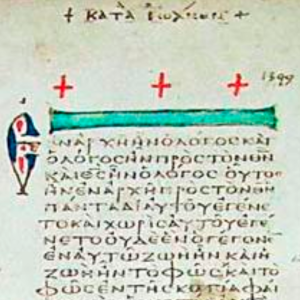
This is the pivotal section of the Fourth Gospel. The incarnated Logos*, the Wisdom of God the Father, is delivering his last homily to the eleven men who will, eventually, prove faithful to him. He is by nature the greatest of all God’s prophets, and is about to enter upon a mystical, tripartite exaltation—Crucifixion, Resurrection, Ascension—which none of his students fully understand yet. Thereafter, his “function” as a teacher will be complete; following the second stage of his exaltation, he will remain with his former students forty days to reassure them that his return was not a dream or a delusion, and also to straighten out one or two knots his students tied themselves in during the first stage.*
However, throughout this period of nearly six weeks, none of the Gospels shows the Lord imparting any new “content” to the Eleven. Such guidance as he gives is mainly practical: the exposition of how to allegorize Scripture hinted at in Luke 24, the inauguration of the ministry of forgiveness in John 20, the pardoning and reinstatement of St. Peter in the following chapter. (The only place where the narrative comes close to his disclosure of information not hitherto revealed is in Acts 1, and even there, it is proposed only to be instantly dismissed.) So, on his final night among his students, he sums up and perfects his teaching; and naturally, he advises them of the change in “mode” that Beyt Yeshua will undergo in about two months. At that time, on Shavuot*—the feast of the reception of the* Torah*—the infant Church becomes the tower to heaven that the ziggurats of Babylon could not be. The teaching function, or rather the unfolding and illumination of what he has taught, is to be handed over to a new Advocate. Except the Advocate is not new either, but is to be the same Spirit that we saw (or rather, that St. Yochanan the Baptist saw and gave us testimony about in the high holy days at the beginning of the year) falling on the incarnate Logos before he himself began to teach.*
My initial plan had been to release a much more substantial translation, all the way down to 15:17. I discovered while writing that the commentary just on these five verses was becoming gargantuan—appropriate, really—so I reworked things a little. This new Torah opens with its own new mitzvah: in Latin, the phrase is Mandātum nōvum dō vōbīs*, “A new command I give to you,” and the commandment in question is occasionally referred to by this as a title (most often clipped “the* mandatum novum*” or simply “the* mandatum*“).*
John 13:31-35, RSV-CE
When he had gone out, Jesus said, “Now is the Son of man glorified, and in him God is glorified; if God is glorified in him, God will also glorify him in himself, and glorify him at once. Little children, yet a little while I am with you. You will seek me; and as I said to the Jews so now I say to you, ‘Where I am going you cannot come.’ A new commandment I give to you,a that you love one another; even as I have loved you, that you also love one another.b By this all men will know that you are my disciples, if you have love for one another.”
John 13:31-35, my translation
Then when he went out, Yeshua says: “Now the Son of Man is glorified, and God is glorified in him; if God is glorified in him, God will also glorify him in himself, and he will glorify him straightaway. Children, I am with you a little while yet; you will search for me and just as I told the Jews that ‘Where I go you cannot come,’ I also say to you now. I give you a new charge,a that you love each other—just as I loved you, love each other.b In this, everyone will recognize that you are my students, if you have love among each other.”
Textual Notes
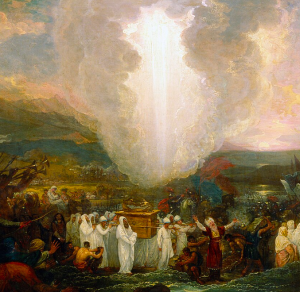
Part of Joshua Passing the Jordan River With
the Ark of the Covenant (1800), by Benjamin West.
a. A new commandment I give to you/I give you a new charge | ἐντολὴν καινὴν δίδωμι ὑμῖν [entolēn kainēn didōmi hümin]: This language of a “new commandment” or “new charge,” especially in conjunction with the announcement of a “new testament in my blood for the forgiveness of sins” (cf. Matthew 26:26-29, Mark 14:22-25, and Luke 22:14-20) during the sacrosanct course of the Seder, may have put the Twelve in mind of a famous text from Jeremiah:
“Behold, the days come,” saith the Lord, “that I will make a new covenant
…with the house of Israel, and with the house of Judah:
not according to the covenant that I made with their fathers
in the day that I took them by the hand
…to bring them out of the land of Egypt;
which my covenant they brake,
…although I was an husband unto them,” saith the Lord:
but this shall be the covenant that I will make with the house of Israel;
…after those days,” saith the Lord,
“I will put my law in their inward parts,
…and write it in their hearts;
and will be their God,
…and they shall be my people.
And they shall teach no more every man his neighbor,
…and every man his brother,
saying, ‘Know the Lord’:
…for they shall all know me,
…from the least of them unto the greatest of them,” saith the Lord:
“for I will forgive their iniquity,
…and I will remember their sin no more.”
—Jer. 31:31-34
This highlights what this “new charge” is. It is not merely a sequentially novel piece of moral, spiritual, or practical instruction. It is a new law to go with this new covenant—a new Torah. Earlier in Holy Week, a scribe had challenged Christ about which was the greatest commandment, to which the Lord gave what (I understand) was already the consensus answer of Judaic orthodoxy:
שְׁמַ֖ע יִשְׂרָאֵ֑ל יְהוָ֥ה אֱלֹהֵ֖ינוּ יְהוָ֥ה׀ אֶחָֽד׃ וְאָ֣הַבְתָּ֔ אֵ֖ת יְהוָ֣ה אֱלֹהֶ֑יךָ .בְּכָל־לְבָבְךָ֥ וּבְכָל־נַפְשְׁךָ֖ וּבְכָל־מְאֹדֶֽךָ1
“Which, being interpreted, is”:
Hear, O Israel, the LORD our God, the LORD is one: And thou shalt love the LORD thy God with all thine heart, and with all thy soul, and with all thy might.
The similarities and differences between this and what the Lord is about to say by way of expressing his new commandment could make a feast according to the interpretive principles used in midrash, a standard genre of rabbinic exegesis in the late Second Temple period. We came close to this topic in our analysis of chapter 2,2 and it comes up in Anderson’s outstanding book That I May Dwell Among Them (see the bibliography for further details). The subject is of course a nuanced one, and we of course have no space to do justice to the topic, and of course I don’t understand it particularly well in the first place—but the Chabad-Lubavitch Hasidic dynasty do, and despite what you might picture when you hear the expression “Hasidic dynasty,” they have a website, so they can introduce it. However, purely for the purposes of comparing the Shema Yisroel with the Mandatum Novum, below are listed seven principles of midrash laid down by Hillel the Elder, the most eminent authority on the Torah in the generation preceding the Lord’s own. (Note that these principles were as much for the application and adjudication of religious law as for moral and literary commentary, so their focus is a little different from what Christians usually expect from a commentary.)
- Applying a principle derived from one text to a new case a fortiori.
- Interpreting two texts along similar lines based on synonyms or homonyms they contain.
- Extending a principle found explicitly in one text to other similar texts.
- Extending a principle synthesized from two texts to other texts.
- Deciding particular questions according to the broader category they fall into.
- Interpreting two texts along similar lines based on similar content.
- Deducing a text’s interpretation from its surrounding context.
b. even as I have loved you, that you also love one another/just as I loved you, love each other | καθὼς ἠγάπησα ὑμᾶς ἵνα καὶ ὑμεῖς ἀγαπᾶτε ἀλλήλους [kathōs ēgapēsa hümas hina kai hümeis agapate allēlous]: Quite the challenge, to put it mildly! However, the newness of this new commandment is (I believe) often misconstrued.
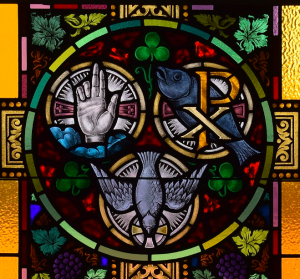
Symbolic depiction of the Trinity from St.
Patrick Catholic Church, Merlin, Ontario.
Photo by Wikimedia contributor Nheyob,
used via a CC BY-SA 4.0 license (source).

There is a thoroughly cartoonish but extremely popular version of What The Bible Says according to which depicts “the God of the Old Testament” as constantly wrathful and “the God of the New Testament” (identification with Jesus of Nazareth optional) as all mercy and love: the only thing to say about this is that it is not true. Most Christians who’ve had any formal catechesis know better than this, at least in theory.
There is another version of What The Bible Says that, I’ve become convinced, is exactly as cartoonishly untrue as the previous—yet this idea gets accepted and repeated even by educated Christians, all the time, including professional theologians. My eighth-grade systematic theology teacher,3 God rest him, who intellectually speaking was whatever the opposite of a slouch is (a … spike?), taught it to me and my classmates in its most cartoonish form. I’m talking about the idea that the Torah (or the Hebrew Bible generally, or Judaism) is all about earning your way to heaven by pleasing God through good works, whereas with the New Testament we get salvation as a free gift in Christ and are so delivered from the trap of torment that Judaism consists in.
I think this compels so many Christians partly because the second half—minus the extremely negative evaluation of Judaism—is an okay if incomplete summary of a lot of the New Testament. The problem lies with the first half. The spiritual error of trying to force God to like us through good behavior is not a uniquely or specially Jewish phenomenon; that’s a human problem,4 likely to emerge in any society where a strong moral code has a strongly religious coloring. Yet if anything, the Tanakh shows signs of being written with an eye to counteracting that tendency. I mean, look at the Shema, look at the covenants God made with Abraham, look at the story of the Exodus, look at the entire book of Hosea. The notion that Judaism was all and only about “works righteousness” in the first place—that, to quote my late theology teacher, the role of Judaism in the divine economy was the role of “not having any grace in it”! (in order to illuminate the gospel by contrast)—it’s utter nonsense. It contradicts practically every page of the Hebrew Bible . Neither debt nor duty lie at the heart of the relation of man to God, for Christianity or Judaism; that sacred heart is love; this is something the author of the Gospel of John knew very well.
In the beginning was the Word, and the Word was there with God, and the Word was God. … in him was life, and this life was humans’ light … The Word became flesh and dwelt among us, and we beheld his glory—glory as of only-begotten from his Father, full of grace and truth; … because we all took from his fullness, and grace in place of grace; because the law was given through Mosheh—grace and truth came to be through Yeshua the Anointed.
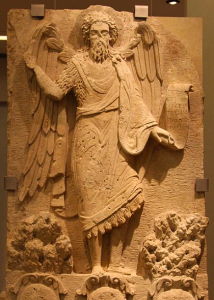
Relief carving of St. John the Baptist (17th c.)
from Zakynthos, an island off the western coast
of Greece, close to Ithaca. Used via
a CC BY-SA 2.0 license (source).

There are three reasons I so belabor this matter. First, I think that as a result of this misprision, a lot of Christians have been grossly misreading the Old Testament for a long time. We should cut it out! Misreading eighty percent of your holy book by volume is embarrassing.
Secondly. The following is rarely avowed or intended in a conscious way among Christians; or rather it wasn’t, when I was a boy. But I’m of the opinion that this flawed idea of Judaism lies downstream of Christian anti-Semitism, instantiates it, and is a motive to its perpetuation.5 The possible effects of this idea range from the grave—like the Christian Nationalist bile we’ve seen regularly vomited up for the last decade by the likes of Corey Mahler or Stephen Wolfe—all the way down to just needlessly annoying Jewish friends and acquaintances. I mean, look at it from their point of view. Besides any personal feelings of offense or hurt we may unwittingly cause them in these contexts, they then get the added, unenviable task of deciding between (a) letting maybe-damaging, definitely-exasperating errors about Judaism be propagated by us, or (b) trying to correct said errors, a strategy which has a modest chance of success, but is extremely likely to result in the Christian they’re speaking to telling the Jew what his religion consists in.6
(Incidentally, lest anybody start to suspect me of going around “making friends,” the way I learned all this was not by anything as noble as attempting to “bear one another’s burdens” with Jews: it was, hilariously, by becoming a Catholic. Maybe it’s not like this everywhere, but in the predominantly Protestant US, many Protestants behave this same way to Catholics. Which I had somehow managed to forget, despite being a practicing Protestant for a little under twenty years and, I am 100% sure, doing this exact thing to Catholics at some point, probably more than once! No idea what the moral of that is.)
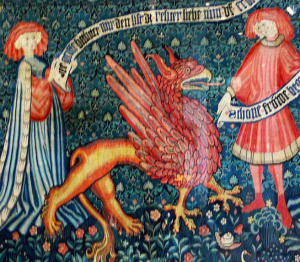
A griffin depicted in a tapestry (c. 1450?)
from Basel. The griffin, being a compound
of the noblest beast and bird, served in the
Middle Ages as a symbol of the Incarnation.
But the most important reason is the third, which also brings us back to our text. The greatest commandment of the old Torah is to love the Lord your God with all your heart, soul, and strength; the new commandment is to love as Christ has loved. The terms of this new Torah place us in a predicament far more un-resolvable than the code of Sinai was at its most exacting. Why? Because of the clause defining the manner of the love set down for us. As we touched on in the intro, when the Lord Yeshua speaks of how he has loved his students, it is the Logos Itself who is speaking; that is, it is God himself. So when he commands us to do something “as I have …”
When God spoke of love in Deuteronomy, it was love with all our heart, soul, and might—a dizzyingly high standard, and nobody meets it, but it does not defy logic. It propounds a human duty in human terms. The love here proposed, however, is proposed in terms of what God can do. The problem that confronts us in keeping this charge is not merely that we are sinners. It is that we are finite.
Much of the rest of this “new Torah” will be expanding on how we are to observe this metaphysically impossible mitzvah. As, it seems, is so often the Lord’s way, the solution to this paradox lies concealed in the inner pages, but he opens with the slightly scary and confusing summary. If he wills, we’ll resume from v. 36 forward next week.
Footnotes
1Transliteration: Sh’maȝ Yšrâ’êl [TETRAGRAMMATON] ‘Èlohêynú [TETRAGRAMMATON] ‘echâdh: we’âhêv’tâ ‘êth [TETRAGRAMMATON] ‘Èloheykhâ b’khâl-l’vâv’khâ úv’khâl-naf’sh’khâ úv’khâl-me’odhekhâ. Readers who have a little familiarity with Hebrew will notice that, besides the niqqud (vowel pointing), there are some additional marks adorning this text; I believe these are what are called cantillation marks, used to guide cantors in chanting the text in question during synagogue services. However, all I know for sure is that they appear in the Westminster Leningrad Codex (a digitized version of the Leningrad Codex, which is a celebrated manuscript copy of the Hebrew Bible—it is the oldest complete copy, dating to the early eleventh century, and was among our oldest sources for the Hebrew Bible until the discovery of the Dead Sea Scrolls). I was able to use the WLC as the source for this, thanks to the good people who run Bible Gateway.
2Specifically, at the link provided, it’s in footnote 8, which expands on something from textual note g.
3What, you think a dude gets as weird as me by random chance? I literally went to school for this, before becoming a Classics major on purpose. When you were partying, I studied the blade …
4Which is not to deny the truth of the quip (variously attributed) that the Jews are a people “just like everyone else, only more so.” Indeed, if they are God’s chosen among mankind, this would presumably be precisely appropriate.
5A minor but digressive clarification is called for here. When I say that I think this misunderstanding of Judaism “lies downstream of” anti-Semitism, I do not mean that anybody who mistakenly thinks it’s a good account of Judaism is therefore a dyed-in-the-wool anti-Semite. What I’m saying is that I think the cultural conditions that have made it so plausible to so many Christians are (at greater or lesser removes) traceable to anti-Semitic ideas and policies.
6On a related and urgent note, whatever happened to the brief fad of referring to embarrassing conduct as “maidenless behavior”? So much newly-coined slang is ugly or incomprehensible or both, especially to me, An Old; nevertheless I quite relished the expressiooohh, they got rid of it because Olds liked it. It is slang, so yeah, fair enough, never mind.
Previous Post

June 11, 2026
The Gospel of John: A Feast Before the Dusk
Next Post
June 25, 2026 The Gospel of John: The New Torah, Part II
Recent Comments
"On the contrary, such a proclamation, among the Aztecs or Maya, would be disastrously misunderstood. ..."
The Gospel of John: The Bread ..."
"Many thanks for your scholarly study on the Cleansing of the Ten Lepers in the ..."
The Cleansing of the Ten Lepers
"Four Last Things: not the video game, but Death, Judgment, Heaven and Hell.Momento mori. Remember, ..."
"I am going by the time that these sayings began to be converted into written ..."
Are Our Bibles in the Wrong ..."
Browse Our Archives
Select a Category abuse antifascism art bad Catholic celibacy chastity Church crucifixion culture war eros forgiveness gay gender homophobia ikons language liturgy peace poems politics Pope Francis prayer pro-life race recommendations reform repentance review sacraments saints satire scandal schism scripture sex suffering theology Uncategorized violence
Select a Month October 2026 September 2026 August 2026 July 2026 June 2026 May 2026 April 2026 March 2026 February 2026 January 2026 December 2025 November 2025 October 2025 September 2025 August 2025 July 2025 June 2025 May 2025 April 2025 March 2025 February 2025 January 2025 December 2024 November 2024 October 2024 September 2024 August 2024 July 2024 June 2024 May 2024 April 2024 March 2024 February 2024 January 2024 December 2023 November 2023 October 2023 September 2023 August 2023 July 2023 June 2023 May 2023 April 2023 March 2023 February 2023 January 2023 December 2022 November 2022 October 2022 September 2022 August 2022 July 2022 June 2022 May 2022 April 2022 March 2022 February 2022 January 2022 December 2021 November 2021 October 2021 September 2021 August 2021 July 2021 June 2021 May 2021 April 2021 March 2021 February 2021 January 2021 December 2020 November 2020 October 2020 September 2020 August 2020 July 2020 June 2020 May 2020 April 2020 March 2020 February 2020 January 2020 December 2019 November 2019 October 2019 September 2019 August 2019 July 2019
Follow Us!
TAKE THE
Religious Wisdom Quiz
What does "Bethel" mean in Hebrew?
Select your answer to see how you score.
House of God God's Dwelling City of Light Holy Ground
Related posts from Mudblood Catholic

The Sermon on the Mount, Part I: Matthew...

The Gospel of Matthew: Christ and Antichrist

John the Baptist and the Winnowing Fork: Matthew...

The Gospel of Matthew: The Coventry Carol
TRENDING AT PATHEOS Catholic

The Problem with False Prophets
Miller’s Station UMC| 10/18/26| Anchor Verse: Jeremiah 23: 1, 9-23 I...

Emotion in Early Christianity by Andrew Crislip
Andrew Crislip’s Emotion in Early Christianity examines an often overlooked dimension of...

16 Spiritual Touchstones for a More Grounded Life
After decades of spiritual study, here are 16 principles I try...

Catholic Evangelization: Sharing Your Faith Every Day
Welcome back to the Graceful Awakening mini-series called, “From Faith to Mission.” ...

The Pillar of the Boatmen: the Ancient Monument...
The Pillar of the Boatmen is a Romano-Gaulish sculpture that dates from...

In one sense walking into Westminster Abbey is like walking down the...
view all Catholic blogs
What Are Your Thoughts?leave a comment
Ad-Free & Subscriber Log-In Subscription Support
- About Us
- 2026 Calendar
- Videos
- Podcasts
- Library of World Religions
- Faith In Media Tracker
- Advertise With Us
- Write for Us
- Privacy Policy
- Terms of Service
- Do Not Sell My Data
- Contact Us
- Radiant Digital
- Manage Newsletter Subscriptions
- Unsubscribe From Notifications
- Sitemap
Copyright 2008-2026, Patheos. All rights reserved.
Subscription Support Ad-Free & Subscriber Log-In
Follow Patheos