
BuddhistCatholicContemplativeEvangelicalGeneral ChristianHinduJewishLatter-day SaintMuslimNew VisionsProgressive Christian
Beliefs
- Buddhist
- Catholic
- Contemplative
- Evangelical
- General Christian
- Hindu
- Jewish
- Latter-day Saint
- More Voices
- Muslim
- New Visions
- Pagan
- Progressive Christian
Topics
- Religion News
- Food and Religion
- Sports and Religion
- Religious Art
- Religious Music and Entertainment
- Religious Events
- History and Religion
- Style and Religion
- Politics and Religion
- Women in Religion
- Recreation Outdoors and Religion
- Business Finance and Religion
- Careers Workplace and Religion
- Education and Religion
- Family Parenting and Religion
- Health Fitness and Religion
- Home and Religion
- Relationships and Religion
- Technology and Religion
- Travel and Religion
Columnists
- Buddhist Columnists
- Business Finance and Religion Columnists
- Careers Workplace and Religion Columnists
- Catholic Columnists
- Contemplative Columnists
- Education and Religion Columnists
- Evangelists Columnists
- Family Parenting and Religion Columnists
- General Christian Columnists
- Health Fitness and Religion Columnists
- Hindu Columnists
- History and Religion Columnists
- Home and Religion Columnists
- Jewish Columnists
- More Voices Columnists
- Latter Day Columnists
- Muslim Columnists
- New Visions Columnists
- Nonreligious Columnists
- Pagan Columnists
- Politics and Religion Columnists
- Progressive Columnists
- Recreation Outdoors and Religion Columnists
- Relationships and Religion Columnists
- Religion News Columnists
- Religious Art Columnists
- Religious Events Columnists
- Religious Music and Entertainment Columnists
- Sports and Religion Columnists
- Style and Religion Columnists
- Technology and Religion Columnists
- Travel and Religion Columnists
- Women in Religion Columnists
Resource Library
- 2026 Calendar
- Library of World Religions
- The 100 Most Holy Places on Earth
- Patheos Answers
- Podcasts
- Videos
- Faith Leaders Database
- Anglican Episcopalian
- Bahai
- Baptist
- Buddhism
- Christianity
- Confucianism
- Eastern Orthodoxy
- Hinduism
- Holiness and Pentecostal
- ISKCON
- Islam
- Judaism
- Lutheran
- Methodist
- The Church of Jesus Christ of Latter-day Saints
- New Age
- Paganism
- Presbytarian and Reformed
- Protestantism
- Religion Behind the Scenes
- Roman Catholic
- Scientology
- Shia Islam
- Sikhism
- Sufism
- Sunni Islam
- Taoism
- Zen
- See all religions
Research Tools
 Ad-Free & Subscriber Log-In Subscription Support
Ad-Free & Subscriber Log-In Subscription Support
Follow Patheos 

- Trending:
- Forgiveness
- |
- Marriage
- |
- Consciousness
- |
- Death Penalty
- |
- Election
- |
- Halloween

- Home
- Catholic
- The Gospel of John: A Feast Before the Dusk
The Gospel of John: A Feast Before the Dusk
Last updated on: June 12, 2026 at 8:08 pm by Gabriel Blanchard
The Gospel of John: A Feast Before the Dusk 2026-06-12T20:08:48-04:00 Gabriel Blanchard
Patheos Explore the world's faith through different perspectives on religion and spirituality! Patheos has the views of the prevalent religions and spiritualities of the world.
John 13:1-30, RSV-CE
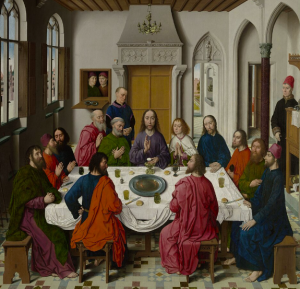
The Last Supper (1468), by Dieric Bouts, and
possibly the most aggressively Dutch Renais-
sance object ever created.
Now before the feast of the Passover, when Jesus knew that his hour had come to depart out of this world to the Father, having loved his own who were in the world, he loved them to the end.a And during supper, when the devil had already put it into the heart of Judas Iscariot, Simon’s son, to betray him,b Jesus, knowing that the Father had given all things into his hands, and that he had come from God and was going to God, rose from supper, laid aside his garments,c and girded himself with a towel. Then he poured water into a basin, and began to wash the disciples’ feet,d and to wipe them with the towel with which he was girded. He came to Simon Peter; and Peter said to him, “Lord, do you wash my feet?” Jesus answered him, “What I am doing you do not know now, but afterward you will understand.” Peter said to him, “You shall never wash my feet.” Jesus answered him, “If I do not wash you, you have no part in me.” Simon Peter said to him, “Lord, not my feet only but also my hands and my head!”e Jesus said to him, “He who has bathed does not need to wash, except for his feet, but he is clean all over;f and you are clean, but not all of you.”g For he knew who was to betray him; that was why he said, “You are not all clean.”
Author's note:
You can find my two-part introduction to the Gospel of John at these two links, and my index/outline for it here; for the previous installment on John 12:12-50, go here.
The Gospel of John*: A Feast Before the Dusk (*John 13:1-30)
The exact timing and nature of the events of these thirty verses are one of the most contentious elements in New Testament studies, because John appears to be giving information that conflicts with what the Synoptics tell us … maybe. That discussion does not really impinge on our text’s meaning, though, so I leave it for the postscript.
The principal thematic content here is the maundy1*—i.e., the foot-washing rite, which the Church continues to practice every year on Maundy Thursday. The principal “plot” content is the departure of Yudah Ysh-Qriyot, to effect the promised, and prophesied, betrayal of Yeshua to the Sanhedrin (or rather, if my theory from two weeks ago is correct, to the illicitly-organized subcommittee of the Sanhedrin actually involved here). Here, too, we come at last to the third nightfall of the book. The previous nights were briefer: the first only occupied the opening half of chapter 3, while the second was a fairly brief episode within the narrative of chapter 6. This one will last, without “cuts,” until we reach the next dawn, which will not come until late in chapter 18.*
Textual note p contains a minor but, to my mind, interesting digression that is inessential to understanding the text. I have placed this digression in small print. Also, note that due to a rearrangement of the elements of the English sentence in v. 23, notes n and o appear to be in reversed sequence in the RSV; this appearance is misleading: they are affixed to the phrases they properly belong with.
When he had washed their feet, and taken his garments, and resumed his place, he said to them,h “Do you know what I have done to you? You call me Teacher and Lord; and you are right, for so I am. If I then, your Lord and Teacher, have washed your feet, you also ought to wash one another’s feet. For I have given you an example, that you also should do as I have done to you. Truly, truly, I say to you, a servanti is not greater than his master; nor is he who is sent greater than he who sent him. If you know these things, blessed are you if you do them. I am not speaking of you all; I know whom I have chosen; it is that the scripture may be fulfilled, ‘He who ate my bread has lifted his heel against me.’j I tell you this now, before it takes place, that when it does take place you may believe that I am he.k Truly, truly, I say to you, he who receives any one whom I send receives me; and he who receives me receives him who sent me.”l
When Jesus had thus spoken, he was troubled in spirit, and testified, “Truly, truly, I say to you, one of you will betray me.” The disciples looked at one another, uncertainm of whom he spoke. One of his disciples, whom Jesus loved,o was lying close to the breast of Jesus;n so Simon Peter beckoned to him and said, “Tell us who it is of whom he speaks.” So lying thus, close to the breast of Jesus, he said to him, “Lord, who is it?” Jesus answered, “It is he to whom I shall give this morselp when I have dipped it.” So when he had dipped the morsel, he gave it to Judas, the son of Simon Iscariot. Then after the morsel, Satan entered into him. Jesus said to him, “What you are going to do, do quickly.”q Now no one at the table knew why he said this to him. Some thought that, because Judas had the money box, Jesus was telling him, “Buy what we need for the feast”; or, that he should give something to the poor. So, after receiving the morsel, he immediately went out; and it was night.
John 13:1-30, my translation
Before the feast of Paskha, Yeshua, seeing that his hour had come that he should go out of this world to the Father, loving his own who were in the world, loved them to the end.a And when dinner came, when the accuser had already thrown into the mind of Yudah [son] of Symeon Ysh-Qriyot that he give him over,b seeing that the Father had given everything into his hands, and that he came out from God and to God he is going—he rises from the dinner and put [aside] his mantlec and, taking a towel, belted himself; then he throws water into a wash-basin, and he started to wash the feet of his studentsd and wipe them with the towel with which he was belted.
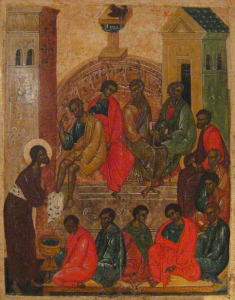
Russian ikon (15th c.) from the Pskov school
showing Christ washing his disciples’ feet.
So he comes to Symeon Rocky. He says to him: “Sir, are you washing my feet?”
Yeshua tells him in response, “You do not yet know what I am doing, yet you will recognize [it] after these things.”
Rocky tells him, “You will not wash my feet, into the age.”
Yeshua responds to him, “Unless I will wash you, you have no part with me.”
Symeon Rocky tells him, “Sir, not only my feet, but also my hands and head.”e
Yeshua tells him: “He who has bathed has no need to wash except his feet, but is wholly clean;f and you all are clean, but not every one of you.”g For he already knew who would give him over; because of this he said that “Not every one of you are clean.”
Then, when he had washed their feet and taken his mantle and reclined again, he said to them,h “Do you know what I have done for you? You call me ‘the teacher’ and ‘the master,’ and you speak fairly, for I am. So if I have washed your feet, the master and the teacher, you too ought to wash each other’s feet; for I have given you an example, in order that just as I do to you, you should do. ‘Amin, ‘amin, I tell you, a slavei is not greater than his master, nor an emissary greater than he who dispatched him. If you know these things, you are happy if you do them. I am not talking about all of you; I know whom I selected; but in order that the Writ might be fulfilled: ‘He who chews my bread lifted his heel in front of me.’j I am telling you now, before it happens, in order that you may have faith whenever it does happen that I am.k ‘Amin, ‘amin, I tell you, he who accepts anyone I dispatch is accepting me, and he who accepts me is accepting him who dispatched me.”l Saying these things, Yeshua was agitated in spirit, and he witnessed and told them: “‘Amin, ‘amin, I tell you that one of you will give me over.”
His students began looking at each other, nonplussedm [as to] whom he was talking about. There was one of his students reclining beside Yeshua,n whom Yeshua loved;o so Symeon Rocky nodded at this one to inquire whom he might be talking about. He, reclining against Yeshua’s chest, said to him: “Sir, who is it?”
Yeshua responds, “It is that one to whom I will immerse the morselp and give [it] to him”; then, immersing the morsel, he gave it to Yudah [son of] Symeon Ysh-Qriyot. Then, with the morsel, Šaṭan also went into him. So Yeshua says to him: “What you are doing—do [it] quickly.”q None of those reclining [there] knew why he said this to him; for some deemed, because Yudah has the money-box, that Yeshua was telling him: “Purchase what we have need of for the feast,” or that he should give something to beggars.
Then, having taken the morsel, he straightaway went out. It was night.

The lower Nile, the Delta, and the Holy Land, seen
at night from the International Space Station.
Textual Notes
a. loved them to the end | εἰς τέλος ἠγάπησεν αὐτούς [eis telos ēgapēsen autous]: Like the English end, the Greek τέλος can mean either “limit, conclusion, boundary” or “purpose, goal.” It’s possible the latter meaning is at play in this text as well as the former, and that the evangelist is here establishing (under different terminology) that—after the long wait which began when the idea was introduced in chapter 2—we have, at last, reached the Lord’s “hour”; when we reach chapter 17, we will have explicit confirmation that “the hour hath come.”
b. when the devil had already put it into the heart of Judas Iscariot, Simon’s son, to betray him/when the accuser had already thrown into the mind of Yudah [son] of Symeon Ysh-Qriyot that he give him over | τοῦ διαβόλου ἤδη βεβληκότος εἰς τὴν καρδίαν ἵνα παραδοῖ αὐτὸν Ἰούδας Σίμωνος Ἰσκαριώτου [tou diabolou ēdē beblēkotos eis tēn kardian hina paradoi auton Ioudas Simōnos Iskariōtou]: This phrasing is interesting: “the accuser had already thrown it into the mind of Yudah,” but then in v. 27, “with the morsel, Šaṭan also went into him.” Perhaps, before then, the traitor hadn’t altogether made up his mind, or was wavering in purpose.
c. garments/mantle | τὰ ἱμάτια [ta himatia]: The standard clothing worn in the Levant at the time, as far as I’ve been able to work out, was as follows:
- The tunic (כֻּתֹּנֶת [kutoneth] in Hebrew, χιτών [chitōn] in Greek). This was a simple undergarment similar to a long shirt, typically woven out of linen. It was similar to the Roman tunica, hence the translation.
- The mantle (שִׂמְלָה [shim’lâh] in Hebrew, ἱμάτια or ἱμάτιον [himation] in Greek). This outer garment resembled a robe; it might be linen but (in the Holy Land) was more often made of wool.
- Sandals—the preferred footgear not only because of the warm climate, but because they were far more adaptable to different shapes and sizes of feet than prefabricated, close-toed shoes.
- For adult, male Jews, a tallith, i.e. prayer-shawl (טַלִּית [ṭalyth]). This was required for appropriate recitation of daily prayers. This garment would most likely be made of wool, and its four corners would include the צִיצִיּוֹת [tzytziyouth], or tassels, mandated by Numbers 15 and Deuteronomy 22. I think this would have been worn every day, but I’m not sure.
- Also for adult, male Jews, tefillin, i.e. phylacteries (תְּפִלִּין [t’fillyn]). These were small boxes made of leather (perhaps an inch or two per side), with leather straps that secure them to the head and wrap around one arm and hand. These are held to be part of the mitzvah given in Exodus 13 and Deuteronomy 6 and 11. Current custom does not dictate the donning of tefillin on the sabbath or certain holidays, only on weekdays (which of course includes Sundays for Jews); while tefillin did exist at the time (e.g., they are referenced in a passage from Matthew just before the monologue known as the Seven Woes), I’m not clear what customs for donning them were standard in the first century.
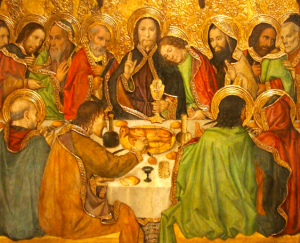
Last Supper (c. 1470), by Jaume Huguet.
d. he … began to wash the disciples’ feet/he started to wash the feet of his students | ἤρξατο νίπτειν τοὺς πόδας τῶν μαθητῶν [ērxato niptein tous podas tōn mathētōn]: Feet being then much what they are now, the task of washing those of guests was not a pleasant one, and would normally be assigned to a slave. Of course, in a world where the sandal was standard footwear, problems of the fungal variety would have been far more limited—though, in all probability, not absolutely absent.
On the other hand, roads were far less … I don’t know how to put this succinctly! Roads were not typically paved in Classical Antiquity. Some were; the Romans were well known for building and maintaining paved roads. But often a “road” was just a route, which would at most see the wear and packed-ness of a footpath, resulting in a trek that was far dirtier than walking on even the most ill-maintained modern street or sidewalk. Moreover, pedestrians and the occasional wheeled vehicle were not the only road-users back then: horses, donkeys, mules, camels, and the odd ox, goat, or sheep could be expected to use ancient roads. This meant a whole smorgasbord of dung (to say nothing of the local birds and other wildlife). Obviously, people would try to avoid that stuff as much as possible; and obviously, they wouldn’t succeed all the time.
e. also my hands and my head/also my hands and head | καὶ τὰς χεῖρας καὶ τὴν κεφαλήν [kai tas cheiras kai tēn kefalēn]: This is probably the saint’s shorthand for “my whole body.” However, the feet, hands, and head can also be interpreted as one’s “way” or general conduct, one’s powers or responsibilities (what one “has in hand”), and one’s conscious intent or mind.
f. He who has bathed does not need to wash, except for his feet, but he is clean all over/He who has bathed has no need to wash except his feet, but is wholly clean | Ὁ λελουμένος οὐκ ἔχει χρείαν εἰ μὴ τοὺς πόδας νίψασθαι, ἀλλ’ ἔστιν καθαρὸς ὅλος [ho leloumenos ouk echei chreian ei mē tous podas nipsasthai, all’ estin katharos holos]: I’m not sure what to make of this remark; it is, I suppose, obviously true when taken literally, but “taking things literally” is not an approach that is often or unambiguously correct when dealing with Christ’s words the Gospels. (Which is one of the things that bugs me about many Catholics’ defenses of the doctrine of the Real Presence—merely quoting the words “This is my body” and implying or even stating outright that that should settle the matter, as though the Lord were not given to saying things with a figurative meaning!) Of course, he does speak literally sometimes; admittedly, more often in the Synoptics than in John. The only symbolic meaning that came to mind was that this might be an allusion to baptism, with the washing of the feet then being analogous to the sacrament of penance, which no one can administer to himself; given that the ministry of absolution will be explicitly passed on the Apostles near the other end of the Book of Glory, I feel there may be something in this interpretation.
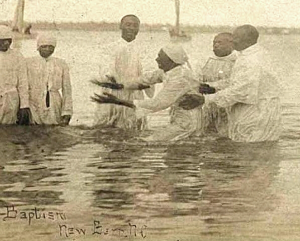
Baptism in a river in New Bern, North Carolina,
ca. 1900 (source).
g. you are clean, but not all of you/you all are clean, but not every one of you | ὑμεῖς καθαροί ἐστε, ἀλλ’ οὐχὶ πάντες [hümeis katharoi este, all’ ouchi pantes]: Since we’ve effectively lost the number distinction in the second person (i.e., “you” is both singular and plural), “not all of you” is slightly ambiguous. This ambiguity isn’t present in the Greek, which does maintain the distinction of number in its second-person verbs and pronouns, so I tried to convey that in the English I used.
h. and resumed his place, he said to them/and reclined again, he said to them | καὶ ἀνέπεσεν, πάλιν εἶπεν αὐτοῖς [kai anepesen, palin eipen autois] -OR- καὶ ἀνέπεσεν πάλιν, εἶπεν αὐτοῖς [kai anepesen palin, eipen autois]: There is a textual variant here, and for once, I’m siding with the RSV, against the SBL’s preferred reading. The variant is in whether we choose to place the comma before the word πάλιν, as the SBL does, or after it, as the RSV does: the first choice gives us the reading “and reclined, he said further to them,” while the second gives us the translation that I have produced. It is worth noting, when the subject of how many textual variants exist in the New Testament, that most of them are about this trivial!
i. a servant/a slave | δοῦλος [doulos]: I’m frequently frustrated on this point by English translations of the New Testament—though realistically, the frustration is not entirely the fault of other translators. The truth is, when dealing with slavery in Classical Antiquity, the modern translator is in something of a bind.
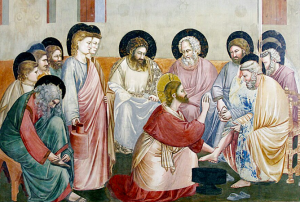
Christ Reasoning with Peter (c. 1305),
by Giotto di Bondone, a fresco from
the Scrovegni Chapel in Padua.
Points in Favor of Using “Slave”
On the one hand, slavery was a commonplace, widespread institution in the early Roman Empire. Under the norms of that institution, human beings who were turned from free men into slaves (e.g. criminals or prisoners of war) or were born the children of a slave were, legally, the property of other human beings—which is in no way the same thing as being a servant. Linguistically, they’re not the same word, or even related words: a δοῦλος was a slave; a servant was a διάκονος [diakonos]. And as for the actual experience! Being a servant was a job; being a slave was a class, in the legal sense, like being a patrician or a plebeian had been in republican Rome. I almost wrote “being a slave was a thing,” et pour cause.
Therefore, treating servanthood and slavery as the interchangeable “sanitizes” the text of the New Testament in a way that I, at least, am really uncomfortable with. From a religious perspective, I think it’s absurd for us to have the audacity to “clean up” what the Bible has to say. And I don’t like it any better from a scholarly point of view, because it distorts the meaning of the text to give the impression that two quite different institutions in a society were the same thing, or so similar that the distinction made no difference. It’d be like conflating cops and the military, or restaurants and bars.
Points in Favor of Not Using “Slave”
Yet on the other hand, classical slavery was, in several important respects, nothing like the kind of slavery we’re familiar with from American history, and it’s inevitably going to be that which an American reader first thinks of when they hear or read the word “slave.” Slaves in the ancient world generally received wages: indeed, it was not unknown for a slave to save up and buy his freedom. Manumission for other reasons was also fairly commonplace. During the imperial period, slaves even began to enjoy certain rights, hitherto unheard of; Emperor Claudius passed a law freeing slaves whose masters deserted them, and Nero, of all people, instituted laws allowing slaves to file legal complaints against their masters for mistreatment.
Above all, there was no racial element in the institution of slavery in the ancient world. On the contrary, racism effectively didn’t exist in the Classical world. This point merits some attention.
First, the whole concept of race is actually a fairly recent one that doesn’t appear until about the eighteenth century. The unfairly oversimplified explanation is “It’s Kant’s fault.”2 Differences in skin tone were as visible back then as they are now; nonetheless, ancient societies don’t seem to have taken much interest in them. The then-prevailing theory about why people had different skin colors was based on climate and culture, not ancestry. After all, it was quite obvious that people of the fair-to-olive range of complexions prevailing around the Mediterranean would tan darker than their “baseline” color in warm, sunny weather, or if they spent a lot of time outside. If the modern notion of races forming a sort of super-category, into which ethnicities can be fit, had been proposed to an intellectual from the Classical era, I personally suspect most of them would have thought for a few moments and then said something like, “Okay … maybe. What for, though?”
Just to be clear, this is not a “woke” attempt to feign that they were free of chauvinism: as a rule, the ancients were shameless snobs. They just didn’t happen to see skin color as something to be snobbish over. For example, to the Greeks, the primary thing that made a person a βάρβαρος [barbaros]—i.e. a non-Greek and therefore a presumed inferior—was their ability or inability to speak Greek. And even when they were snobs about a person’s ancestry, which was often, this was generally a matter of one or both of two kinds of lineage:
-
- Descent from an “inferior” class. Having a freedman parent or grandparent, for example, was not respectable. This prejudice was attenuated as the ancestry grew more remote, perhaps because the ostensibly embarrassing ancestor was less and less likely to appear in person at anything.
- Descent from a specific illustrious or infamous family. The Gracchi (a pair of reformist brothers in the late Roman Republic) were influential partly because their mother was of a prestigious gens, the Cornelii; in Athens, the house of the Alcmæonids could be admired for its accomplishments or viewed dimly for the curse it was rumored to be under, as one pleased.
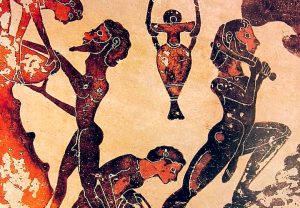
Terracotta votive tablet (late 7th c. BC) from
Corinth, depicting slaves at work in mines.
And neither of these things is race. By contrast, the idea of race, and the supposed “racial character” that went with it (with an extra filter from Aristotle), became precisely the justification for the institution of slavery in American practice. And many Christians are, quite understandably, not hot on comparing God with the likes of Delphine LaLaurie!3
My Call
However, on balance, I think it’s more important to mark the continuity between ancient and modern practice here. The slave trade came close to dying out in the Middle Ages—but it never quite did. There will always be a sense in which modern slavery is an outworking of slavery in the ancient world, no matter how much more humane the classical norms were; and in an individualistic culture governed by a liberal constitution, it is particularly important to recollect that the Bible was written in societies which were neither of those things.
j. He who ate my bread has lifted his heel against me/He who chews my bread has lifted his heel in front of me | Ὁ τρώγων μου τὸν ἄρτον ἐπῆρεν ἐπ’ ἐμὲ τὴν πτέρναν αὐτοῦ [ho trōgōn mou ton arton epēren ep’ eme tēn pternan autou]: Given that the soles of the feet are associated with insults in the Near East, a casual reader might assume that this text is about that. However, what it actually points us to is a wrestling move, one used to trip one’s opponent.
k. that I am he/that I am | ὅτι ἐγώ εἰμι [hoti egō eimi]: Here we have another “I AM” statement which I didn’t know about! I’m beginning to suspect these form another heptad.
l. he who receives any one whom I send receives me; and he who receives me receives him who sent me/he who accepts anyone I dispatch is accepting me, and he who accepts me is accepting him who dispatched me | ὁ λαμβάνων ἄν τινα πέμψω ἐμὲ λαμβάνει, ὁ δὲ ἐμὲ λαμβάνων λαμβάνει τὸν πέμψαντά με [ho lambanōn an tina pempsō eme lambanei, ho de eme lambanōn lambanei ton pempsanta me]: Cf. the commission of the Seventy (“the apostles” in the broader sense than the Twelve) in Luke 10:
The harvest truly is great, but the laborers are few: pray ye therefore the Lord of the harvest, that he would send forth laborers into his harvest. Go your ways … And into whatsoever house ye enter, first say, ‘Peace be to this house.’ And if the son of peace be there, your peace shall rest upon it: if not, it shall turn to you again. … But into whatsoever city ye enter, and they receive you not, go your ways out into the streets of the same, and say, ‘Even the very dust of your city, which cleaveth on us, we do wipe off against you: notwithstanding be ye sure of this, that the kingdom of God is come nigh unto you.’ But I say unto you, that it shall be more tolerable in that day for Sodom, than for that city. … He that heareth you heareth me; and he that despiseth you despiseth me; and he that despiseth me despiseth him that sent me.
—Vv. 2-3a, 5-6, 10-12, 16
m. uncertain/nonplussed | ἀπορούμενοι [aporoumenoi]: If memory serves, this is the only occurrence of this term in the New Testament. Its more literal meaning is something like “no-go,” “journey-less” or “dead-ended”; the idea is that they are stumped or baffled. Certain Platonic dialogues that reach no satisfactory conclusion, like the Meno, are described as aporetic for this reason. This is rather interesting, as, especially in conjunction with vv. 28-29 of this chapter, it indicates that the disclosure of 12:6 (that Judas was a thief) was not common knowledge at the time, and was only worked out after the fact.
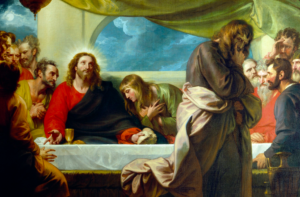
The Last Supper (1786), by Benjamin West. I
mostly dislike this painting, except for its
striking choice—which I’ve never seen else-
where—to give Judas eye contact with the viewer.
n. lying close to the breast of Jesus/reclining beside Yeshua | ἀνακείμενος … ἐν τῷ κόλπῳ τοῦ Ἰησοῦ [anakeimenos … en tō kolpō tou Iēsou]: You may possibly recall that the ending of the prologue had a word, κόλπος [kolpos], that doesn’t go neatly into English, and that this word was used to describe the relationship between the Father and the Logos: “God, no one has ever seen; God the only-begotten, who is there in the lap of the Father, this one has explained him.” Lap was my best approximation of κόλπος there; beside is my best approximation of it here. The point is that the evangelist here establishes the same kind of cherished intimacy between the Beloved Disciple and the Logos that the Logos has with the Father. If the author of the Fourth Gospel was aware of one or more of the other three (and most New Testament scholars think he probably was), and only composed his gospel later, this may be an assertion on his part that his work merits the same authority as theirs—or, if my personal theory about its composition is correct, it may be an assertion on St. John the Elder’s part, regarding these memoirs of St. John the Apostle that he has been the amanuensis for.
o. whom Jesus loved/whom Yeshua loved | ὃν ἠγάπα ὁ Ἰησοῦς [hon ēgapa ho Iēsous]: The claim that the disciple “whom Jesus loved” was his lover, in an erastes-eromenos type of affair,4 is not a new one; people have (reputedly) been making edgy remarks about that since Christopher Marlowe’s time if not before. I bring it up here only to point out that, if literally everything about Jewish culture and the Judaic religion at the time is not enough to convince us, the language is against it too. If that were the meaning, we would expect the verb ἐράω [eraō] by default, or possibly φιλέω [fileō] (which is frequent in John). The verb we actually have, ἀγαπάω [agapaō], on the other hand, is tailor-made to not mean this.
p. this morsel/the morsel | τὸ ψωμίον [to psōmion]: According to Thayer’s Lexicon, this was a particularly significant gesture. The normal way of eating at an ancient banquet in the Near East was that everyone had their own spot to lie on atop mats or couches surrounding a central table, with common dishes of everything on it, and one served oneself from these dishes; while platters were in use, individual plates weren’t really a thing before the Early Modern Period. This use of common dishes still applied if one were going to dip a piece of food into some sort of sauce. However, both in general and especially when handling something that might be messy, one would use a small piece of bread, matzah in this case, as sort of a makeshift self-service utensil. For someone in the role of a host to do this for someone else at the table, as Christ does for Judas here, was a gesture of significant honor, indicating both respect and affection for the recipient—and, in this case, concealing the identity of the traitor from everyone but the Beloved Disciple (we aren’t even told that he, the Beloved, ever had a chance to tell St. Peter, who had prompted him to ask in the first place).
I do wonder exactly how literally we should take the term ψωμίον in this case. The normative foods of the paschal Seder have evolved over the course of Jewish history, and not all the customary dishes appear in the Pentateuch. The main foods mentioned in Exodus are unleavened bread, roast lamb, and maror, “bitter herbs,” symbolizing the bitterness of the enslavement in Egypt. In Div. II, Tractate iii of the Mishnah (named פְּסָחִים [P’sâchym], “Passovers”), several plants are listed as acceptable interpretations of maror, the most popular today being horseradish, lettuce, or parsnip. The same Tractate mentions charoset, a sweet blend of wine and finely chopped nuts and fruit, which the maror is traditionally dipped in (not to alleviate the bitterness of the maror, which isn’t allowed, but to kill parasites). A meaning has been assigned to charoset that pairs with the meaning of maror: since the term charoset appears to derive from the Hebrew word for clay, it represents the mortar used in making bricks (cf. Exodus 5). So, even though it doesn’t appear in the Torah, we know charoset was a standard part of the Passover meal by about 200, and likely went much further back than that, as in all probability did the custom of dipping the maror in it, which is observed to this day. We also know that one of the customs observed by Hillel the Elder—whose school of interpreting the Law Yeshua regularly shows the strongest sympathy with—was to make what’s now called a korech or “Passover sandwich,” placing some of the lamb and charoset-dipped maror in between two pieces of matzah. (Or maybe, if it was unleavened yet soft, he made something more like a proto-shawarma with it.) This allowed a person to fulfill the commandments attached to eating the Lord’s Passover rather more in the spirit of those present for the first: “your loins girded, your shoes on your feet, and your staff in your hand; and ye shall eat it in haste”. The word ψωμίον normally means a piece of bread, or more literally a crumb; but, especially in light of what Christ tells his betrayer immediately afterward (see note q below), I have to wonder whether what he actually handed him was a korech. However, this is pure speculation to say the least! and the significance of the ψωμίον does not depend on it.

Cover of an English edition of Silence (1966) by
Shūsaku Endō (image provided for under fair
use). Christ’s words to Judas in this passage
are a recurring motif in the novel.
q. What you are going to do, do quickly/What you are doing—do [it] quickly | Ὃ ποιεῖς ποίησον τάχιον [ho poieis poiēson tachion]: This is a very mysterious remark, for a reason highlighted by the Japanese Catholic novelist Shūsaku Endō: on any ordinary analysis, the Lord is telling Yudah to commit a sin. Let’s be frank: like the prayer of agony in Gethsemane being answered No from on high, this is confusing and even disturbing. I do not have any solution for this.
Postscript on the Chronology of Holy Week
Working out the timeline of Holy Week from the Gospels is a notoriously difficult problem. Because Judas departs in v. 30, this meal in John 13 is generally taken to be the Passover Seder that immediately precedes the agony in Gethsemane (the first “movement” of the Passion) in the Synoptic Gospels—cf. Matthew 26:17-30, Mark 14:12-26, and Luke 22:7-39. The problem is, that doesn’t make any sense, because v. 1 states bluntly that this is “Before the feast of Paskha“. Solutions to the timeline problems of this part of the New Testament are manifold. (While I was a Protestant, I heard at least one alternative chronology set forth in which the Lord was really crucified on a Wednesday, thus ensuring that the “three days” he spent in the tomb would in fact number three—Thursday, Friday, and Saturday—although this runs aground on the fact that counting was usually inclusive in the ancient world, so that if he really had been crucified on a Wednesday and first seen alive on a Sunday, he would have been described as spending five days in the tomb. But I digress.)
Throughout, the author of John presents the Passion as occurring immediately before Passover (so that the Crucifixion occurs at the same time as the slaughter of the paschal lambs—probably; more on that below). There seems to be a corroboration of this in Mark 14:1-2, right after the Lord concludes the Marcan version of the Olivet Discourse:
After two days was the feast of the passover, and of unleavened bread: and the chief priests and the scribes sought how they might take him by craft, and put him to death. But they said, “Not on the feast day, lest there be an uproar of the people.” (emphasis mine)
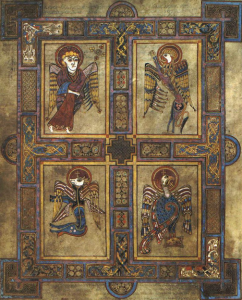
The symbols of the Four Evangelists
in the Book of Kells.
Moreover, it seems incredible that even the hypocritical accomplices of Yosef ben Qayafa would countenance an execution occurring on one of the most solemn dates in the Judaic year (cf. 18:28, “Then led they Jesus from Caiaphas unto the hall of judgment … and they themselves went not into the judgment hall, lest they should be defiled; but that they might eat the passover”). That said, there really doesn’t seem to be any way around the assertion, common to all the other canonical Gospels, that the meal in question was a Seder; and, while I am prepared to believe that John stitched together elements from different times based on their topical connection, I don’t think the dinner of John 13 is actually meant to be a separate meal from the one in Matthew 26, Mark 14, and Luke 22.
I have read in a few places that there were multiple, contradictory customs among first-century Jews when it came to observing Pesach. 14th Nisan5 was the date designated for Pesach in the Torah; difficulties arose from a few ambiguous details in the Pentateuch. For example, the day of Pesach or Passover proper immediately preceded the festival of Matzot, Unleavened Bread, which the Torah imposed for seven days. Did that mean that the festival of Pesach-plus-Matzot should last eight days total, or seven? One authority gave one answer, another another.
Or consider this passage from the Mishnah, discussing not Pesach but Shavuot:
If the Feast of Pentecost fell on the eve of a Sabbath, the School of Shammai say: The day for slaughtering is after the Sabbath. And the School of Hillel say: It needs no other day for slaughtering. But they agree that if [the Feast] fell on a Sabbath, the day for slaughtering is after the Sabbath.* The High Priest may not put on his high-priestly vestments, and mourning and fasting are permitted, to lend no support to the words of them that say, “Pentecost falls on the day after the Sabbath.”
*Since, among private offerings, only the Passover-offering overrides the Sabbath.
—Division II (מוֹעֵד [Mouȝêdh]), Tractate xii (חֲגִיגָה [Chàgygâh])—see my bibliography for translation and publication details
So the timing of the sabbath presumably couldn’t throw out the calculus of Passover. Right? Haha, of course wrong! All that means is that the requirement to slaughter the paschal lamb overrode the rule against slaughtering on the sabbath if the two laws clashed (see note f of this post). There could still be other elements at work screwing with the calendar. Indeed, we know there were: parts of Enoch and Jubilees, two books excluded from both the Septuagint and the Masoretic Text but which made it into the Ethiopic canon (not only for the Orthodox Tewahedo Church6 but for Beta Israel, i.e. Ethiopian Jewry), are devoted precisely to arguing about the calendar.
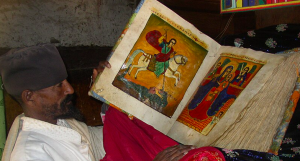
An Ethiopian Miaphysite6 monk with an
illuminated copy of the Bible. (Source.)
The latter in particular suggests, indirectly, that in some circles Pesach may have been conditionally postponed until the sabbath on or following 14th Nisan:
Remember the commandment which the Lord commanded thee concerning the Passover, that thou shouldst celebrate it in its season on the fourteenth of the first month, that thou shouldst kill it before it is evening, and that they should eat it by night on the evening of the fifteenth from the time of the setting of the sun [remember that the Hebrew day begins at sunset]. For on this night—the beginning of the festival and the beginning of the joy—ye were eating the passover in Egypt, when all the powers of Mastema7 had been let loose … And remember thou this all the days of thy life … and do not adjourn it from day to day, or from month to month. For it is an eternal ordinance, and engraven on the heavenly tables … Let the children of Israel come and observe the passover on the day of its fixed time, on the fourteenth day of the first month, between the evenings … and there may be no passing over from day to day, and month to month, but on the day of its festival let it be observed.
—Jubilees 49:1-4, 10-11, 14, 21, emphases mine—text courtesy of Sefaria
After all, you don’t need to bother forbidding people to do something unless they’re at least considering it.
Jubilees opens the possibility, and I’ve also found a few sources claiming positively that there was a widespread custom of combining the celebration of Passover with the sabbath that fell on or after 14th Nisan, and that the Lord instead kept the feast on its prescribed date. If this is the case, and 14th Nisan fell on a Thursday in the year of the Passion, this would explain the apparently contradictory accounts of when the Last Supper was relative to Pesach. This theory also seems consistent with the implication, common to all four canonical Gospels, that the celebration of Passover when Christ was crucified was to be held on the sabbath following the Crucifixion.
However, it must be kept in mind that this is, strictly, not evidence for this theory.8 Likewise more broadly, the theory that the paschal feast and the sabbath were blended appears plausible, but I haven’t yet made the time to properly verify the sources claiming this is what was going on. For the present, I can do no more than raise this possibility, while cautioning that it is (to my knowledge) not confirmed.
Footnotes
1This term comes to us from the Latin word mandātum, part of the phrase mandātum nōvum dō vōbīs, “A new commandment I give unto you.”
2Basically, Kant devised a theory according to which there were four races: the “blonde,” “copper-red,” “black,” and “olive-yellow,” roughly aligning with what we’d now call Caucasians, Indians (both American and South Asian), Blacks, and Asians. These corresponded to the supposed four humors, so that there were “racial temperaments” as well as phenotypes. Kant’s theory did draw on accepted folly that was already current, and had been since the beginning of the Early Modern period. This can arguably be traced to policies of the Kingdoms of Aragon and Castile, which treated moriscos and conversos—former Iberian Muslims and Jews who had converted to Christianity by or in 1492—as under more or less perpetual suspicion of perjured conversion. (This was done in order to secure advantages craved for themselves by viejos Cristianos, “old Christians,” because what is Christianity even about if it’s not about getting ahead based on who your dad knows, am I right.) To do justice to Kant himself, he eventually opposed colonialism and the slave trade, though by the time he came around to these views, the colonial European powers that were involved in the slave trade had heard as much anthropology from him as they wanted to, and by the way, our favorite bit is the one that justifies human trafficking as good, for the trafficked. (I swear, the audacity of this is almost as offensive as the actual maltreatment.) You can find a more detailed treatment of the history of the concept of race from the Stanford Encyclopedia of Philosophy at this link.
3To save those who aren’t familiar with this monstrous woman from Googling her name and unintentionally learning far more than they wished to: Delphine LaLaurie (1787-1849) was a slavemistress from New Orleans whose treatment of her slaves was so brutal that, when it was discovered, it shocked and enraged the local populace—as in, the populace of pro-slavery Louisiana—into forming a mob and burning her house down; today, she is widely regarded as a serial killer. LaLaurie escaped the destruction of her home and fled to France, and never faced earthly justice for her actions.
4The Greeks were about the only culture in the ancient Mediterranean that thought highly of these relationships. The Romans tolerated them, while Semitic cultures tended to frown upon them, and the Torah forbade such relations categorically. Even among Greeks, there was generally (though not always) an understanding that this was supposed to be the sort of thing one “grew out of.” The modern conception of sexual orientation didn’t really exist at the time, though of course it would have been as evident then as it is now that a small but persistent segment of the populace are erotically interested only in members of their own sex—but nobody was doing longitudinal studies, not only because the science of statistics had not been much developed, but because nobody greatly cared.
5The month of Nisan, also known as Abib (or Aviv), equates very roughly with April on the Gregorian calendar. It can begin as early as mid-March or as late as late April. 1st Nisan most typically falls during the twenty-day stretch centered on 1st April. §IV.2.a.ה of the “Outroduction” outlines the Hebrew calendar in a little bit more detail.
6The Ethiopian and Eritrean Orthodox Tewahedo Churches are parts of the communion known as the Oriental Orthodox Churches, or sometimes as Miaphysites. (These should not be confused with the pro-Chalcedonian communion of the Eastern Orthodox.) Tewahedo is a Ge’ez word synonymous with “Miaphysite,” a term derived from μία φύσις [mia füsis], “one substance” or “one nature.” The Christology of this communion does not speak of Christ having two natures, one divine and one human, but of his having one divine-human nature. They accordingly reject the Council of Chalcedon of 451, and have been in schism from the rest of the Church since that time. Besides the Tewahedo Churches from the Horn of Africa, Oriental Orthodoxy includes:
• the Armenian Apostolic Church, present in the Caucasus and Levant as well as among the Armenian diaspora;
• the Coptic Orthodox Church, centered in Egypt (Miaphysite Christology originated in Alexandria, and its patriarch, like the Bishop of Rome, uses the title “pope”);
• the Malankara Orthodox Syrian Church of India; and
• the Syriac Orthodox Church of Antioch, also serving the Levant (and which has a dependency, the Jacobite Syrian Christian Church, also in India).
Additionally, the UK’s British Orthodox Church and India’s Malabar Independent Syrian Church share Miaphysite theology, but are out of communion with the rest of Oriental Orthodoxy. (If you’re wondering why so many Christians from India have “Syrian” in their name, this is because the gospel first reached India not in the Greek-by-way-of-Latin form we’re most familiar with, but in Syriac, a form of Aramaic that throve throughout most of the first millennium as the lingua franca in Central and West Asia.) By Catholic lights, Oriental Orthodox Churches, like those of Eastern Orthodoxy and the Church of the East, do possess valid lines of apostolic succession and thus celebrate valid sacraments.
7Mastema (מַשְׂטֵמָה [maš’ṭêmâh]), here treated as a name for what Christians sometimes refer to as the Destroying Angel, is a Hebrew word meaning “animosity, hatred.” Mastema as a “character” occurs earlier on in the book; in Jubilees 10:7-20, he is referred to as “the chief of the spirits”—i.e., the ghosts of the nephilim, here said explicitly to be angelic-human hybrids—and is credited with obtaining permission from God for a tenth of these ghosts to remain free on the surface of the earth, while the other nine tenths are bound in the netherworld at the prayer of Noah.
8Basically, what we really have here is a lack of evidence against the theory I’ve set forth. This must be sharply distinguished from evidence for the theory. (After all, there are always immense quantities of no evidence against any theory you please.)


About Gabriel Blanchard
Gabriel Blanchard is a Catholic convert, gay author, radical leftist, unprofessional linguist, and Japanese food snob. He grew up as an evangelical Navy brat and got a degree in Classics from the University of Maryland. He currently lives in Baltimore and is a member of a local parish of the Ordinariate of the Chair of Peter. The everything notwithstanding, he is in fact not a vegan. You can read more about the author here.
Previous Post
June 4, 2026
The Gospel of John: The Prologue to a New Torah
Next Post
June 18, 2026 The Gospel of John: The New Torah, Part I
Recent Comments
"On the contrary, such a proclamation, among the Aztecs or Maya, would be disastrously misunderstood. ..."
The Gospel of John: The Bread ..."
"Many thanks for your scholarly study on the Cleansing of the Ten Lepers in the ..."
The Cleansing of the Ten Lepers
"Four Last Things: not the video game, but Death, Judgment, Heaven and Hell.Momento mori. Remember, ..."
"I am going by the time that these sayings began to be converted into written ..."
Are Our Bibles in the Wrong ..."
Browse Our Archives
Select a Category abuse antifascism art bad Catholic celibacy chastity Church crucifixion culture war eros forgiveness gay gender homophobia ikons language liturgy peace poems politics Pope Francis prayer pro-life race recommendations reform repentance review sacraments saints satire scandal schism scripture sex suffering theology Uncategorized violence
Select a Month October 2026 September 2026 August 2026 July 2026 June 2026 May 2026 April 2026 March 2026 February 2026 January 2026 December 2025 November 2025 October 2025 September 2025 August 2025 July 2025 June 2025 May 2025 April 2025 March 2025 February 2025 January 2025 December 2024 November 2024 October 2024 September 2024 August 2024 July 2024 June 2024 May 2024 April 2024 March 2024 February 2024 January 2024 December 2023 November 2023 October 2023 September 2023 August 2023 July 2023 June 2023 May 2023 April 2023 March 2023 February 2023 January 2023 December 2022 November 2022 October 2022 September 2022 August 2022 July 2022 June 2022 May 2022 April 2022 March 2022 February 2022 January 2022 December 2021 November 2021 October 2021 September 2021 August 2021 July 2021 June 2021 May 2021 April 2021 March 2021 February 2021 January 2021 December 2020 November 2020 October 2020 September 2020 August 2020 July 2020 June 2020 May 2020 April 2020 March 2020 February 2020 January 2020 December 2019 November 2019 October 2019 September 2019 August 2019 July 2019
Follow Us!
TAKE THE
Religious Wisdom Quiz
What symbol is most commonly associated with Christianity worldwide?
Select your answer to see how you score.
The lamb The cross The fish The dove
Related posts from Mudblood Catholic

The Sermon on the Mount, Part I: Matthew...

The Gospel of Matthew: Christ and Antichrist

John the Baptist and the Winnowing Fork: Matthew...

The Gospel of Matthew: The Coventry Carol
TRENDING AT PATHEOS Catholic

Emotion in Early Christianity by Andrew Crislip
Andrew Crislip’s Emotion in Early Christianity examines an often overlooked dimension of...

16 Spiritual Touchstones for a More Grounded Life
After decades of spiritual study, here are 16 principles I try...

Catholic Evangelization: Sharing Your Faith Every Day
Welcome back to the Graceful Awakening mini-series called, “From Faith to Mission.” ...

The Pillar of the Boatmen: the Ancient Monument...
The Pillar of the Boatmen is a Romano-Gaulish sculpture that dates from...

In one sense walking into Westminster Abbey is like walking down the...

'Super Scam Me' Exposes AI Jon Bon Jovi...
Leslie Pickett believed she was in a relationship with Jon Bon Jovi....
view all Catholic blogs
What Are Your Thoughts?leave a comment
Ad-Free & Subscriber Log-In Subscription Support
- About Us
- 2026 Calendar
- Videos
- Podcasts
- Library of World Religions
- Faith In Media Tracker
- Advertise With Us
- Write for Us
- Privacy Policy
- Terms of Service
- Do Not Sell My Data
- Contact Us
- Radiant Digital
- Manage Newsletter Subscriptions
- Unsubscribe From Notifications
- Sitemap
Copyright 2008-2026, Patheos. All rights reserved.
Subscription Support Ad-Free & Subscriber Log-In
Follow Patheos