
BuddhistCatholicContemplativeEvangelicalGeneral ChristianHinduJewishLatter-day SaintMuslimNew VisionsProgressive Christian
Beliefs
- Buddhist
- Catholic
- Contemplative
- Evangelical
- General Christian
- Hindu
- Jewish
- Latter-day Saint
- More Voices
- Muslim
- New Visions
- Pagan
- Progressive Christian
Topics
- Religion News
- Food and Religion
- Sports and Religion
- Religious Art
- Religious Music and Entertainment
- Religious Events
- History and Religion
- Style and Religion
- Politics and Religion
- Women in Religion
- Recreation Outdoors and Religion
- Business Finance and Religion
- Careers Workplace and Religion
- Education and Religion
- Family Parenting and Religion
- Health Fitness and Religion
- Home and Religion
- Relationships and Religion
- Technology and Religion
- Travel and Religion
Columnists
- Buddhist Columnists
- Business Finance and Religion Columnists
- Careers Workplace and Religion Columnists
- Catholic Columnists
- Contemplative Columnists
- Education and Religion Columnists
- Evangelists Columnists
- Family Parenting and Religion Columnists
- General Christian Columnists
- Health Fitness and Religion Columnists
- Hindu Columnists
- History and Religion Columnists
- Home and Religion Columnists
- Jewish Columnists
- More Voices Columnists
- Latter Day Columnists
- Muslim Columnists
- New Visions Columnists
- Nonreligious Columnists
- Pagan Columnists
- Politics and Religion Columnists
- Progressive Columnists
- Recreation Outdoors and Religion Columnists
- Relationships and Religion Columnists
- Religion News Columnists
- Religious Art Columnists
- Religious Events Columnists
- Religious Music and Entertainment Columnists
- Sports and Religion Columnists
- Style and Religion Columnists
- Technology and Religion Columnists
- Travel and Religion Columnists
- Women in Religion Columnists
Resource Library
- 2026 Calendar
- Library of World Religions
- The 100 Most Holy Places on Earth
- Patheos Answers
- Podcasts
- Videos
- Faith Leaders Database
- Anglican Episcopalian
- Bahai
- Baptist
- Buddhism
- Christianity
- Confucianism
- Eastern Orthodoxy
- Hinduism
- Holiness and Pentecostal
- ISKCON
- Islam
- Judaism
- Lutheran
- Methodist
- The Church of Jesus Christ of Latter-day Saints
- New Age
- Paganism
- Presbytarian and Reformed
- Protestantism
- Religion Behind the Scenes
- Roman Catholic
- Scientology
- Shia Islam
- Sikhism
- Sufism
- Sunni Islam
- Taoism
- Zen
- See all religions
Research Tools
 Ad-Free & Subscriber Log-In Subscription Support
Ad-Free & Subscriber Log-In Subscription Support
Follow Patheos 

- Trending:
- Forgiveness
- |
- Marriage
- |
- Consciousness
- |
- Death Penalty
- |
- Election
- |
- Halloween

- Home
- Catholic
- The Gospel of John: Chanukah
The Gospel of John: Chanukah
Last updated on: May 13, 2026 at 8:11 pm by Gabriel Blanchard
The Gospel of John: Chanukah 2026-05-13T20:11:51-04:00 Gabriel Blanchard
Patheos Explore the world's faith through different perspectives on religion and spirituality! Patheos has the views of the prevalent religions and spiritualities of the world.
This post is up a day earlier than usual, in honor of tomorrow being the Solemnity of the Lord’s Ascension (as observed by the Ordinariate of the Chair of Saint Peter, which is effectively my “diocese”). You can find my two-part introduction to the Gospel of John at these two links, and my index/outline for it here; for the previous installment on John 9:35-10:21, go here.
The Gospel of John: Chanukah (John 10:22-42)
The explicit liturgical theming in John is again at the fore in the first verse of our text; as the King James has v. 22, “And it was at Jerusalem the feast of the dedication, and it was winter.” The dedication is a translation of “Chanukah”: חֲנֻכָּה [chànûkâh] means “dedication, consecration” in Hebrew, in reference to the Temple. Today, this holiday enjoys a somewhat exaggerated importance in the minds of many Gentiles, since it has been contextualized as “Jewish Christmas” (an attitude which I gather Jews mostly view with something ranging between distaste and indifference). Chanukah is not a very important feast in modern Judaism, as there is no Temple in the Holy City. However, the holiday enjoyed more practical significance and esteem in the time of Jesus, and it was doubtless observed with great splendor at the Temple itself: among other things, we learn from Josephus that it was already known as the “feast of lights” (whether the name was taken from or inspired the lighting of many lamps at Chanukah, for purposes symbolic, decorative, or both). The holiday’s history forms a key part of the background to the whole New Testament, and I’ve included a postscript detailing some of that history to the best of my ability.
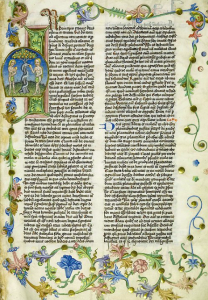
A leaf from a 1466 manuscript copy of The
Antiquities of the Jews.
However, this passage in the Fourth Gospel’s narrative continues to center the pastoral imagery of the first half of chapter 10. The symbol brought forward by the saying “I am the light of the world” near the beginning of chapter 9, itself picking up from the potent imagery of the prologue, seems at first glance to have been let fall for the moment. Nonetheless, vv. 40-42 evoke John the Baptist again, one of the first such allusions since ch. 5, which made the Baptist “a lamp, burning and shining”; and Christ’s quotation of Psalm 82, which speaks of mighty princes “walking on in darkness,” gestures at the enemies of the divine illumination which the festival of lights instantiates.
John 10:22-42, RSV-CE
It was the feast of the Dedication at Jerusalem; it was winter, and Jesus was walking in the temple, in the portico of Solomon.a So the Jews gathered round him and said to him, “How long will you keep us in suspense?b If you are the Christ, tell us plainly.” Jesus answered them, “I told you, and you do not believe. The works that I do in my Father’s name, they bear witness to me; but you do not believe, because you do not belong to my sheep. My sheep hear my voice, and I know them, and they follow me; and I give them eternal life, and they shall never perish, and no one shall snatch them out of my hand. My Father, who has given them to me, is greater than all, and no one is able to snatch them out of the Father’s hand. I and the Father are one.”c
The Jews took up stones again to stone him. Jesus answered them, “I have shown you many good works from the Father; for which of these do you stone me?” The Jews answered him, “We stone you for no good work but for blasphemy; because you, being a man, make yourself God.” Jesus answered them, “Is it not written in your law, ‘I said, you are gods’?d If he called them gods to whom the word of God came (and scripture cannot be broken), do you say of him whom the Father consecrated and sent into the world,e ‘You are blaspheming,’ because I said, ‘I am the Son of God’? If I am not doing the works of my Father, then do not believe me; but if I do them, even though you do not believe me, believe the works, that you may know and understand that the Father is in me and I am in the Father.” Again they tried to arrest him, but he escaped from their hands.
He went away again across the Jordan to the place where John at first baptized, and there he remained. And many came to him; and they said, “John did no sign, but everything that John said about this man was true.” And many believed in him there.
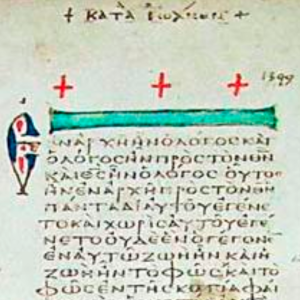
The beginning of the Gospel of John in Codex
Vaticanus, one of the most important ancient
manuscripts of the New Testament.
John 10:22-42, my translation
Then it came to be the Rededication in Yrushalem; it was winter, and Yeshua was walking around in the Temple in Shlomoh’s Colonnade.a Then the Jews encircled him and told him: “How long will you keep us holding our breath?b If you are the Anointed, tell us publicly.”
Yeshua responded to them, “I told you and you did not have faith; the works which I do in the name of my Father, these witness about me; but you do not have faith, because you are not of my sheep. Sheep of mine hear my voice, and I know them, and they follow me and I give them age-long life, and they will not be destroyed into the age and no one will snatch them from my hand. My Father (who is greater than all) has given me this, and no one can snatch them from my Father’s hand. I and the Father are one.”c
Then the Jews again began picking up stones in order to stone him.
Yeshua responded to them, “Many fair works I have shown you from the Father; on account of which work of these are you stoning me?”
The Jews responded to him, “We are not stoning you over a fair work but over blasphemy, and because you, being a person, are making yourself God.”
Yeshua responded to them: “Is it not written in your law that ‘I said, You are gods‘?d If he called those ‘gods’ to whom the word of God came to be, and the Writ cannot be loosened, are you telling [the one] whom the Father hallowed and sent into the worlde that ‘You are blaspheming’ because I said, ‘I am the Son of God’? If I do not do the works of my Father, do not have faith in me; but if I do, and yet you would not have faith in me, have faith in the works, in order that you may recognize and know that the Father is in me and I am in the Father.” So again they searched to seize him; but he went out of their hand.
And he went away again beyond the Yarden into the place where Yochanan was at first immersing, and he stayed there. And many came to him and were saying that “Though Yochanan did no sign, still, everything which Yochanan said about this man was true.” And many had faith in him there.
Textual Notes
a. the portico of Solomon/Shlomoh’s Colonnade | τῇ στοᾷ τοῦ Σολομῶνος [tē stoa tou Solomōnos]: Shlomoh is my Anglicization of the name we usually turn into Solomon (שְׁלֹמֹה [Sh’lomoh] is the Hebrew, derived from שָׁלוֹם [shâloum] “peace”—we got Solomon out of the Greek Σολομών [Solomōn]).1 His name was no doubt invoked by the builders of the Second Temple not only as a memory of Israel in its glory, but as the king who was privileged to build the first Temple.
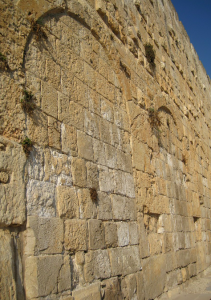
Remains today of the Triple Huldah Gate into
the templar complex in Jerusalem. Photo by
Deror Avi.
The place most often called Solomon’s Portico or Porch was what is technically known as a cloister. Today we mostly use this word as a synecdoche for a monastery or monastic life, since monastic houses have cloisters; but in strictly architectural terms, a cloister is just a covered walkway. (The word comes from the Latin claustrum “enclosure.”) Cathedrals and parish churches, as well as monasteries and convents, often include a cloister even today; these often surrounding an unroofed interior atrium, a prayer garden, things like that. This particular cloister was sort of border area between the rest of the Holy City and the Court of the Gentiles, which was the large exterior court containing the more sacred courts within it, and which of course we met way back in chapter 2. Most of the time in the Levant, it’d be more natural to mill about in the Court itself, which was far more spacious; however, as we’ve touched on, Chanukah falls a little after the beginning of the winter rainy season, and a cloister is a more natural place to stroll in bad or unpredictable weather.
b. How long will you keep us in suspense?/How long will you keep us holding our breath? | Ἕως πότε τὴν ψυχὴν ἡμῶν αἴρεις; [heōs pote tēn psüchēn hēmōn aireis?]: This idiom, αἴρω [airō] τὴν ψυχὴν, does fairly literally mean “to take away the breath.” However, in a funny twist, it treats the action of breath-holding as running another way: what these folks ask Yeshua is, word for word, “How long will you hold our breath?”
c. and I give them eternal life, and they shall never perish, and no one shall snatch them out of my hand. My Father, who has given them to me, is greater than all, and no one is able to snatch them out of the Father’s hand. I and the Father are one/and I give them age-long life, and they will not be destroyed into the age and no one will snatch them from my hand. My Father (who is greater than all) has given me this, and no one can snatch them from my Father’s hand. I and the Father are one | κἀγὼ δίδωμι αὐτοῖς ζωὴν αἰώνιον, καὶ οὐ μὴ ἀπόλωνται εἰς τὸν αἰῶνα, καὶ οὐχ ἁρπάσει τις αὐτὰ ἐκ τῆς χειρός μου. ὁ πατήρ μου ὃ δέδωκέν μοι πάντων μεῖζων ἐστιν, καὶ οὐδεὶς δύναται ἁρπάζειν ἐκ τῆς χειρὸς τοῦ πατρός. ἐγὼ καὶ ὁ πατὴρ ἕν ἐσμεν [kagō didōmi autois zōēn aiōnion, kai ou mē apolōntai eis ton aiōna, kai ouch harpasei tis auta ek tēs cheiros mou. ho Patēr mou ho dedōken moi pantōn meizōn estin, kai oudeis dünatai harpazein ek tēs cheiros tou Patros. egō kai ho Patēr hen esmen]: There are a number of subtle parallels between chapters 9-10 on the one hand (the healing of the man born blind and the subsequent Good Shepherd discourse) and chapter 5 (the healing of the paralytic and its following discourse about the Son doing the works of the Father and the resurrected dead hearing his voice). Both speak of the Son being given the authority to grant eternal life to those who believe in him—the imagery of chapter 5 focuses on “those who are in monuments,” which in a way aligns with St. Paul’s phrase in Colossians describing the Lord as “the firstborn of the dead,” whereas here pastoral imagery predominates. Chapters 9-10 are not without a touch of the more perilous symbols, but here they enter in an explicit condition of defeat: the wage-earner may run away from a robber or a wolf, but the fair shepherd will not, and no one can burgle their way through this Door.
I alluded to this very briefly when I discussed triadic motifs in my preface to the Gospel of John (namely, in IV.2.ד of the “Outroduction”), but one of the triads in this Gospel seems to be a triad of more or less spontaneous attempts on the life of Yeshua. I take these to be relatively spontaneous because in all of them, the author’s description of the intent and his description of the attempt fall with a verse or two of one another; by contrast, the premeditated effort to have Yeshua executed that culminates in chapters 18-19 is set up at the end of chapter 11, very far in advance. Both here and in chapter 8, stoning is specified, as is the accusation of blasphemy. 5:18 states that they “searched … [for a way] to kill him, because he … said his own father was God, making himself equal with God.” Given the close verbal parallel between that statement and the words of the hostile segment of the Jews in this text, it seems likely enough that chapter 5 is also implying an attempted stoning.
d. Is it not written in your law, ‘I said, you are gods’?/Is it not written in your law that ‘I said, You are gods‘? | Οὐκ ἔστιν γεγραμμένον ἐν τῷ νόμῳ ὑμῶν ὅτι Ἐγὼ εἶπα· Θεοί ἐστε; [ouk estin gegrammenon en tō nomō hümōn hoti «egō eipa: ‹theoi este›»?]: The allusion here is to Psalm 82. As it’s reasonably short, I give it here in full.
God standeth in the congregation of the mighty;
…..he judgeth among the gods.
“How long will ye judge unjustly,
…..and accept the persons of the wicked?
Defend the poor and fatherless:
…..do justice to the afflicted and needy.
Deliver the poor and needy:
…..rid them out of the hand of the wicked.”
They know not,
…..neither will they understand;
they walk on in darkness:
…..all the foundations of the earth are out of course.
“I have said, ‘Ye are gods;
…..and all of you are children of the most High.’
But ye shall die like men,
…..and fall like one of the princes.”
Arise, O God, judge the earth:
…..for thou shalt inherit all nations.
e. of him whom the Father consecrated and sent into the world/whom the Father hallowed and sent into the world | ὃν ὁ πατὴρ ἡγίασεν καὶ ἀπέστειλεν εἰς τὸν κόσμον [hon ho Patēr hēgiasen kai apesteilen eis ton kosmon]: As so often, we here have a compact verbal parallel to the prologue:
In the beginning was the Word, and the Word was there with God, and the Word was God. … What came to be in him was life, and this life was humans’ light; and the light appears in the darkness … The true light, which lights up every person, was coming into the world. He was in the world, and the world came to be through him, yet the world did not know him. He came to his own, and his own people did not receive him. Such as did take him, he gave to them authority to become God’s children … God, no one has ever seen; only-begotten God, who is there in the lap of the Father, this one has explained him.
—John 1:1, 4-5, 9-12, 18
Postscript: The Early History of Chanukah
At the time, Chanukah was quite a new solemnity in the Judaic calendar, newer than Purim (and, as mentioned in the 1906 Jewish Encyclopedia, the canonicity of Esther was still debated in the time of Christ). The event Chanukah commemorated was only a little further in the past than the origin of Juneteenth is to us today—so, substantially closer than the basis of Independence Day. The holiday’s underlying historical themes, while religious, were also nationalist and at least potentially seditious, since its origins laid in the Maccabean Revolt of 167-160 BC, a revolt that won the Jews autonomy within the Seleucid Empire; in 134, Judea had become an independent realm, for the first time in over four hundred and fifty years. For a solid century following Herod the Great’s usurpation of the throne in 37 BC, which occurred with ostentatious reliance upon Roman forces, the old rebellion was plainly much in the minds of the Jews of Palestine. Its influence can be felt all over the New Testament. Even the popular names of the era reflect it: giving them in their “Biblical Anglo-Greek” forms, the initial instigator of the Maccabee Revolt was a priest named Matthias, whose five sons were Judas, Lazarus, Simon, John, and Jonathan. This is more than enough reason to take a look at it ourselves.
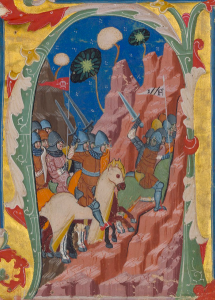
An illumination from a 14th-c. Italian
antiphonary, depicting the Maccabees as
Medieval knights.
The roots of the conflict lie (as the author of Daniel perceived) in the conquests of Alexander the Great. Though still a subject people, the Jews had been reasonably content to live under Persian rule. It was after all a Kšayathiya Kšayathiyanam or “King of Kings” (the Old Persian title for the shah), Kurush,2 who had permitted the Jewish aristocracy and scribal class to return from Babylonia to the Holy Land, and had encouraged the rebuilding of the Temple—indeed, he is the only person the prophets explicitly refer to as “the messiah.” Moreover, Kurush’s successor Darayaush I2 had greenlit the Second Temple’s construction starting up again, after a long interruption based on accusations of treasonous intent against the Jews en masse. The Persians made a general point of respecting their subjects’ religion.3 This was a trait which, as the Jews already knew only too well, was not a common attitude toward Judaism in … the earth. So when Alexander vanquished Darayaush III, this was not necessarily good news to the Jews.
Alexander died with no clear heir, and his generals squabbled for decades over the ruins of his empire. It so happened that Ptolemy I Soter, who made himself the next Pharaoh, also took control of the Levant. In general, the Ptolemies followed the good example set by Persia; indeed, it was not only under the Ptolemies but at their behest that Greek-speaking Jews created the Septuagint, the first Greek translation of the Judaic Scriptures (and some bonus material). For about a century, things were roughly alright for the Jews.
The Battle of Panium in 200 BC brought the realm of Judea out of the orbit of the Ptolemies and into that of the Seleucid Empire,4 a Græco-Syrian power who had managed to claim more of the old realm than any other post-Alexander successor state. This did not immediately ruin everything. But in 175 BC, a new Seleucid emperor took power, Antiochus IV Epiphanes; and he did not propose to let a villain name as good as Antiochus Epiphanes go to waste. What his exact reasons were is debated, but he quickly determined to exterminate Judaism as a religion. The measures he took included the following; the third through sixth carried death as the penalty for disobedience.
- Forcibly converting the Judaic and Samaritan temples5 respectively into shrines to Ζεύς Ὀλύμπιος [Zeus Olümpios] or “Olympian Zeus” and Ζεύς ξένιος [Zeus Xenios] or “Zeus the Friend of Strangers.”6
- Offering pigs on the altars at these temples.
- Forbidding circumcision.
- Forbidding the teaching of the Torah, or even possessing scrolls of it.
- Forbidding anyone to keep the sabbath.
- Forbidding anyone to keep kashrut, i.e. the dietary laws.
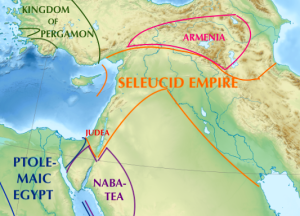
A rough map of major powers in the Near East
at the time of the Maccabee Revolt. Based on
a blank map of the region by Sémhur, used
via a CC BY-SA 4.0 license (source).

Predictably, rather than cowing the Jews, this outraged them. A priest named Mattithyahu from the Chashmonai family first led the uprising against the Seleucids; he was followed by his five sons, particularly the eldest, Yudah. Yudah earned the nickname מַכַּבִּי [makaby], which he in turn bestowed on the insurgency. (מַכַּבִּי is said to be a borrowing from an Aramaic word meaning “hammer,” though this is uncertain. The family name was retained by the priestly and then royal dynasty the family became, though we know it in the Hellenized form Hasmonean.) After a few years’ hard fighting, in or about the year 164 BC, Maccabee forces retook Yrushalem, ritually cleansed the Temple, and rededicated it to the service of the LORD their God.
Principal historical sources on the revolt include:
- The First Book of Maccabees, author anonymous (c. 130-100 BC?). This history was originally written in Hebrew, though most surviving copies are in Greek. (Catholic and Orthodox Christians consider I Maccabees part of sacred Scripture; most Protestants follow the Judaic canon in excluding it.) We know little of its author, save that he most likely resided in Palestine, the only place where Hebrew was much used. It is sixteen chapters long. The book opens with the accession of Antiochus Epiphanes, and closes with John Hyrcanus I (Judah Maccabee’s nephew) thwarting an attempted assassination immediately before acceding to the throne. It therefore covers 175-134 BCE, and cannot have been finished before the latter date; furthermore, since it presents the Romans in a positive light, most scholars hold that it cannot have been finished any later than 63 BCE, the year Pompey invaded Judea and desecrated the Temple. It tends to follow the model of the books of Samuel and Kings, and is to this day regarded, from a strictly scholarly point of view, as a credible source on the Maccabee Revolt. Some commentators suspect Sadducee or proto-Sadducee influence on the book, given its omission of theological points that II Maccabees attends to particularly, namely the intermediate existence of the soul and the coming resurrection of the dead.
- The Second Book of Maccabees, author anonymous (c. 130-100 BC?). This work, by a different hand, is also anonymous; however, it was composed in Koiné Greek, and was therefore never under serious consideration for status as Scripture in the eyes of most Jews (though Catholics and Orthodox Christians accept this book also7). The author is deemed to have most likely been a native of Alexandria in Egypt. Its fifteen chapters cover about the same material as I Maccabees 1-7—approximately, 178-161 BCE. Unlike I Maccabees, its author alludes in several places to the doctrine of the resurrection of the dead, notably at the end of ch. 12: this passage makes a point of explaining the practice of prayer for the dead in terms of Pryshaya eschatology, which of course was inherited by Christianity. The book’s martyrology in chapter 7 is doubtless its most celebrated passage; it is almost certainly what the author of Hebrews has in mind in 11:35 of his epistle.
- The Antiquities of the Jews, by Flavius Josephus (94 CE). Josephus had taken part in the First Jewish War early on, but surrendered to Vespasian’s forces in 67; thereafter, he became part of the Flavian family’s retinue (the family which included Vespasian and his two sons, Titus and Domitian). The Antiquities chronicled almost the entirety of Jewish history at the time they were written, beginning with creation and running all the way to the procuratorship (64-66 CE) of Gessius Florus, whose insolent, corrupt governance had helped provoke the First Jewish War. It consists in twenty books, of which the twelfth addresses the period between the death of Alexander the Great in 323 BC and that of Judah Maccabee himself in 160 BC, thus covering the earliest and most important phase of the Maccabee Revolt, including the reclamation and cleansing of the Temple and the institution of Chanukah.
II Maccabees links the institution of Chanukah with the preëxisting Biblical feast of Sukkot, which as we have already seen was an occasion of immense rejoicing. Further, as mentioned above, Josephus informs us that this holiday was already a “festival of lights” by the first century.
And so Judas together with his fellow-citizens celebrated the restoration of sacrifices in the Temple for eight days … So much pleasure did they find in the renewal of their customs and in unexpectedly obtaining the right to have their own service after so long a time, that they made a law that their descendants should celebrate the restoration of the Temple for eight days. And from that time to the present we observe this festival, which we call the festival of Lights [φῶτα {fōta}], giving this name to it, I think, from the fact that the right to worship appeared [φανῆναι {fanēnai}] to us at a time when we hardly dared hope for it.8
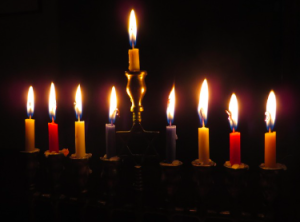
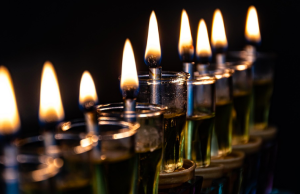
A fully-lit chanukiyah. The offset light,
known as the shamash (roughly “sexton“),
is used in households of the Ashkenazic
minhag9 to light the rest.
Those of my readers who are already familiar with the story of Chanukah may have begun wondering if I’m ever going to get to that! It’s an excellent story, if you haven’t heard it already: the legend states that when the Maccabees retook the Holy City and were readying the Temple to be restored to its proper purpose, only a single day’s supply of oil for lighting the Menorah could be found—yet, as if in echo of the miracle wrought by Elisha in II Kings 4, this supply miraculously kept the Menorah lit for eight days, which was the precise amount of time required for more ritually pure oil to be prepared.
None of the three sources above explicitly connects the holiday with this story. Nor do any of them mention the use of the chanukiyah—the object widely referred to by English-speaking Gentiles as a “Chanukah menorah.” (The term menorah really only applies to the seven-branched candelabrum used in the Temple, or of course to depictions of it, whereas a chanukiyah has nine branches: a row of eight, plus one additional branch positioned separately from the rest, whether below or above them.) It’s possible that the story is fictional and had not yet arisen, and that chanukiyot had not become standard “gear” for celebrating Chanukah either. The account of the miracle is first related in the Babylonian Talmud, a few hundred years later, and may be an alteration (deliberate or accidental) of a story related in II Maccabees 1:18-36.
That said, it’s also possible the chanukiyah may already have been in use. There was reportedly a dispute between Beyt Hillel and Beyt Shammai10 about whether to light all eight lamps on the first night and reduce them one by one each night, or to light only one the first night of Chanukah, two the second, and so on. The fact that this dissension arose between these two schools doesn’t tell us how early it arose—it might have been at basically any point in the Tannaitic period (which lasted until around 200 CE)—but arrays of lights go together well with festivity, especially in winter, so it’s possible the custom started earlier rather than later. If lighting the chanukiyah were as yet only a folk custom and not treated as a mitzvah, then Josephus could have been familiar with it, yet not mentioned it because he was operating on the assumption that both the title “feast of lights” and the chanukiyah itself were, so to speak, downstream of the symbolism of the Torah being God’s light in a dark world.
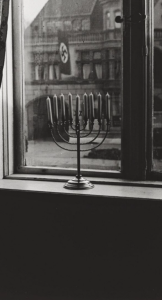
A chanukiyah on display in a Jewish home
in Kiel, Germany in 1931. Photo by
Rachel Posner.
Footnotes
1Where the Greek form picked up that final -ν [-n], I can’t be sure. However, it’s possible it was added because names ending in -ω [-ō] tend to be feminine in Greek. Reasonably well-known examples include: Ἀληκτώ [Alēktō] (Alecto, one of the Furies); Καλυψώ [Kalüpsō] (Calypso, the nymph who detained Odysseus for years on her island); and Κλωθώ [Klōthō] (Clotho, the spinner of thread among the Three Fates—her sisters were Lachesis, the measurer, and Atropos, i.e. “the Un-turnable,” who cut the thread at the end).
2Kurush was adapted by the Greeks as Κῦρος [Küros] (which, for a change, seems like a very defensible Hellenization of a non-Greek name); this was then transcribed into Latin as Cyrus, which we borrowed into English by stealing the French pronunciation of c and apparently just selecting an entirely random value for y. The form of the name used in Hebrew, e.g. in Isaiah 45, was much closer than even the Greek: כּוֹרֶשׁ [Kouresh]. (This form was chosen by Vernon Wayne Howell, the leader of an offshoot of an offshoot of the Seventh-Day Adventist Church, for the 1990 name change that legally made him David Koresh.) Similarly, Darayaush became Δαρεῖος [Dareios] in Greek, and thence Dārīus in Latin; in this case the Hebrew was דֱּרְיָוֵשׁ [Dèr’yâwêsh].
3This was not only true of the Jews, or only of specifically religious traditions; the Persians maintained a broadly live-and-let-live attitude toward all their subjects, though they did regard them, and expected them to regard themselves, precisely as subjects. This, especially when taken in combination with their high ethical standards and social liberality—e.g. far better treatment of slaves than was usual in the Mediterranean—may be why the Persian Empires won the loyalty of at least some of their subjects. To take the obvious example: while the story of Athenian and Spartan resistance to Persia absolutely is inspiring, the Greeks of Ionia, whose revolt against the Persian Empire in 499 BC set off the Græco-Persian War, were more loyal after the revolt was suppressed than they had been before it. And this was not just a “having the mutinous thoughts beaten out of them” sort of response, either. After the revolt had been suppressed, far from taking revenge, the Persians did things like replace tyrannies with locally-autonomous democracies, encourage Persian aristocrats to intermarry with Greek nobles and give their children Greek names, and even lower taxes. Talk about team-building.
4The Seleucid dynasty was named for Seleucus Nicator, who like Ptolemy Soter was a general of Alexander’s. Their realm was long the largest and, for a while, most powerful of the bunch; at the time they took the land of Canaan away from Egypt, the Seleucids ruled over a territory more or less encompassing what is now Afghanistan, Iran, Iraq, Kuwait, Lebanon, and Syria. The land they took from Egypt amounted to modern Israel, Jordan, and Palestine.
5There was at this time a Samaritan temple on Mount Gerizim. This is attested in written sources (e.g. II Maccabees 6:2), and its archæological remnants have been found. It was destroyed around 110 BC by John Hyrcanus, the nephew of Judah Maccabee. Hyrcanus was high priest for thirty years, from 134 to 104 BC, and also reigned over Judea during the same interval, first as its ethnarch (while subject to the Seleucid Emperor) and later as its king (independently). In contrast to the pre-Exilic monarchies of Israel and Judah, the zenith of sacerdotal and political authority were joined in most of the Hasmonean monarchs.
6History does not relate that it crossed the mind of Antiochus Epiphanes that defiling a foreign temple and forcing it to change its object of worship to Zeus the Friend of Strangers, on the grounds that he wished to stamp out these foreigners’ religion, might have been an astonishingly stupid thing to do even from his own perspective.
7There are in total eight books “of Maccabees”—or, if we add the books of Meqabyan, sometimes referred to as “Ethiopic Maccabees,” eleven. All are concerned, directly or indirectly, with persecutions of the Jews, chiefly that which took place under Antiochus Epiphanes; however, III Maccabees describes or invents a different persecution that occurred in Egypt under the Ptolemies, and the books of Meqabyan appear to be an extremely garbled retelling of I and IV Maccabees (possibly drawing on other sources entirely, like the book of Judith). The Catholic Church considers only I and II Maccabees to be canonical. The Orthodox Church, along with the Church of the East and some Miaphysite bodies, such as the Armenian Apostolic Church, also esteem III Maccabees as inspired. The Eritrean and Ethiopian Orthodox Tewahedo Churches make no use of the eight books of Maccabees “proper,” but consider I, II, and III Meqabyan canonical.
8This comes from the Loeb translation of Book XII of Josephus’ Antiquities, pp. 167 and 169; I sourced the text via archive.org here. The relation between φῶτα and φανῆναι may not be intuitively obvious to the English-speaking reader! However, the singular of φῶτα, φῶς [fōs], is a contraction of the earlier φάος [faos]; it is a little easier to see the kinship between that and φαίνω [fainō], the dictionary form of φανῆναι.
9A minhag in Judaism is a little like a rite in Catholicism: it indicates a specific inculturation of the faith, including when certain prayers are used, their exact wording in certain cases, interpretations of certain rules, etc. In the US, the most familiar minhagim are the Ashkenazi and Sephardi. The former refers to those Jews who lived in Central and Eastern Europe in the Middle Ages (and their descendants), and is associated with the Yiddish language, a.k.a. Judæo-German, thought to have as many as six hundred thousand modern speakers. The Sephardic minhag pertains to those who lived in the Muslim and Christian realms of Medieval Spain (with their descendants), who spoke Ladino, or Judæo-Spanish; although endangered, Ladino still has around fifty thousand speakers.
10These were the leading schools among Pryshaya during the late first century BC and through the first century CE; they were named for their founders, Hillel the Elder (c. 70 BC-c. 10 CE) and Shammai the Elder (c. 50 BC-c. 30 CE). Loosely speaking, Beyt Hillel was the “generous” or “permissive” school of interpreting the Torah, whereas Beyt Shammai was the “strict” or “rigorist” school. Beyt Hillel was, and remains, the more influential and esteemed of the two schools, and there are a number of conspicuous links between it and what I have dubbed “Beyt Yeshua” (the Christian movement as it existed when it was understood only as “a new teaching,” before it began to be viewed as a distinct religion altogether). For example, one famous story about Hillel the Elder has him summarizing the Torah in terms of what’s sometimes dubbed the Silver Rule, in parallel to the Golden Rule: “What is hateful to you, do not do to your brother.”
Previous Post
May 7, 2026
The Gospel of John: Unblinding Light, Part II
Next Post
May 21, 2026 The Raising of Lazarus: John's Climactic Seventh Sign
Recent Comments
"On the contrary, such a proclamation, among the Aztecs or Maya, would be disastrously misunderstood. ..."
The Gospel of John: The Bread ..."
"Many thanks for your scholarly study on the Cleansing of the Ten Lepers in the ..."
The Cleansing of the Ten Lepers
"Four Last Things: not the video game, but Death, Judgment, Heaven and Hell.Momento mori. Remember, ..."
"I am going by the time that these sayings began to be converted into written ..."
Are Our Bibles in the Wrong ..."
Browse Our Archives
Select a Category abuse antifascism art bad Catholic celibacy chastity Church crucifixion culture war eros forgiveness gay gender homophobia ikons language liturgy peace poems politics Pope Francis prayer pro-life race recommendations reform repentance review sacraments saints satire scandal schism scripture sex suffering theology Uncategorized violence
Select a Month October 2026 September 2026 August 2026 July 2026 June 2026 May 2026 April 2026 March 2026 February 2026 January 2026 December 2025 November 2025 October 2025 September 2025 August 2025 July 2025 June 2025 May 2025 April 2025 March 2025 February 2025 January 2025 December 2024 November 2024 October 2024 September 2024 August 2024 July 2024 June 2024 May 2024 April 2024 March 2024 February 2024 January 2024 December 2023 November 2023 October 2023 September 2023 August 2023 July 2023 June 2023 May 2023 April 2023 March 2023 February 2023 January 2023 December 2022 November 2022 October 2022 September 2022 August 2022 July 2022 June 2022 May 2022 April 2022 March 2022 February 2022 January 2022 December 2021 November 2021 October 2021 September 2021 August 2021 July 2021 June 2021 May 2021 April 2021 March 2021 February 2021 January 2021 December 2020 November 2020 October 2020 September 2020 August 2020 July 2020 June 2020 May 2020 April 2020 March 2020 February 2020 January 2020 December 2019 November 2019 October 2019 September 2019 August 2019 July 2019
Follow Us!
TAKE THE
Religious Wisdom Quiz
According to 1 Timothy, what is a trustworthy saying deserving of full acceptance?
Select your answer to see how you score.
Christ Jesus came into the world to save sinners Faith without works is dead The Lord is our shepherd God is love
Related posts from Mudblood Catholic

The Sermon on the Mount, Part I: Matthew...

The Gospel of Matthew: Christ and Antichrist

John the Baptist and the Winnowing Fork: Matthew...

The Gospel of Matthew: The Coventry Carol
TRENDING AT PATHEOS Catholic

Jad Gillies on New Hillsong Worship Songs and...
For worship leader Jad Gillies, Hillsong Worship’s next chapter is not about...

Looking at the Largest Orthodox Cathedral on Earth
There is often a considerable amount of anger and, shall we...

The Problem with False Prophets
Miller’s Station UMC| 10/18/26| Anchor Verse: Jeremiah 23: 1, 9-23 I...

Emotion in Early Christianity by Andrew Crislip
Andrew Crislip’s Emotion in Early Christianity examines an often overlooked dimension of...

16 Spiritual Touchstones for a More Grounded Life
After decades of spiritual study, here are 16 principles I try...

Catholic Evangelization: Sharing Your Faith Every Day
Welcome back to the Graceful Awakening mini-series called, “From Faith to Mission.” ...
view all Catholic blogs
What Are Your Thoughts?leave a comment
Ad-Free & Subscriber Log-In Subscription Support
- About Us
- 2026 Calendar
- Videos
- Podcasts
- Library of World Religions
- Faith In Media Tracker
- Advertise With Us
- Write for Us
- Privacy Policy
- Terms of Service
- Do Not Sell My Data
- Contact Us
- Radiant Digital
- Manage Newsletter Subscriptions
- Unsubscribe From Notifications
- Sitemap
Copyright 2008-2026, Patheos. All rights reserved.
Subscription Support Ad-Free & Subscriber Log-In
Follow Patheos