
BuddhistCatholicContemplativeEvangelicalGeneral ChristianHinduJewishLatter-day SaintMuslimNew VisionsProgressive Christian
Beliefs
- Buddhist
- Catholic
- Contemplative
- Evangelical
- General Christian
- Hindu
- Jewish
- Latter-day Saint
- More Voices
- Muslim
- New Visions
- Pagan
- Progressive Christian
Topics
- Religion News
- Food and Religion
- Sports and Religion
- Religious Art
- Religious Music and Entertainment
- Religious Events
- History and Religion
- Style and Religion
- Politics and Religion
- Women in Religion
- Recreation Outdoors and Religion
- Business Finance and Religion
- Careers Workplace and Religion
- Education and Religion
- Family Parenting and Religion
- Health Fitness and Religion
- Home and Religion
- Relationships and Religion
- Technology and Religion
- Travel and Religion
Columnists
- Buddhist Columnists
- Business Finance and Religion Columnists
- Careers Workplace and Religion Columnists
- Catholic Columnists
- Contemplative Columnists
- Education and Religion Columnists
- Evangelists Columnists
- Family Parenting and Religion Columnists
- General Christian Columnists
- Health Fitness and Religion Columnists
- Hindu Columnists
- History and Religion Columnists
- Home and Religion Columnists
- Jewish Columnists
- More Voices Columnists
- Latter Day Columnists
- Muslim Columnists
- New Visions Columnists
- Nonreligious Columnists
- Pagan Columnists
- Politics and Religion Columnists
- Progressive Columnists
- Recreation Outdoors and Religion Columnists
- Relationships and Religion Columnists
- Religion News Columnists
- Religious Art Columnists
- Religious Events Columnists
- Religious Music and Entertainment Columnists
- Sports and Religion Columnists
- Style and Religion Columnists
- Technology and Religion Columnists
- Travel and Religion Columnists
- Women in Religion Columnists
Resource Library
- 2026 Calendar
- Library of World Religions
- The 100 Most Holy Places on Earth
- Patheos Answers
- Podcasts
- Videos
- Faith Leaders Database
- Anglican Episcopalian
- Bahai
- Baptist
- Buddhism
- Christianity
- Confucianism
- Eastern Orthodoxy
- Hinduism
- Holiness and Pentecostal
- ISKCON
- Islam
- Judaism
- Lutheran
- Methodist
- The Church of Jesus Christ of Latter-day Saints
- New Age
- Paganism
- Presbytarian and Reformed
- Protestantism
- Religion Behind the Scenes
- Roman Catholic
- Scientology
- Shia Islam
- Sikhism
- Sufism
- Sunni Islam
- Taoism
- Zen
- See all religions
Research Tools
 Ad-Free & Subscriber Log-In Subscription Support
Ad-Free & Subscriber Log-In Subscription Support
Follow Patheos 

- Trending:
- Forgiveness
- |
- Marriage
- |
- Consciousness
- |
- Death Penalty
- |
- Election
- |
- Halloween

- Home
- Catholic
- Pivot for MMXXVI
Pivot for MMXXVI
Last updated on: November 25, 2025 at 9:44 pm by Gabriel Blanchard
Pivot for MMXXVI 2025-11-25T21:44:04-04:00 Gabriel Blanchard
Patheos Explore the world's faith through different perspectives on religion and spirituality! Patheos has the views of the prevalent religions and spiritualities of the world.
It Is Written
A few years ago, I shifted from writing mainly theological and political commentary to mainly translating New Testament passages. In doing so, I’ve followed the lectionary pretty exclusively. Lately I’ve been thinking about reorienting slightly; I decided to take the plunge with the new liturgical year, MMXXVI (2026), which begins at sunset on 29th November, 2025.
What I mean to do now is a straightforward translation of the whole New Testament, start to finish. There are parts of the New Testament which we never hear in the liturgy: if we take both Sunday and daily Mass readings into account, we miss about 10% of the Gospels, and nearly half of the rest. Moreover, because we hear these texts piecemeal and almost never read the entirety of a book, the structure of most books of Scripture remains obscure to a majority of people. (The situation is far worse with respect to the Old Testament, of which we read only about an eighth, but I am nowhere close to being able to produce even a passably competent rendering of anything from Hebrew, so I can’t do much about that.)
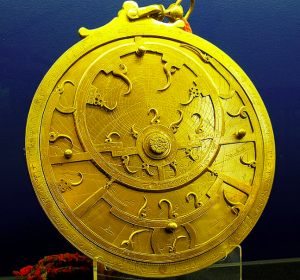
An 18th-c. Persian astrolabe; photo by Andrew
Dunn, used via a CC BY-SA 2.0 license (source).

St. Jerome famously said that “Ignorance of the Scriptures is ignorance of Christ.” My aim in offering translations here has always been, and still is, to make the text as it was to its original audience more available to Catholics today; to my mind, that should mean the whole book. It probably wouldn’t be reasonable to expect the Mass readings alone to serve this purpose anyway—which is where Bible studies come in handy.
This reorientation will follow an idea I discussed a few months ago—a redesign of the New Testament, following a precedent suggested by the structure of the Hebrew Bible. If you’re interested in the background, you can find the discussion of that idea in my series “Are Our Bibles in the Wrong Order?” (at these links, in four parts). If you’re just interested in the practical results, here’s what my proposed New Testament redesign would look like (color-coded based on my personal opinion of their authorship—I reach a total of ten authors and twelve authorships); :
- Gospel of John
- Gospel of Matthew
- Gospel of Mark
- Gospel of Luke
- Acts of the Apostles
- Ist Letter of Peter
- IInd Letter of Peter
- Letter of Jude
- Letter of James
- Ist Letter of John
- IInd Letter of John
- IIIrd Letter of John
- Letter to the Romans
- Ist Letter to the Corinthians
- IInd Letter to the Corinthians
- Letter to the Galatians
- Letter to the Ephesians
- Letter to the Philippians
- Letter to the Colossians
- Ist Letter to the Thessalonians
- IInd Letter to the Thessalonias
- Ist Letter to Timothy
- IInd Letter to Timothy
- Letter to Titus
- Letter to Philemon
- Letter to the Hebrews
- Apocalypse of Jesus Christ1
The colors2 indicate authorships as listed below. The list is in alphabetical order by author, excepting the last three entries, which are special cases; all, including the last three, have the number or numbers of the books from the list above set in parentheses after the name.
…Emerald: St. James the Less the Apostle3 (9)
…Carbuncle: St. John the Apostle (27)
…Amethyst: St. John the Elder (11-12)
…Gold: St. Jude Thaddæus the Apostle3 (8)
…Beryl: St. Luke the Evangelist (4-5)
…Chrysolite: St. Mark the Evangelist (3)
…Jasper: St. Matthew the Apostle3 (2)
…Sapphire: St. Paul the Apostle (13-25)
…Sardonyx: St. Peter the Apostle (6)
…Jacinth: collaboration between SS. John and John (1, 10)
…Carnelian: collaboration between SS. Jude and Peter (7)
…Pearl4: authorship known only to God (26)
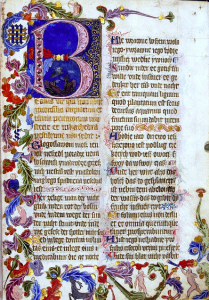
Extra Credit: A Synopsis of Why I Thus Remixed the New Testament
The epistles have been re-sorted according to the precedence generally given to the apostles who wrote them—an example of my personal taste. There are two essential structural changes in this arrangement of the New Testament:
- moving John to the beginning of the Gospels; and
- moving Hebrews to the end of the epistles.
These changes genuinely reshape the New Testament along the lines on which the Hebrew Bible was planned. In parallel to the Law-Prophets-Writings of the Hebrew Bible, we have a New Testament of Gospels-Epistles-Apocalypse.5
Moving John places it in apposition with Genesis: both now occur at the beginning of their respective Testaments, as is naturally suggested by the prologue to John. This move has secondary benefits as well. Luke and Acts are now next to each other, which smooths out the transition between the Gospels and Acts, showing how the latter belongs with the former; additionally, John and Revelation—which share certain crucial motifs and focuses, regardless of authorship—now bookend the whole New Testament.
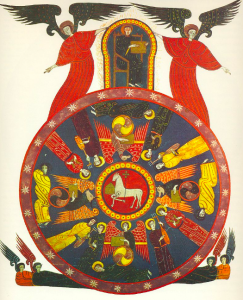
An illumination (1047) of the Lamb among the
cherubim and the twenty-four elders by Facundus
of Castile, for a copy of Beatus of Liébana’s
commentary on the Apocalypse.
As for Hebrews, placing it last among the epistles seems fitting in a couple of ways. For one thing, it is the only truly and completely anonymous epistle; all the others, genuine or not, at least claim to be by so-and-so. Only Hebrews is without father or mother, without genealogy, having neither beginning salutation nor ending signature. But the chief reason to place it at the end is, it forms a natural bridge between the other epistles and the book of Revelation. This is thanks to its intimate concern with the heavenly Temple—the very place in which Revelation is set. Which brings us back to Revelation and John, for John is the most “templar” of the Gospels. It records Jesus visiting the Temple the highest number of times, pays the most attention to the Judaic liturgy, associates the Temple with “the body of Christ” the most blatantly.
Didn’t You Say Something About “Practical Results” a Minute Ago?
This arrangement of the New Testament brings out a theological concept inherent in it, one already adumbrated in the Hebrew Bible. The covenant God forges through Moses with Israel revolves around a terrestrial temple. The covenant God forges through Jesus with the Church revolves likewise around a temple—but this latter professes to be the celestial original, the divine archetype of the Mosaic ectype. The whole plot of Scripture is traceable in templar terms. The presence of God, once manifest in Eden, withdraws from mankind. Then It descends upon the Tabernacle; much later, It consents to transfer Itself to Solomon’s Temple, but ultimately withdraws from there, and only ambiguously returns in the Second Temple. That presence then reappears uniquely in the person of Christ; It extends from him to his Church; and finally It flows out from there to a new creation.
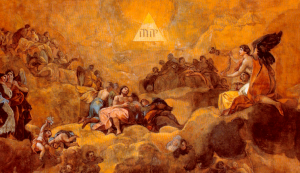
Adoración del Nombre de Dios [Worship of the
Name of God] (1772), by Francisco José de Goya
y Lucientes.
I’m planning to try and keep to my once-a-week posting schedule, generally on Thursdays (though I’ll sometimes need to go with a Wednesday or a Friday instead—for example, this coming Christmas and New Year’s Day are Thursdays). So, on Thursday, 4th December, I’ll—hopefully—be starting things off with a general introduction to the Gospel of John, followed on the 11th by a translation of and commentary on its prologue (John 1:1-18). If you’d like to support me in doing this work, my foremost need is naturally prayer. I’d also be grateful for any consideration you can give me via Patreon.
Footnotes
1For more on why this is in fact a more correct name than “the Apocalypse of John,” check out the second paragraph of this post.
2Is naming the colors after precious metals and gemstones from the Bible ludicrously pretentious? Yes. So come back here and stop me, why don’tcha.
3Interestingly, in different places, all three of these saints are called “sons of Alphæus.” There is a theory that Alphæus and Clopas were the same person (both names are thought to be Greek adaptions of the Aramaic Chalfai); if this is correct, and the theory that “Mary of Clopas” was the sister of the Theotokos is also correct, then the extended Holy Family played a fairly prominent role in the primitive Church—an idea reputedly set forth in the (now lost) Gospel of the Hebrews.
4If you think this color can’t be that of a pearl, think again.
5Indeed, correspondences go further. The Hebrew Bible features a twofold division of its Prophets into Former (Joshua, Judges, Samuel, and Kings) and Latter (Isaiah, Jeremiah, Ezekiel, and the Twelve or Minor Prophets); likewise, the epistles as I have listed them show a clear demarcation between those (reputedly) written by members of the Twelve Apostles, and those written by others (Paul and the anonymous author of Hebrews). To be clear, I’m not claiming a one-to-one correspondence between the books of the Old and New Testaments on my schema—this is in fact mathematically impossibly, since they have different numbers of books! Though that said, I am tickled by the fact that, if you follow my list of the New Testament and the list of books in the Hebrew Bible, the three Johannine epistles come in the same numerical slots as Isaiah, Jeremiah, and Ezekiel.
Previous Post
November 21, 2025
His Throne
Next Post
December 4, 2025 The Gospel According to Saint John: An Introduction
Recent Comments
"On the contrary, such a proclamation, among the Aztecs or Maya, would be disastrously misunderstood. ..."
The Gospel of John: The Bread ..."
"Many thanks for your scholarly study on the Cleansing of the Ten Lepers in the ..."
The Cleansing of the Ten Lepers
"Four Last Things: not the video game, but Death, Judgment, Heaven and Hell.Momento mori. Remember, ..."
"I am going by the time that these sayings began to be converted into written ..."
Are Our Bibles in the Wrong ..."
Browse Our Archives
Select a Category abuse antifascism art bad Catholic celibacy chastity Church crucifixion culture war eros forgiveness gay gender homophobia ikons language liturgy peace poems politics Pope Francis prayer pro-life race recommendations reform repentance review sacraments saints satire scandal schism scripture sex suffering theology Uncategorized violence
Select a Month October 2026 September 2026 August 2026 July 2026 June 2026 May 2026 April 2026 March 2026 February 2026 January 2026 December 2025 November 2025 October 2025 September 2025 August 2025 July 2025 June 2025 May 2025 April 2025 March 2025 February 2025 January 2025 December 2024 November 2024 October 2024 September 2024 August 2024 July 2024 June 2024 May 2024 April 2024 March 2024 February 2024 January 2024 December 2023 November 2023 October 2023 September 2023 August 2023 July 2023 June 2023 May 2023 April 2023 March 2023 February 2023 January 2023 December 2022 November 2022 October 2022 September 2022 August 2022 July 2022 June 2022 May 2022 April 2022 March 2022 February 2022 January 2022 December 2021 November 2021 October 2021 September 2021 August 2021 July 2021 June 2021 May 2021 April 2021 March 2021 February 2021 January 2021 December 2020 November 2020 October 2020 September 2020 August 2020 July 2020 June 2020 May 2020 April 2020 March 2020 February 2020 January 2020 December 2019 November 2019 October 2019 September 2019 August 2019 July 2019
Follow Us!
TAKE THE
Religious Wisdom Quiz
How many verses are in Psalm 119?
Select your answer to see how you score.
125 176 150 200
Related posts from Mudblood Catholic

The Sermon on the Mount, Part I: Matthew...

The Gospel of Matthew: Christ and Antichrist

John the Baptist and the Winnowing Fork: Matthew...

The Gospel of Matthew: The Coventry Carol
TRENDING AT PATHEOS Catholic

Methodist Central Hall and Westminster Abbey
Situated on the same square is Methodist Central Hall and Westminster Abbey. ...

57th Dove Awards Honor Dolly Parton, Crown New...
On gospel music’s biggest night, the 57th annual GMA Dove Awards honored...

The First Eucharistic Controversy: Christ’s Real Presence
For Catholics, the Eucharist is the source and summit of the Christian...

What a Stop Sign Can Teach Us About...
How to Make a Decision When You Can't Hear God Main point:...

Archdiocese Hosts Military Marriage Retreat in Germany
RASTATT, Germany — The transient military lifestyle, with its frequent deployments and...

Nearly every morning, I make the drive to Detroit with my high-school-age...
view all Catholic blogs
What Are Your Thoughts?leave a comment
Ad-Free & Subscriber Log-In Subscription Support
- About Us
- 2026 Calendar
- Videos
- Podcasts
- Library of World Religions
- Faith In Media Tracker
- Advertise With Us
- Write for Us
- Privacy Policy
- Terms of Service
- Do Not Sell My Data
- Contact Us
- Radiant Digital
- Manage Newsletter Subscriptions
- Unsubscribe From Notifications
- Sitemap
Copyright 2008-2026, Patheos. All rights reserved.
Subscription Support Ad-Free & Subscriber Log-In
Follow Patheos