
BuddhistCatholicContemplativeEvangelicalGeneral ChristianHinduJewishLatter-day SaintMuslimNew VisionsProgressive Christian
Beliefs
- Buddhist
- Catholic
- Contemplative
- Evangelical
- General Christian
- Hindu
- Jewish
- Latter-day Saint
- More Voices
- Muslim
- New Visions
- Pagan
- Progressive Christian
Topics
- Religion News
- Food and Religion
- Sports and Religion
- Religious Art
- Religious Music and Entertainment
- Religious Events
- History and Religion
- Style and Religion
- Politics and Religion
- Women in Religion
- Recreation Outdoors and Religion
- Business Finance and Religion
- Careers Workplace and Religion
- Education and Religion
- Family Parenting and Religion
- Health Fitness and Religion
- Home and Religion
- Relationships and Religion
- Technology and Religion
- Travel and Religion
Columnists
- Buddhist Columnists
- Business Finance and Religion Columnists
- Careers Workplace and Religion Columnists
- Catholic Columnists
- Contemplative Columnists
- Education and Religion Columnists
- Evangelists Columnists
- Family Parenting and Religion Columnists
- General Christian Columnists
- Health Fitness and Religion Columnists
- Hindu Columnists
- History and Religion Columnists
- Home and Religion Columnists
- Jewish Columnists
- More Voices Columnists
- Latter Day Columnists
- Muslim Columnists
- New Visions Columnists
- Nonreligious Columnists
- Pagan Columnists
- Politics and Religion Columnists
- Progressive Columnists
- Recreation Outdoors and Religion Columnists
- Relationships and Religion Columnists
- Religion News Columnists
- Religious Art Columnists
- Religious Events Columnists
- Religious Music and Entertainment Columnists
- Sports and Religion Columnists
- Style and Religion Columnists
- Technology and Religion Columnists
- Travel and Religion Columnists
- Women in Religion Columnists
Resource Library
- 2026 Calendar
- Library of World Religions
- The 100 Most Holy Places on Earth
- Patheos Answers
- Podcasts
- Videos
- Faith Leaders Database
- Anglican Episcopalian
- Bahai
- Baptist
- Buddhism
- Christianity
- Confucianism
- Eastern Orthodoxy
- Hinduism
- Holiness and Pentecostal
- ISKCON
- Islam
- Judaism
- Lutheran
- Methodist
- The Church of Jesus Christ of Latter-day Saints
- New Age
- Paganism
- Presbytarian and Reformed
- Protestantism
- Religion Behind the Scenes
- Roman Catholic
- Scientology
- Shia Islam
- Sikhism
- Sufism
- Sunni Islam
- Taoism
- Zen
- See all religions
Research Tools
 Ad-Free & Subscriber Log-In Subscription Support
Ad-Free & Subscriber Log-In Subscription Support
Follow Patheos 

- Trending:
- Forgiveness
- |
- Marriage
- |
- Consciousness
- |
- Death Penalty
- |
- Election
- |
- Halloween

- Home
- Catholic
- If You Will, You Can Become All Flame
If You Will, You Can Become All Flame
Last updated on: October 6, 2025 at 10:13 pm by Gabriel Blanchard
If You Will, You Can Become All Flame 2025-10-06T22:13:06-04:00 Gabriel Blanchard
Patheos Explore the world's faith through different perspectives on religion and spirituality! Patheos has the views of the prevalent religions and spiritualities of the world.
Transfiguration
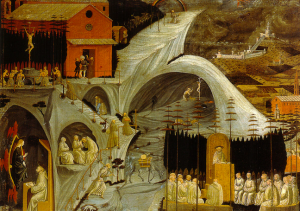
The Thebaid (ca. 1460), by Paolo Uccello. This
was a term for Upper (i.e., southern) Egypt,
associated historically and allegorically with
monasticism.1
There is a famous story in the Apophthegmata,2 a collection of maxims and conversations from the Desert Fathers, the early generations of Egyptian monasticism, often published under the more complicated title Sayings of the Desert Fathers. In Benedicta Ward’s translation, it reads as follows (note that abba, “father,” was a common title and form of address not only for priests but for older or more experienced ascetics):
Abba Lot went to Abba Joseph and said to him, “Abba, as far as I can I say my little office, I fast a little, I pray and meditate, I live in peace as far as I can, I purify my thoughts. What else can I do?” Then the old man stood up and stretched his hands toward heaven. His fingers became like ten lamps of fire and he said to him, “If you will, you can become all flame.”
I’ve never been clear what Abba Joseph was on about—and unluckily, the Apophthegmata isn’t the sort of book where more context will usually explain anything; plenty of its stories have this much context and absolutely no more. Like, if you glanced at the couple hundred words before this text and the couple hundred after it, you’d probably just see the end of the previous cryptic statement and the beginning of the next. So I can’t exactly illuminate this for my readers! Except that I assume it is not what St. Paul is talking to St. Timothy about, which (given the mention of laying on of hands) seems to have to do with conferring holy orders, where Abba Joseph appears to have been speaking about something obtained by ascesis, and thus available in principle to any Christian, though probably obtained in practice by few contemplatives and still fewer actives.3
As far as how it sounds, it is extremely cool, not that I need to tell you that; I mean, you read it, you know how cool it sounds.
II Timothy 1:6-8, 9-12, 13-14, RSV-CE
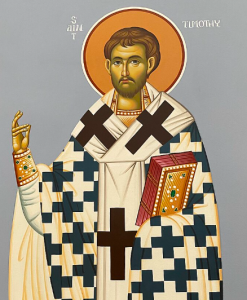
Ikon of St. Timothy, written by Wikimedia
contributor Moralmonke, used under
a CC BY-SA 4.0 license (source).

Hence I remind you to rekindle the gifta of God that is within you through the laying on of my hands; for God did not give us a spirit of timidityb but a spirit of power and love and self-control.
Do not be ashamed then of testifying to our Lord, nor of me his prisoner, but take your share of suffering for the gospel in the power of God, who saved us and called us with a holy calling, not in virtue of our works but in virtue of his own purpose and the grace which he gave us in Christ Jesus ages ago, and now has manifested through the appearing of our Savior Christ Jesus, who abolished death and brought life and immortality to lightc through the gospel. For this gospel I was appointedd a preacher and apostle and teacher, and therefore I suffer as I do. But I am not ashamed, for I know whom I have believed, and I am sure that he is able to guard until that Day what has been entrusted to me.e Follow the pattern of the sound words which you have heard from me, in the faith and love which are in Christ Jesus; guard the truth that has been entrusted to you by the Holy Spirit who dwells withinf us.
II Timothy 1:6-8, 9-12, 13-14, my translation
It is for this cause that I remind you to rekindle the gracious gifta of God, which is in you through the imposition of my hands; for it is no spirit of cowardice God has given us,b but of power and love and self-discipline. Do not then be ashamed of the witness of our Lord, nor of me his bondsman, but co-suffer for the good news according to God’s power, who, saving and calling us, calls for holy things, not according to our works but according to his own purpose and grace, which is given to us in the Anointed, Jesus, before everlasting times, and is now manifested through the appearance of our savior, Jesus the Anointed, who made death inoperative and moreover shed light on life and incorruptibilityc through the good news—into which I was put,d a herald and emissary and teacher. It is for this cause too that I suffer these things, but I am not ashamed, for I know in whom I have put my faith, and am persuaded that he is powerful [enough] to guard my trust,e unto that Day. Keep an outline of healthy words which you have heard from me in the faith and love in the Anointed, Jesus; guard this good trust, through the holy spirit that is housed inf us.
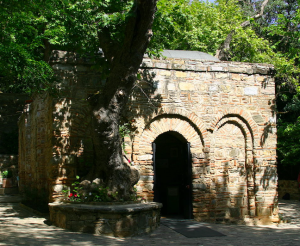
Chapel built over the reputed house of the
Mother of God in Ephesus (modern Selçuk,
Turkey). Photo by Martin Fryc, used under
a CC BY-SA 2.5 license (source).

Textual Notes
a. gift/gracious gift | χάρισμα [charisma]: Catholic terminology generally adapts this word directly: charism. It comes from the base noun χάρις, which means “favor, grace; benefit, blessing, kindness, gift; joy, pleasure, delight; gratitude, thanks.” The ending -μα(τ) is a nominalizing (noun-making) suffix, often indicating something like “instance of” or even “piece of,” usually attached to the stem of a verb. The word charism is therefore more specific than χάρισμα necessarily is in the Greek, since charism generally indicates a grace given to fulfill some specific purpose or function.
b. for God did not give us a spirit of timidity/for it is no spirit of cowardice God has given us | οὐ γὰρ ἔδωκεν ἡμῖν ὁ θεὸς πνεῦμα δειλίας [ou gar edōken hēmin ho theos pneuma deilias]: The syntax of this phrase is hard to convey in English, which has gotten rid of most of its inflections at the cost of a far less flexible word order. The negative (“not” in the RSV, “no” in mine) is the very first word of the phrase: “has not given us” receives the most emphasis here, syntactically.
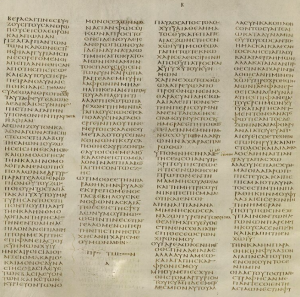
The end of I and beginning of II Timothy in
the Codex Sinaiticus (a 4th-c. manuscript of
the New Testament).
c. now has manifested through the appearing … brought life and immortality to light/now manifested through the appearance … shed light on life and incorruptibility | φανερωθεῖσαν δὲ νῦν διὰ τῆς ἐπιφανείας … φωτίσαντος δὲ ζωὴν καὶ ἀφθαρσίαν [fanerōtheisan de nün dia tēs epifaneias … fōtisantos de zōēn kai aftharsian]: The verbs and participles in this pair of phrases have a lot of imagery suggesting radiance—φανερωθεῖσαν, ἐπιφανείας, and φωτίσαντος (“manifested,” “appearing/appearance,” and “brought to light/shed light on”) all ultimately come from either the verb φαίνω [fainō], “to shine,” or the noun φῶς [fōs], “light.” This is rather characteristic of Paul (the same thing is quite noticeable in the early chapters of II Corinthians, for example); it is easy to see in this the influence of his first encounter with Jesus.
d. For this gospel I was appointed/into which I was put | εἰς ὃ ἐτέθην ἐγὼ [eis ho etethēn egō]: The feel of the Greek here is honestly rather funny. The use of τίθημι [tithēmi], a basic verb meaning “to place, put, set,” is by no means incorrect or overly unusual, but one half expects a compound verb of some kind. The bare verb has a vague feeling of Paul describing himself almost as being shoved in clumsily, like a MacGyvered solution to an unexpected problem.
e. what has been entrusted to me/my trust | τὴν παραθήκην μου [tēn parathēkēn mou]: This rendering on the RSV’s part strikes me as a bit odd. It’s not an impossible reading of the text, but the RSV’s take on the “direction” of the entrusting (what heaven has entrusted to Paul, rather than what Paul has entrusted to heaven) seems counter-intuitive to me; moreover, there are other translations than mine that read it as what Paul has entrusted to heaven, so I assume it isn’t just a matter of me forgetting some rule or other about Greek syntax.
f. dwells within/is housed in | ἐνοικοῦντος ἐν [enoikountos en]: If you’ve been following this blog for a while, or are otherwise familiar with Greek, that -οικο- in the verb may look familiar; this is one of the many derivatives of οἶκος [oikos] “house, household.”
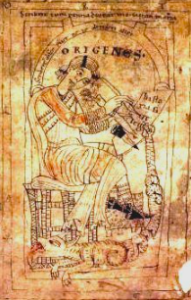
An undated illumination of Origen, a 3rd-c.
Biblical scholar.
Luke 17:5-10, RSV-CE
The apostles said to the Lord, “Increase our faith!” And the Lord said, “If you had faith as a grain of mustard seed,g you could say to this sycamineh tree, ‘Be rooted up, and be planted in the sea,’ and it would obey you.
“Will any one of you, who has a servant plowing or keeping sheep, say to him when he has come in from the field, ‘Come at once and sit down at table’? Will he not rather say to him, ‘Prepare supper for me, and gird yourself and serve me, till I eat and drink; and afterward you shall eat and drink’? Does he thanki the servant because he did what was commanded? So you also, when you have done all that is commanded you, say, ‘We are unworthy servants; we have only done what was our duty.’”j
Luke 17:5-10, my translation
And the emissaries said to the Lord: “Add to our faith.”
But the Lord said, “If you have faith like a mustard seed,g if you were to tell this mulberryh tree, ‘Be uprooted and be implanted in the sea,’ it would even obey you. Will any of you who has a slave plowing or shepherding say to him as he comes in from the field: ‘Come here right away and sit down’?—won’t he rather say, ‘Prepare something for me to dine on, belt yourself up, and serve me while I eat and drink, and after that, you shall eat and drink’? Does he give thanksi to his slave that he did what he was charged with? Likewise, you also, whenever you do everything that you have been charged with, say that ‘We are useless slaves, doing what we ought to have done.'”j
Textual Notes
g. as a grain of mustard seed/like a mustard seed | ὡς κόκκον σινάπεως [hōs kokkon sinapeōs]: Mustard (probably Brassica nigra, or black mustard) gives seeds barely a few millimeters across. (When I was young, for some reason every message I heard about this text seemed to want to use it as an example of why quality is so much more important than quantity. I’m now baffled by this, largely because what, in this context, is that supposed to mean? In what way can faith be divided into contrastable amounts? How can those then be further contrasted with the, I don’t know, grade of the faith in question? Is amount of faith measured in pounds, or gallons? grade in carats, or perhaps parts per million?)
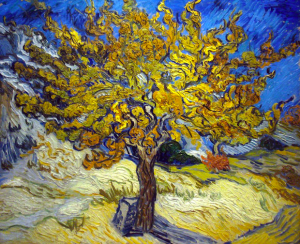
The Mulberry Tree (1889), by Vincent van Gogh.
h. sycamine/mulberry | συκαμίνῳ [sükaminō]: The species here is unclear. Sycamine, or sycomore-fig,4 is one possibility, mulberry another. (Mulberries themselves apparently look like elongated blackberries.)
i. thank/give thanks to | ἔχει χάριν [echei charin]: I went with the slightly more elaborated give thanks to to suggest the literal meaning here, which is “have favor” or “keep grace.”
j. We are unworthy servants; we have only done what was our duty/We are useless slaves, doing what we ought to have done | Δοῦλοι ἀχρεῖοί ἐσμεν, ὃ ὠφείλομεν ποιῆσαι πεποιήκαμεν [douloi achreioi esmen, ho ōfeilomen poiēsai pepoiēkamen]: “Useless” in my translation is perhaps overly literal (ἀχρεῖοί would have been part of a stock expression of unworthiness, and a little hyperbolic); translations that use “unprofitable” are arguably nearer the mark—”nothing special” or “unremarkable” might do in a paraphrase.
Footnotes
1Upper Egypt was so called because it was higher in elevation—traveling south along the course of the Nile, the terrain slopes up, as we should expect if we remember that water does not slope up. However, Upper Egypt forms a stronger contrast with Lower Egypt (basically just the environs of the Nile Delta and Faiyum Oasis) than, say, the Prairies do with the Atchafalaya Basin. The North American Prairies are drier than the Gulf Coast, sure, but only relatively; conversely, the wide riverine plains of Lower Egypt differ sharply from the terrain to the south. Surrounded by untamed desert to both west and east, as one enters Upper Egypt, the habitable regions withdrew to the immediate environs by the course of the Nile. Upper Egypt was also called the Thebaid, i.e. the region around or marked by Thebes (a Greek name: the Egyptian name Waset). If we aren’t counting St. John the Baptist, Christian monasticism was born in Egypt, and the Thebaid was an important center of it; it came to symbolize the hard-won wisdom of the contemplative life. Accordingly, though hard to spot at this scale, this painting includes nods to the stigmatization of St. Francis at the top, St. Jerome in his cave in the center, St. Bernard’s vision of the Mother of God on the lower left, and St. Benedict preaching a sermon on the lower right.
2In English, this word means “apophthegms.”
3If this distinction isn’t familiar, the contemplative life means a life lived withdrawn from the outside world, in continual pursuit of prayer and meditation. This form of life is associated with the cloistered orders (otherwise known as monks proper and nuns)—the Benedictines, Discalced Carmelites, Poor Clares, and Trappists are examples. However, the contemplative life is not identical with the religious life; some orders live and work “in the world” (often though not always as teachers), like the Dominicans, the Jesuits, or the Missionaries of Charity. Both religious whose work is in the world, and all Catholics who are not vowed religious, lead the active life, which complements the contemplative. (Religious who lead active lives are typically called friars or brothers, or sisters, rather than monks or nuns.)
4I am unable to explain why, in this case, it isn’t spelled “sycamore” like it is everywhere else, but it does bother me.
Previous Post
September 30, 2025
And People Say Jesus Never Laughed ...
Next Post
October 7, 2025 The Cleansing of the Ten Lepers
Recent Comments
"On the contrary, such a proclamation, among the Aztecs or Maya, would be disastrously misunderstood. ..."
The Gospel of John: The Bread ..."
"Many thanks for your scholarly study on the Cleansing of the Ten Lepers in the ..."
The Cleansing of the Ten Lepers
"Four Last Things: not the video game, but Death, Judgment, Heaven and Hell.Momento mori. Remember, ..."
"I am going by the time that these sayings began to be converted into written ..."
Are Our Bibles in the Wrong ..."
Browse Our Archives
Select a Category abuse antifascism art bad Catholic celibacy chastity Church crucifixion culture war eros forgiveness gay gender homophobia ikons language liturgy peace poems politics Pope Francis prayer pro-life race recommendations reform repentance review sacraments saints satire scandal schism scripture sex suffering theology Uncategorized violence
Select a Month October 2026 September 2026 August 2026 July 2026 June 2026 May 2026 April 2026 March 2026 February 2026 January 2026 December 2025 November 2025 October 2025 September 2025 August 2025 July 2025 June 2025 May 2025 April 2025 March 2025 February 2025 January 2025 December 2024 November 2024 October 2024 September 2024 August 2024 July 2024 June 2024 May 2024 April 2024 March 2024 February 2024 January 2024 December 2023 November 2023 October 2023 September 2023 August 2023 July 2023 June 2023 May 2023 April 2023 March 2023 February 2023 January 2023 December 2022 November 2022 October 2022 September 2022 August 2022 July 2022 June 2022 May 2022 April 2022 March 2022 February 2022 January 2022 December 2021 November 2021 October 2021 September 2021 August 2021 July 2021 June 2021 May 2021 April 2021 March 2021 February 2021 January 2021 December 2020 November 2020 October 2020 September 2020 August 2020 July 2020 June 2020 May 2020 April 2020 March 2020 February 2020 January 2020 December 2019 November 2019 October 2019 September 2019 August 2019 July 2019
Follow Us!
TAKE THE
Religious Wisdom Quiz
Which book records the walls of Jerusalem being rebuilt?
Select your answer to see how you score.
Malachi Haggai Nehemiah Ezra
Related posts from Mudblood Catholic

The Sermon on the Mount, Part I: Matthew...

The Gospel of Matthew: Christ and Antichrist

John the Baptist and the Winnowing Fork: Matthew...

The Gospel of Matthew: The Coventry Carol
TRENDING AT PATHEOS Catholic

Catholic Evangelization: Sharing Your Faith Every Day
Welcome back to the Graceful Awakening mini-series called, “From Faith to Mission.” ...

The Pillar of the Boatmen: the Ancient Monument...
The Pillar of the Boatmen is a Romano-Gaulish sculpture that dates from...

In one sense walking into Westminster Abbey is like walking down the...

'Super Scam Me' Exposes AI Jon Bon Jovi...
Leslie Pickett believed she was in a relationship with Jon Bon Jovi....

The Brazilian Remake of Kendricks' 'Flywheel' Opens in...
“Flywheel,” the story that launched the Kendrick Brothers’ filmmaking career is getting...

The Dangers of Gradual Accommodation (Winking at Sin)
Recently, the “law of gradualness” resurfaced during the opening of a weeklong,...
view all Catholic blogs
What Are Your Thoughts?leave a comment
Ad-Free & Subscriber Log-In Subscription Support
- About Us
- 2026 Calendar
- Videos
- Podcasts
- Library of World Religions
- Faith In Media Tracker
- Advertise With Us
- Write for Us
- Privacy Policy
- Terms of Service
- Do Not Sell My Data
- Contact Us
- Radiant Digital
- Manage Newsletter Subscriptions
- Unsubscribe From Notifications
- Sitemap
Copyright 2008-2026, Patheos. All rights reserved.
Subscription Support Ad-Free & Subscriber Log-In
Follow Patheos