
BuddhistCatholicContemplativeEvangelicalGeneral ChristianHinduJewishLatter-day SaintMuslimNew VisionsProgressive Christian
Beliefs
- Buddhist
- Catholic
- Contemplative
- Evangelical
- General Christian
- Hindu
- Jewish
- Latter-day Saint
- More Voices
- Muslim
- New Visions
- Pagan
- Progressive Christian
Topics
- Religion News
- Food and Religion
- Sports and Religion
- Religious Art
- Religious Music and Entertainment
- Religious Events
- History and Religion
- Style and Religion
- Politics and Religion
- Women in Religion
- Recreation Outdoors and Religion
- Business Finance and Religion
- Careers Workplace and Religion
- Education and Religion
- Family Parenting and Religion
- Health Fitness and Religion
- Home and Religion
- Relationships and Religion
- Technology and Religion
- Travel and Religion
Columnists
- Buddhist Columnists
- Business Finance and Religion Columnists
- Careers Workplace and Religion Columnists
- Catholic Columnists
- Contemplative Columnists
- Education and Religion Columnists
- Evangelists Columnists
- Family Parenting and Religion Columnists
- General Christian Columnists
- Health Fitness and Religion Columnists
- Hindu Columnists
- History and Religion Columnists
- Home and Religion Columnists
- Jewish Columnists
- More Voices Columnists
- Latter Day Columnists
- Muslim Columnists
- New Visions Columnists
- Nonreligious Columnists
- Pagan Columnists
- Politics and Religion Columnists
- Progressive Columnists
- Recreation Outdoors and Religion Columnists
- Relationships and Religion Columnists
- Religion News Columnists
- Religious Art Columnists
- Religious Events Columnists
- Religious Music and Entertainment Columnists
- Sports and Religion Columnists
- Style and Religion Columnists
- Technology and Religion Columnists
- Travel and Religion Columnists
- Women in Religion Columnists
Resource Library
- 2026 Calendar
- Library of World Religions
- The 100 Most Holy Places on Earth
- Patheos Answers
- Podcasts
- Videos
- Faith Leaders Database
- Anglican Episcopalian
- Bahai
- Baptist
- Buddhism
- Christianity
- Confucianism
- Eastern Orthodoxy
- Hinduism
- Holiness and Pentecostal
- ISKCON
- Islam
- Judaism
- Lutheran
- Methodist
- The Church of Jesus Christ of Latter-day Saints
- New Age
- Paganism
- Presbytarian and Reformed
- Protestantism
- Religion Behind the Scenes
- Roman Catholic
- Scientology
- Shia Islam
- Sikhism
- Sufism
- Sunni Islam
- Taoism
- Zen
- See all religions
Research Tools
 Ad-Free & Subscriber Log-In Subscription Support
Ad-Free & Subscriber Log-In Subscription Support
Follow Patheos 

- Trending:
- Forgiveness
- |
- Marriage
- |
- Consciousness
- |
- Death Penalty
- |
- Election
- |
- Halloween

- Home
- Catholic
- Business, Finance and Religion
- And People Say Jesus Never Laughed …
And People Say Jesus Never Laughed …
Last updated on: October 6, 2025 at 9:43 pm by Gabriel Blanchard
And People Say Jesus Never Laughed … 2025-10-06T21:43:17-04:00 Gabriel Blanchard
Patheos Explore the world's faith through different perspectives on religion and spirituality! Patheos has the views of the prevalent religions and spiritualities of the world.
Po’ Lazarus
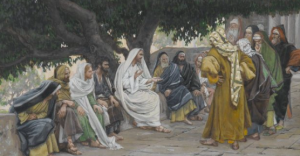
Les Pharisiens et les Saducéens Viennent Pour
Tenter Jésus [The Pharisees and Sadducees Come
to Tempt Jesus] (ca. 1885-1895), by James Tissot.1
Now that both Sunday and Michaelmas have passed, I decided to do the Gospel from this past Sunday after all. It’s another beloved parable unique to Luke, that of the rich man and Lazarus. However, as usual, I’ve given the names their Hebraic forms: instead of Lazarus, Abraham, and Moses, you’ll here see Eleazar, Avraham, and Moshe.
The rich man, interestingly, is given no name. In itself this is not so unusual; Jesus doesn’t name the characters in his parables often—in fact, I think this is the only parable where he does so. But in this one, it leaves the rich man strikingly anonymous beside the other two principals. The rich man is occasionally given a kind of pseudo-name in English, in the form of the Latin adjective dīves, which means “wealthy” (typical modern pronunciation being dee-vase). It is derived from the same root as the terms dīvus and deus, “divine” and “god, deity.” The usage is rare outside of fairly archaic and specially literary contexts, but if you ever run across an allusion to “Dives and Lazarus,” this is why.
The setting of this parable’s original telling is not altogether clear. The last specific place-name indications were in chapter 13, in vv. 22 and 31-35, which stated that Jesus was on his way to Jerusalem and therefore somewhere outside of it—specifically (v. 31), somewhere within the dominions of Herod Antipas. This actually does narrow things down, as Herod ruled only the Galilee and Perea (see map). Since Jesus is later described (17:11-19) as crossing through Samaria to get to Judæa proper, which is the next geographical statement in the text, we can deduce that this almost certainly took place in the Galilee; that said, the bulk of his ministry is thought to have been in the Galilee in any case, so that doesn’t allow us to deduce much more.
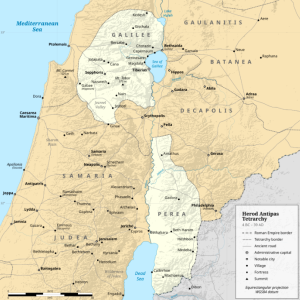
The tetrarchy of Herod Antipas is shown in off-
white. Map by Wikimedia contributor DEGA
MD, used under a CC BY-SA 4.0 license (source).

If—against probability—this did take place in Perea, it would be easier to read this parable as being aimed at the Sadducees. The Sadducees were mostly כּוֹהֲנִים [kouhànym], i.e. not only Levites but specifically priests. They were pretty strongly concentrated in Judæa for that reason, and any outliers would have been likelier to live in Perea than Samaria or the Galilee; mainstream Judaism was unpopular in Samaria, and the Galilee was much too far away for prompt travel to Jerusalem, so Sadduceeism was probably vanishingly rare up north.
Now, just a few lines ago, in v. 14 of this chapter, Luke notes that “the Pharisees heard all this,” i.e., the Parable of the Unjust Steward, and scoffed at it because they were “lovers of money” (φιλάργυροι [filargüroi] in Greek, and can I just say that I wish we’d needlessly imported the word philargyry as a synonym for avarice,2 because it both sounds and looks great—I’m now dying to call someone a philargyrist). This is interesting, because what it doesn’t describe them as is rich; in any group as large as the Pharisees, who were the Judaic mainstream in both the Holy Land and Mesopotamia, there were presumably some wealthy individuals, but it hardly seems possible that the majority of them were. Nonetheless, we know only too well how obsessively we can love something we do not possess.
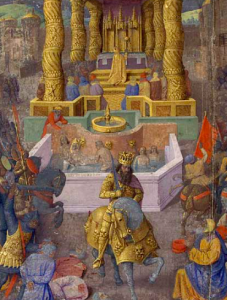
An illumination (ca. 1470-1475) of the capture
of Jerusalem by Herod the Great, by the French
Renaissance miniaturist Jean Fouquet.
But you know who were wealthy? Sadducees. They were the party of the hereditary Judean aristocracy—not that all of the wealthy were Sadducees by any means, but that their views both expressed and protected aristocratic interests: collaboration with the Romans and with the Herod dynasty. (The Gospel of Mark contains several references to the Herodians, who, to the extent the two differed, would be the political wing to the Sadducees’ ecclesiastical wing.) Anyone from real life who was wealthy enough to be wearing fine linen and Tyrian purple and holding a feast every day would more than likely be a Sadducee; not that this parable had a clear in-real-life “target” (it may have, but if so, I doubt we can discern whom any more), but that the person listeners would have imagined would probably be associated with that class. And the rich man’s soul being tormented in the afterlife would in that case have had an added spice, since the Sadducees didn’t believe there was any afterlife to be tormented in. In that light, along with the main message of the parable delivered in v. 31, the post-mortem scenario this parable establishes would function as a more Pharisee-specific warning: y’all sure you love silver this much?
However, like I said, the presumptions that most easily facilitate that perspective on this parable seem unlikely. Speaking of which, let’s turn to our text.
Luke 16:19-31, RSV-CE
There was a rich man, who was clothed in purple and fine linena and who feasted sumptuouslyb every day. And at his gate lay a poor man named Lazarus,c full of sores, who desired to be fed with what fell from the rich man’s table; moreover the dogsd came and licked his sores. The poor man died and was carried by the angels to Abraham’s bosom.f The rich man also died and was buried;e and in Hades,g being in torment, he lifted up his eyes, and saw Abraham far off and Lazarus in his bosom. And he called out, “Father Abraham, have mercy upon me, and send Lazarush to dip the end of his finger in water and cool my tongue; for I am in anguish in this flame.” But Abraham said, “Son, remember that you in your lifetime received your good things,i and Lazarus in like manner evil things; but now he is comforted here, and you are in anguish. And besides all this, between us and you a great chasm has been fixed, in order that those who would pass from here to you may not be able, and none may cross from there to us.” And he said, “Then I beg you, father, to send him to my father’s house,j for I have five brothers, so that he may warn them, lest they also come into this place of torment.” But Abraham said, “They have Moses and the prophets; let them hear them.” And he said, “No, father Abraham; but if some one goes to them from the dead, they will repent.”k He said to him, “If they do not hear Moses and the prophets, neither will they be convinced if some one should rise from the dead.”L
Luke 16:19-31, my translation
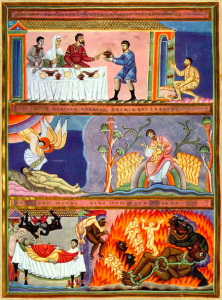
Lazarus and Dives, an illumination from
the 11th-c. Codex Aureus of Echternach.
There was a certain rich person, clothed in both purple and fair linen,a opulentlyb making merry every day. A certain beggar, Eleazarc by name, was thrown at his gateway, covered in sores, and craving to be filled from what fell from the rich man’s counter; besides, dogsd also came and licked his sores. Now the beggar’s death came, and he was carried away by the messengers to the lap of Avraham;f the rich man also died, and was buried.e And in hell,g he lifted up his eyes, while in tortures, and saw Avraham from far off, and Eleazar in his lap. And calling, he said: “Father Avraham, have mercy on me and send Eleazarh in order that he may dip the tip of his finger in water and cool down my tongue, because I am in agony in this flame.”
But Avraham said, “Child, remember that you took in your good things in your life,i and Eleazar bad things likewise; now, he is encouraged here and you are in agony. And on top of all these things, between us and you, a large chasm is established, so that those who want to go over from there toward you should not be able to, nor can they cross from there over toward us.”
So he said, “Then I ask you, father, to send him to my father’s house,j for I have five brothers, so that he may bear witness to them, in order that they may not also come into this place of torture.” Avraham said: “They have Moshe and the prophets; may they listen to them.” And he said, “No, father Avraham, but if someone comes to them from the dead, they will have a change of heart.”k But he said, “If they do not listen to Moshe and the prophets, neither will they be persuaded if someone should rise from the dead.”L
Textual Notes
a. purple and fine linen/purple and fair linen | πορφύραν καὶ βύσσον [porfüran kai büsson]: Πορφύρα, or true Tyrian purple, was the most expensive dye available in the ancient world, generally producing a deep purplish-red color; this is why it has given its name to the variety of stone known as porphyry.
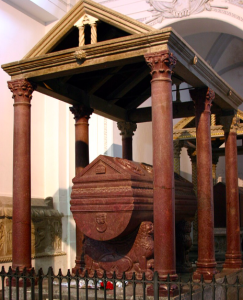
The sarcophagus of Holy Roman Emperor
Frederick II (d. 1250), carved from porphyry.
Photo by José Luis Bernardes Ribeiro, used
under a CC BY-SA 4.0 license (source).

As for βύσσος [büssos], this was both the name of the flax from which a type of linen was spun, and the name of the linen itself. This kind of flax was grown especially in Egypt, and the linen spun from it was generally white (sometimes yellow) and exceptionally soft. Linen was a comparatively luxurious textile, in part because it is an extremely breathable fabric, which is the sort of thing you want in a hot climate. Other available textiles would include silk (another luxury fabric, but less climate-adapted than linen), cotton (which, as you probably know from wearing jeans, isn’t miserable in the heat, but isn’t super-breathable either) and wool (which is great at keeping you warm, even when it’s wet).
b. sumptuously/opulently | λαμπρῶς [lamprōs]: This word indicates not just finery, but, specifically, showiness; it is derived from an adjective meaning “splendid, radiant.”
c. Lazarus/Eleazar | Λάζαρος [Lazaros]: The Hebrew form of this name is אֶלְעָזָר [‘El’uâzâr], meaning “God-help” (the name Ebenezer is related). So far as I can see, it isn’t relevant to the interpretation of this parable, but I wonder whether Jesus used this name with his mind on his friend Lazarus of Bethany, the brother of Martha and Mary.
d. dogs | κύνες [künes]: It’s important to note that, unlike today, dogs were not necessarily seen first and foremost as sweet household pets. Dogs have been domestic animals for many thousands of years; they were probably the first animals humans ever tamed, and were used both for hunting and in guarding flocks. However, among Jews, they were also unclean animals—all carnivores and omnivores are—and dogs were habitually fed scraps (the idea of “dog food” as something deliberately prepared didn’t really exist before the nineteenth century). Accordingly, being licked by dogs, even if they were being affectionate, would probably be an added indignity to Eleazar’s condition.
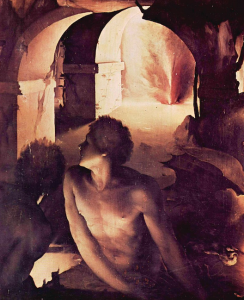
Inferno [Hell] (1530), by Domenico Beccafumi—
an unusually eerie portrayal of hell.3
e. The poor man died and was carried by the angels to Abraham’s bosom. The rich man also died and was buried/Now the beggar’s death came, and he was carried away by the messengers to the lap of Avraham; the rich man also died, and was buried | ἐγένετο δὲ ἀποθανεῖν τὸν πτωχὸν καὶ ἀπενεχθῆναι αὐτὸν ὑπὸ τῶν ἀγγέλων εἰς τὸν κόλπον Ἀβραάμ· ἀπέθανεν δὲ καὶ ὁ πλούσιος καὶ ἐτάφη [egeneto de apothanein ton ptōchon kai apenechthēnai auton hüpo tōn angelōn eis ton kolpon Abraam: apethanen de kai ho plousios kai etafē]: Note the contrasting movement of these two clauses: the allusion to angels brings upward motion to mind, whereas death and burial suggest a compounding downward movement.
f. Abraham’s bosom/the lap of Avraham | τὸν κόλπον Ἀβραάμ [ton kolpon Abraam]: Remember when you were a kid and you’d use the bottom edge of your shirt as a sort of makeshift basket sometimes? That’s what a κόλπος [kolpos] is. (Which sounds like a line from a Stefon sketch on Saturday Night Live. “Stefon, what is a kolpos?” “You know that thing of when you use your shirt as a basket, and [insert joke that crosses so many lines in rapid succession that even Bill Hader can barely bring himself to tell it]?”)
g. in Hades/in hell | ἐν τῷ ᾅδῃ [en tō hadē]: In origin, ᾅδης [hadēs] meant “the unseen” or “the invisible.” The Hebrew equivalent was שְׁאוֹל [sh’oul], which became שׁיוּל [shyuul] in Aramaic; I was unable to find an etymology for this term. The English word hell is related to the name of the Norse goddess ᚻᛖᛚ [Hel], who was the queen of the netherworld. Interestingly, though not related etymologically to ᾅδης, hell and ᚻᛖᛚ do come from an Indo-European root meaning “to cover, conceal,” and thus correspond to it in sense.
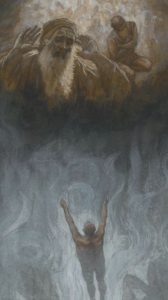
Le Mauvais Riche Dans L’Enfer [The Bad Rich
Man in Hell] (ca. 1885-1895), by James Tissot.
h. send Lazarus/send Eleazar | πέμψον Λάζαρον [pempson Lazaron]: Dives shows himself remarkably ready to assume that Eleazar is just at his disposal in the afterlife (a habitual objectification that he never gets past throughout the parable).
i. you in your lifetime received your good things/you took in your good things in your life | ἀπέλαβες τὰ ἀγαθά σου ἐν τῇ ζωῇ σου [apelabes ta agatha sou en tē zōē sou]: The rebuke here is veiled almost to the point of nonexistence. The rich man callously ignored Eleazar, presumably for decades, while glutting himself; he does this thanks to wealth whose origins we are not given in detail, but the wealthy don’t seem to have been morally better back then than they are now. If, as discussed in the intro, the Sadducees were particularly in view here, their collaboration with the Romans as well as their sinecure positions as aristocrats probably netted them some lucre that was more or less filthy, as the saying goes.
j. Then I beg you, father, to send him to my father’s house/Then I ask you, father, to send him to my father’s house | Ἐρωτῶ σε οὖν, πάτερ, ἵνα πέμψῃς αὐτὸν εἰς τὸν οἶκον τοῦ πατρός μου [erōtō se oun, pater, hina pempsēs auton eis ton oikon tou patros mou]: Here, there is at last a glimmer of disinterestedness in the rich man. It is not perhaps much: it takes only his own family into account, and only after his first request (which was entirely self-centered) has proven impractical. Yet it is something, all the same.
k. they will repent/they will have a change of heart | μετανοήσουσιν [metanoēsousin]: This word, conventionally translated “repent,” is ultimately derived from the word νοῦς [nous], meaning “mind.” However, the connotations of the expression “change one’s mind” are lighter, even a bit trivial, compared with those of the expression “change of heart.”
It might seem like sending Eleazar would be an effective antidote to his relatives’ complacency, but with a little thought, it’s difficult not to see the patriarch’s point here. Step back and think for a moment: what Dives is requesting is for Eleazar to haunt his siblings. Now ask yourself—how many people do you know who didn’t believe in ghosts at one point, encountered one, changed their minds, and listened to whatever message the ghost might have for them? Is it zero? Because I’m betting it’s zero (and if it’s not, that friend of yours is a statistical outlier). Most people who see ghosts already believed in them, and most people who disbelieve in ghosts can explain away pretty much any apparition.

A “stairway to nowhere” from the Winchester
Mystery House in San Jose, CA, a famous
haunted house.4 Photo by Susan Gerbic, used
under a CC BY-SA 4.0 license (source).

l. If they do not hear Moses and the prophets, neither will they be convinced if some one should rise from the dead/If they do not listen to Moshe and the prophets, neither will they be persuaded if someone should rise from the dead | Εἰ Μωϋσέως καὶ τῶν προφητῶν οὐκ ἀκούουσιν, οὐδ’ ἐάν τις ἐκ νεκρῶν ἀναστῇ πεισθήσονται [ei Mōüseōs kai tōn profētōn ouk akouousin, oud’ ean tis ek nekrōn anastē peisthēsontai]: I find it impossible to picture Jesus saying this without a sly smile on his face. You cannot convince me otherwise: this sentence is a joke, almost a practical joke.
Footnotes
1I love that Tissot chose to depict not one but two of the challengers in the arms-akimbo “Now you listen here, mister man!” stance.
2The term’s literal meaning is “love of silver” (ἄργυρος [argüros], Ancient Greek for “silver,” comes from a root meaning “white, shining”). Silver, not gold, was the principal metal from which currency was coined both in Classical Antiquity and the Middle Ages: both metals are rare, but silver is much the more common of the two, although it usually occurs in compounds with something else, like nickel or copper. Gold, copper, and electrum were also used—electrum is a naturally-occurring gold-silver alloy, known colloquially as “green gold” (the Greek ἤλεκτρον [ēlektron] originally referred to amber; the fact that we got the term “electron” from it is not a coincidence—static electricity was discovered partly because amber easily becomes charged, e.g. by rubbing it against wool). But silver was the main thing.
3Depictions of hell are almost universally horrible, as in the Divine Comedy, and sometimes ridiculous as well, as in the works of Hieronymus Bosch; occasionally, one instead finds a dreary hell, as in The Great Divorce. But this painting is one of the few examples I can think of in which creepiness, rather than obvious horror, is the top note: the figures in this picture appear alarmed, as if wary of something that might be approaching, but still unsure at the same time. The only comparison I can think of for this—which is rather outside the circle of Christian eschatology—is the fifth season of the horror podcast The Magnus Archives.
4The Winchester Mystery House is named for Sarah Winchester, the widow of William Winchester (d. 1881); he had been treasurer of the Winchester Repeating Arms Company, a firearms manufacturer. After her death, rumors flourished (apparently without any real foundation) that she had been warned by a medium to keep construction going incessantly on her properties in order to appease the spirits of those who were killed by Winchester rifles. The Winchester Mystery House exhibits a number of eccentricities, including staircases, windows, and doorways to nowhere, spiderweb designs in stained glass, and the recurrence of the number thirteen in various features.
Business, Finance and Religion
Careers, Workplace and Religion
Previous Post
September 26, 2025
Michaelmas, Part II: The Angelic Gospel
Next Post
October 6, 2025 If You Will, You Can Become All Flame
Recent Comments
"On the contrary, such a proclamation, among the Aztecs or Maya, would be disastrously misunderstood. ..."
The Gospel of John: The Bread ..."
"Many thanks for your scholarly study on the Cleansing of the Ten Lepers in the ..."
The Cleansing of the Ten Lepers
"Four Last Things: not the video game, but Death, Judgment, Heaven and Hell.Momento mori. Remember, ..."
"I am going by the time that these sayings began to be converted into written ..."
Are Our Bibles in the Wrong ..."
Browse Our Archives
Select a Category abuse antifascism art bad Catholic celibacy chastity Church crucifixion culture war eros forgiveness gay gender homophobia ikons language liturgy peace poems politics Pope Francis prayer pro-life race recommendations reform repentance review sacraments saints satire scandal schism scripture sex suffering theology Uncategorized violence
Select a Month October 2026 September 2026 August 2026 July 2026 June 2026 May 2026 April 2026 March 2026 February 2026 January 2026 December 2025 November 2025 October 2025 September 2025 August 2025 July 2025 June 2025 May 2025 April 2025 March 2025 February 2025 January 2025 December 2024 November 2024 October 2024 September 2024 August 2024 July 2024 June 2024 May 2024 April 2024 March 2024 February 2024 January 2024 December 2023 November 2023 October 2023 September 2023 August 2023 July 2023 June 2023 May 2023 April 2023 March 2023 February 2023 January 2023 December 2022 November 2022 October 2022 September 2022 August 2022 July 2022 June 2022 May 2022 April 2022 March 2022 February 2022 January 2022 December 2021 November 2021 October 2021 September 2021 August 2021 July 2021 June 2021 May 2021 April 2021 March 2021 February 2021 January 2021 December 2020 November 2020 October 2020 September 2020 August 2020 July 2020 June 2020 May 2020 April 2020 March 2020 February 2020 January 2020 December 2019 November 2019 October 2019 September 2019 August 2019 July 2019
Follow Us!
TAKE THE
Religious Wisdom Quiz
Who said, "To the pure, all things are pure"?
Select your answer to see how you score.
Paul John Peter James
Related posts from Mudblood Catholic

The Sermon on the Mount, Part I: Matthew...

The Gospel of Matthew: Christ and Antichrist

John the Baptist and the Winnowing Fork: Matthew...

The Gospel of Matthew: The Coventry Carol
TRENDING AT PATHEOS Catholic

'Super Scam Me' Exposes AI Jon Bon Jovi...
Leslie Pickett believed she was in a relationship with Jon Bon Jovi....

The Brazilian Remake of Kendricks' 'Flywheel' Opens in...
“Flywheel,” the story that launched the Kendrick Brothers’ filmmaking career is getting...

The Dangers of Gradual Accommodation (Winking at Sin)
Recently, the “law of gradualness” resurfaced during the opening of a weeklong,...

The Iron Gates and the Lion of the...
Yesterday, I didn't finish my report about, well, yesterday. So I'll...

The Image: On the Horror of Capitalism and...
The Image Then went the Pharisees, and took counsel how they might...

We are approaching the date of our new American national holiday: October...
view all Catholic blogs
What Are Your Thoughts?leave a comment
Ad-Free & Subscriber Log-In Subscription Support
- About Us
- 2026 Calendar
- Videos
- Podcasts
- Library of World Religions
- Faith In Media Tracker
- Advertise With Us
- Write for Us
- Privacy Policy
- Terms of Service
- Do Not Sell My Data
- Contact Us
- Radiant Digital
- Manage Newsletter Subscriptions
- Unsubscribe From Notifications
- Sitemap
Copyright 2008-2026, Patheos. All rights reserved.
Subscription Support Ad-Free & Subscriber Log-In
Follow Patheos