
BuddhistCatholicContemplativeEvangelicalGeneral ChristianHinduJewishLatter-day SaintMuslimNew VisionsProgressive Christian
Beliefs
- Buddhist
- Catholic
- Contemplative
- Evangelical
- General Christian
- Hindu
- Jewish
- Latter-day Saint
- More Voices
- Muslim
- New Visions
- Pagan
- Progressive Christian
Topics
- Religion News
- Food and Religion
- Sports and Religion
- Religious Art
- Religious Music and Entertainment
- Religious Events
- History and Religion
- Style and Religion
- Politics and Religion
- Women in Religion
- Recreation Outdoors and Religion
- Business Finance and Religion
- Careers Workplace and Religion
- Education and Religion
- Family Parenting and Religion
- Health Fitness and Religion
- Home and Religion
- Relationships and Religion
- Technology and Religion
- Travel and Religion
Columnists
- Buddhist Columnists
- Business Finance and Religion Columnists
- Careers Workplace and Religion Columnists
- Catholic Columnists
- Contemplative Columnists
- Education and Religion Columnists
- Evangelists Columnists
- Family Parenting and Religion Columnists
- General Christian Columnists
- Health Fitness and Religion Columnists
- Hindu Columnists
- History and Religion Columnists
- Home and Religion Columnists
- Jewish Columnists
- More Voices Columnists
- Latter Day Columnists
- Muslim Columnists
- New Visions Columnists
- Nonreligious Columnists
- Pagan Columnists
- Politics and Religion Columnists
- Progressive Columnists
- Recreation Outdoors and Religion Columnists
- Relationships and Religion Columnists
- Religion News Columnists
- Religious Art Columnists
- Religious Events Columnists
- Religious Music and Entertainment Columnists
- Sports and Religion Columnists
- Style and Religion Columnists
- Technology and Religion Columnists
- Travel and Religion Columnists
- Women in Religion Columnists
Resource Library
- 2026 Calendar
- Library of World Religions
- The 100 Most Holy Places on Earth
- Patheos Answers
- Podcasts
- Videos
- Faith Leaders Database
- Anglican Episcopalian
- Bahai
- Baptist
- Buddhism
- Christianity
- Confucianism
- Eastern Orthodoxy
- Hinduism
- Holiness and Pentecostal
- ISKCON
- Islam
- Judaism
- Lutheran
- Methodist
- The Church of Jesus Christ of Latter-day Saints
- New Age
- Paganism
- Presbytarian and Reformed
- Protestantism
- Religion Behind the Scenes
- Roman Catholic
- Scientology
- Shia Islam
- Sikhism
- Sufism
- Sunni Islam
- Taoism
- Zen
- See all religions
Research Tools
 Ad-Free & Subscriber Log-In Subscription Support
Ad-Free & Subscriber Log-In Subscription Support
Follow Patheos 

- Trending:
- Forgiveness
- |
- Marriage
- |
- Consciousness
- |
- Death Penalty
- |
- Election
- |
- Halloween

- Home
- Catholic
- History and Religion
- There Is, Very Rarely, Such a Thing as Free Lunch
There Is, Very Rarely, Such a Thing as Free Lunch
Last updated on: October 6, 2025 at 10:41 pm by Gabriel Blanchard
There Is, Very Rarely, Such a Thing as Free Lunch 2025-10-06T22:41:54-04:00 Gabriel Blanchard
Patheos Explore the world's faith through different perspectives on religion and spirituality! Patheos has the views of the prevalent religions and spiritualities of the world.
Well, at Least Once, Anyway
I thought I had translated two other Gospels’ accounts of this miracle before—John’s last July, and Mark’s … at some point. In truth, I had bamboozled myself: Just before translating John’s account of the feeding of the five thousand,1 I translated Mark’s lead-in to this miracle, which by itself was our Gospel text for the Sunday before we started in on John.

Loaves and fishes from the Catacombs
of Callixtus (3rd century?).
This miracle is a remarkable one. It’s one of the few outside the Passion and Resurrection which all four Gospels, across the Synoptic-Johannine divide, record; it is also a favorite motif in primitive Christian art and patristic commentary, frequently receiving a eucharistic interpretation. Along with the other feeding (that of the four thousand, recorded in Matthew 15 and Mark 8) and the changing of the water into wine (John 2), I believe these are the Lord’s only culinary miracles—though the blasting of the fig tree lies adjacent on one side, and the institution of the Eucharist on the other. Let’s dig in.
Luke 9:11b-17, RSV-CE
Jesus welcomed the crowds2 and spoke to them of the kingdom of God, and cured those who had need of healing. Now the day began to wear away; and the twelve came and said to him, “Send the crowd away, to go into the villages and country round about, to lodge and get provisions; for we are here in a lonely place.” But he said to them, “You give them something to eat.” They said, “We have no more than five loaves and two fish—unless we are to go and buy food for all these people.” For there were about five thousand men. And he said to his disciples, “Make them sit down in companies, about fifty each.” And they did so, and made them all sit down. And taking the five loaves and the two fish he looked up to heaven, and blessed and broke them, and gave them to the disciples to set before the crowd. And all ate and were satisfied. And they took up what was left over, twelve baskets of broken pieces.
Luke 9:11b-17, my translation
And [Jesus], having welcomed the [crowds], talked to them about the kingship of God, and those who had need of medical aid, he healed.

The day began to slant; so the Twelve came and said to him: “Dismiss the crowd, so that they may journey to the circle of villages and fields to stop in somewhere and find provisions, because this place where we are is a desert.” But he said to them, “You give them something to eat.” So they said, “There is nothing more among us than five loaves of bread and two fish, unless we are to journey to buy food for this whole people.” For something like five thousand men were there.
He said to his students: “Make them take seats, in something like fifties.” And they did just that and made them all take seats. Taking the five loaves of bread and the two fish, he looked up into heaven, blessed them, and broke them up, and gave them to his students to put before the crowd. And all they ate and were full, and twelve baskets picked up the overflow from their broken pieces of bread.
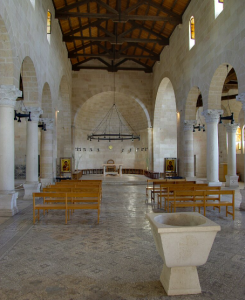
The nave and sanctuary of the Church of
the Multiplication, the traditional site
of this miracle in the Galilee.
Photo by Berthold Werner.
Textual Notes
a. the kingdom of God/the kingship of God | τῆς βασιλείας τοῦ θεοῦ [tēs basileias tou theou]: The distinction between kingdom and kingship is subtle, but less subtle than it may seem. Really, kingship is a rather imperfect way of conveying the real implications of the suffix -εία [-eia]; it tends to imply action considered as a thing. Accordingly, if there were such a verbal noun, “kinging” would be better.
b. Now the day began to wear away/The day began to slant | Ἡ δὲ ἡμέρα ἤρξατο κλίνειν [Hē de hēmera ērxato klinein]: I love this idiom, “the day began to slant”—it’s so visible in the imagination. The verb I’ve translated “slant,” which the RSV renders “wear away,” is κλίνω [klinō]. Its most literal rendering is probably “to recline,” and it does a surprising amount of work in this passage, because, besides it taking place in the afternoon or early evening, it was then customary to recline rather than sit while eating (both the RSV and I translated it in forms of “to sit” just a few verses further down).
c. to lodge/to stop in | καταλύσωσιν [katalüsōsin]: This verb, a form of καταλύω [katalüō], is a strange one to English speakers: Its primary and tertiary meanings are “destroy, dissolve, abolish” and “cast down, overthrow,” while its secondary meaning is “be a guest, lodge”! The closest approximation I could come up with that was somewhat consistent with both meanings was “stop,” since “stopping somewhere” can idiomatically mean staying there temporarily, but, like most verbs of interrupted motion, it can also be used to suggest death or ruin.

d. We have no more/There is no more among us | Οὐκ εἰσὶν ἡμῖν πλεῖον [Ouk eisin hēmin pleion]: We know from John 6 that the five loaves and two fish were actually offered by a little boy from the crowd; I’m sure Luke here is doing nothing more than telescoping the information a little bit, but I can’t help but be amused at the resulting mental picture of the Twelve just commandeering the poor kid’s lunchbox.
e. for all these people/for this whole people | εἰς πάντα τὸν λαὸν [eis panta ton laon]: This phrase reminded me of Moses striking the rock to obtain water for the Israelites, and at first I couldn’t think why. I think it is because of the word λαός [laos] (of which λαὸν is a form). This word can mean “people” or “nation” in general, but it is applied especially to God’s chosen people; this is why it is the root of the English term laity.
f. Make them sit down in companies, about fifty each/Make them take seats, in something like fifties | Κατακλίνατε αὐτοὺς κλισίας ὡσεὶ ἀνὰ πεντήκοντα [Kataklinate autous klisias hōsei ana pentēkonta]: The initial verb there, a form of κατακλίνω [kataklinō], is one of those verbs with a preposition stuck onto it—Greek, like both English and Latin, loves to do this (the line between prepositions and adverbs, which can both answer the question “where?”, is fine-to-nonexistent in several Indo-European languages). This also happens to be a verb that is what we might call “optionally causative,” an option Luke’s author went with here: in other words, the verb can mean either “to do X” or “to cause to do X.”
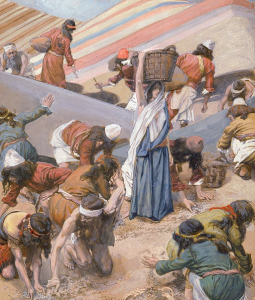
The Gathering of the Manna (1902),
by James Tissot.
The allusion to “fifties”—which, if women and children were counted, probably came to something more like a couple hundred, varying in either direction by as much as a few dozen—may seem mundane at first, since fifty is not a particularly symbolic number in most of Scripture. If it has a symbolic importance, I suspect that importance lies in what we get by doing a little basic math: namely, the fact that there were therefore ten of these fifties. Ten (albeit less so than seven and and twelve) was a number that symbolized perfection; in particular, it represented moral perfection, whether the perfection taught by the Torah or that attained by complete observance of the Torah.
g. were satisfied/were full | ἐχορτάσθησαν [echortasthēsan]: This verb (a form of χορτάζω [chortazō], “to feed, fill up, stuff; to fatten”) is also a funny one in my opinion, just because it almost sounds like an onomatopoeia.
Footnotes
1Which was in reality a feeding, probably, of anywhere from fifteen to twenty-five thousand, since women and children were not counted but (as we know from John) were also present in some number.
2This is not the exact wording of the RSV in context; our reading picks up in the middle of verse 11, so the original RSV-CE text has “he” and “them” rather than “Jesus” and “the crowds.”
History and Religion
Previous Post
June 17, 2025
A Divine Haunting
Next Post

July 4, 2025 St. Paul's Gotta Lot of Problems With You People,
Recent Comments
"On the contrary, such a proclamation, among the Aztecs or Maya, would be disastrously misunderstood. ..."
The Gospel of John: The Bread ..."
"Many thanks for your scholarly study on the Cleansing of the Ten Lepers in the ..."
The Cleansing of the Ten Lepers
"Four Last Things: not the video game, but Death, Judgment, Heaven and Hell.Momento mori. Remember, ..."
"I am going by the time that these sayings began to be converted into written ..."
Are Our Bibles in the Wrong ..."
Browse Our Archives
Select a Category abuse antifascism art bad Catholic celibacy chastity Church crucifixion culture war eros forgiveness gay gender homophobia ikons language liturgy peace poems politics Pope Francis prayer pro-life race recommendations reform repentance review sacraments saints satire scandal schism scripture sex suffering theology Uncategorized violence
Select a Month October 2026 September 2026 August 2026 July 2026 June 2026 May 2026 April 2026 March 2026 February 2026 January 2026 December 2025 November 2025 October 2025 September 2025 August 2025 July 2025 June 2025 May 2025 April 2025 March 2025 February 2025 January 2025 December 2024 November 2024 October 2024 September 2024 August 2024 July 2024 June 2024 May 2024 April 2024 March 2024 February 2024 January 2024 December 2023 November 2023 October 2023 September 2023 August 2023 July 2023 June 2023 May 2023 April 2023 March 2023 February 2023 January 2023 December 2022 November 2022 October 2022 September 2022 August 2022 July 2022 June 2022 May 2022 April 2022 March 2022 February 2022 January 2022 December 2021 November 2021 October 2021 September 2021 August 2021 July 2021 June 2021 May 2021 April 2021 March 2021 February 2021 January 2021 December 2020 November 2020 October 2020 September 2020 August 2020 July 2020 June 2020 May 2020 April 2020 March 2020 February 2020 January 2020 December 2019 November 2019 October 2019 September 2019 August 2019 July 2019
Follow Us!
TAKE THE
Religious Wisdom Quiz
What was the outcome of Sennacherib's army attacking Jerusalem?
Select your answer to see how you score.
They captured Hezekiah Destroyed by an angel They won The city fell
Related posts from Mudblood Catholic

The Sermon on the Mount, Part I: Matthew...

The Gospel of Matthew: Christ and Antichrist

John the Baptist and the Winnowing Fork: Matthew...

The Gospel of Matthew: The Coventry Carol
TRENDING AT PATHEOS Catholic

The Dangers of Gradual Accommodation (Winking at Sin)
Recently, the “law of gradualness” resurfaced during the opening of a weeklong,...

The Iron Gates and the Lion of the...
Yesterday, I didn't finish my report about, well, yesterday. So I'll...

Dolly Parton’s Last Song Wins Dove Award with...
Bluegrass band The Grascals, speaking on the red carpet at the 57th...

The Image: On the Horror of Capitalism and...
The Image Then went the Pharisees, and took counsel how they might...

We are approaching the date of our new American national holiday: October...

Letters on Living the Faith by C.S. Lewis
Most of us met C.S. Lewis as a public intellectual. Mere Christianity....
view all Catholic blogs
What Are Your Thoughts?leave a comment
Ad-Free & Subscriber Log-In Subscription Support
- About Us
- 2026 Calendar
- Videos
- Podcasts
- Library of World Religions
- Faith In Media Tracker
- Advertise With Us
- Write for Us
- Privacy Policy
- Terms of Service
- Do Not Sell My Data
- Contact Us
- Radiant Digital
- Manage Newsletter Subscriptions
- Unsubscribe From Notifications
- Sitemap
Copyright 2008-2026, Patheos. All rights reserved.
Subscription Support Ad-Free & Subscriber Log-In
Follow Patheos