
BuddhistCatholicContemplativeEvangelicalGeneral ChristianHinduJewishLatter-day SaintMuslimNew VisionsProgressive Christian
Beliefs
- Buddhist
- Catholic
- Contemplative
- Evangelical
- General Christian
- Hindu
- Jewish
- Latter-day Saint
- More Voices
- Muslim
- New Visions
- Pagan
- Progressive Christian
Topics
- Religion News
- Food and Religion
- Sports and Religion
- Religious Art
- Religious Music and Entertainment
- Religious Events
- History and Religion
- Style and Religion
- Politics and Religion
- Women in Religion
- Recreation Outdoors and Religion
- Business Finance and Religion
- Careers Workplace and Religion
- Education and Religion
- Family Parenting and Religion
- Health Fitness and Religion
- Home and Religion
- Relationships and Religion
- Technology and Religion
- Travel and Religion
Columnists
- Buddhist Columnists
- Business Finance and Religion Columnists
- Careers Workplace and Religion Columnists
- Catholic Columnists
- Contemplative Columnists
- Education and Religion Columnists
- Evangelists Columnists
- Family Parenting and Religion Columnists
- General Christian Columnists
- Health Fitness and Religion Columnists
- Hindu Columnists
- History and Religion Columnists
- Home and Religion Columnists
- Jewish Columnists
- More Voices Columnists
- Latter Day Columnists
- Muslim Columnists
- New Visions Columnists
- Nonreligious Columnists
- Pagan Columnists
- Politics and Religion Columnists
- Progressive Columnists
- Recreation Outdoors and Religion Columnists
- Relationships and Religion Columnists
- Religion News Columnists
- Religious Art Columnists
- Religious Events Columnists
- Religious Music and Entertainment Columnists
- Sports and Religion Columnists
- Style and Religion Columnists
- Technology and Religion Columnists
- Travel and Religion Columnists
- Women in Religion Columnists
Resource Library
- 2026 Calendar
- Library of World Religions
- The 100 Most Holy Places on Earth
- Patheos Answers
- Podcasts
- Videos
- Faith Leaders Database
- Anglican Episcopalian
- Bahai
- Baptist
- Buddhism
- Christianity
- Confucianism
- Eastern Orthodoxy
- Hinduism
- Holiness and Pentecostal
- ISKCON
- Islam
- Judaism
- Lutheran
- Methodist
- The Church of Jesus Christ of Latter-day Saints
- New Age
- Paganism
- Presbytarian and Reformed
- Protestantism
- Religion Behind the Scenes
- Roman Catholic
- Scientology
- Shia Islam
- Sikhism
- Sufism
- Sunni Islam
- Taoism
- Zen
- See all religions
Research Tools
 Ad-Free & Subscriber Log-In Subscription Support
Ad-Free & Subscriber Log-In Subscription Support
Follow Patheos 

- Trending:
- Forgiveness
- |
- Marriage
- |
- Consciousness
- |
- Death Penalty
- |
- Election
- |
- Halloween

- Home
- Catholic
- A Divine Haunting
A Divine Haunting
Last updated on: June 17, 2025 at 4:36 am by Gabriel Blanchard
A Divine Haunting 2025-06-17T04:36:25-04:00 Gabriel Blanchard
Patheos Explore the world's faith through different perspectives on religion and spirituality! Patheos has the views of the prevalent religions and spiritualities of the world.
Trinitytide
This is the longest single season in the Anglican Use liturgical year.1 In terms of the lectionary, it corresponds to most of Ordinary Time in the Novus Ordo calendar, but Trinitytide doesn’t kick in until after Pentecost—the chunk of Ordinary Time between Christmas and Lent equates with Epiphanytide in the Ordinariate’s calendar.
I got into this a little bit early this year in my series on sacred time; I there identified Trinitytide as one of the five principal seasons of the Catholic ritual year. There is a logic to such a large share of the year being devoted to Trinitytide (something I used to find disappointingly monotonous). Where the Christmas and Paschal seasons recount specific temporal events, Trinitytide implicitly opens upon eternity; and insofar as grace is the infused life of the Trinity—that idea of divine life being why green2 is the liturgical color of the season—the other two great mysteries of the faith, the Incarnation and the Redemption, are significant to mankind first of all because they communicate Trinitarian life to us.
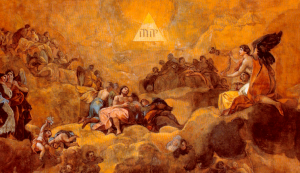
Adoración del Nombre de Díos [Adoration of
the Name of God] (1772), by Francisco José
de Goya y Lucientes.
The Gospel passage for Trinity Sunday in Year C—which is comparatively short; I have only two notes on the text!—comes from John instead of Luke: specifically, from part of the Upper Room Discourse, or John 13:31-17:26. This discourse (which may be amalgamated from multiple “talks” given by Jesus to the disciples, possibly even including things said to them after the Resurrection) is the promulgation of the New Covenant, and therefore the setting in which he delivers the new law per se: “As I have loved you, that ye also love one another,” as he says in 13:34. This passage comes from much later in the discourse, where he is explaining the role the Holy Ghost is going to play in the life of the Church.
John 16:12-15, RSV-CE
I have yet many things to say to you, but you cannot bear them now. When the Spirit of trutha comes, he will guide you into all the truth; for he will not speak on his own authority, but whatever he hears he will speak, and he will declare to you the things that are to come. He will glorify me, for he will take what is mine and declare it to you. All that the Father has is mine; therefore I said that he will take what is mine and declare it to you.b
John 16:12-15, my translation
Many things I have to speak to you about, but you cannot bear them at present; when he comes, the Spirit of truth,a he will guide you into all the truth, for he will not talk on his own, but whatever he hears, he will tell you, and he will announce the things that are coming. He will glorify me, because he will take what is mine and announce it to you. Everything which the Father has is mine; because of this, I said that he takes from what is mine and announces it to you.b
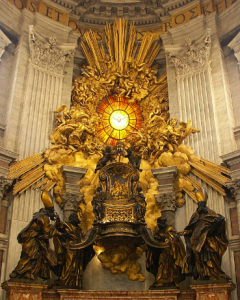
Cathedra Petri [“Throne of Peter”] (1666),
by Gian Lorenzo Bernini. Photo by Wikimedia
contributor Dnalor 01, used under
a CC BY-SA 3.0 license (source).

Textual Notes
a. the Spirit of truth (τὸ πνεῦμα τῆς ἀληθείας [to pneuma tēs alētheias]): Unlike my divergence from the RSV articulated in note h of this post, here, there is no contextual ambiguity about whether “a holy spirit” or “the Holy Spirit” is meant: A good deal of this whole discourse is about the Holy Ghost, or the Paraclete. This title is derived from the Greek παράκλητος [paraklētos]; its literal meaning is “one called alongside, helper, aide,” from which it got two further senses. One was “advocate, legal assistant”—and note the contrast here with the etymological ancestor of the word devil, namely διάβολος [diabolos] “accuser, slanderer”; the pair is not quite, but draws close to, that of a plaintiff versus the counsel for the defense. The other was “mediator, intercessor,” which we see St. Paul pick up in Romans 8.
b. All that the Father has is mine; therefore I said that he will take what is mine and declare it to you | Everything which the Father has is mine; because of this, I said that he takes from what is mine and announces it to you (πάντα ὅσα ἔχει ὁ πατὴρ ἐμά ἐστιν· διὰ τοῦτο εἶπον ὅτι ἐκ τοῦ ἐμοῦ λαμβάνει καὶ ἀναγγελεῖ ὑμῖν [panta hosa echei ho patēr ema estin: dia touto eipon hoti ek tou emou lambanei kai anangelei hümin]): All of this pertains to the temporal mission of the Holy Ghost, i.e. his activity in the Church on earth. This should not be confused with the distinct question of the procession of the Holy Ghost—that is, whether, ontologically, he proceeds from the Father and not the Son, or from the Father and from the Son (or, as a pseudo-third possibility, whether this is not something we can know).
If you’ve heard the notorious Latin word filioque, “and from the Son,” this debate is why it is important. In the Latin West, starting in Spain, filioque was added to the Nicene Creed as a way of combatting semi-Arianism. (Arian Christianity was prevalent among the Visigoths and Ostrogoths, who governed Spain and Italy respectively from about the late fifth century, and Catholicism made slow headway among them up until about the eighth.) The East objected to this addition, partly on procedural grounds—it was argued, and with good reason, that the Creed should not be changed except with the consent of an ecumenical council—and partly because, though not all did so, many Greek and Syriac-speaking theologians disagreed with the doctrine it represented.
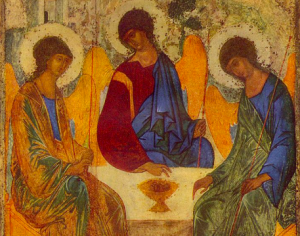
The Trinity (either 1411 or 1427),
written by Andrei Rublev.
I am not an expert on Trinitarian theology, so take what follows with a grain of salt. Moreover, since I grew up Protestant and then became a Catholic, it is predictable that I should side with the filioquists3; I have only ever partaken of Latinate Christianity, whether in or out of communion with Peter. However, I thought for a long time about converting to Orthodoxy rather than Catholicism, and the topic of the filioque—both ritually and doctrinally—was not absent from my deliberations. Foreseeable my loyalty may be, but it is not thoughtless.
And the thought that mainly occurs to me in support of the filioque is: How is God the Son supposed to be “the image of the invisible God,” “the brightness of his glory, and the express image of his person,” so “that in all things he might have the preeminence,” and how can it have “pleased the Father that in him should all fulness dwell,” if the Spirit does not proceed from the Son? Wouldn’t that render him “the all-but-image of the invisible God,” “part of the brightness of his glory, and the incomplete image of his person,” so “that in the overwhelmingly majority of things he might have the preeminence”?
I’m skeptical of most of the theological conclusions extrapolated from the filioque, whether the extrapolating is done by the doctrine’s opponents or its advocates. In part, this is because I’m resistant to the idea that we can or should hold forth freely about the “mechanics” of the Trinity, who is the supreme mystery of all existence!
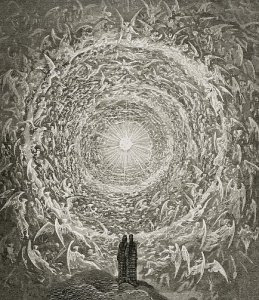
“The Empyrean” (1892), an illustration of
Canto XXXI of the Paradiso, drawn
by Gustave Doré.
But I’d also point to the very verse that gave rise to this doctrinal note, which was originally about the temporal mission of the Holy Ghost: “He takes from what is mine and announces it to you.” Arguing about theological niceties, while it is not pointless, does have a strong tendency to distract from this; all too often, arguments about theological niceties are the smart person’s way of explaining to ourselves why God hathn’t really said we must not eat of the tree that is in the center of the garden …
Footnotes
1The liturgical year of the Roman Rite (regardless of use), because it always begins on the First Sunday of Advent and always ends on the Saturday after Christ the King, contains a range of days slightly wider than that of the natural year—if I’ve mathed right, it’s 358 days at minimum and 373 days at maximum.
2If I were doing a Percy Dearmer, I would doubtless take this opportunity to mention that, due to the tree’s importance in Scripture, olive green is the most ideal shade of green for liturgical use, in much the same way that wine-color is the most preferable shade of purple. But I am not doing a Percy Dearmer, so I shall say nothing about the subject.
3That is, I am a filioquist in theology. I am at the same time firmly of the opinion that—though there are certain extenuating factors that probably apply—the (fairly late) decision of the papacy to insert the filioque into the public recitation of the Creed, without first securing the assent of the Church in ecumenical council, was a grave breach of the heavenly courtesy with which the Church ought at all times to comport herself. By the same token, I don’t consider it my place as a layman to desist from reciting the Creed at Mass as it was taught to me, including the filioque, but I would consider its removal from the liturgy a deeply appropriate gesture on Rome’s part. (Since I am therefore kind of caught between two impulses, when saying the Creed at Mass, I pray a short, silent prayer for Christian reunion when we say “and from the Son.”)
Previous Post

June 12, 2025
A Book of Prisms, Chapter Three
Next Post
June 22, 2025 There Is, Very Rarely, Such a Thing as Free Lunch
Recent Comments
"On the contrary, such a proclamation, among the Aztecs or Maya, would be disastrously misunderstood. ..."
The Gospel of John: The Bread ..."
"Many thanks for your scholarly study on the Cleansing of the Ten Lepers in the ..."
The Cleansing of the Ten Lepers
"Four Last Things: not the video game, but Death, Judgment, Heaven and Hell.Momento mori. Remember, ..."
"I am going by the time that these sayings began to be converted into written ..."
Are Our Bibles in the Wrong ..."
Browse Our Archives
Select a Category abuse antifascism art bad Catholic celibacy chastity Church crucifixion culture war eros forgiveness gay gender homophobia ikons language liturgy peace poems politics Pope Francis prayer pro-life race recommendations reform repentance review sacraments saints satire scandal schism scripture sex suffering theology Uncategorized violence
Select a Month October 2026 September 2026 August 2026 July 2026 June 2026 May 2026 April 2026 March 2026 February 2026 January 2026 December 2025 November 2025 October 2025 September 2025 August 2025 July 2025 June 2025 May 2025 April 2025 March 2025 February 2025 January 2025 December 2024 November 2024 October 2024 September 2024 August 2024 July 2024 June 2024 May 2024 April 2024 March 2024 February 2024 January 2024 December 2023 November 2023 October 2023 September 2023 August 2023 July 2023 June 2023 May 2023 April 2023 March 2023 February 2023 January 2023 December 2022 November 2022 October 2022 September 2022 August 2022 July 2022 June 2022 May 2022 April 2022 March 2022 February 2022 January 2022 December 2021 November 2021 October 2021 September 2021 August 2021 July 2021 June 2021 May 2021 April 2021 March 2021 February 2021 January 2021 December 2020 November 2020 October 2020 September 2020 August 2020 July 2020 June 2020 May 2020 April 2020 March 2020 February 2020 January 2020 December 2019 November 2019 October 2019 September 2019 August 2019 July 2019
Follow Us!
TAKE THE
Religious Wisdom Quiz
Who said, "For unto us a child is born, unto us a son is given"?
Select your answer to see how you score.
Micah Isaiah David Zechariah
Related posts from Mudblood Catholic

The Sermon on the Mount, Part I: Matthew...

The Gospel of Matthew: Christ and Antichrist

John the Baptist and the Winnowing Fork: Matthew...

The Gospel of Matthew: The Coventry Carol
TRENDING AT PATHEOS Catholic

Methodist Central Hall and Westminster Abbey
Situated on the same square is Methodist Central Hall and Westminster Abbey. ...

57th Dove Awards Honor Dolly Parton, Crown New...
On gospel music’s biggest night, the 57th annual GMA Dove Awards honored...

The First Eucharistic Controversy: Christ’s Real Presence
For Catholics, the Eucharist is the source and summit of the Christian...

What a Stop Sign Can Teach Us About...
How to Make a Decision When You Can't Hear God Main point:...

Archdiocese Hosts Military Marriage Retreat in Germany
RASTATT, Germany — The transient military lifestyle, with its frequent deployments and...

Nearly every morning, I make the drive to Detroit with my high-school-age...
view all Catholic blogs
What Are Your Thoughts?leave a comment
Ad-Free & Subscriber Log-In Subscription Support
- About Us
- 2026 Calendar
- Videos
- Podcasts
- Library of World Religions
- Faith In Media Tracker
- Advertise With Us
- Write for Us
- Privacy Policy
- Terms of Service
- Do Not Sell My Data
- Contact Us
- Radiant Digital
- Manage Newsletter Subscriptions
- Unsubscribe From Notifications
- Sitemap
Copyright 2008-2026, Patheos. All rights reserved.
Subscription Support Ad-Free & Subscriber Log-In
Follow Patheos