
BuddhistCatholicContemplativeEvangelicalGeneral ChristianHinduJewishLatter-day SaintMuslimNew VisionsProgressive Christian
Beliefs
- Buddhist
- Catholic
- Contemplative
- Evangelical
- General Christian
- Hindu
- Jewish
- Latter-day Saint
- More Voices
- Muslim
- New Visions
- Pagan
- Progressive Christian
Topics
- Religion News
- Food and Religion
- Sports and Religion
- Religious Art
- Religious Music and Entertainment
- Religious Events
- History and Religion
- Style and Religion
- Politics and Religion
- Women in Religion
- Recreation Outdoors and Religion
- Business Finance and Religion
- Careers Workplace and Religion
- Education and Religion
- Family Parenting and Religion
- Health Fitness and Religion
- Home and Religion
- Relationships and Religion
- Technology and Religion
- Travel and Religion
Columnists
- Buddhist Columnists
- Business Finance and Religion Columnists
- Careers Workplace and Religion Columnists
- Catholic Columnists
- Contemplative Columnists
- Education and Religion Columnists
- Evangelists Columnists
- Family Parenting and Religion Columnists
- General Christian Columnists
- Health Fitness and Religion Columnists
- Hindu Columnists
- History and Religion Columnists
- Home and Religion Columnists
- Jewish Columnists
- More Voices Columnists
- Latter Day Columnists
- Muslim Columnists
- New Visions Columnists
- Nonreligious Columnists
- Pagan Columnists
- Politics and Religion Columnists
- Progressive Columnists
- Recreation Outdoors and Religion Columnists
- Relationships and Religion Columnists
- Religion News Columnists
- Religious Art Columnists
- Religious Events Columnists
- Religious Music and Entertainment Columnists
- Sports and Religion Columnists
- Style and Religion Columnists
- Technology and Religion Columnists
- Travel and Religion Columnists
- Women in Religion Columnists
Resource Library
- 2026 Calendar
- Library of World Religions
- The 100 Most Holy Places on Earth
- Patheos Answers
- Podcasts
- Videos
- Faith Leaders Database
- Anglican Episcopalian
- Bahai
- Baptist
- Buddhism
- Christianity
- Confucianism
- Eastern Orthodoxy
- Hinduism
- Holiness and Pentecostal
- ISKCON
- Islam
- Judaism
- Lutheran
- Methodist
- The Church of Jesus Christ of Latter-day Saints
- New Age
- Paganism
- Presbytarian and Reformed
- Protestantism
- Religion Behind the Scenes
- Roman Catholic
- Scientology
- Shia Islam
- Sikhism
- Sufism
- Sunni Islam
- Taoism
- Zen
- See all religions
Research Tools
 Ad-Free & Subscriber Log-In Subscription Support
Ad-Free & Subscriber Log-In Subscription Support
Follow Patheos 

- Trending:
- Forgiveness
- |
- Marriage
- |
- Consciousness
- |
- Death Penalty
- |
- Election
- |
- Halloween

- Home
- Catholic
- A Book of Prisms, Chapter One
A Book of Prisms, Chapter One
Last updated on: June 7, 2025 at 5:00 pm by Gabriel Blanchard
A Book of Prisms, Chapter One 2025-06-07T17:00:43-04:00 Gabriel Blanchard
Patheos Explore the world's faith through different perspectives on religion and spirituality! Patheos has the views of the prevalent religions and spiritualities of the world.
“Thirty Days, Thirty Verses”
As we know, June is LGBTQ Pride Month; and thereby hangs a tale, and as usual, it’s the worst.

For the last few years, I have been much annoyed by the attempt among some right-wing Catholics to turn June’s dedication to the Sacred Heart into an expression of homophobia. These are not their words; they’ve generally called it “reclaiming June for the Sacred Heart,” who needs our assistance apparently (doesn’t he always). It turns out God can be in competition with his creatures—sort of the same way Iago would have been able to wound Shakespeare if he’d gotten big enough.
Jokes aside, the idea that there might be something kinda off about taking a devotion centered on God’s compassion, and making it the name of a cause for condemnation, rejection, and division, does not appear to have entered these Catholics’ minds. They appear unfortunately to have missed the lesson that, while there is such a thing as speaking the truth in love, it doesn’t follow that speaking the truth is enough to be speaking in love. Not even close.
Last year specifically, I got sufficiently irked by this that I invented a game on Twitter, which I called “Thirty Days, Thirty Verses.” On each of the thirty days of June, I selected a brief text from Scripture (usually one verse, occasionally more), and tried to provide a reflection on it that would be particularly relevant for queer Christians. It turned out to be pretty fun, and I learned a few things by analyzing the texts I found.
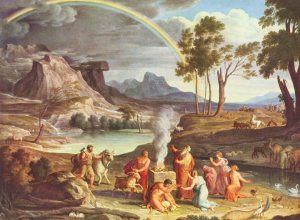
Landscape With Noah (ca. 1803),
by Joseph Anton Koch.
I’d half-forgotten about this until a few weeks ago, when one of them popped into my head and I decided to chase it down to its source. Naturally, not all thirty reflections were of equal worth!—but I was still pleased with quite a few of them. I’ve decided to reproduce them here, tidied up some, with expanded the Scripture references here and there, and arranged in a loose thematic order. They proved a lot longer in this format than I had realized (like, you wouldn’t think even a long eight- or nine-tweet thread would be more than a couple paragraphs, right? wrong, it turns out!), so as I often do with longer posts, I’ve split this into multiple “chapters.”
Exodus 20:16
Thou shalt not bear false witness against thy neighbor.
It horrifies me to say that a considerable amount of Christian discussion of LGBT people is categorically in violation of the very simple commandment not to tell lies. If I felt like being generous, I could restrict this (according to the text of the commandment, whose wording suggests a court setting) to “not to tell damaging lies,” but even if I did, little would change, as far as I can tell. Traditional-ethic Christians seem almost addicted to telling damaging lies about us.
That is, some are damaging. For instance:
- that our orientations or gender identities are the consequences of sexual abuse
- that we are disproportionately likely to be abusers
- that trans women are just men who want access to women’s spaces
- that we are demon-possessed
- that LGBT terms are implicitly heretical, or reveal heretical beliefs
- that trans people harbor a Gnostic disdain for the body
All of these (and I do mean all) are both damaging and untrue. Technically, some of the others are merely stupid or ridiculous—e.g., that trans identities and drag have anything to do with each other—but even these can provide important connective tissue for the damaging lies. However, there is one kind of lie I especially want to highlight. I mean the casual, lazy lie; the statement, or idea, or rumor, heard somewhere or other and lightly repeated, as if every idle word were a thing of no consequence. I mean, it isn’t like the Almighty doth see; he who formed man’s ears hathn’t understanding, hath he?
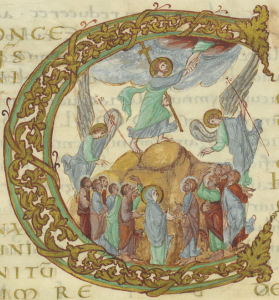
The Ascension in an illuminated capital from
the Drogo Sacramentary (c. 850), created for
Charlemagne’s son Drogo, Bishop of Metz
from 823 to 855.
I saw a sample of this a few weeks back.* I work in education (not as a teacher or an admin; I work for a private company, and my job’s closer to curriculum design). A professional contact of my boss repeated, and in repeating garbled, the ridiculous story Chaya Raichik shared about a public school having litterboxes made available on the premises for students who were furries. Now. If you know what furries are, you probably fractured a rib laughing at this kind of idiocy; but this woman did not know what furries are. And not only did she not realize that this story was a lie, she didn’t bother to check. I don’t know why she didn’t bother; but regardless of why, she then took the further step of repeating something that deranged, as fact, to other people.
A lot of the time, stuff that stupid doesn’t do much harm, because it’s so dumb that nobody takes it seriously. But, if you blend popular fanaticism, misinformation, and paranoia in just the right proportions and circumstances, you instead get the Salem Witch Trials. Or, if you feel I’m focusing unfairly on the sins of Christians in this, uh, post about Christian sin, then look at the first persecutions of the Church.
The Christians were accused not only of the definite act [of setting the Great Fire of Rome in 64] but of the more general evil of “a hatred of mankind.” … One would have supposed that this first outbreak of persecution would have caused all later Christians to have hesitated over belief in popular rumor, official assurances, and partisan histories. It has not done so. The blazing crosses of the Vatican gardens throw their lurid light on all our easy credulity, on the “I heards” and “he saids” of our daily life; our repetitions bark like the dogs to whom the faithful, wrapped in wild beasts’ skins, were thrown.
—Charles Williams, The Descent of the Dove, Ch. I: The Definition of Christendom
John 9:2-3
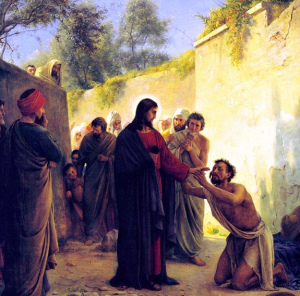
Healing of the Blind Man by Jesus Christ
(1871), by Carl Bloch.
And his disciples asked him, saying, “Master, who did sin, this man, or his parents, that he was born blind?” Jesus answered, “Neither hath this man sinned, nor his parents: but that the works of God should be made manifest in him.”
This verse comes to my mind in every discussion of the causes of queer sexuality and gender identity. I’ve heard the nature vs. nurture issue rehashed so many times, I’m about ready to throw something if I hear it again—not least because it’s been settled, largely though not entirely in nature’s favor, at least where sexual orientation is concerned. (Yes, epigenetics are more complicated than just “nature did it.” However, as a counterpoint, [begins throwing things].)
But on one level we do have to keep having this conversation. Because the fact that reparative drive theory (RDT) and rapid-onset gender dysphoria (RODG) have both been so totally debunked that even their proponents today are rightly embarrassed to admit believing in them … doesn’t get people to stop believing in them. And when I say “debunked,” I do not mean “rendered unfashionable” or even “relegated to the academic fringe.” I mean “decades of research have produced no serious evidence in support of these theories, whereas rival theories have reached academic consensus in the same time period, while on the practical side, therapies based on RDT/RODG claiming to cure homosexuality and gender dysphoria have proven ineffectual at best and actively harmful at worst.” I’m not clear what else anyone wants by way of debunking.
Nevertheless, some traditional-ethic Christians continue to insist on their validity—not because the prior Christian tradition or the Bible say anything about these therapies (they don’t), but, as far as I can tell, because it would make them feel like the bad guy if they had to say something like: “Through no fault of their own, most LGBT people who accept our sexual ethic will have to remain unmarried, a state in life for which we provide them little to no support.” It’s much more attractive to be countercultural in ways that involve prophesying against the sins of others. It’s unattractive to not just say the Confiteor, but get really specific about those things we have left undone which we ought to have done. In the unforgettable words of Williams about the beginnings of the Early Modern witchcraft hysteria, “It is always agreeable to hold someone responsible.”
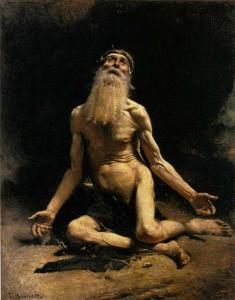
Job (1880), by Léon Bonnat.
This text, however, cuts right through the nonsense. Like RDT and RODG, the idea that blindness must be a punishment for sin was something the Apostles should have known better than to suppose. The Book of Job, even based on a very late date for it, had been around for three hundred years; and while plenty in that book is cryptic, one of its least ambiguous messages is, “The idea that a person’s suffering is a punishment for sin, even their own sin, and that you can discern this from the outside, is an idea that is dumb and bad; have ideas that are smart and good instead.” This isn’t a lesson they should have needed Jesus to teach them, any more than Christians today should need Jesus to teach them things like “Don’t tell lies (including slanted half-truths,” “Don’t endorse junk science for political advantage,” and “Really don’t do that stuff and pretend, to yourself or others, that you’re doing it for me.”
I don’t understand Jesus’ reply in verse 3—that the man was born blind “that the works of God might be revealed in him.” That sounds very callous, and also very silly. Yet even if I don’t follow, the text does at least assert itself without hedging. Having been through a few years of ex-gay therapy myself, the directness at least is refreshing.
Matthew 23:4
For they bind heavy burdens and grievous to be borne, and lay them on men’s shoulders; but they themselves will not move them with one of their fingers.
This is part of the rhetorical lead-in to the Seven Woes, the harshest passage of rebuke anywhere in the Gospels; at least when Jesus called St. Peter “Satan,” it was over quickly. It is also a passage that needs to be handled carefully: Like a number of other passages, it’s historically been used as an excuse to rationalize anti-Semitism among Christians; and this is an internet of the early twenty-first century, so we have to explain at least a little bit why anti-Semitism is bad (not for the vast majority of people claiming they see nothing wrong it with, but for the two or three who’ve fallen for enough anti-Semitic rhetoric to sincerely not understand what’s wrong here).
I won’t try to summarize everything that’s the matter with it now. I will just remind my fellow believers that anyone who hates or scorns the Jews is doing two things. First, he is despising what God treasures:
My kinsmen according to the flesh … are Israelites; to whom pertaineth the adoption, and the glory, and the covenants, and the giving of the law, and the service of God, and the promises; whose are the fathers, and of whom as concerning the flesh Christ came, who is over all, God blessed for ever. Amen. … I say then, Hath God cast away his people? God forbid. For I also am an Israelite, of the seed of Abraham, of the tribe of Benjamin. God hath not cast away his people which he foreknew. … Have they stumbled that they should fall? God forbid: but rather through their fall salvation is come unto the Gentiles, for to provoke them to jealousy. … For if the casting away of them be the reconciling of the world, what shall the receiving of them be, but life from the dead? For … if the root be holy, so are the branches. And if some of the branches be broken off, and thou, being a wild olive tree, wert grafted in among them, and with them partakest of the root and fatness of the olive tree; boast not against the branches. But if thou boast, thou bearest not the root, but the root thee. … For the gifts and calling of God are without repentance.
—Romans 9:3-5, 11:1-2, 11, 15-18, 29

Sunrise as seen from the peak of Mount Sinai.
And second, he is making a nonsense of his religion (no matter how many august quotations he can list from the Church Fathers). For if you confess Jesus as Lord, then your reason for not loving the Jewish people—which, remember, means treating them as you would want to be treated—can only be “I’m find with ignoring, defying, and laughing at my Lord’s express instructions on how to treat other people, especially my enemies, because it’s just that important to me to be nasty both to and about my Lord’s blood relatives.” I’m no Knight Templar, but to me, that doesn’t sound particularly honorable.
I’ve most often seen the Seven Woes interpreted as essentially universal, human corruptions—expressed in a Judaic idiom, clearly, but it doesn’t take a lot of imagination to see how “straining out a gnat and swallowing a camel” (the smallest and largest unclean animals) could, for Catholics, be translated into a metaphor like “skipping the ranch dressing on Fridays in Lent while eating a whole basket of wings.” The point is about missing the point of religious rituals, not “camels are bad.”
But what, in my opinion, makes Matthew 23:4 specially relevant to LGBT Christians? That’s simple: American churches, with less than no Scriptural warrant or traditional justification, impose false commandments upon us, of their own devising: Thou shalt be normal, and especially the more stringent Thou shalt be heterosexual (“which I commanded them not, neither came it into my heart”). For the last fifty years, US churches have been ossifying against all genuine difference here—not just gay relationships (chaste or not); even celibacy gets trampled on, borderline forbidden, in some churches. Back when I was Side A, I’d have made allowances for people hesitating to accept same-sex relationships, on the grounds that the lack of clear precedent for doing so could sincerely trouble someone’s conscience. But I thought then, and I think now, that when even a vocation as Scripturally explicit and traditionally endorsed as celibacy is getting flak, or at any rate getting flak when it’s queer people doing it, there is no other explanation: That is homophobia, rooted in an idolatry of “being normal,” and it has nothing whatsoever to do with Christ.
This idolatry is expressed in many ways. Our churches in this country have much of Sardis and Laodicea, but what sticks out to me the most as a “heavy burden grievous to be borne” is the ex-gay drivel that so many churches are still, still peddling—which has now also pivoted to being ex-trans drivel, without any increase in facts or in relevant qualifications: They have neither. This stuff has spent fifty years ruining thousand of lives with false promises, often by misleading people into entering marriages practically doomed to fail. And I say “practically doomed” not because orientation is fate, but because these relationships have been built on habitual dishonesty with themselves and each other. Lots of people listened to them, not because they were terrible people, but because they trusted clergy and authors and therapists who didn’t know what they were talking about, and who then blamed their victims as “recidivists” when their guesses and lies didn’t pan out.

*Well, it was a few weeks back when I wrote this, which was a year ago.
Previous Post
May 28, 2025
Catholics Must Be Antiracist—Acts 15 Tells Us Why (Pt. 2)
Next Post
June 7, 2025 A Book of Prisms, Chapter Two
Recent Comments
"On the contrary, such a proclamation, among the Aztecs or Maya, would be disastrously misunderstood. ..."
The Gospel of John: The Bread ..."
"Many thanks for your scholarly study on the Cleansing of the Ten Lepers in the ..."
The Cleansing of the Ten Lepers
"Four Last Things: not the video game, but Death, Judgment, Heaven and Hell.Momento mori. Remember, ..."
"I am going by the time that these sayings began to be converted into written ..."
Are Our Bibles in the Wrong ..."
Browse Our Archives
Select a Category abuse antifascism art bad Catholic celibacy chastity Church crucifixion culture war eros forgiveness gay gender homophobia ikons language liturgy peace poems politics Pope Francis prayer pro-life race recommendations reform repentance review sacraments saints satire scandal schism scripture sex suffering theology Uncategorized violence
Select a Month October 2026 September 2026 August 2026 July 2026 June 2026 May 2026 April 2026 March 2026 February 2026 January 2026 December 2025 November 2025 October 2025 September 2025 August 2025 July 2025 June 2025 May 2025 April 2025 March 2025 February 2025 January 2025 December 2024 November 2024 October 2024 September 2024 August 2024 July 2024 June 2024 May 2024 April 2024 March 2024 February 2024 January 2024 December 2023 November 2023 October 2023 September 2023 August 2023 July 2023 June 2023 May 2023 April 2023 March 2023 February 2023 January 2023 December 2022 November 2022 October 2022 September 2022 August 2022 July 2022 June 2022 May 2022 April 2022 March 2022 February 2022 January 2022 December 2021 November 2021 October 2021 September 2021 August 2021 July 2021 June 2021 May 2021 April 2021 March 2021 February 2021 January 2021 December 2020 November 2020 October 2020 September 2020 August 2020 July 2020 June 2020 May 2020 April 2020 March 2020 February 2020 January 2020 December 2019 November 2019 October 2019 September 2019 August 2019 July 2019
Follow Us!
TAKE THE
Religious Wisdom Quiz
What was the primary trade good in Biblical times?
Select your answer to see how you score.
Purple cloth Olive oil Spices Wheat
Related posts from Mudblood Catholic

The Sermon on the Mount, Part I: Matthew...

The Gospel of Matthew: Christ and Antichrist

John the Baptist and the Winnowing Fork: Matthew...

The Gospel of Matthew: The Coventry Carol
TRENDING AT PATHEOS Catholic

Letters on Living the Faith by C.S. Lewis
Most of us met C.S. Lewis as a public intellectual. Mere Christianity....

When Halloween Unmasks Married Hearts
Written by Dr. David K. Ewen from Eternal Truth Bible College Behind...

Aristotle. He’s been called the father of logic, the father of the...

Methodist Central Hall and Westminster Abbey
Situated on the same square is Methodist Central Hall and Westminster Abbey. ...

57th Dove Awards Honor Dolly Parton, Crown New...
On gospel music’s biggest night, the 57th annual GMA Dove Awards honored...

The First Eucharistic Controversy: Christ’s Real Presence
For Catholics, the Eucharist is the source and summit of the Christian...
view all Catholic blogs
What Are Your Thoughts?leave a comment
Ad-Free & Subscriber Log-In Subscription Support
- About Us
- 2026 Calendar
- Videos
- Podcasts
- Library of World Religions
- Faith In Media Tracker
- Advertise With Us
- Write for Us
- Privacy Policy
- Terms of Service
- Do Not Sell My Data
- Contact Us
- Radiant Digital
- Manage Newsletter Subscriptions
- Unsubscribe From Notifications
- Sitemap
Copyright 2008-2026, Patheos. All rights reserved.
Subscription Support Ad-Free & Subscriber Log-In
Follow Patheos