
BuddhistCatholicContemplativeEvangelicalGeneral ChristianHinduJewishLatter-day SaintMuslimNew VisionsProgressive Christian
Beliefs
- Buddhist
- Catholic
- Contemplative
- Evangelical
- General Christian
- Hindu
- Jewish
- Latter-day Saint
- More Voices
- Muslim
- New Visions
- Pagan
- Progressive Christian
Topics
- Religion News
- Food and Religion
- Sports and Religion
- Religious Art
- Religious Music and Entertainment
- Religious Events
- History and Religion
- Style and Religion
- Politics and Religion
- Women in Religion
- Recreation Outdoors and Religion
- Business Finance and Religion
- Careers Workplace and Religion
- Education and Religion
- Family Parenting and Religion
- Health Fitness and Religion
- Home and Religion
- Relationships and Religion
- Technology and Religion
- Travel and Religion
Columnists
- Buddhist Columnists
- Business Finance and Religion Columnists
- Careers Workplace and Religion Columnists
- Catholic Columnists
- Contemplative Columnists
- Education and Religion Columnists
- Evangelists Columnists
- Family Parenting and Religion Columnists
- General Christian Columnists
- Health Fitness and Religion Columnists
- Hindu Columnists
- History and Religion Columnists
- Home and Religion Columnists
- Jewish Columnists
- More Voices Columnists
- Latter Day Columnists
- Muslim Columnists
- New Visions Columnists
- Nonreligious Columnists
- Pagan Columnists
- Politics and Religion Columnists
- Progressive Columnists
- Recreation Outdoors and Religion Columnists
- Relationships and Religion Columnists
- Religion News Columnists
- Religious Art Columnists
- Religious Events Columnists
- Religious Music and Entertainment Columnists
- Sports and Religion Columnists
- Style and Religion Columnists
- Technology and Religion Columnists
- Travel and Religion Columnists
- Women in Religion Columnists
Resource Library
- 2026 Calendar
- Library of World Religions
- The 100 Most Holy Places on Earth
- Patheos Answers
- Podcasts
- Videos
- Faith Leaders Database
- Anglican Episcopalian
- Bahai
- Baptist
- Buddhism
- Christianity
- Confucianism
- Eastern Orthodoxy
- Hinduism
- Holiness and Pentecostal
- ISKCON
- Islam
- Judaism
- Lutheran
- Methodist
- The Church of Jesus Christ of Latter-day Saints
- New Age
- Paganism
- Presbytarian and Reformed
- Protestantism
- Religion Behind the Scenes
- Roman Catholic
- Scientology
- Shia Islam
- Sikhism
- Sufism
- Sunni Islam
- Taoism
- Zen
- See all religions
Research Tools
 Ad-Free & Subscriber Log-In Subscription Support
Ad-Free & Subscriber Log-In Subscription Support
Follow Patheos 

- Trending:
- Forgiveness
- |
- Marriage
- |
- Consciousness
- |
- Death Penalty
- |
- Election
- |
- Halloween

- Home
- Catholic
- Catholics Must Be Antiracist—Acts 15 Tells Us Why (Pt. 1)
Catholics Must Be Antiracist—Acts 15 Tells Us Why (Pt. 1)
Last updated on: October 23, 2025 at 2:16 pm by Gabriel Blanchard
Catholics Must Be Antiracist—Acts 15 Tells Us Why (Pt. 1) 2025-10-23T14:16:36-04:00 Gabriel Blanchard
Patheos Explore the world's faith through different perspectives on religion and spirituality! Patheos has the views of the prevalent religions and spiritualities of the world.
The Synod of Jerusalem
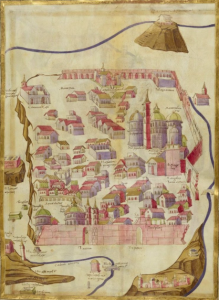
Map of Jerusalem (1472) by Pietro del Massaio
and Hugo Comminelli.
Our text here is the lesson from the Sixth Sunday in Easter, the Sunday before Ascension. It’s from Acts 15, and recounts the Church’s first-ever synod, or council, which is thought to have been held around the year 50. The First Council of Nicæa, the source of the Creed,1 took place two hundred and seventy-five years after this; to the Nicene bishops, the Synod of Jerusalem was as long ago as the French and Indian War is to us.
I like thinking of the Synod of Jerusalem as a sort of zeroth ecumenical council. Most of the Twelve are still alive and in attendance; the new “Nazarene” sect of Judaism is still so young that “Gentile Christian” is a baffling phrase to a lot of people; the vibe is completely different. Above all, unlike later councils, the Synod of Jerusalem is strictly halakhic2 in nature—it’s strictly about the application of the Torah in daily life. A doctrinal issue is present, and the doctrine is the basis for the halakhah,2 but for the most part, the content of the faith enters in only implicitly, as a background already understood and assumed. After this, the Church experiences a major pivot in her whole mode of life. This is what makes the rest of Christian history and a majority-Gentile Church possible.
What About Two-Sides-ism
But what, pray tell, does this have to do with anti-racism?
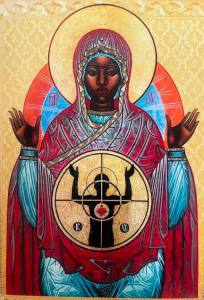
Our Lady of Ferguson (2015), an ikon written
by Mark Doox.
Well, let’s clarify a couple things. First, I don’t mean “Christians have a moral duty to both read and agree with Ibram X. Kendi’s How to Be an Antiracist,” or something like that. (I’m not sure there can be a moral duty for Christians to read any book besides the Bible; and anyway, I haven’t read Kendi and don’t know what he thinks.) The point here is not that we must subscribe to leftist politics. It is that we must be anti-racists—which is assuredly going to affect our politics, especially in the present climate. Now, I admit I’d expect a well-informed person of good sense who converted to Catholic Christianity, and sincerely submitted their political ideas to the Lord, to either remain or move noticeably to the left of the American average. (I say this not because I fancy anybody is looking to me for political guidance, but to clarify the perspective I’m bringing to the topic.) However, that’s largely because—like most people—I think my views are correct. It isn’t because there’s some inherent link between “being a Christian” and “being politically left of the national average” that exists for all times and places.
And it is possible for intelligent people of good will to differ about what the fairest and most effective means of putting our anti-racism into practice are. I have no desire to take God’s name in vain by attaching an untruthful “thus saith the Lord” to political strategies, merely because I prefer them to the alternatives. I could be mistaken; it’s happened before.
Textus Pretextus
With those provisos in place, I wish to point out a pretext under which racism is often concealed or excused, that’s ruled out by this text.
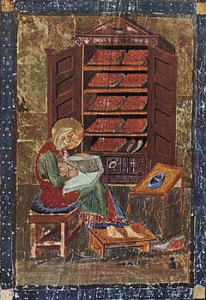
A depiction of Ezra the Scribe from the Jarrow
Codex (completed c. 700, considered the best-
preserved manuscript of the Vulgate).
The pretext at stake is the one expressed in phrases like “I only want to preserve my culture,” “it’s not hate, it’s heritage,” and so on. Fascistic racists are particularly apt to claim that what they are concerned with is “protecting” a culture or a way of life, not a literal bloodline or ancestry group (even if an ethnicity is overwhelmingly aligned with biological descent, there are always some exceptions, like how the formerly Norman FitzGerald dynasty were adopted into being Irish). This is a strong move, as it lets them sound a lot more politically sophisticated than, say, the “fourteen words.”
It’s also a barefaced lie. (Or rather, there are a few naïve fellow-travelers with fascists, who learn to say things like this because they think the rest mean them sincerely.) The real purpose of claims like these is to lend weight to tokenizing tactics—stuff like “See? Our organization’s vice president is biracial; we’d hardly put up with that if we ‘hated Black people,’ would we?”
It is worth pausing to say: Yes they would. Like many sins, racism isn’t, and can’t be, practiced consistently. I mean, we’re talking about a delusion that prejudices against entire ethnicities are not only normal and acceptable ways of thinking, which is already ludicrous, but that these prejudices are so above critique, not sharing these prejudices is somehow disloyal to your kin. In reality, being prejudiced against any entire ethnicity is not only unjust—and for a Christian, sacrilegious—but extremely juvenile. It isn’t just wrong; it is that which is, on the internet, worse than wrong: cringe.
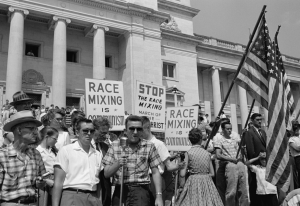
A rally held in Little Rock in 1959,
opposing school integration.
Still, most people who cling to this delusion and try to rationalize it, will at the same time be prepared to recognize a few people from among their target group as “the good ones.” This is, in a grim way, amusing, but it’s no mystery. Even most shameless misogynists love their mothers, but they find a way to misogyne all the same.
After seeing a clip from one of the White House Press Secretary’s “briefings” of the media earlier this month, a pertinent quote from a horror podcast I like (The Magnus Archives) has been echoing in my mind. Discussing his wife, a more significant player in the series’ events, a minor character says, “She didn’t lie to me because she expected me to believe her; she lied because she expected me to obey her.”3
Textus Rejectus
But to bring this all back to the first-century controversy resolved at the Synod of Jerusalem. Many racists, and especially those of fascist sympathies, try to maintain that their views are “not really racism” (you’ll note that most things that are, in the form of a question, called “the real racism” are directed against white people). They claim it’s about heritage, culture, tradition—things to which surely there can be no objection.
… Except heritage, culture, and tradition, merely for their own sake, are exactly the things which the Synod resolved not to impose on Gentile converts here. And as if to make this exact point (which “seemed good to the Holy Ghost and to us”), the things “loosed on earth and in heaven” here are not the cultural distinctives of just anyone. They are those of the Jews—the only nation that can, on Christian premises, advance any serious claim to divine election as a nation, the only ethnicity that appears in Scripture to matter qua ethnicity.
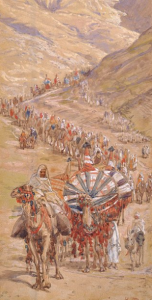
The Caravan of Abraham (c. 1900),
by James Tissot.
What advantage then hath the Jew? or what profit is there of circumcision? Much every way: chiefly, because that unto them were committed the oracles of God. For what if some did not believe? shall their unbelief make the faith of God without effect? God forbid: yea, let God be true, but every man a liar … I could wish that myself were accursed from Christ for my brethren, my kinsmen according to the flesh: who are Israelites; to whom pertaineth the adoption, and the glory, and the covenants, and the giving of the law, and the service of God, and the promises; whose are the fathers, and of whom as concerning the flesh Christ came, who is over all, God blessed for ever. Amen. … God hath not cast away his people which he foreknew.
—Romans 3:1-4a, 9:3-5, 11:2a
Not only is Christianity incompatible with more obvious forms of racism, the forms that blaspheme God in his images—that is, human beings—directly. The Church here, at her most pristine, is also shown recognizing and rejecting what we might call the “soft racist” ideology that twentieth and twenty-first century nationalists like Stephen Wolfe want to promote. (I’m especially stuck on Wolfe, because it just flabbergasts me that a Calvinist, of all people, would seriously advance the argument that “preferring” your own race is fine and good because it’s “human nature.” The thought, not even of what R. C. Sproul would actually say in rebuke to this, but of the mere tone of voice with which he’d say it, is a tonic imaginative exercise that I recommend to everyone.) In the end, the image of God in man, and in Christ “the taking of that Manhood into God,” are both abhorrent to this ideology; for our neighbor need not be even culturally white, and Jesus Christ was not and is not.
Which kind of tracks with what the book of Acts is, you know, about.
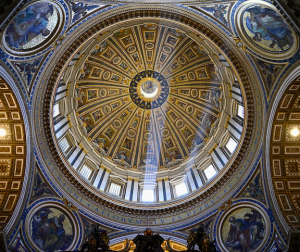
Dome of St. Peter’s Basilica in Rome, with
pendentives portraying the Evangelists.
Photo by Joaquim Alves Gaspar, used under
a CC BY-SA 4.0 license (source).

At its very beginning, death itself has just been undone. Both the Ascension and the sending of the Holy Ghost indicate that the separation between humanity and God, endured like death since our expulsion from Eden, is now unraveling; accordingly, the world is flooded a second time, not now with water but with fire, and the spell of Babel is broken. At the same time we hear Israel’s journey from Egypt to the Holy Land rehearsed in sermon after sermon, we see the gospel crossing from Judea to Samaria, from Samaria to Syria, from Syria to Anatolia, and from Anatolia to Greece, from which the keen-eyed can descry the shoreline of Rome, where the capital-in-exile is soon to be set up, out in “the uttermost part of the earth.” As it is written: “In thee shall all families of the earth be blessed.”
Footnotes
1Well, sort of. Baptismal creeds had already existed for a long time, like the Apostles’ Creed, and the Nicene Creed (the one we recite at Mass most Sundays, also called the Credo) was modeled on them. Moreover, the text of the Nicene Creed itself was fixed not at Nicæa in 325, but in 381, at the First Council of Constantinople. (This is why you’ll see it called the Niceno-Constantinopolitan Creed, if you hang out around enough people with strong opinions about how to reunite Catholicism and Orthodoxy.)
2Halakhah means the application of the Torah to day-to-day life; it extends and specifies the Written and Oral Torah, and is required to address new circumstances in terms of existing law. (The word comes from the Hebrew הֲלָכָה [hàlâkhâh], itself derived from the verb for “to walk”; note the resonance between this and Christ’s self-identification as “the Way.”) For example, it seems that chickens were originally domesticated for use in cockfighting—which means that when people did start eating them, a halakhic decision on whether this was permissible for Jews was required. This does bring in certain questions of principle, like whether one should be “strict constructionist” and allow only animals expressly mentioned in the Torah to be eaten, or “broad constructionist” and allow whatever is not ruled out, especially since the kashrut are given mainly in the form of principles (see Leviticus 11:2-4); still, it brings in the theology only indirectly. One of the principal effects of the Synod of Jerusalem, however, was to reduce obligatory Christian halakhah to vanishing point.
3The pertinent episode is MAG 154, “Bloody Mary.” If you’re new to the series, please note that this episode occurs near the end of the fourth season (of five all told); I advise beginning instead at the beginning of the first season, namely with MAG 1, “Angler Fish.”
Previous Post
May 13, 2025
Babel Unraveling
Next Post
May 28, 2025 Catholics Must Be Antiracist—Acts 15 Tells Us Why (Pt. 2)
Recent Comments
"On the contrary, such a proclamation, among the Aztecs or Maya, would be disastrously misunderstood. ..."
The Gospel of John: The Bread ..."
"Many thanks for your scholarly study on the Cleansing of the Ten Lepers in the ..."
The Cleansing of the Ten Lepers
"Four Last Things: not the video game, but Death, Judgment, Heaven and Hell.Momento mori. Remember, ..."
"I am going by the time that these sayings began to be converted into written ..."
Are Our Bibles in the Wrong ..."
Browse Our Archives
Select a Category abuse antifascism art bad Catholic celibacy chastity Church crucifixion culture war eros forgiveness gay gender homophobia ikons language liturgy peace poems politics Pope Francis prayer pro-life race recommendations reform repentance review sacraments saints satire scandal schism scripture sex suffering theology Uncategorized violence
Select a Month October 2026 September 2026 August 2026 July 2026 June 2026 May 2026 April 2026 March 2026 February 2026 January 2026 December 2025 November 2025 October 2025 September 2025 August 2025 July 2025 June 2025 May 2025 April 2025 March 2025 February 2025 January 2025 December 2024 November 2024 October 2024 September 2024 August 2024 July 2024 June 2024 May 2024 April 2024 March 2024 February 2024 January 2024 December 2023 November 2023 October 2023 September 2023 August 2023 July 2023 June 2023 May 2023 April 2023 March 2023 February 2023 January 2023 December 2022 November 2022 October 2022 September 2022 August 2022 July 2022 June 2022 May 2022 April 2022 March 2022 February 2022 January 2022 December 2021 November 2021 October 2021 September 2021 August 2021 July 2021 June 2021 May 2021 April 2021 March 2021 February 2021 January 2021 December 2020 November 2020 October 2020 September 2020 August 2020 July 2020 June 2020 May 2020 April 2020 March 2020 February 2020 January 2020 December 2019 November 2019 October 2019 September 2019 August 2019 July 2019
Follow Us!
TAKE THE
Religious Wisdom Quiz
True or False: Saul held the coats of those who stoned Stephen.
Select your answer to see how you score.
TRUE FALSE
Related posts from Mudblood Catholic

The Sermon on the Mount, Part I: Matthew...

The Gospel of Matthew: Christ and Antichrist

John the Baptist and the Winnowing Fork: Matthew...

The Gospel of Matthew: The Coventry Carol
TRENDING AT PATHEOS Catholic

Emotion in Early Christianity by Andrew Crislip
Andrew Crislip’s Emotion in Early Christianity examines an often overlooked dimension of...

16 Spiritual Touchstones for a More Grounded Life
After decades of spiritual study, here are 16 principles I try...

Catholic Evangelization: Sharing Your Faith Every Day
Welcome back to the Graceful Awakening mini-series called, “From Faith to Mission.” ...

The Pillar of the Boatmen: the Ancient Monument...
The Pillar of the Boatmen is a Romano-Gaulish sculpture that dates from...

In one sense walking into Westminster Abbey is like walking down the...

'Super Scam Me' Exposes AI Jon Bon Jovi...
Leslie Pickett believed she was in a relationship with Jon Bon Jovi....
view all Catholic blogs
What Are Your Thoughts?leave a comment
Ad-Free & Subscriber Log-In Subscription Support
- About Us
- 2026 Calendar
- Videos
- Podcasts
- Library of World Religions
- Faith In Media Tracker
- Advertise With Us
- Write for Us
- Privacy Policy
- Terms of Service
- Do Not Sell My Data
- Contact Us
- Radiant Digital
- Manage Newsletter Subscriptions
- Unsubscribe From Notifications
- Sitemap
Copyright 2008-2026, Patheos. All rights reserved.
Subscription Support Ad-Free & Subscriber Log-In
Follow Patheos