
BuddhistCatholicContemplativeEvangelicalGeneral ChristianHinduJewishLatter-day SaintMuslimNew VisionsProgressive Christian
Beliefs
- Buddhist
- Catholic
- Contemplative
- Evangelical
- General Christian
- Hindu
- Jewish
- Latter-day Saint
- More Voices
- Muslim
- New Visions
- Pagan
- Progressive Christian
Topics
- Religion News
- Food and Religion
- Sports and Religion
- Religious Art
- Religious Music and Entertainment
- Religious Events
- History and Religion
- Style and Religion
- Politics and Religion
- Women in Religion
- Recreation Outdoors and Religion
- Business Finance and Religion
- Careers Workplace and Religion
- Education and Religion
- Family Parenting and Religion
- Health Fitness and Religion
- Home and Religion
- Relationships and Religion
- Technology and Religion
- Travel and Religion
Columnists
- Buddhist Columnists
- Business Finance and Religion Columnists
- Careers Workplace and Religion Columnists
- Catholic Columnists
- Contemplative Columnists
- Education and Religion Columnists
- Evangelists Columnists
- Family Parenting and Religion Columnists
- General Christian Columnists
- Health Fitness and Religion Columnists
- Hindu Columnists
- History and Religion Columnists
- Home and Religion Columnists
- Jewish Columnists
- More Voices Columnists
- Latter Day Columnists
- Muslim Columnists
- New Visions Columnists
- Nonreligious Columnists
- Pagan Columnists
- Politics and Religion Columnists
- Progressive Columnists
- Recreation Outdoors and Religion Columnists
- Relationships and Religion Columnists
- Religion News Columnists
- Religious Art Columnists
- Religious Events Columnists
- Religious Music and Entertainment Columnists
- Sports and Religion Columnists
- Style and Religion Columnists
- Technology and Religion Columnists
- Travel and Religion Columnists
- Women in Religion Columnists
Resource Library
- 2026 Calendar
- Library of World Religions
- The 100 Most Holy Places on Earth
- Patheos Answers
- Podcasts
- Videos
- Faith Leaders Database
- Anglican Episcopalian
- Bahai
- Baptist
- Buddhism
- Christianity
- Confucianism
- Eastern Orthodoxy
- Hinduism
- Holiness and Pentecostal
- ISKCON
- Islam
- Judaism
- Lutheran
- Methodist
- The Church of Jesus Christ of Latter-day Saints
- New Age
- Paganism
- Presbytarian and Reformed
- Protestantism
- Religion Behind the Scenes
- Roman Catholic
- Scientology
- Shia Islam
- Sikhism
- Sufism
- Sunni Islam
- Taoism
- Zen
- See all religions
Research Tools
 Ad-Free & Subscriber Log-In Subscription Support
Ad-Free & Subscriber Log-In Subscription Support
Follow Patheos 

- Trending:
- Forgiveness
- |
- Marriage
- |
- Consciousness
- |
- Death Penalty
- |
- Election
- |
- Halloween

- Home
- Catholic
- Prodigal Notes on the Prodigal Son, Part 2
Prodigal Notes on the Prodigal Son, Part 2
Last updated on: April 4, 2025 at 2:45 am by Gabriel Blanchard
Prodigal Notes on the Prodigal Son, Part 2 2025-04-04T02:45:50-04:00 Gabriel Blanchard
Patheos Explore the world's faith through different perspectives on religion and spirituality! Patheos has the views of the prevalent religions and spiritualities of the world.
Go here for Part 1, which has textual notes a and b in it—they proved a lot heftier than I had expected! This post has notes c through n; o to z will hopefully all fit in Part 3. (Update: they did!) I’ve posted the Scripture here again, but in small type and without illustrations, to save a little space.
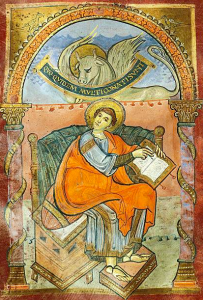
Portrait of St. Luke the Evangelist
from the Gospel of Charlemagne (ca. 800).
Luke 15:1-3, 4-10, 11-32, RSV-CE
Note: To make it easier to see, I’ve used a capital letter for note l in the text here; however, down in the textual notes, it’s in lower case like the rest. The textual notes dealt with in this installment are in bold in the Gospel passage below.
Now the tax collectors and sinnersa were all drawing near to hear him. And the Pharisees and the scribesb murmured, saying, “This man receives sinners and eats with them.”
So he told them this parable: “What man of you, having a hundred sheep, if he has lost one of them, does not leave the ninety-nine in the wilderness, and go after the one which is lost, until he finds it? And when he has found it, he lays it on his shoulders, rejoicing. And when he comes home, he calls together his friends and his neighbors, saying to them, ‘Rejoice with me, for I have found my sheep which was lost.’ Just so, I tell you, there will be more joy in heaven over one sinner who repentsc than over ninety-nine righteous persons who need no repentance.
“Or what woman, having ten silver coins,d if she loses one coin, does not light a lamp and sweep the house and seek diligently until she finds it? And when she has found it, she calls together her friends and neighbors, saying, ‘Rejoice with me, for I have found the coin which I had lost.’ Just so, I tell you, there ise joy before the angels of God over one sinner who repents.”
And he said, “There was a man who had two sons; and the younger of them said to his father, ‘Father, give me the share of propertyf that falls to me.’ And he divided his livingf between them. Not many days later, the younger son gathered all he had and took his journey into a farg country, and there he squandered his property in loosef living. And when he had spent everything, a greath famine arose in that country, and he began to be in want. So he went and joinedi himself to one of the citizens of that country, who sent him into his fields to feed swine.j And he would gladlyk have fed on the podsL that the swine ate; and no one gave him anything. But when he came to himself he said, ‘How many of my father’s hired servants have bread enough and to spare, but I perish here with hunger!m I will arise and go to my father, and I will say to him, “Father, I have sinned against heaven and before you; I am no longer worthy to be called your son; treat me as one of your hired servants.”’ And he arose and came to his father. But while he was yet at a distance,n his father saw him and had compassion,o and ranp and embraced him and kissed him. And the son said to him, ‘Father, I have sinned against heaven and before you; I am no longer worthy to be called your son.’ Butq the father said to his servants, ‘Bring quickly the best robe,r and put it on him; and put a ringr on his hand, and shoesr on his feet; and bring the fatteds calf and kill it, and let us eat and make merry; for this my son was dead, and is alive again; he was lost, and is found.’ And they began to make merry.
“Now his elder son was in the field; and as he came and drew near to the house, he heard musict and dancing. And he called one of the servants and asked what this meant.u And he said to him, ‘Your brother has come, and your father has killed the fatted calf, because he has received him safe and sound.’v But he was angry and refused to go in. His father came out and entreatedw him, but he answered his father, ‘Lo, these many years I have served you,x and I never disobeyed your command; yet you never gave me a kid, that I might make merry with my friends.x But when this son of yours came, who has devoured your living with harlots, you killed for him the fatted calf!’ And he said to him, ‘Son,y you are always with me, and all that is mine is yours. It was fitting to make merry and be glad,z for this your brother was dead, and is alive; he was lost, and is found.’”
Luke 15:1-3, 4-10, 11-32, my translation
Note: To make it easier to see, I’ve used a capital letter for note l here in the text; however, down in the textual notes, it’s in lower case like the rest. The textual notes dealt with in this installment are in bold in the Gospel passage below.
All the tax-farmers and sinnersa were were drawing near to him to hear him. And the Pharisees were murmuring, as were the scribes,b saying that “This man receives sinners and eats with them.”
Then he spoke to them in this analogy, saying: “Would any person among you who had a hundred sheep and lost one of them not leave the ninety-nine behind in the desert, and make your way to the lost one until you found it? And, once found, he lays it on his shoulders with his hands, and on coming home he will call together his loved ones and neighbors, telling them, ‘Give thanks with me that I found my sheep that was lost.’ I tell you that thus is there joy in heaven over one sinner who has a change of heart,c more than over ninety-nine just sorts who have no need for a change of heart. Or say a woman has ten drachmasd; if she should lose one drachma, won’t she grab a lamp and sweep the household and search diligently until she finds it? And, once found, she will call together her loved ones and neighbors, saying: ‘Give thanks with me that I have found the drachma that was lost.’ Thus, I tell you, joy arisese in the presence of the messengers of God over one sinner who has a change of heart.”
And he said, “A certain person had two sons; and the younger of them said to his father: ‘Father, give me the part of your substancef that falls to me.’ So he divided his livingf between them. Not many days afterwards, the younger son gathered everything and went abroad into a country a long way off,g and there he scattered his substance, living extravagantly.f When he had spent everything of his own, a fierceh famine befell that country, and he began to fall short; and, making his way along, he affixedi himself to one citizen of that country, who sent him out into his fields to feed pigsj; and he desiredk to fill his innards with the carob podsL which the pigs ate, but no one gave anything to him.
“Then he came to himself and said: ‘How many of my father’s hired hands are overflowing with bread, and here I am starving to death!m—I will get back up, go to my father, and say to him, “Father, I sinned against heaven and in your presence; I am no longer worthy to be called your son; make me like one of your hired hands.”‘ And he got up and went to his father.
“Yet while was a long way off,n his father saw him and was gutted with pity,o and running out,p he fell on his neck and kissed him. His son told him, ‘Father, I sinned against heaven and in your presence; I am no longer worthy to be called your son’—butq his father told the slaves, ‘Quickly, bring out the finest gownr and dress him, and give him a finger-ringr on his hand and sandalsr on his feet, and bring the grain-feds calf, sacrifice it, and we will make merry eating it! for this is my son who was dead, and he lives again—who was lost and has been found.” And they began to make merry.
“Now, his elder son was in the field; and as he was coming back, getting near the household, he heard harmoniest and dancing, and calling one of the boys over he inquired what this might beu; he told him that ‘Your brother is here, and your father sacrificed the grain-fed calf, because he got him back safe and sound.’v He was enraged, and did not want to come inside. Yet his father came out and called forw him. He told his father in reply: ‘Look, all these years I slave for youx and never bypassed a command of yours, and you have never given me a goat-kid in order to make merry with my loved onesx; yet when this son of yours comes back, who eats your living up with whores, for him you sacrifice the grain-fed calf.’ He told him: ‘Child,y you are always with me, and everything of mine is yours; but we had to make merry and rejoice,z because this, your brother, was dead and lives, and was lost and is found.'”

Textual Notes, Resumed
c. repents/has a change of heart (μετανοοῦντι [metanoounti]): I’ve often lamented words taking on an exclusively or presumptively religious meaning here, but it’s probably worth reiterating that my problem is not with the existence or use of religious language. Liturgical languages, like Hebrew for Jews, are the literal extreme of “religious language”: we have no trace of Jesus criticizing that. Indeed, if Matthew’s description of the Fourth Word from the Cross is more accurate than Mark’s, we have at least one example of Jesus deliberately employing liturgical language rather than the vernacular.† (Indeed, my only complaint about our use of the RSV in the Ordinariate in the context of the Mass is that I wish we’d use the King James!)
But what does bug me is using words that are specifically religious in the target language, English in this case, for stuff which wasn’t specifically religious in the original language. It may not be much, it may occasionally be unavoidable, but still, it’s adding something—religious connotations—that wasn’t in the original. “Repent” is such a word in English, and, at least in the Koiné era, μετανοέω [metanoeō] was not: it meant simply “to rethink, re-evaluate, have second thoughts; to change one’s mind; to regret;” or ” to have a change of heart.” Any of those things might in fact be religiously motivated, of course—but that isn’t the same as the word itself having a religious feel to it.

On the other hand, we are talking about a word being used by Jesus in a discussion of moral principle with the scribes and Pharisees that directly mentions the response of God and the angelic powers to … changes of heart. There’s only so worked up I can get about minor changes in connotations, really.
d. silver coins/drachmas (δραχμὰς [drachmas]): The drachma was a Greek coin, worth slightly more than the Roman denarius (though the two were sometimes treated as interchangeable, and this was likely common in Judæa, where both were equally foreign to the native shekel). Both coins had become commonplace throughout the Mediterranean over the preceding three hundred years, since Alexander jazzercised his way through the Achæmenid Persian Empire in the fourth century BCE and Rome became the dominant power in the Mediterranean in the second.1
e. there is/arises (γίνεται [ginetai]): The verb here is literally a form to “to become”—that verb replaces “to be” in a fair number of contexts in Greek.
f. property … living … loose/substance … living … extravagantly (οὐσίας [ousias] … βίον [bion] … ἀσώτως [asōtōs]): These three words, together, in this parable, feel downright pointed.
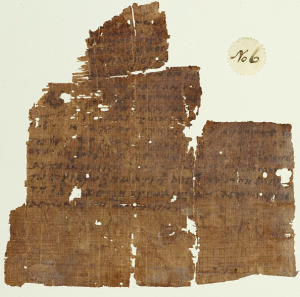
The Rylands Nicene Creed papyrus, also known
as Greek Papyrus 6, believed to be the oldest
surviving copy of the Creed (though it is damaged
and for the most part quite hard to read).
Students of Christian history may recognize οὐσία, one of the key words of the trinitarian debates of the fourth century; substance or essence are usual translations, as is being; I prefer substance for its flexibility: obviously it has theological and philosophical connotations, but it can also be used to suggest wealth, as when we speak of “a man of substance” (because it is 1906 and we are Edwardian ladies, I guess).
The fact that βίος [bios] is then promptly used as a synonym for οὐσία immediately brings the prologue of John to mind: In the beginning was the Word, and the Word was with God, and the Word was God. ... All things were made by him … In him was life (John 1:1, 3a, 4a).
And the word used for the prodigal son’s immoral, uh, prodigality,2 ἀσώτως, comes from σῴζω [sōzō], “to save”—I’d have preferred to translate it by the etymologically correct unsafely, except that that’s too generic in English to communicate the meaning.
g. far/a long way off (μακράν [makran]): This term is slightly ambiguous, but it becomes part of a bit of wordplay; wait for it …

Turns out finding non-copyrighted images of
Neil Patrick Harries qua Barney Stinson is
at least mildly difficult, so cheap joke it is
h. great/fierce (ἰσχυρὰ [ischüra]): This word literally means “strong,” but I wasn’t quite willing to try my luck by presenting readers with the expression “a strong famine” as if that were legible English.
i. joined/affixed (ἐκολλήθη [ekollēthē]): I suspect the implication here is indentured servitude, because the standard meaning of the verb here, κολλάω [kollaō], is actually “to glue.” When employed metaphorically, as it is here, it could also be used in lighter or at least more positive senses, as when we speak of friends who “stick together”; but, given that the boy apparently wasn’t even being given literal pigswill to eat, somehow I don’t think sticking-together-as-friends is the vibe here.

I did not think typing “swill” in Wikipedia’s
search box would return any results, and I
was wrong.
j. to feed swine/to feed pigs (βόσκειν χοίρους [boskein choirous]): Readers may know already that there are some surprising similarities between humans and pigs, to the point that cannibal societies in the Pacific islands would (allegedly) refer to human meat euphemistically as “long pig.” It also happens to be the case that pigs are what you might call “extreme omnivores”—this makes them great at getting rid of what is, to humans, garbage, which is probably one of the reasons we domesticated wild swine in the first place. The domestication was of course successful: pot-bellied pigs are sometimes kept as pets, since pigs in general are about as smart as dogs. However, like dogs, pigs aren’t always safe; there are other reasons than “getting disgusting stuff on you” that you don’t want to fall into a pigsty. This may be a stretch, but, considering the master the prodigal son’s been glued to apparently can’t be bothered to give him any food, I do wonder whether saying that he was sent out “to feed the pigs” might be a dark joke.
k. would gladly/desired (ἐπεθύμει [epethümei]): The Greek here indicates an urgent, almost overpowering longing; “to lust for” or “to crave” are natural translations. The noun from which the verb is derived, θυμός [thümos], is also the root of the word Plato used for what English renditions of the Republic often call “the spirited element” (contrasted with the intellect on the one hand and the appetites on the other); it is sometimes straightforwardly a word for anger..
l. pods/carob pods (τῶν κερατίων [tōn keratiōn]): In the Mediterranean, carob is occasionally used faute de mieux as a substitute for sugar or chocolate, and has historically been eaten by the poor in hard times. I’ve never tried the stuff, but I imagine the fact that carob pods are here treated as fit for swine even during a famine probably says plenty about how they taste, sweet or not.

Carob pods on a tree. Photo by Nevit
Dilmen, made available under a CC BY-SA
3.0 license (source).

m. I perish here with hunger/here I am starving to death (ἐγὼ δὲ λιμῷ ὧδε ἀπόλλυμαι [egō de limō hōde apollümai]): Here, between my translation and the RSV, mine is actually the less literal, though neither is word-for-word. The verb ἀπόλλυμι [apollümi] in Greek, of which ἀπόλλυμαι is the medio-passive3 form, means “to destroy, kill,” or sometimes “to lose,” with the implication of irrevocability. This medio-passive came, by frequent use, to function almost as an independent, deponent3 verb meaning “to die.” (This is also where we get the angelic, or possibly demonic, title mentioned in Revelation, Apollyon, meaning “the destroyer.” The term is there explicitly equated with the Hebrew אֲבַדּוֹן [‘àvadawn]; in the Hebrew Bible, אֲבַדּוֹן gives the impression of being a place-name, like Sheol, though as we know from the words hell and hades, these aren’t always firmly distinguished from the name of a principal inhabitant.4)
n. at a distance/a long way off (μακράν [makran]): And there it is. First, the parable tells us that the prodigal son goes to a country that is μακράν; then, as he is returning, his father sees him μακράν.
… Thou understandest my thought afar off. …
Thou hast beset me behind and before …
Whither shall I go from thy spirit? or whither shall I flee from thy presence?
If I ascend up into heaven, thou art there: if I make my bed in hell, behold, thou art there.
If I take the wings of the morning, and dwell in the uttermost parts of the sea;
Even there shall thy hand lead me, and thy right hand shall hold me.
—Psalm 139:2b, 5a, 7-10
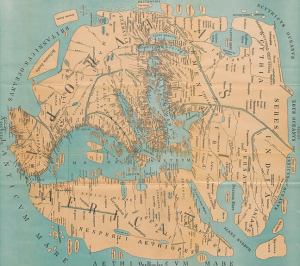
A reconstruction of the world map of Pomponius
Mela, a Roman cartographer of the early first
century; medieval “T and O” maps obviously
belong to the same tradition.
Footnotes
1I’m dating Rome’s supremacy in the Mediterranean (not yet empire, but supremacy) to the end of the Third Punic War in 146 BCE; given the subjugation of Carthage after the Second in 201 BCE, Roman hegemony could be dated a little earlier.
2When I was small, I vaguely supposed that prodigal meant something to do with sex. Actually what it means is “wasteful, squandering, spendthrift, lavish.”
3The medio-passive is a verb form in some inflected languages which can be either in the middle voice or the passive voice. A deponent verb is a verb which is active in meaning, but passive or medio-passive in form.
4Most of us had to do enough Greek myths at school to learn the name of the Greek god of the dead, but it is less well-known that the English word hell also derives from the name of a deity—that of the Norse goddess Hel, mistress of the dead, who again shared a name with the domain she ruled.
Previous Post
March 31, 2025
Prodigal Notes on the Prodigal Son, Part 1
Next Post
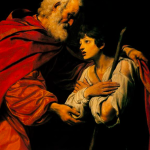
April 4, 2025 Prodigal Notes on the Prodigal Son, Part 3
Recent Comments
"On the contrary, such a proclamation, among the Aztecs or Maya, would be disastrously misunderstood. ..."
The Gospel of John: The Bread ..."
"Many thanks for your scholarly study on the Cleansing of the Ten Lepers in the ..."
The Cleansing of the Ten Lepers
"Four Last Things: not the video game, but Death, Judgment, Heaven and Hell.Momento mori. Remember, ..."
"I am going by the time that these sayings began to be converted into written ..."
Are Our Bibles in the Wrong ..."
Browse Our Archives
Select a Category abuse antifascism art bad Catholic celibacy chastity Church crucifixion culture war eros forgiveness gay gender homophobia ikons language liturgy peace poems politics Pope Francis prayer pro-life race recommendations reform repentance review sacraments saints satire scandal schism scripture sex suffering theology Uncategorized violence
Select a Month October 2026 September 2026 August 2026 July 2026 June 2026 May 2026 April 2026 March 2026 February 2026 January 2026 December 2025 November 2025 October 2025 September 2025 August 2025 July 2025 June 2025 May 2025 April 2025 March 2025 February 2025 January 2025 December 2024 November 2024 October 2024 September 2024 August 2024 July 2024 June 2024 May 2024 April 2024 March 2024 February 2024 January 2024 December 2023 November 2023 October 2023 September 2023 August 2023 July 2023 June 2023 May 2023 April 2023 March 2023 February 2023 January 2023 December 2022 November 2022 October 2022 September 2022 August 2022 July 2022 June 2022 May 2022 April 2022 March 2022 February 2022 January 2022 December 2021 November 2021 October 2021 September 2021 August 2021 July 2021 June 2021 May 2021 April 2021 March 2021 February 2021 January 2021 December 2020 November 2020 October 2020 September 2020 August 2020 July 2020 June 2020 May 2020 April 2020 March 2020 February 2020 January 2020 December 2019 November 2019 October 2019 September 2019 August 2019 July 2019
Follow Us!
TAKE THE
Religious Wisdom Quiz
Who was the villain plotting to destroy the Jews in Esther?
Select your answer to see how you score.
Ben-Hadad Sanballat Tobiah Haman
Related posts from Mudblood Catholic

The Sermon on the Mount, Part I: Matthew...

The Gospel of Matthew: Christ and Antichrist

John the Baptist and the Winnowing Fork: Matthew...

The Gospel of Matthew: The Coventry Carol
TRENDING AT PATHEOS Catholic

Methodist Central Hall and Westminster Abbey
Situated on the same square is Methodist Central Hall and Westminster Abbey. ...

57th Dove Awards Honor Dolly Parton, Crown New...
On gospel music’s biggest night, the 57th annual GMA Dove Awards honored...

The First Eucharistic Controversy: Christ’s Real Presence
For Catholics, the Eucharist is the source and summit of the Christian...

What a Stop Sign Can Teach Us About...
How to Make a Decision When You Can't Hear God Main point:...

Archdiocese Hosts Military Marriage Retreat in Germany
RASTATT, Germany — The transient military lifestyle, with its frequent deployments and...

Nearly every morning, I make the drive to Detroit with my high-school-age...
view all Catholic blogs
What Are Your Thoughts?leave a comment
Ad-Free & Subscriber Log-In Subscription Support
- About Us
- 2026 Calendar
- Videos
- Podcasts
- Library of World Religions
- Faith In Media Tracker
- Advertise With Us
- Write for Us
- Privacy Policy
- Terms of Service
- Do Not Sell My Data
- Contact Us
- Radiant Digital
- Manage Newsletter Subscriptions
- Unsubscribe From Notifications
- Sitemap
Copyright 2008-2026, Patheos. All rights reserved.
Subscription Support Ad-Free & Subscriber Log-In
Follow Patheos