
BuddhistCatholicContemplativeEvangelicalGeneral ChristianHinduJewishLatter-day SaintMuslimNew VisionsProgressive Christian
Beliefs
- Buddhist
- Catholic
- Contemplative
- Evangelical
- General Christian
- Hindu
- Jewish
- Latter-day Saint
- More Voices
- Muslim
- New Visions
- Pagan
- Progressive Christian
Topics
- Religion News
- Food and Religion
- Sports and Religion
- Religious Art
- Religious Music and Entertainment
- Religious Events
- History and Religion
- Style and Religion
- Politics and Religion
- Women in Religion
- Recreation Outdoors and Religion
- Business Finance and Religion
- Careers Workplace and Religion
- Education and Religion
- Family Parenting and Religion
- Health Fitness and Religion
- Home and Religion
- Relationships and Religion
- Technology and Religion
- Travel and Religion
Columnists
- Buddhist Columnists
- Business Finance and Religion Columnists
- Careers Workplace and Religion Columnists
- Catholic Columnists
- Contemplative Columnists
- Education and Religion Columnists
- Evangelists Columnists
- Family Parenting and Religion Columnists
- General Christian Columnists
- Health Fitness and Religion Columnists
- Hindu Columnists
- History and Religion Columnists
- Home and Religion Columnists
- Jewish Columnists
- More Voices Columnists
- Latter Day Columnists
- Muslim Columnists
- New Visions Columnists
- Nonreligious Columnists
- Pagan Columnists
- Politics and Religion Columnists
- Progressive Columnists
- Recreation Outdoors and Religion Columnists
- Relationships and Religion Columnists
- Religion News Columnists
- Religious Art Columnists
- Religious Events Columnists
- Religious Music and Entertainment Columnists
- Sports and Religion Columnists
- Style and Religion Columnists
- Technology and Religion Columnists
- Travel and Religion Columnists
- Women in Religion Columnists
Resource Library
- 2026 Calendar
- Library of World Religions
- The 100 Most Holy Places on Earth
- Patheos Answers
- Podcasts
- Videos
- Faith Leaders Database
- Anglican Episcopalian
- Bahai
- Baptist
- Buddhism
- Christianity
- Confucianism
- Eastern Orthodoxy
- Hinduism
- Holiness and Pentecostal
- ISKCON
- Islam
- Judaism
- Lutheran
- Methodist
- The Church of Jesus Christ of Latter-day Saints
- New Age
- Paganism
- Presbytarian and Reformed
- Protestantism
- Religion Behind the Scenes
- Roman Catholic
- Scientology
- Shia Islam
- Sikhism
- Sufism
- Sunni Islam
- Taoism
- Zen
- See all religions
Research Tools
 Ad-Free & Subscriber Log-In Subscription Support
Ad-Free & Subscriber Log-In Subscription Support
Follow Patheos 

- Trending:
- Forgiveness
- |
- Marriage
- |
- Consciousness
- |
- Death Penalty
- |
- Election
- |
- Halloween

- Home
- Catholic
- Sacred Time: The Waning of the Sun
Sacred Time: The Waning of the Sun
Last updated on: February 8, 2025 at 10:16 am by Gabriel Blanchard
Sacred Time: The Waning of the Sun 2025-02-08T10:16:33-04:00 Gabriel Blanchard
Patheos Explore the world's faith through different perspectives on religion and spirituality! Patheos has the views of the prevalent religions and spiritualities of the world.
Series Table of Contents:
Introduction (what sacred/liturgical time is and why we have it)
The Canonical Hours (the Catholic “clock”)
The Former Holy Week (pagan antecedents of the week)
The Seventh Day (the Judaic week and the Sabbath)
The Revelation of the Octave (the Catholic week)
To Everything There Is a Season (Easter computus; fourfold interpretation of Scripture)
The Waxing of the Sun (the literal/meteorological year; the yearly allegory of the life of Christ)
⇒ The Waning of the Sun (the spiritual life through the lens of the year)
A Time to Get, and a Time to Keep (liturgical seasons in the Anglican Use)
The Moral Year …?
And when this epistle is read among you, cause that it be read also in the church of the Laodiceans; and that ye likewise read the epistle from Laodicea.
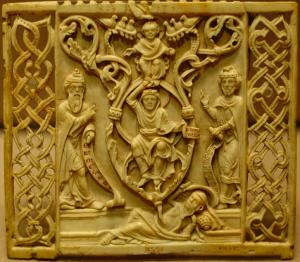
An ivory comb from Bavaria (ca. 1200),
featuring an abbreviated form of the “Tree
of Jesse” motif.
At first I wasn’t going to include a “moral interpretation” of the calendar; I couldn’t think of one. I did rather suddenly hit on an idea several days ago—one more like a second level of allegorical interpretation than a properly moral one, but something to fill the slot, anyway. I worked it out some, but I kept having this nagging feeling that posting it would be a bad idea, that it was open to dangerous abuses down the road.
I didn’t, and don’t, claim to see how that’s true. This could just be scrupulosity and paranoia talking. But, I don’t know, this felt like a hunch that needed to be listened to. And I couldn’t help but remember Joachim of Fiore at this juncture.
Joachim of Fiore was a twelfth-century Cistercian preacher from the south of Italy, and something of a “Bible codes” guy. His speculative doctrines got kind of out there; one of his major theories was that history was divided into three ages, corresponding to the Father (represented by the Torah), the Son (the age of the Church), and the Holy Ghost (whose age was yet to come but, Joachim calculated, imminent). He was widely known for his personal holiness, and acclaimed by some people as a prophet. However, the man himself disclaimed the title, and voluntarily submitted his writings to the judgment of the Church. No doubt it was partly for this reason that even when some of his ideas were condemned as heresy, he himself was never adjudged a heretic.1
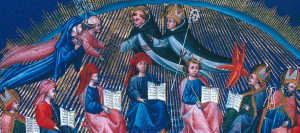
Beatrice and Dante meet the souls of the wise
(including Joachim of Fiore) in the Sun in
Paradiso X; miniature ca. 1450, by
Giovanni di Paolo.
Well, some people latched onto the guy’s stuff excessively, as people will even if their The Guy tells them not to.2 The largest group influenced by Joachimism were the Fraticelli, a sect—or rather, a series of sects—derived from the Franciscan Order who believed the “age of the Holy Ghost” was imminent or had arrived, and usually that this or that pope (Boniface VIII, for example) was the Antichrist. On the whole, the millenarian beliefs of the Fraticelli were harmless, in the visible sense anyway.
The same cannot truthfully be said of the “Apostolic Brothers,” also called Dolcinians or Pseudo-Apostles. They took over the basic beliefs of the Fraticelli and added some good old-fashioned “Our leader (Brother Dolcino) is a prophet/the pope of this new Holy Ghost age and also we can have sex with whomever we like”; then, upset with the general populace of northwestern Italy for not taking their side, they went ahead and started murdering people and taking their stuff. After a few years, the ringleaders of the movement were caught and burnt by the Inquisition.3
Point is, I’m not interested in being the latest update of Joachim of Fiore! History doesn’t need that! So I’m gonna listen to my hunch and just move on.
But Christ Is All, And In All
(The Mystical Year)
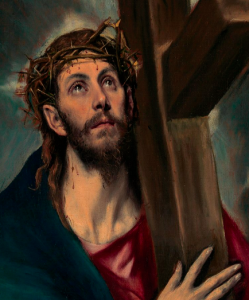
Selection from Cristo Abrazado a la Cruz
[Christ Carrying the Cross] (1580),
by El Greco.
The mystical or anagogical meanings of Scripture are its applications to the individual soul on its journey into God. Here, I think, we are on firmer ground. Spiritually, I believe the analogues belowhold up reasonably well. Note that in three cases, sacraments rather than phases of life are listed. This is deliberate. The whole Catholic doctrine of the sacraments implies that, whether we subjectively experience them as such or not, they are in fact key events in our spiritual lives. (There are also three cases in which I think a solemnity, rather than the season it defines, most closely corresponds to the movements of the mystical way; this, I’m open to challenge about.)
- Advent: Our lives before baptism, especially as catechumens4
- Christmas: Baptism
- Epiphany: Confirmation
- Lent: sacramental Confession
- Eastertide until Ascension: life in the state of grace
- Eastertide after Ascension: The intermediate state5
- Pentecost: The Parousia (i.e., the Second Coming)
- Whitsuntide: The general resurrection and Last Judgment
- Trinitytide: Life in the new creation
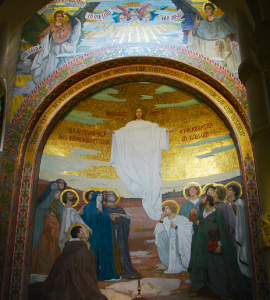
The Ascension, depicted in the Rosary Basilica
at Lourdes, France; photo by Wikimedia
contributor Vassil.
Note that these correspondences are not just sequential. Baptism is described as being “born ἄνωθεν [anōthen]” i.e. “again” or “from above,” in John 3; the name and theme of Epiphany both have to do with God’s self-revelation, and the sealing of the believer with the Spirit in Confirmation aligns with his dovelike descent at Jesus’ baptism; the Holy Ghost’s descent on the Church includes certain symbolism associated with the Last Judgment, and St. Peter’s Pentecost sermon explicitly appeals to a prophecy set “in the last days”.
Obviously, the bulk of our earthly lives is spent in a recurring cycle of 4 and 5! Additionally, those of us baptized as infants aren’t going to remember 1 or 2, and the catechetical aspect of 1 will be postponed, usually to a period of our natural lives preparatory to 3.
Perhaps the most significant part of this “chronology,” to my mind, is how much of it is taken up by our life after the Last Judgment. It does give a certain fresh perspective on the rest, doesn’t it?
Again, the Kingdom of Heaven Is Like …
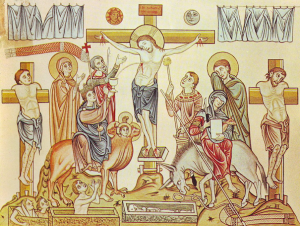
Crucifixion of Jesus of Nazareth (12th c.),
illustration by abbess Herrad of Landsberg
for the Hortus Deliciarum (“Garden of
Delights”), an encyclopedia.
I wonder to what extent the recognized structure of the contemplative or mystical life is also presented, cryptically, in the liturgical year. Both within and outside the Christian faith, a tripartite sequence of mystical growth is widely recognized: first, a period of purification, normally characterized by arduous ascesis of various kinds (fasts, vigils, etc.); then, a period of enlightenment, in which intellectual problems and mysteries are disclosed; and finally, a period of accomplished, if transitory or incomplete, union. The monastic tradition of the Church recognizes these three basic stages of mysticism, and finds that they are typically separated by two sub-phases (which I gather are normally more intense and briefer than the main stages), known as “nights.” They go like this:
I. The Purgative Stage
The Night of Sense
II. The Illuminative Stage
The Night of the Spirit
III. The Unitive Stage
I believe the terminology, at least for the “nights,” comes from St. John of the Cross. Let’s discuss the whole schema in just a bit more detail.
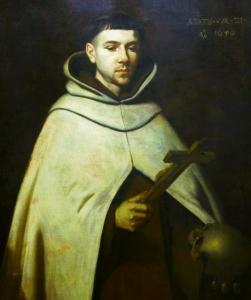
John of the Cross (1656), attributed
to Francisco de Zurbarán.
When we embark on the deliberate pursuit of holiness—that is, when we wholeheartedly make intimacy with God our most important goal—the first stage of growth is spent in cleansing ourselves from corrupting habits and attachment to occasions of sin. This is followed by a purgation (the “night of sense”) that falls upon us from without, so to speak, which detaches us from dependence on our merely natural motives for pursuing intimacy with God.
In the illuminative stage, God speaks directly to the heart. I gather that genuine visions and locutions, if they occur, are likeliest to come in this stage—however, I’m not sure how firm a rule this is. Another, more profound purification, the “night of the spirit” or “dark night of the soul,” follows. This often feels like an attack to the adept, though St. John of the Cross explains in his eponymous book that it is in truth a form of far deeper enlightenment: Its apparent darkness is in reality something more like being temporarily dazzled by the sun after time spent underground.
Finally, in the last stage, the soul increasingly enjoys union with God, usually of an intermittent nature. I get the impression that, regardless of the adept’s age, this generally signals that death will come within a few years, though again I’m not entirely clear or certain here.
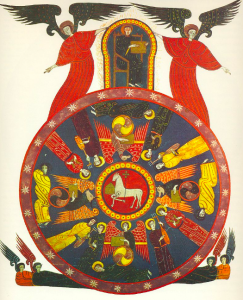
Vision of the Lamb, the cherubim, and the
twenty-four elders from the 8th-c.
Apocalypse of Beatus of Liébana.
This structure does feel natural to me; however, interestingly, I’m having a hard time correlating it to the liturgical year. The Lent-Eastertide-Trinity part tracks well enough, especially if we treat the Passion as the night of sense and the novena before Pentecost as the night of the spirit. (I think I picked this idea up in a book I read by Fr. Reginald Garrigou-Lagrange—at any rate, I know it would never have occurred to me to align the Cenacle’s time waiting for the descent of the Spirit with the dark night of the soul.) But that’s only a portion of the year, and leaves the whole Christmas cycle right out.
I have two more topics to cover—one on the specifically Anglican seasonal structure that I promised we’d come back to, and one on the relative ranking of the difference observances on the Church’s calendar. However, those are basically glorified (and nested) footnotes, and this post is long enough, so they can wait!
Footnotes
1Another name for this distinction is material versus formal heresy. Material heresy is being seriously wrong about a point of doctrine—something that can happen quite innocently; there are canonized saints, doctors of the Church even, who have held materially heretical beliefs. Formal heresy is different (don’t think of it in terms of “mere formalities,” but in terms of “the Platonic form of a thing”). It is a rebellious refusal to accept that one’s error is an error: There is an element of dishonesty and disobedience at work in it, some level on which the formal heretic really knows better than to be stubborn about this. Formal heresy takes what may have been a mere mistake and turns it into a deliberate lie, usually told first of all to oneself. Willing, ready surrender to the judgment of the Church is therefore the spiritual opposite of formal heresy.
2The late Ethiopian Emperor Haile Selassie’s reaction to the Rastafarian movement proclaiming him divine springs to mind—not the sort of pastoral conundrum faced by most Orthodox Tewahedo believers, or indeed most Christians of any denomination.
3Okay, not technically by the Inquisition; technically, the Inquisition never burned anybody, or tortured anybody, or any of that stuff—all those things were technically done to heretics by the secular arm, either as lawful punishment for heresy (which was a capital civil crime in most of Europe) or as part of the (again, lawful) interrogation process, since heretics were always presumed to have accomplices. But no one in his senses can seriously argue that this makes inquisitors, or the Church in general, innocent of these things. If the Church had (1) objected to the institution of heresy laws and the authorization of torture when they were proposed, (2) regularly protested against these things while they existed, (3) done everything in her power to prevent accused persons (regardless of their guilt) from being victimized by these policies, and (4) been an active force in the repeal of the heresy laws and the abolition of torture—then, on those four conditions, the Church could disclaim responsibility for the horrors we associate with the name of the Inquisition. As history actually went down, however, the Church is very justly and proportionally blamed for her role in the treatment of heretics, Jews, and those accused of witchcraft over the thirteenth to eighteenth centuries (especially during the witchcraft mania of the sixteenth and seventeenth).
4Given that many Christians are baptized in infancy, this correspondence won’t be exact; however, even in ancient times, instruction did continue after baptism (for the first year especially—persons in this part of their religious life were known as neophytes).
5In Christian terminology, “the intermediate state” refers to the period between an individual person’s death and the general resurrection, which will take place at or shortly after the Parousia (i.e. the Second Coming). Catholics believe that those who die in a state of grace will spend the intermediate state in heaven, either with or without a preparatory rehabilitative period in Purgatory (which is not really a “separate place” from heaven—”heaven’s mud-room” would be a better analogy).
Previous Post
January 25, 2025
Sacred Time: The Waxing of the Sun
Next Post
February 6, 2025 Sacred Time: A Time to Get, And a Time to Keep
Recent Comments
"On the contrary, such a proclamation, among the Aztecs or Maya, would be disastrously misunderstood. ..."
The Gospel of John: The Bread ..."
"Many thanks for your scholarly study on the Cleansing of the Ten Lepers in the ..."
The Cleansing of the Ten Lepers
"Four Last Things: not the video game, but Death, Judgment, Heaven and Hell.Momento mori. Remember, ..."
"I am going by the time that these sayings began to be converted into written ..."
Are Our Bibles in the Wrong ..."
Browse Our Archives
Select a Category abuse antifascism art bad Catholic celibacy chastity Church crucifixion culture war eros forgiveness gay gender homophobia ikons language liturgy peace poems politics Pope Francis prayer pro-life race recommendations reform repentance review sacraments saints satire scandal schism scripture sex suffering theology Uncategorized violence
Select a Month October 2026 September 2026 August 2026 July 2026 June 2026 May 2026 April 2026 March 2026 February 2026 January 2026 December 2025 November 2025 October 2025 September 2025 August 2025 July 2025 June 2025 May 2025 April 2025 March 2025 February 2025 January 2025 December 2024 November 2024 October 2024 September 2024 August 2024 July 2024 June 2024 May 2024 April 2024 March 2024 February 2024 January 2024 December 2023 November 2023 October 2023 September 2023 August 2023 July 2023 June 2023 May 2023 April 2023 March 2023 February 2023 January 2023 December 2022 November 2022 October 2022 September 2022 August 2022 July 2022 June 2022 May 2022 April 2022 March 2022 February 2022 January 2022 December 2021 November 2021 October 2021 September 2021 August 2021 July 2021 June 2021 May 2021 April 2021 March 2021 February 2021 January 2021 December 2020 November 2020 October 2020 September 2020 August 2020 July 2020 June 2020 May 2020 April 2020 March 2020 February 2020 January 2020 December 2019 November 2019 October 2019 September 2019 August 2019 July 2019
Follow Us!
TAKE THE
Religious Wisdom Quiz
Who said, "Surely this man was the Son of God!" at Jesus' crucifixion?
Select your answer to see how you score.
Judas A Roman centurion Peter Pilate
Related posts from Mudblood Catholic

The Sermon on the Mount, Part I: Matthew...

The Gospel of Matthew: Christ and Antichrist

John the Baptist and the Winnowing Fork: Matthew...

The Gospel of Matthew: The Coventry Carol
TRENDING AT PATHEOS Catholic

How to Make a Decision When You Can't...
Main point: It’s much more valuable to stay close to God so...

Archdiocese Hosts Military Marriage Retreat in Germany
RASTATT, Germany — The transient military lifestyle, with its frequent deployments and...

Nearly every morning, I make the drive to Detroit with my high-school-age...

The Real AI Story Is Adoption Without Trust
Artificial intelligence has crossed a political threshold. It is no longer a...

A new article, written by Jeff Lindsay and Gale L. Pooley,...

Swimfan: Forgotten Aughts Pleasures
This is a recovery effort. In 2002, My Big Fat Greek Wedding...
view all Catholic blogs
What Are Your Thoughts?leave a comment
Ad-Free & Subscriber Log-In Subscription Support
- About Us
- 2026 Calendar
- Videos
- Podcasts
- Library of World Religions
- Faith In Media Tracker
- Advertise With Us
- Write for Us
- Privacy Policy
- Terms of Service
- Do Not Sell My Data
- Contact Us
- Radiant Digital
- Manage Newsletter Subscriptions
- Unsubscribe From Notifications
- Sitemap
Copyright 2008-2026, Patheos. All rights reserved.
Subscription Support Ad-Free & Subscriber Log-In
Follow Patheos