
BuddhistCatholicContemplativeEvangelicalGeneral ChristianHinduJewishLatter-day SaintMuslimNew VisionsProgressive Christian
Beliefs
- Buddhist
- Catholic
- Contemplative
- Evangelical
- General Christian
- Hindu
- Jewish
- Latter-day Saint
- More Voices
- Muslim
- New Visions
- Pagan
- Progressive Christian
Topics
- Religion News
- Food and Religion
- Sports and Religion
- Religious Art
- Religious Music and Entertainment
- Religious Events
- History and Religion
- Style and Religion
- Politics and Religion
- Women in Religion
- Recreation Outdoors and Religion
- Business Finance and Religion
- Careers Workplace and Religion
- Education and Religion
- Family Parenting and Religion
- Health Fitness and Religion
- Home and Religion
- Relationships and Religion
- Technology and Religion
- Travel and Religion
Columnists
- Buddhist Columnists
- Business Finance and Religion Columnists
- Careers Workplace and Religion Columnists
- Catholic Columnists
- Contemplative Columnists
- Education and Religion Columnists
- Evangelists Columnists
- Family Parenting and Religion Columnists
- General Christian Columnists
- Health Fitness and Religion Columnists
- Hindu Columnists
- History and Religion Columnists
- Home and Religion Columnists
- Jewish Columnists
- More Voices Columnists
- Latter Day Columnists
- Muslim Columnists
- New Visions Columnists
- Nonreligious Columnists
- Pagan Columnists
- Politics and Religion Columnists
- Progressive Columnists
- Recreation Outdoors and Religion Columnists
- Relationships and Religion Columnists
- Religion News Columnists
- Religious Art Columnists
- Religious Events Columnists
- Religious Music and Entertainment Columnists
- Sports and Religion Columnists
- Style and Religion Columnists
- Technology and Religion Columnists
- Travel and Religion Columnists
- Women in Religion Columnists
Resource Library
- 2026 Calendar
- Library of World Religions
- The 100 Most Holy Places on Earth
- Patheos Answers
- Podcasts
- Videos
- Faith Leaders Database
- Anglican Episcopalian
- Bahai
- Baptist
- Buddhism
- Christianity
- Confucianism
- Eastern Orthodoxy
- Hinduism
- Holiness and Pentecostal
- ISKCON
- Islam
- Judaism
- Lutheran
- Methodist
- The Church of Jesus Christ of Latter-day Saints
- New Age
- Paganism
- Presbytarian and Reformed
- Protestantism
- Religion Behind the Scenes
- Roman Catholic
- Scientology
- Shia Islam
- Sikhism
- Sufism
- Sunni Islam
- Taoism
- Zen
- See all religions
Research Tools
 Ad-Free & Subscriber Log-In Subscription Support
Ad-Free & Subscriber Log-In Subscription Support
Follow Patheos 

- Trending:
- Forgiveness
- |
- Marriage
- |
- Consciousness
- |
- Death Penalty
- |
- Election
- |
- Halloween

- Home
- Catholic
- Sacred Time in the Catholic Faith: Introduction
Sacred Time in the Catholic Faith: Introduction
Last updated on: February 8, 2025 at 10:12 am by Gabriel Blanchard
Sacred Time in the Catholic Faith: Introduction 2025-02-08T10:12:35-04:00 Gabriel Blanchard
Patheos Explore the world's faith through different perspectives on religion and spirituality! Patheos has the views of the prevalent religions and spiritualities of the world.
Divide and eat the lingering hours,
Consume that nourishment of light;
Drink the nectar of evening flowers,
And water from the wells of night.
—Epigraph, Wells of Night
Series Table of Contents:
⇒ Introduction (what sacred/liturgical time is and why we have it)
The Canonical Hours (the Catholic “clock”)
The Former Holy Week (pagan antecedents of the week)
The Seventh Day (the Judaic week and the Sabbath)
The Revelation of the Octave (the Catholic week)
To Everything There Is a Season (Easter computus; fourfold interpretation of Scripture)
The Waxing of the Sun (the literal/meteorological year; the yearly allegory of the life of Christ)
The Waning of the Sun (the spiritual life through the lens of the year)
A Time to Get, and a Time to Keep (liturgical seasons in the Anglican Use)
Weary Se’n-nights Nine Times Nine
Since I revamped the blog last autumn, I’ve more or less followed the liturgical year in my content. However, I haven’t touched much on Christianity’s relationship to time. Here, near the beginning of liturgical year 2025, I’d like to take a little while to do so.
Originally, I had envisioned this post just as a review of the liturgical seasons (of which, depending on how you count them, there are anywhere from three to about sixteen). But, to put the seasons in context, I started writing about calendars more generally. It’s a short step from researching calendars to researching clocks; before you know it, you’re up to your eyes in John A. T. Robinson’s Redating the New Testament to track down his passing reference to a document that’s not even in the New Testament, and trying to decide if it’s worth it to explain the precession of the equinoxes.
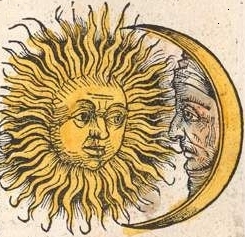
A depiction of the sun and moon, who have just
about had it had it up to here with my bull by
now, in the Nuremberg Chronicle (1493).
Point is, I actually bit off a lot more than I could chew with the casual thought “what if explain calendar” (intercalaries: not even once). So, this’ll be the first post in a series!
Entering Sacred Time
Disclaimer: Expressions like “sacred time” can put a person’s hackles up if they’ve heard such names as Joseph Campbell or Mircea Eliade cited with an air of reverence once too often. However. To any of my readers for whom that’s true, I’d like cordially to invite you to get over it. Yes, a lot of anthropologists have handled their own subject with the aplomb, humility, and intellectual modesty of Dr. Jordan B. Peterson’s wardrobe; the same thing is true of every other academic field; reality bites, you’re welcome.
Most cultures set certain things aside as sacred; indeed, the concept of sacredness is so universal that it is hard to articulate (the old “ask a fish to describe water” problem). The best, or at least the simplest, way to convey the idea of sanctity might be to say that it has two subjectively-perceived qualities, usually very strongly: otherness, and importance. The latter quality has some wiggle room: Things that are trivial do not feel sacred, or, if they do, their triviality immediately takes on a paradoxical quality. It feels strange or funny for something sacred to also be in any sense unimportant.
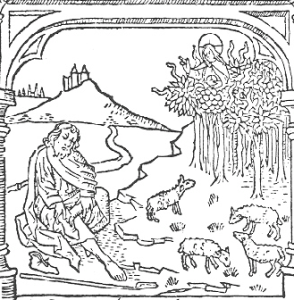
A woodcut depicting Moses removing his sandals
before the burning bush theophany, from a
16th c. edition of the 14th. c. work Speculum
Humanæ Salvationis.
But the “center of gravity” for sacredness as an idea lies more in its aura of otherness. Being unknown or incomprehensible can be an element of this otherness (and the greater the sanctity, the likelier we are to encounter this “cloud of unknowing”), but it is not only an intellectual quality. It carries with it a sense of not “playing by our rules,” both in the practical sense of not being able to predict the behavior of the sacred or enforce human standards of behavior upon it, and also in a more mysterious sense almost of not having rights in its presence, of being “out of one’s depth” or “outranked” in a moral or ontological sense as well as the mental sense.
In particular, the sphere of “the religious”—a term which smarter and better-educated people than me have tried and failed to define—is apt to designate certain places as holy: the shrines, temple precincts, sacred grottoes, and forbidden mountains of religions the world over. In those places, when they can be visited at all, the rules of behavior are usually different from what they are outside, usually either on the grounds that the pertinent deity requires these differences, or (more boringly) in order to evoke and foster an atmosphere of sacredness.
Sacred time is to the rest of time what sacred places are to the rest of space. Following a precedent established by the Hebrew calendar, the Christian liturgical calendar attempts the sanctification of all time—not in the sense of doing away with the distinctions between sacred and profane, but, as with the discussion of “trivial sanctities” above, by awakening a paradoxical sense of universal otherness, as it were.

In the late 1930s, Charles Williams, one of the less-famous Inkling-adjacent authors, wrote a commendable, strange, useless, brilliant account of Christian history, titled The Descent of the Dove. It opens like this:
The beginning of Christendom is, strictly, at a point out of time. A metaphysical trigonometry finds it among the spiritual Secrets, at the meeting of two heavenward lines, one drawn from Bethany along the Ascent of Messias, the other from Jerusalem against the Descent of the Paraclete.1 That measurement, the measurement of eternity in operation, of the bright cloud and the rushing wind, is, in effect, theology.
The history of Christendom is the history of an operation. It is an operation of the Holy Ghost towards Christ, under the conditions of our humanity … The visible beginning of the Church is at Pentecost, but that is only a result of its actual beginning—and ending—in heaven. … They had not the language; they had not the ideas; they had to discover everything. They had only one fact, and that was that it had happened. … “It is!” they said, but then they had to go on saying “It is!” Time existed, and time itself had, as it were, to be converted, to be rededicated towards the thing out of time. … How, and how far, do we pass out of time? The apostates are only those who abandon the problem; the saints are only those who solve it.2
Expositions of the Mystery
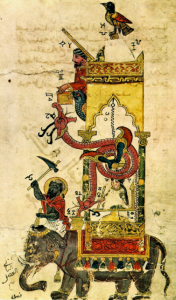
A depiction of an elephant clock (apparently
a type of water-clock!) in Ismail al-Jazari’s
Book of Knowledge of Ingenious Mechanical
Devices, first published in 1206.
Practically speaking, Christianity (like mankind, its mother) tracks time on multiple levels, governed primarily by means of the sun and moon. This is their ostensible purpose, Scripturally:
And God said, “Let there be lights in the firmament of the heaven to divide the day from the night; and let them be for signs, and for seasons, and for days, and years: and let them be for lights in the firmament of the heaven to give light upon the earth”: and it was so. And God made two great lights; the greater light to rule the day, and the lesser light to rule the night: he made the stars also. And God set them in the firmament of the heaven to give light upon the earth, And to rule over the day and over the night, and to divide the light from the darkness: and God saw that it was good. —Genesis 1:14-18
The Christian schema makes use of three temporal cycles. Two, the day and the year, are solar; the third, the week, may originally have been lunar (approximating the transition from one of the moon’s “cardinal” phases3 to the next), though it has long since been detached from any actual changes in the moon.
Clock face from the Marienkirche in Lübeck, Germany.
You may notice that the month is conspicuously absent from the liturgical analysis here. Its origins are certainly lunar—you can even see the name as a slightly worn-down version of “mooneth.”4 The month did and does play a role in the Hebrew calendar; however, months are of minimal importance to Christian practice. Their place has been more or less handed over to seasons. But, since no liturgical season except Easter has an exactly set number of days, and (as far as I’ve been able to discern) there is no underlying structure that all liturgical seasons share with each other, it isn’t really possible to speak of months being “reworked” into seasons or anything along those lines.
To recap, these are the kinds of sacred time we’ll be looking at:
- The day is measured mostly from sunrise to sunrise.5 The Christian day is subdivided into around seven canonical hours, a topic we’ll come back to momentarily.
- The week consists in seven full days, usually reckoned from Sunday as the first. Days can be classified in a few different ways, but we’ll analyze this at greater length in a later post.
- The other solar cycle is the year: one year is the amount of time it takes the Earth to complete one orbit around the sun.6 The civil year used by most cultures is divided twelve or thirteen months, while the Catholic year is divided into about five principal liturgical seasons, plus a large host of secondary and ancillary quasi-seasons.
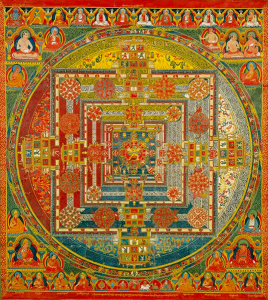
A 16th-cent. Tibetan mandala of the Kālacakra
or “wheel of time.” This is not particularly like
the Catholic ritual year in any way; it is,
however, very pretty.
Through the canonical hours, the Christian week, and the liturgical year, the Church proposes to make time the vehicle of eternity. The strength of this idea is suggested by C. S. Lewis, speaking through the mouth of Screwtape in his eighth letter to Wormwood:
Has no one ever told you about the law of Undulation? Humans are amphibians—half spirit and half animal. (The Enemy’s determination to produce such a revolting hybrid was one of the things that determined Our Father to withdraw his support from Him.) As spirits they belong to the eternal world, but as animals they inhabit time. This means that while their spirit can be directed to an eternal object, their bodies, passions, and imaginations are in continual change, for to be in time means to change. Their nearest approach to constancy, therefore, is undulation—the repeated return to a level from which they repeatedly fall back … If you had watched your patient carefully you would have seen this undulation in every department of his life—his interest in his work, his affection for his friends, his physical appetites, all go up and down. … The dryness and dullness through which your patient is now going … are merely a natural phenomenon which will do us no good unless you make a good use of it.
Coming up next: a deep(er) dive into the canonical hours that structure the sacred day.
Footnotes
1“Paraclete” is a title of the Holy Ghost; it transliterates the Greek term most Bibles render “comforter,” “advocate,” or “helper.”
2Descent pp. 1, 3, 15 (italics in the fifth sentence of the second paragraph are original).
3I.e., the new, quarter, and full moons. The crescent and gibbous phases technically cover the whole period between these cardinal phases,
4To be clear, this isn’t really an ancestral form of the word “month.” The Middle English (and modern Scots) form was moneth, from Anglo-Saxon ᛗᚩᚾᚪᚦ [mōnath]—its final -th is not the third-person singular verb ending we see on doth or worketh, but a now-obsolete ending for making verbal nouns (one that also appears in words like growth, stealth, or, though differently pronounced, weight). However, its ultimate Proto-Indo-European root seems to be a derivative of a verb (one meaning “to measure”), and it felt only just to get the name of the Moon in there, so I adjudged the pseudo-antique form was justified for illustrative purposes.
5That is, in practice. In principle, the Biblical day begins at sunset, which is why vigil Masses are a thing. However, the principle is inconsistently applied—for example, in Catholic prayer books, Sundays and solemnities normally feature a First and Second Vespers/Evening Prayer/Evensong, one for the evening preceding the holy day and one for the evening following.
6That’s how we describe it now. Obviously this was not known before heliocentrism, but they were still able to measure the length of a year to a high degree of accuracy, by a quite different means. If you watch where on the horizon the sun rises from in most of the northern hemisphere, you’ll notice that the sun gradually creeps southward over July through November, reaching its furthest-south “point of origin” on the winter solstice. After that, it reverses, rising from horizon-points further and further north until the summer solstice, and then heads south again. The reason the sun “moves” like this is because of the tilt of the Earth’s axis, which in turn makes sense. I imagine.
General Christian
Previous Post
November 29, 2024
Thanksgiving Prayer in the Prayer-Book Style
Next Post
December 20, 2024 Sacred Time: The Canonical Hours
Recent Comments
"On the contrary, such a proclamation, among the Aztecs or Maya, would be disastrously misunderstood. ..."
The Gospel of John: The Bread ..."
"Many thanks for your scholarly study on the Cleansing of the Ten Lepers in the ..."
The Cleansing of the Ten Lepers
"Four Last Things: not the video game, but Death, Judgment, Heaven and Hell.Momento mori. Remember, ..."
"I am going by the time that these sayings began to be converted into written ..."
Are Our Bibles in the Wrong ..."
Browse Our Archives
Select a Category abuse antifascism art bad Catholic celibacy chastity Church crucifixion culture war eros forgiveness gay gender homophobia ikons language liturgy peace poems politics Pope Francis prayer pro-life race recommendations reform repentance review sacraments saints satire scandal schism scripture sex suffering theology Uncategorized violence
Select a Month October 2026 September 2026 August 2026 July 2026 June 2026 May 2026 April 2026 March 2026 February 2026 January 2026 December 2025 November 2025 October 2025 September 2025 August 2025 July 2025 June 2025 May 2025 April 2025 March 2025 February 2025 January 2025 December 2024 November 2024 October 2024 September 2024 August 2024 July 2024 June 2024 May 2024 April 2024 March 2024 February 2024 January 2024 December 2023 November 2023 October 2023 September 2023 August 2023 July 2023 June 2023 May 2023 April 2023 March 2023 February 2023 January 2023 December 2022 November 2022 October 2022 September 2022 August 2022 July 2022 June 2022 May 2022 April 2022 March 2022 February 2022 January 2022 December 2021 November 2021 October 2021 September 2021 August 2021 July 2021 June 2021 May 2021 April 2021 March 2021 February 2021 January 2021 December 2020 November 2020 October 2020 September 2020 August 2020 July 2020 June 2020 May 2020 April 2020 March 2020 February 2020 January 2020 December 2019 November 2019 October 2019 September 2019 August 2019 July 2019
Follow Us!
TAKE THE
Religious Wisdom Quiz
Which sea did God part for the Israelites to escape Egypt?
Select your answer to see how you score.
Red Sea Jordan River Sea of Galilee Dead Sea
Related posts from Mudblood Catholic

The Sermon on the Mount, Part I: Matthew...

The Gospel of Matthew: Christ and Antichrist

John the Baptist and the Winnowing Fork: Matthew...

The Gospel of Matthew: The Coventry Carol
TRENDING AT PATHEOS Catholic

'Super Scam Me' Exposes AI Jon Bon Jovi...
Leslie Pickett believed she was in a relationship with Jon Bon Jovi....

The Brazilian Remake of Kendricks' 'Flywheel' Opens in...
“Flywheel,” the story that launched the Kendrick Brothers’ filmmaking career is getting...

The Dangers of Gradual Accommodation (Winking at Sin)
Recently, the “law of gradualness” resurfaced during the opening of a weeklong,...

The Iron Gates and the Lion of the...
Yesterday, I didn't finish my report about, well, yesterday. So I'll...

The Image: On the Horror of Capitalism and...
The Image Then went the Pharisees, and took counsel how they might...

We are approaching the date of our new American national holiday: October...
view all Catholic blogs
What Are Your Thoughts?leave a comment
Ad-Free & Subscriber Log-In Subscription Support
- About Us
- 2026 Calendar
- Videos
- Podcasts
- Library of World Religions
- Faith In Media Tracker
- Advertise With Us
- Write for Us
- Privacy Policy
- Terms of Service
- Do Not Sell My Data
- Contact Us
- Radiant Digital
- Manage Newsletter Subscriptions
- Unsubscribe From Notifications
- Sitemap
Copyright 2008-2026, Patheos. All rights reserved.
Subscription Support Ad-Free & Subscriber Log-In
Follow Patheos