
BuddhistCatholicContemplativeEvangelicalGeneral ChristianHinduJewishLatter-day SaintMuslimNew VisionsProgressive Christian
Beliefs
- Buddhist
- Catholic
- Contemplative
- Evangelical
- General Christian
- Hindu
- Jewish
- Latter-day Saint
- More Voices
- Muslim
- New Visions
- Pagan
- Progressive Christian
Topics
- Religion News
- Food and Religion
- Sports and Religion
- Religious Art
- Religious Music and Entertainment
- Religious Events
- History and Religion
- Style and Religion
- Politics and Religion
- Women in Religion
- Recreation Outdoors and Religion
- Business Finance and Religion
- Careers Workplace and Religion
- Education and Religion
- Family Parenting and Religion
- Health Fitness and Religion
- Home and Religion
- Relationships and Religion
- Technology and Religion
- Travel and Religion
Columnists
- Buddhist Columnists
- Business Finance and Religion Columnists
- Careers Workplace and Religion Columnists
- Catholic Columnists
- Contemplative Columnists
- Education and Religion Columnists
- Evangelists Columnists
- Family Parenting and Religion Columnists
- General Christian Columnists
- Health Fitness and Religion Columnists
- Hindu Columnists
- History and Religion Columnists
- Home and Religion Columnists
- Jewish Columnists
- More Voices Columnists
- Latter Day Columnists
- Muslim Columnists
- New Visions Columnists
- Nonreligious Columnists
- Pagan Columnists
- Politics and Religion Columnists
- Progressive Columnists
- Recreation Outdoors and Religion Columnists
- Relationships and Religion Columnists
- Religion News Columnists
- Religious Art Columnists
- Religious Events Columnists
- Religious Music and Entertainment Columnists
- Sports and Religion Columnists
- Style and Religion Columnists
- Technology and Religion Columnists
- Travel and Religion Columnists
- Women in Religion Columnists
Resource Library
- 2026 Calendar
- Library of World Religions
- The 100 Most Holy Places on Earth
- Patheos Answers
- Podcasts
- Videos
- Faith Leaders Database
- Anglican Episcopalian
- Bahai
- Baptist
- Buddhism
- Christianity
- Confucianism
- Eastern Orthodoxy
- Hinduism
- Holiness and Pentecostal
- ISKCON
- Islam
- Judaism
- Lutheran
- Methodist
- The Church of Jesus Christ of Latter-day Saints
- New Age
- Paganism
- Presbytarian and Reformed
- Protestantism
- Religion Behind the Scenes
- Roman Catholic
- Scientology
- Shia Islam
- Sikhism
- Sufism
- Sunni Islam
- Taoism
- Zen
- See all religions
Research Tools
 Ad-Free & Subscriber Log-In Subscription Support
Ad-Free & Subscriber Log-In Subscription Support
Follow Patheos 

- Trending:
- Forgiveness
- |
- Marriage
- |
- Consciousness
- |
- Death Penalty
- |
- Election
- |
- Halloween

- Home
- Catholic
- The Eviler-Than-Thou Eye
The Eviler-Than-Thou Eye
Last updated on: September 27, 2024 at 3:24 pm by Gabriel Blanchard
The Eviler-Than-Thou Eye 2024-09-27T15:24:09-04:00 Gabriel Blanchard
Patheos Explore the world's faith through different perspectives on religion and spirituality! Patheos has the views of the prevalent religions and spiritualities of the world.
A Sep-twofer
I’ve combined the Gospel passages for both the 22nd and the 29th into a single post; neither is especially long or complex, and they do form part of a single discussion on one coherent topic, manifest under multiple forms. The topic arises fairly naturally after the promulgation of the Petrine office (the Gospel from the 15th), and the forms it takes in the texts I’m analyzing here are along commonplace lines: now that the top spot in the messiah’s admin is spoken for, a. what’s the rest of the pecking order, and b. what do we do about people copying us? The common thread between these may not seem obvious at first glance, but it is familiar to readers of every period, language, and culture. Indeed, it is a drearily typical failing of religious persons and organizations—partly because it rarely allows its own right name to be spoken (and, for this among other reasons, has a specially easy time disgusing itself as an angel of light). That name is envy.
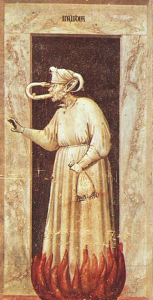
Invidia (“Envy”), an allegorical painting
by Giotto di Bondone, ca. 1306.
We’ll come back to this. Let’s first have a look at the text.
Mark 9.30-37; 9.38-43, 44, 45, 46, 47-48, 49-50, RSV-CE
They went on from there and passed through Galilee. And he would not have any one know it; for he was teaching his disciples, saying to them, “The Son of man will be delivered into the hands of men, and they will kill him; and when he is killed, after three days he will rise.” But they did not understand the saying, and they were afraid to ask him.
And they came to Capernaum; and when he was in the house he asked them, “What were you discussing on the way?” But they were silent; for on the way they had discussed with one another who was the greatest. And he sat down and called the twelve; and he said to them, “If any one would be first, he must be last of all and servant of all.”a And he took a child, and put him in the midst of them; and taking him in his arms, he said to them, “Whoever receives one such child in my name receives me; and whoever receives me, receives not me but him who sent me.”
† † †
John said to him, “Teacher, we saw a man casting out demons in your name, and we forbade him, because he was not following us.” But Jesus said, “Do not forbid him; for no one who does a mighty work in my name will be able soon afterb to speak evil of me. For he that is not against us is for us. For truly, I say to you, whoever gives you a cup of water to drink because you bear the name of Christ,c will by no means lose his reward.
“Whoever causes onee of these little ones who believe in me to sin,d it would be better for him if a great millstonef were hung round his neck and he were thrown into the sea. And if your hand causes you to sin, cut it off; it is better for you to enter life maimed than with two hands to go to hell,g to the unquenchable fire[, where their worm does not die, and the fire is not quenched].h And if your foot causes you to sin, cut it off; it is better for you to enter life lame than with two feet to be thrown into hell[, where their worm does not die, and the fire is not quenched].h And if your eye causes you to sin, pluck it out; it is better for you to enter the kingdom of God with one eye than with two eyes to be thrown into hell, where their worm does not die, and the fire is not quenched. For every one will be salted with fire. Salt is good; but if the salt has lost its saltness, how will you season it? Have salt in yourselves, and be at peace with one another.”

Salt deposits on the Jordanian shore of the
Dead Sea. Photo by Bernard Gagnon, used
under a CC BY-SA 3.0 license (source).

Mark 9.30-37; 9.38-43, 44, 45, 46, 47-48, 49-50, my translation
And they left there and passed through the Galilee, but he did not want anyone to know; he taught his students and told them that “The Son of Man is to be handed over into the hands of men, and they will kill him, and three days after he has been killed, he will rise again.” But they did not understand this message, and were afraid to ask him about it.
And he came to K’far-Nachum. And once they were in the household, he asked them: “What were you discussing on the road?” But they were silent, for they had been arguing with each other on the road who was the greatest. Having sat down, he called the Twelve and told them, “If anyone wants to be first, let him be last of all and servant of all.”a And taking a little child, he stood it in the midst of them, and scooping it up in his arms, he said to them, “Whoever will receive one of these little children for the sake of my name, he receives me; and whoever receives me, receives not me but him who sent me.”
John told him: “Teacher, we saw someone casting out demons in your name, and we forbade him to, because he does not follow with us.” Jesus said, “Do not forbid him, for there is no one who will work power in my name who is also easily ableb to speak ill of me; for whoever is not against us, he is with us. For whoever offers you a little cup of water in my name, because you are of the Anointedc—amen, I tell you that he will not lose his reward.
“As for the person who trips upd onee of these little ones that believe in me, it would be better for him if a mule-drawn millstonef were placed around his neck and he were cast into the sea. So if your hand trips you up, cut it off: it is better for you to come deformed into life than to go out, having two hands, into Gehinnom.g, h Or if your eye trips you up, cast it out it is better for you to come one-eyed into the kingdom of God than to be thrown, having two eyes, into Gehinnom, where their worms do not end and the fire is not quenched. For everything will be salted with fire. Salt is good; yet if salt becomes un-salty, what will you season it with? Have salt in yourselves, and make peace with each other.”
Textual Notes
a. servant of all: As far as I know, it’s only incidentally interesting that the Greek word used here* for “servant” is διάκονος [diakonos], the source of the word “deacon” in English. More pertinent to the meaning of this passage is that one of the Latin epithets of the popes is servus servorum Dei, or “servant of the servants of God.”

This illustration (by Lucas Caspar Businger,
drawn ca. 1881) is excellently executed, but
what draws my attention here is the claim it’s
“depicting papal infallibility.” What? How?

b. who … will be able soon after/who is also easily able: The key word in this case is ταχὺ [tachü], an adjective meaning “swift, fast, quick” (as in the medical term tachycardia, or elevated heart rate). This can certainly bear the meaning offered by the RSV; mine is a slightly looser interpretation.
I find this passage striking, because we know from the later history of the primitive Church that ensuring legitimacy of authority by certifying who did and didn’t “follow with” the Apostles was going to be a concern of some moment (as in the episode of the sons of Sceva). Even so, Jesus plainly does not want the Apostles primed to be jealous of their dignity.
c. because you bear the name of Christ/in my name, because you are of the Anointed: The reason for the slighlty awkward syntax here is that the Greek is a little vague. “Because you bear the name of Christ” is a defensible translation, but to my mind, it overdetermines the meaning of the text. All it really says is “because you are of the Anointed,” which could mean a few distinct things. The “of” construction frequently represents the genitive case in Greek and Latin, because the English preposition “of” does a really good job covering the same range of grammatical functions. More often than anything else, some kind of possession or ownership is meant; the origin or creator of something can also be conveyed this way, as can what a thing or group is made “of,” and so on. (The genitive case has a wider range of meanings in Greek than in Latin, because Latin retained a couple more specialized cases that had fallen out of use in Greek.)
d. causes … to sin/trips up: The RSV here follows an ancient interpretive tradition by rendering the verb σκανδαλίζω [skandalizō] as “cause to sin”; however, it is an interpretive trandition, and one that goes slightly beyond the meaning of the term itself. A σκάνδαλον [skandalon] was, in its remote origins, a “jumper”: i.e., a thing that needs to be jumped over (like a hurdle, or the snare of a trap). In Christian discourse (and possibly in Greek-speaking Jewish discourse before it), this came to refer to temptations—sometimes in the restricted sense used by St. James (“God cannot be tempted with evil, neither tempteth he any man: but every man is tempted, when he is drawn away of his own lust, and enticed”), and sometimes in the broader sense present in the Book of Hebrews (“in that he himself hath suffered being tempted, he is able to succor them that are tempted”).
This term obviously relates to what is called the sin of scandal in Catholic moral theology. (A brief introduction to the topic can be found in the Catechism of the Catholic Church §§2284-2287.) For those unfamiliar, to give scandal is essentially to set a bad example—not merely in the sense of not being perfect or exemplary, but in the sense of giving others fresh ideas to do what is wrong, or fresh reasons to dispute, reject, or ignore the truth. For instance, if we let loose with a rude word during a specially exasperating task, and a very young relative overhears us and thinks that is a word they can simply say at any time, then we have—intentionally or not—given them scandal, as an older relative whom a child very naturally assumes can be relied upon for how they ought to behave.
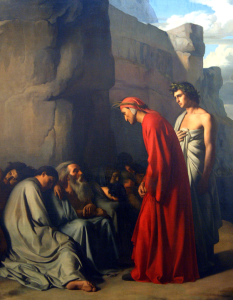
Le Dante, conduit par Virgile, offre des
consolations aux âmes des Envieux, a
scene from the Purgatorio by Hippolyte
Flandrin, 19th c.
Scandal is a somewhat tricky topic in moral theology, both because the person giving scandal may not intend or be aware of their action, and because the scandalous act need not even be wrong. The lengthy discussions in Acts, I Corinthians, and Romans about when and why eating meat sacrificed to idols was or was not alright turn on precisely this point: the objective act had been adjudged innocent by the Church in council, but it did not follow that every individual Christian could do so without entering mental territory that, for them, was vulnerable to wavering and temptations. The “strong” Christians, then, had a duty in charity to be tender with the tender consciences of their “weak” brethren; the liberty of the strong was curtailed. However, equally, the matter of principle had been decided in favor of the strong; the weak were not to strut about making up new rules that they were the best at keeping (which tends to be a favorite hobby of the weak), or to pretend that the strong were merely callous because they found themselves easily swayed.
The relationship between envy and scandal may not be entirely obvious at first either. The key to both is that they revolve around comparing ourselves with others.
e. one: It’s rather striking that the Greek here does not use a word like τίς [tis] “someone, anyone,” or a form of the definite article; it uses ἕνα [hena], the numeral one. In other words, Christ is conveying in exceedingly exact language what the worth of literally every individual is to him and to his Father.
f. great millstone/mule-drawn millstone: What the text actually called for is a μύλος ὀνικὸς [mülos onikos], or a “donkey-type millstone” (the newest of the ultra-rare Pokémon). Millstones in general aren’t very familiar to most of us today: they were used to grind wheat or barley kernels into flour. Some were small enough to be used by hand, like a mortar and pestle. Others required mutiple people, or even—a draught animal.
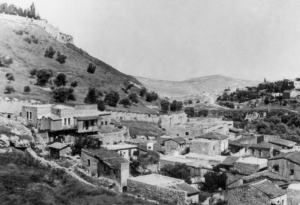
The Valley of Hinnom, photographed in 1948
by Aviva Rabinovich.
g. hell/Gehinnom: The Greek here is Γέεννα [Ge’enna], representing a Hebrew-Aramaic גֵיהִינֹּם [Gêhînnom]. This was a valley or gorge to the southern edge of Jerusalem, which reputedly was used as a garbage dump at this time. In the time of the divided monarchy, particularly under King Manasseh (who reigned in the first half of the seventh century BC, immediately after the Kingdom of Israel was destroyed), it is thought to have been the site of a תֹּפֶת [tofeth], a shrine dedicated to the purpose of sacrificing infants to Molech.
h. [vv. 44, 46]: Here, we at last have not only a simple textual note, but a simple and very good reason that the reading skips two verses it might easily have included! Verse 48 does say “where their worm does not die, etc.,” and in some manuscripts of Mark, this is the third in a series of repetitions on Jesus’ part, the two repetitions being verses 44 and 46 in the standard versification of the Bible.** However, the earliest and the best manuscripts of Mark lack verses 44 and 46. Scholars think that what happened here is most likely that a copyist (for any one of several reasons) looked at the wrong line of the text while creating his copy of Mark, and thus replicated the line in extra places in the text; then, subsequent copies made from that copy faithfully reproduced the mistake.
Another possibility—just in a general sense; I don’t know of evidence that would suggest this specifically is the cause of this—would be that, if this text were put to special use in some local church’s rites (e.g. in a litany or a catechism), that ritual usage might have involved the repetition of the phrase “where their worm does not die, etc.” A scribe from that community might then, without even necessarily realizing it, have inserted the ritual form he was familiar with instead of the strictly textual form.
*The alternative term to use here, which does occur quite frequently in the New Testament, would be δούλος [doulos], “slave.”
**For this system of chapters and verses (or, if you’re in a mood to sound snotty, of capitulation and versification), we may thank Stephen, Cardinal Langton, sometime the forty-fourth Archbishop of Canterbury in succession from St. Austin.
Previous Post
September 17, 2024
The Stone That Cried Out, Part II
Next Post
October 5, 2024 A Crash Course in Criticism, With a Sample Text
Recent Comments
"On the contrary, such a proclamation, among the Aztecs or Maya, would be disastrously misunderstood. ..."
The Gospel of John: The Bread ..."
"Many thanks for your scholarly study on the Cleansing of the Ten Lepers in the ..."
The Cleansing of the Ten Lepers
"Four Last Things: not the video game, but Death, Judgment, Heaven and Hell.Momento mori. Remember, ..."
"I am going by the time that these sayings began to be converted into written ..."
Are Our Bibles in the Wrong ..."
Browse Our Archives
Select a Category abuse antifascism art bad Catholic celibacy chastity Church crucifixion culture war eros forgiveness gay gender homophobia ikons language liturgy peace poems politics Pope Francis prayer pro-life race recommendations reform repentance review sacraments saints satire scandal schism scripture sex suffering theology Uncategorized violence
Select a Month October 2026 September 2026 August 2026 July 2026 June 2026 May 2026 April 2026 March 2026 February 2026 January 2026 December 2025 November 2025 October 2025 September 2025 August 2025 July 2025 June 2025 May 2025 April 2025 March 2025 February 2025 January 2025 December 2024 November 2024 October 2024 September 2024 August 2024 July 2024 June 2024 May 2024 April 2024 March 2024 February 2024 January 2024 December 2023 November 2023 October 2023 September 2023 August 2023 July 2023 June 2023 May 2023 April 2023 March 2023 February 2023 January 2023 December 2022 November 2022 October 2022 September 2022 August 2022 July 2022 June 2022 May 2022 April 2022 March 2022 February 2022 January 2022 December 2021 November 2021 October 2021 September 2021 August 2021 July 2021 June 2021 May 2021 April 2021 March 2021 February 2021 January 2021 December 2020 November 2020 October 2020 September 2020 August 2020 July 2020 June 2020 May 2020 April 2020 March 2020 February 2020 January 2020 December 2019 November 2019 October 2019 September 2019 August 2019 July 2019
Follow Us!
TAKE THE
Religious Wisdom Quiz
What mountain was the prophet Elijah hiding on when an earthquake, wind, fire, and then a whisper came?
Select your answer to see how you score.
Mount Moriah Mount Gerizim Mount Horeb Mount Carmel
Related posts from Mudblood Catholic

The Sermon on the Mount, Part I: Matthew...

The Gospel of Matthew: Christ and Antichrist

John the Baptist and the Winnowing Fork: Matthew...

The Gospel of Matthew: The Coventry Carol
TRENDING AT PATHEOS Catholic

57th Dove Awards Honor Dolly Parton, Crown New...
On gospel music’s biggest night, the 57th annual GMA Dove Awards honored...

The First Eucharistic Controversy: Christ’s Real Presence
For Catholics, the Eucharist is the source and summit of the Christian...

What a Stop Sign Can Teach Us About...
How to Make a Decision When You Can't Hear God Main point:...

Archdiocese Hosts Military Marriage Retreat in Germany
RASTATT, Germany — The transient military lifestyle, with its frequent deployments and...

Nearly every morning, I make the drive to Detroit with my high-school-age...

The Real AI Story Is Adoption Without Trust
Artificial intelligence has crossed a political threshold. It is no longer a...
view all Catholic blogs
What Are Your Thoughts?leave a comment
Ad-Free & Subscriber Log-In Subscription Support
- About Us
- 2026 Calendar
- Videos
- Podcasts
- Library of World Religions
- Faith In Media Tracker
- Advertise With Us
- Write for Us
- Privacy Policy
- Terms of Service
- Do Not Sell My Data
- Contact Us
- Radiant Digital
- Manage Newsletter Subscriptions
- Unsubscribe From Notifications
- Sitemap
Copyright 2008-2026, Patheos. All rights reserved.
Subscription Support Ad-Free & Subscriber Log-In
Follow Patheos