
BuddhistCatholicContemplativeEvangelicalGeneral ChristianHinduJewishLatter-day SaintMuslimNew VisionsProgressive Christian
Beliefs
- Buddhist
- Catholic
- Contemplative
- Evangelical
- General Christian
- Hindu
- Jewish
- Latter-day Saint
- More Voices
- Muslim
- New Visions
- Pagan
- Progressive Christian
Topics
- Religion News
- Food and Religion
- Sports and Religion
- Religious Art
- Religious Music and Entertainment
- Religious Events
- History and Religion
- Style and Religion
- Politics and Religion
- Women in Religion
- Recreation Outdoors and Religion
- Business Finance and Religion
- Careers Workplace and Religion
- Education and Religion
- Family Parenting and Religion
- Health Fitness and Religion
- Home and Religion
- Relationships and Religion
- Technology and Religion
- Travel and Religion
Columnists
- Buddhist Columnists
- Business Finance and Religion Columnists
- Careers Workplace and Religion Columnists
- Catholic Columnists
- Contemplative Columnists
- Education and Religion Columnists
- Evangelists Columnists
- Family Parenting and Religion Columnists
- General Christian Columnists
- Health Fitness and Religion Columnists
- Hindu Columnists
- History and Religion Columnists
- Home and Religion Columnists
- Jewish Columnists
- More Voices Columnists
- Latter Day Columnists
- Muslim Columnists
- New Visions Columnists
- Nonreligious Columnists
- Pagan Columnists
- Politics and Religion Columnists
- Progressive Columnists
- Recreation Outdoors and Religion Columnists
- Relationships and Religion Columnists
- Religion News Columnists
- Religious Art Columnists
- Religious Events Columnists
- Religious Music and Entertainment Columnists
- Sports and Religion Columnists
- Style and Religion Columnists
- Technology and Religion Columnists
- Travel and Religion Columnists
- Women in Religion Columnists
Resource Library
- 2026 Calendar
- Library of World Religions
- The 100 Most Holy Places on Earth
- Patheos Answers
- Podcasts
- Videos
- Faith Leaders Database
- Anglican Episcopalian
- Bahai
- Baptist
- Buddhism
- Christianity
- Confucianism
- Eastern Orthodoxy
- Hinduism
- Holiness and Pentecostal
- ISKCON
- Islam
- Judaism
- Lutheran
- Methodist
- The Church of Jesus Christ of Latter-day Saints
- New Age
- Paganism
- Presbytarian and Reformed
- Protestantism
- Religion Behind the Scenes
- Roman Catholic
- Scientology
- Shia Islam
- Sikhism
- Sufism
- Sunni Islam
- Taoism
- Zen
- See all religions
Research Tools
 Ad-Free & Subscriber Log-In Subscription Support
Ad-Free & Subscriber Log-In Subscription Support
Follow Patheos 

- Trending:
- Forgiveness
- |
- Marriage
- |
- Consciousness
- |
- Death Penalty
- |
- Election
- |
- Halloween

- Home
- Catholic
- The Veiling of the Ark, Part III
The Veiling of the Ark, Part III
Last updated on: August 21, 2024 at 1:10 am by Gabriel Blanchard
The Veiling of the Ark, Part III 2024-08-21T01:10:18-04:00 Gabriel Blanchard
Patheos Explore the world's faith through different perspectives on religion and spirituality! Patheos has the views of the prevalent religions and spiritualities of the world.
Here are links for Part I and Part II of the notes on this passage. Note a (because it proved to be gargantuan!) makes up Part II; I resume below with note b. I’ve printed the Scripture small, as it’s already been given twice.
Revelation 11.19a, 19b, 12.1-6a, 6b-9, 10a, 10b-12, RSV-CE
Then God’s temple in heaven was opened, and the ark of his covenanta was seen within his temple; and there were flashes of lightning, loud noises, peals of thunder, an earthquake, and heavy hail.
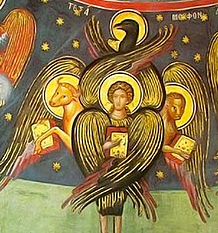
And a great portent appeared in heaven, a woman clothed with the sun, with the moon under her feet, and on her head a crown of twelve starsb; she was with child and she cried out in her pangs of birth, in anguish for delivery. And another portent appeared in heaven; behold, a great red dragon,c with seven heads and ten horns, and seven diadems upon his heads. His tail swept down a third of the stars of heaven, and cast them to the earth. And the dragon stood before the woman who was about to bear a child, that he might devour her child when she brought it forth; she brought forth a male child, one who is to rule all the nations with a rod of iron, but her child was caught up to God and to his throne, and the woman fled into the wilderness, where she has a place prepared by God, in which to be nourished for one thousand two hundred and sixty days.d
Now war arose in heaven, Michael and his angelse fighting against the dragon; and the dragon and his angels fought, but they were defeated and there was no longer any place for them in heaven. And the great dragon was thrown down, that ancientf serpent, who is called the Devil and Satan,g the deceiver of the whole worldh—he was thrown down to the earth, and his angels were thrown down with him. And I heard a loud voice in heaven, saying, “Now the salvation and the power and the kingdom of our God and the authority of his Christ have come, for the accuser of our brethren has been thrown down, who accuses them day and night before our God. And they have conquered him by the blood of the Lamb and by the word of their testimony, for they loved not their lives even unto death.i Rejoice then, O heaven and you that dwell therein! But woe to you, O earth and sea, for the devil has come down to you in great wrath,j because he knows that his time is short!”
Revelation 11.19a, 19b, 12.1-6a, 6b-9, 10a, 10b-12, my translation
And the temple of God which is in heaven opened, and the Ark of his Testamenta was seen in his temple; and there were bolts of lighting and voices and thunderings and an earthquake and great hail.
And a great sign was seen in heaven, a woman clothed with the sun, and the moon was underneath her feet, and on her head was a crown of twelve starsb; and she was with child, and cried out in her labor and was tormented to give birth. And another sign was seen in heaven—and behold, a great fiery dragonc with seven heads and ten horns, and seven diadems on his heads; and his tail swept down a third of the stars of heaven, and they fell to the earth. And the dragon stood in front of the woman who was about to give birth, so that when she bore, he could devour her child.
And she bore a son, a male, who was going to shepherd all nations by an iron rod; and her child was snatched up to God and to his throne. And the woman fled into the desert, wherein she has a place made ready for her by God, so that he can feed her there for a thousand, two hundred, and sixty days.d
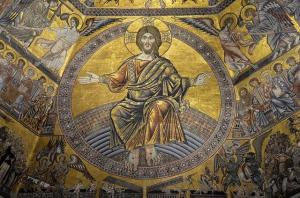
And there was war in heaven: Michael and his messengerse waged war on the dragon. The dragon too began waging war, and his messengers, but they were not strong enough—their place is no longer found in heaven. And he was cast out, the great dragon, the primordialf serpent, who is called the Accuser and Šâṭân,g who wanders around the whole inhabited worldh—he was cast down to the earth, and his messengers were cast down along with him.
And a great voice was heard in heaven that said: “Now have come the salvation and the power and the kingship of our God, and the authority of his Anointed, because the slanderer of our brothers is cast out, he who slanders them in front of our God day and night. And they defeated him by the blood of the Lamb and by the word of their witness, and did not love their life to the point of deathi; rejoice over this, O heavens and you who dwell in them. Woe to the earth and the sea, because the Accuser went down to you in a great rage,j seeing that he has little time.”
Textual Notes B-J
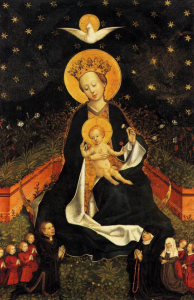
Madonna on a Crescent Moon in Hortus Conclusus,
c. 1450, by an anonymous painter from Cologne.
Hortus conclusus means “enclosed garden”; the
phrase occurs in the Vulgate in Song of Songs 4.12.
b. a woman clothed with the sun … crown of twelve stars: Thanks to Joseph’s famed dream, the astronomical panoply here is specially associated with the people of Israel. The Israelites, or some subset of them (especially the tribe of Judah) are often addressed apostrophically in the Tanakh; one of the stock forms is the בַּת צִיּוֹן [bath Tzîyôn] or “daughter of Zion,” a personification of Jerusalem found most frequently in the books of Isaiah and Lamentations. We are probably meant to understand the “woman clothed with the sun” as the בַּת צִיּוֹן, especially coming right on the heels of the unveiling of the Ark. I for one find it credible that, in the author’s mind, the “daughter of Zion,” despite being originally a mere figure of speech, had been literally fulfilled in the person of Mary. I think this is reinforced in some degree by the fact that the uses of בַּת צִיּוֹן in the Tanakh, except when they occur in rebukes, often make her “the virgin daughter of Zion,” as in Isaiah’s oracle to Hezekiah. The Woman Clothed With the Sun is obviously the non-rebuke-worthy “mode” of God’s people, and thus “the virgin daughter of Zion”—and giving birth to a son right out of the Davidic coronation hymn, Psalm 2, who “will rule the nations with a rod of iron”!
Now, I mentioned in my last that I’ve always found it obvious to interpret the woman clothed with the sun as the Mother of God. However, many commentators find it natural to associate the בַּת צִיּוֹן with either Israel (i.e., the Jewish people) or the Church as the New Israel. I don’t think any of these interpretations inherently excludes the others; in fact, for Christians, Mary is uniquely suited to serve as a symbol of both Israels, being as it were the “hinge” between them, on which the Door swings open for the sheep.

Okay, this level of serene pastoral cuteness
is just unsustainable. Knock it off, you.
That said, I’m inclined to view the Marian interpretation as primary, due to what we’re told in v. 17: “her children” are “those who keep God’s commandments and hold the testimony of Jesus.” That phrase basically is a description of the Church, who were given the Virgin as their Mother at the Cross (John 19.26-27).1 In the abstract, it makes sense to depict the Church in terms of the בַּת צִיּוֹן, since the Church understands herself as the New Israel; what doesn’t really make sense is for God foiling the dragon’s schemes to persecute the Church, to provoke the dragon into … persecuting the Church. (It could still be a metaphorical meaning of the text, but I doubt that it’s the primary intent.)
On the other hand, the interpretation that this is the “daughter of Zion” in a more old-fashioned sense, i.e. the Jewish people, is possible, but doesn’t strike me as very Johannine.2 If that were what the author meant her to represent, then the author seems to assign some kind of ongoing theological role to Israel alongside and distinct from the Church. That’s not so much as hinted at in any other Johannine book, and it’s not made clear in this one. (Paul, the self-styled “Apostle to the Gentiles,” comes closer!)
What’s more, if the woman is the Jewish people, we run into another interpretive problem: are we talking about i. Jewish Christians, or ii. the Jews irrespective of their belief, or iii. specifically about Jews who rejected Jesus and the Apostles? To me, ii. seems to run aground on the objection we just examined. “The woman” is dealt with separately from “her children”—e.g., it is only when the dragon’s pursuit of her fails that he turns to tormenting Christians—so i. doesn’t really make sense either; that leaves iii. But if iii. is true, this still has the same problem of seeming like a message that comes from nowhere, isn’t clear, and leads to nothing, but with an added difficulty: the Johannine corpus contains some of the most severe language in whole the New Testament about Jews who rejected the apostolic message. I really don’t think the “Israel” interpretation of the woman works—certainly not as a primary meaning.
c. red dragon/fiery dragon: “Fiery” here does refer to color—I was initially going to translate it “scarlet,” but the word is derived from the Greek term for “fire.” But about dragons …
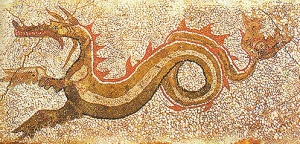
Hellenistic mosaic depicting a dragon, from
Kaulonia, a Greek city in the extreme south
of modern Italy (on underside of
the boot’s “toe”).
In his 2000 book An Instinct for Dragons, anthropologist David E. Jones suggested that human beings have evolved to have an instinctive revulsion toward snakes. Cultures the world over, even in places where snakes are rare or absent (e.g. the Arctic), often maintain lore of some kind of serpentine monster. Of course, this may be an issue of stories spreading from one culture to another, in the same way the unicorn is probably a diffusion of descriptions of the rhinoceros, rather than a Darwinian response.
As far as I could tell, dragons are not a common device in Judaic literature. The Septuagint’s additions to Esther rather ham-fistedly insert a prophetic dream on Mordecai’s part, featuring himself and Haman as quarreling dragons3; the Leviathan, mentioned in Isaiah, Psalms 74 and 104, and Job, seems to be some kind of sea-monster; and … that’s about it, as far as I know.5 Accordingly, this depiction of Satan may, just maybe, represent the influence of Græco-Roman culture on the Bible. (Congratulations?)
The classical concept of the dragon descends partly from myths like that of Typhon: he was an enemy of Zeus, often depicted as draconic, who (depending on the source, and among other offspring) fathered Cerberus, the Chimæra, the Colchian dragon, the Harpies, the Hydra, Ladon, and the Nemean Lion. The Colchian dragon and Ladon are specially noteworthy here, in that the former was the creature set to guard the Golden Fleece, and the latter, the golden apples which grew in the Garden of the Hesperides, at the western end of the world6: both guard golden treasures which they are unable to use or enjoy themselves, as many of their descendants would also be doomed to do. The classical dragon may also owe something to the mythologies of Egypt and the Levant. According to the Coffin Texts and the Book of the Dead,7 every night, the sun god Ra fought the malicious serpent deity Apep, or Apophis, the embodiment of chaos. Meanwhile, in Ugaritic myth, the storm god Baal-Hadad defeats a sea-monster with seven heads, Lōtanu, a name which may be related to that of the Biblical Leviathan.
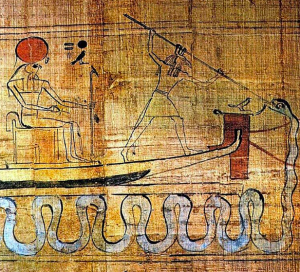
A papyrus showing Ra riding the Barque of the
Sun through the twelve hours of the night,
with Set in the prow spearing Apep (showing
Set in his occasional helpful aspect).
d. one thousand two hundred and sixty days/a thousand, two hundred, and sixty days: The expressions “a thousand, two hundred, and sixty days,” “a time, times, and half a time,” and “forty-two months” all mean the same thing: three and a half years, or one half of seven years. What the significance is of that, I’m not sure; one possibility—which is likelier if the Apocalypse is dated early, but perfectly possible even if it was written as late as the second century—is that it alludes to the first state persecution of Christianity under Nero. The great fire, for which they were made scapegoats, occurred in mid-July of the year 64; it isn’t clear exactly when the scapegoating began (though it does not seem to have been immediate), but it remained official policy until Nero’s death in June of 68. If the persecution began right at the end of 64, that would mean it lasted for about three and a half years.
e. war arose in heaven, Michael and his angels/there was war in heaven: Michael and his messengers: The name Michael, now fully Anglicized though originally Hebrew (מִיכָאֵל [Mikhâ’êl]), means “Who is like God?” The word “messengers,” as elsewhere, is my more-literal-than-most rendering of ἄγγελος [angelos].
This imagery more broadly is drawn from the book of Daniel, who represents the nations of the earth as being governed by, or embodied in, angelic intelligences. We would call these “principalities” today, that being the name of the angelic order that tends to countries and peoples. Daniel implies (e.g. in 10.13) that some of them are fallen; whether this means that some nations just have a fallen principality, or that nations, like individuals, may have both an appointed guardian that is obedient to God and a chronic tempter that is not, I don’t know.
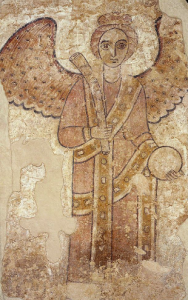
A 9th-cent. depiction of St. Michael from
Makuria, a largely Christian realm located
in Nubia (in terms of modern borders,
southern Egypt and northern Sudan).
f. ancient/primordial: Elsewhere, I have probably translated ἀρχαῖος [archaios] as “old” or “ancient,” which is correct enough. However, the term παλαιός [palaios] also has this meaning, and ἀρχαῖος is related to the word ἀρχή [archē], which means “source, origin, beginning” (for instance, the first words of the Gospel of John are Ἐν ἀρχῇ [en archē], “In the beginning”); I therefore wanted a term that would evoke the beginning.
g. called the Devil and Satan/called the Accuser and Šâṭân: The “translation” devil low-key bugs me. For all intents and purposes, “devil” the name of a type of creature in English, but there is no hint of this in the Greek διάβολος [diabolos]; it is the etymological ancestor of “devil,” but the two words’ meanings and usages are radically unlike one another (since the English has been determined not only by the Greek, but by the specifically religious sense of the Greek); διάβολος just means “slanderer, detractor,” without any specially theological bent. The pseudo-name שָׂטָן [šâṭân] was, likewise, an ordinary noun in Hebrew. It meant “enemy, adversary,” or perhaps something like “plaintiff,” aligning with its translation as διάβολος.
h. the deceiver of the whole world/who wanders around the whole inhabited world: The RSV’s translation is certainly a very Johannine sentiment; my rendering is a little flat-footed, and I half suspect a sort of pun here on the author’s part—more on that shortly. But the RSV and I are, at least, both wrong, in that neither of us translated the participle in this sentence as a participle—they made it into a noun, “deceiver,” while I made it the finite verb “wanders.”
The actual word is πλανῶν [planōn], from πλανάω [planaō] meaning “to wander, stray,” which is the source of the word planet (this handful of “wandering stars” were contrasted with the far more distant “fixed stars” that made up the majority of the cosmos8). From wandering or going astray, one easily reaches the idea of erring or of leading people astray, hence the development of the word.
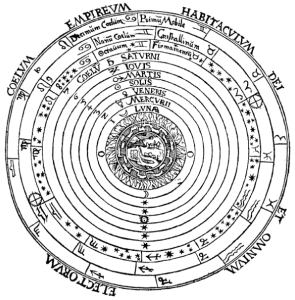
A Medievalist’s diagram of the geocentric world.
The half-pun (I hope you remember it from earlier) that I think I detect is that, while πλανάω did already have its malicious sense at this time, Scripture does give us another description of Satan’s typical behavior; in fact, it’s given twice, in two successive chapters. Here is the text of the second, and see if you can’t detect any parallels to other parts of the Apocalypse (italics mine):
Again there was a day when the sons of God came to present themselves before the Lord, and Satan came also among them to present himself before the Lord.
And the Lord said unto Satan, “From whence comest thou?” And Satan answered the Lord, and said, “From going to and fro in the earth, and from walking up and down in it.” And the Lord said unto Satan, “Hast thou considered my servant Job, that there is none like him in the earth, a perfect and an upright man, one that feareth God, and escheweth evil? and still he holdeth fast his integrity, although thou movedst me against him, to destroy him without cause.”
And Satan answered the Lord, and said, “Skin for skin, yea, all that a man hath will he give for his life. But put forth thine hand now, and touch his bone and his flesh, and he will curse thee to thy face.”
—Job 2.1-5
Additionally, Job’s arguments and lamentation sound not unlike another text from the Apocalypse:
And when he had opened the fifth seal, I saw under the altar the souls of them that were slain for the word of God, and for the testimony which they held: and they cried with a loud voice, saying, “How long, O Lord, holy and true, dost thou not judge and avenge our blood on them that dwell on the earth?” And white robes were given unto every one of them; and it was said unto them, that they should rest yet for a little season, until their fellow-servants also and their brethren, that should be killed as they were, should be fulfilled.
—Rev. 6.9-11
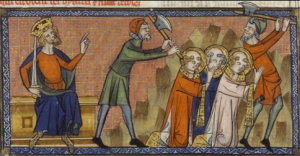
Illumination of the martyrdom of St. Sixtus
II and his companions (d. 258 under Valerian).
Notice the jaunty headsman to the right; I have
nothing to say about him, I just want him noticed.
i. they loved not their lives even unto death/did not love their life to the point of death: The word here translated “life” is ψυχή [psüchē]. It originally referred literally to breath—note that spitting-like sound at the beginning!—and is frequently rendered “soul,” which is how it gave us words with the prefix psych-. There are a few puns in the New Testament about “what a man will give in exchange for his life,” where the everyday not-being-dead-yet meaning is obviously there, but Jesus or the Apostle is obviously urging the hearer or reader to recognize the far greater urgency with which we should look to save our souls.
j. wrath/rage: If the term used here were μῆνις [mēnis], which is famously the first word of the Iliad, nothing could stop me from translating it as “wrath”; the correspondence is perfect—μῆνις is an old-fashioned word that refers especially to the wrath of the gods, as in the the English expression “the wrath of God”! (Ironically enough, when I was studying Classics in college, I got pretty weirded out while we were doing the Iliad, because the word “rage” was recommended for translating μῆνις on the ground that it referred to a superhuman, even a divine kind of anger. Guys, “wrath” is right there; who on earth ever talked about “the rage of God”?)
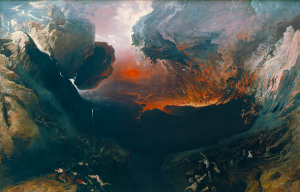
The End of the World (1853), also known as
The Great Day of His Wrath, by
John Martin.
However, the Greek here is θυμός [thümos], which was originally one of a collection of Greek terms for the soul9; it seems to come from an Indo-European root meaning “smoke.” It came to refer to a person’s temper in the sense of their disposition or personality, and then underwent a process very like the English “temper” in coming to indicate anger in particular.
Footnotes
1I’ve occasionally run into the pedantic objection that it doesn’t make sense to talk about “her children” as the Church because Mary is a member of the Church; but this is equivocal. Mary is a member of the Church in the second phrase because that’s using the strict, doctrinal definition of the term; the first phrase is using the term as a generalization of the Church’s members, and can be meaningfully contrasted with just one member of the strict-sense Church—much as when we say that a Senator is “addressing the Senate,” we don’t mean that he or she is not also a Senator.
2Admittedly, it is by no means settled that St. John the Divine (the author of Revelation) and St. John the Evangelist are the same person—that’s been in doubt since the first century! But I would argue that whether Revelation is John’s or not, it is distinctively Johannine, of his school of thought.
3The additions to Esther—parts of the text present in Septuagint, but not in any known Hebrew version, and probably created at the time Esther was translated into Greek—are handled inconsistently in those Bibles that print them. We have St. Jerome to thank for this: not content with simply marking them in the Vulgate as additions, he moved them all bodily to the end of the book, and numbered them as chapters 11-16 accordingly. As a result, some Bibles present the text in that disordered sequence (making the Greek version nigh-illegible for anyone who wants to read it), while others insert them into their plot-appropriate places in the book, keeping their Hieronymic4 numbering (so that, for example, Esther begins with chapter 11, verse 2), or assigning them new chapter numbers (and thus making that Bible’s references for Esther inconsistent with other Bibles), or creating additional verses within the existing chapters (with the same problem in reduced degree), or giving them chapter letters instead of numbers (which looks rather goofy but at least doesn’t upset the apple-cart). In the RSV-CE, the typical Bible of the Anglican Use, the Hieronymic numbering is preserved but the placement is according to the Septuagint: Mordecai’s dream is placed at the beginning of the book, which is chaptered and versed 11.2-12, while the dream’s interpretation comes at the end, in 10.4-13. The NAB and NABRE, standard Catholic versions for readings at Masses in the Ordinary Form—not that we get any substantial passages from Esther in the liturgy, but never mind!—uses the “lettered chapters” solution.
4Hieronymic is, in fact, the adjectival form of Jerome (as Johannine is of John).
5Some scholars see a link between Leviathan and Tiamat, the ancient Sumerian goddess-slash-sea-monster; I certainly wouldn’t say a connection of that kind can be ruled out, but I also don’t really see much of a case for it beyond their both being sea-monsters from vaguely the same cultural region.
6Those of you who remember your myths may observe that several of these creatures—Cerberus, the Hydra, the Nemean Lion, Ladon—feature in the labors of Heracles, and several more in other heroic tales (e.g. the Chimæra killed by Bellerophon, and the Sphinx, indirectly, by Oedipus). It is also a curious coincidence that about half of them have multiple heads, just like the apocalyptic dragon. As for the apples of the Hesperides, there seems to be a modern consensus that they bestowed immortality, but I couldn’t find ancient references for it—maybe they were just pretty. (According to at least one account, the Apple of Discord that ultimately provoked the Trojan War was plucked by Eris from the Garden of the Hesperides.)
7Really, calling it the Book of the Dead is something of a misnomer. Both the Coffin Texts and the Book of the Dead (which the Egyptians called the Ru Nu Peret Em Heru, “Utterances of Going Forth From the Day”) were collections of spells buried with the dead to protect them; while there were some spells that were especially popular or are now particularly well-known, there was no “orthodox” or “classic” list that were expected.
8It may not be a coincidence that, among the many Gnostic systems that attributed some kind of angelic intelligence to the planets, they were generally interpreted as hostile to humanity.
9It is the root of a few English psychiatric terms for this reason, such as dysthymia: a mild form of long-term depression; and alexithymia: difficulty in interpreting, processing, or articulating emotions (a– “not” + lex– “words” + thym– “heart, spirit,” constructed similarly to “dyslexia”), a trait often associated with autism. (Greek pneumatology wasn’t as involved as, say, Egyptian; the words were more in the nature of differently-accented synonyms than enumerated subdivisions.)
Previous Post
August 19, 2024
The Veiling of the Ark, Part II
Next Post

August 27, 2024 The Hidden Bread—Part III
Recent Comments
"On the contrary, such a proclamation, among the Aztecs or Maya, would be disastrously misunderstood. ..."
The Gospel of John: The Bread ..."
"Many thanks for your scholarly study on the Cleansing of the Ten Lepers in the ..."
The Cleansing of the Ten Lepers
"Four Last Things: not the video game, but Death, Judgment, Heaven and Hell.Momento mori. Remember, ..."
"I am going by the time that these sayings began to be converted into written ..."
Are Our Bibles in the Wrong ..."
Browse Our Archives
Select a Category abuse antifascism art bad Catholic celibacy chastity Church crucifixion culture war eros forgiveness gay gender homophobia ikons language liturgy peace poems politics Pope Francis prayer pro-life race recommendations reform repentance review sacraments saints satire scandal schism scripture sex suffering theology Uncategorized violence
Select a Month October 2026 September 2026 August 2026 July 2026 June 2026 May 2026 April 2026 March 2026 February 2026 January 2026 December 2025 November 2025 October 2025 September 2025 August 2025 July 2025 June 2025 May 2025 April 2025 March 2025 February 2025 January 2025 December 2024 November 2024 October 2024 September 2024 August 2024 July 2024 June 2024 May 2024 April 2024 March 2024 February 2024 January 2024 December 2023 November 2023 October 2023 September 2023 August 2023 July 2023 June 2023 May 2023 April 2023 March 2023 February 2023 January 2023 December 2022 November 2022 October 2022 September 2022 August 2022 July 2022 June 2022 May 2022 April 2022 March 2022 February 2022 January 2022 December 2021 November 2021 October 2021 September 2021 August 2021 July 2021 June 2021 May 2021 April 2021 March 2021 February 2021 January 2021 December 2020 November 2020 October 2020 September 2020 August 2020 July 2020 June 2020 May 2020 April 2020 March 2020 February 2020 January 2020 December 2019 November 2019 October 2019 September 2019 August 2019 July 2019
Follow Us!
TAKE THE
Religious Wisdom Quiz
True or False: Luke's Gospel is dedicated to someone named Theophilus.
Select your answer to see how you score.
FALSE TRUE
Related posts from Mudblood Catholic

The Sermon on the Mount, Part I: Matthew...

The Gospel of Matthew: Christ and Antichrist

John the Baptist and the Winnowing Fork: Matthew...

The Gospel of Matthew: The Coventry Carol
TRENDING AT PATHEOS Catholic

The Pillar of the Boatmen: the Ancient Monument...
The Pillar of the Boatmen is a Romano-Gaulish sculpture that dates from...

In one sense walking into Westminster Abbey is like walking down the...

'Super Scam Me' Exposes AI Jon Bon Jovi...
Leslie Pickett believed she was in a relationship with Jon Bon Jovi....

The Brazilian Remake of Kendricks' 'Flywheel' Opens in...
“Flywheel,” the story that launched the Kendrick Brothers’ filmmaking career is getting...

The Dangers of Gradual Accommodation (Winking at Sin)
Recently, the “law of gradualness” resurfaced during the opening of a weeklong,...

The Iron Gates and the Lion of the...
Yesterday, I didn't finish my report about, well, yesterday. So I'll...
view all Catholic blogs
What Are Your Thoughts?leave a comment
Ad-Free & Subscriber Log-In Subscription Support
- About Us
- 2026 Calendar
- Videos
- Podcasts
- Library of World Religions
- Faith In Media Tracker
- Advertise With Us
- Write for Us
- Privacy Policy
- Terms of Service
- Do Not Sell My Data
- Contact Us
- Radiant Digital
- Manage Newsletter Subscriptions
- Unsubscribe From Notifications
- Sitemap
Copyright 2008-2026, Patheos. All rights reserved.
Subscription Support Ad-Free & Subscriber Log-In
Follow Patheos