
BuddhistCatholicContemplativeEvangelicalGeneral ChristianHinduJewishLatter-day SaintMuslimNew VisionsProgressive Christian
Beliefs
- Buddhist
- Catholic
- Contemplative
- Evangelical
- General Christian
- Hindu
- Jewish
- Latter-day Saint
- More Voices
- Muslim
- New Visions
- Pagan
- Progressive Christian
Topics
- Religion News
- Food and Religion
- Sports and Religion
- Religious Art
- Religious Music and Entertainment
- Religious Events
- History and Religion
- Style and Religion
- Politics and Religion
- Women in Religion
- Recreation Outdoors and Religion
- Business Finance and Religion
- Careers Workplace and Religion
- Education and Religion
- Family Parenting and Religion
- Health Fitness and Religion
- Home and Religion
- Relationships and Religion
- Technology and Religion
- Travel and Religion
Columnists
- Buddhist Columnists
- Business Finance and Religion Columnists
- Careers Workplace and Religion Columnists
- Catholic Columnists
- Contemplative Columnists
- Education and Religion Columnists
- Evangelists Columnists
- Family Parenting and Religion Columnists
- General Christian Columnists
- Health Fitness and Religion Columnists
- Hindu Columnists
- History and Religion Columnists
- Home and Religion Columnists
- Jewish Columnists
- More Voices Columnists
- Latter Day Columnists
- Muslim Columnists
- New Visions Columnists
- Nonreligious Columnists
- Pagan Columnists
- Politics and Religion Columnists
- Progressive Columnists
- Recreation Outdoors and Religion Columnists
- Relationships and Religion Columnists
- Religion News Columnists
- Religious Art Columnists
- Religious Events Columnists
- Religious Music and Entertainment Columnists
- Sports and Religion Columnists
- Style and Religion Columnists
- Technology and Religion Columnists
- Travel and Religion Columnists
- Women in Religion Columnists
Resource Library
- 2026 Calendar
- Library of World Religions
- The 100 Most Holy Places on Earth
- Patheos Answers
- Podcasts
- Videos
- Faith Leaders Database
- Anglican Episcopalian
- Bahai
- Baptist
- Buddhism
- Christianity
- Confucianism
- Eastern Orthodoxy
- Hinduism
- Holiness and Pentecostal
- ISKCON
- Islam
- Judaism
- Lutheran
- Methodist
- The Church of Jesus Christ of Latter-day Saints
- New Age
- Paganism
- Presbytarian and Reformed
- Protestantism
- Religion Behind the Scenes
- Roman Catholic
- Scientology
- Shia Islam
- Sikhism
- Sufism
- Sunni Islam
- Taoism
- Zen
- See all religions
Research Tools
 Ad-Free & Subscriber Log-In Subscription Support
Ad-Free & Subscriber Log-In Subscription Support
Follow Patheos 

- Trending:
- Forgiveness
- |
- Marriage
- |
- Consciousness
- |
- Death Penalty
- |
- Election
- |
- Halloween

- Home
- Catholic
- Trinitytide: The End of the Beginning
Trinitytide: The End of the Beginning
Last updated on: June 24, 2024 at 11:39 am by Gabriel Blanchard
Trinitytide: The End of the Beginning 2024-06-24T11:39:53-04:00 Gabriel Blanchard
Patheos Explore the world's faith through different perspectives on religion and spirituality! Patheos has the views of the prevalent religions and spiritualities of the world.
Witnesses
Not officially, but by informal custom, Trinitytide is divided into five parts. The first corresponds to the “Apostles’ Fast” observed in the East; the second lasts until Assumption (15 Aug.); the third, colloquially called “St. Michael’s Lent,” runs till Michaelmas Eve (28 Sep.); the fourth, “Hallowtide,” runs from Michaelmas until All Saints’ Day (1 Nov.) inclusive; and the fifth, “Doomtide,” runs from 2 Nov. (All Souls’ Day) until the beginning of Advent and the new liturgical year.*
This week sees the first part of the long Trinity season conclude. The transition is marked by two solemnities: the Nativity of St. John the Baptist on the 24th, and the martyrdom of SS. Peter and Paul the Apostles on the 29th.
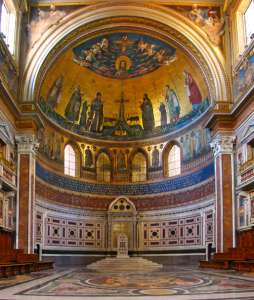
The apse of the papal cathedra in the Lateran
basilica (dedicated to St. John the Baptist).
Photo by Wikimedia contributor Tango7174,
used under a CC BY-SA 4.0 license (source).

First, St. John the Baptist, also known as St. John the Forerunner. For some reason, he is a less popular saint in the West than he used to be; we tend to assume that “Saint John” without specification means the Evangelist, but in antiquity and the Middle Ages, the Baptist would be a safer bet. He is one of several figures whose significance in the economy of salvation is as much “structural” as it is a matter of personal holiness (St. Peter and the Mother of God are also prominent in this category). According to Luke 1.36, he was about six months older than Jesus, who was some type of cousin of his—the relation between the Virgin Mary and St. Elizabeth is not made entirely clear in the text, only that they are relatives. Accordingly, his birth is celebrated at the opposite “end” of the year from Jesus’ own, placing it right around the summer solstice, which in the Medieval period and the Renaissance was known as midsummer.**
Then, on the far side of the Cross, we find St. Peter and St. Paul—the After-runners, if you will. St. Peter, of course, was not only an apostle, but the leader of the pack and part of Jesus’ innermost circle, crucified like his Savior; St. Paul was formally appointed the head of the Gentile mission that soon became (and has remained) the majority of the Church’s membership, and rendered eligible for the apostolate by a unique Resurrection appearance of Christ.
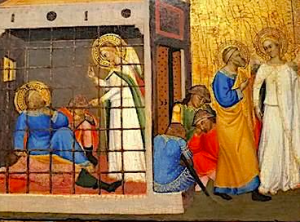
The Apostle Peter Released from Prison
(1371), by Jacopo di Cione, photographed
by Francis Helminski
The astronomical symbolism here is noteworthy: Pentecost falls some time in May or, at latest, early June, meaning that the Holy Ghost descends in fire while the sun is still “waxing” and the days lengthening, and the first movement of Trinitytide reaches a conclusion at midsummer with the nativity of the prophet who foretold that Jesus “will baptize you with the Holy Ghost and with fire,” and the martyrdom of “the two candlesticks standing before the God of the earth.”
Into Trinitytide II
I’ve spent some little time trying to discern the distinctive pattern or character of the second chunk of Trinitytide, which lasts just shy of seven weeks (forty-six days, if I’ve counted correctly); I believe I’ve hit on something, at least tentatively. Its most eminent celebration and only solemnity falls on its very last day, the Assumption of the Mother of God; second to that, it includes the Feast of the Transfiguration (6 Aug.) and the feasts of St. Thomas the Apostle, St. Mary Magdalene, and St. James the Greater (3, 22, and 25 July, respectively). It also begins on 30 June, which, when it does not fall on a Sunday as it does this year, is the memorial of the first martyrs of the Church of Rome.
These might indicate that this is—in some specialized sense—a season devoted to faith, and particularly faith in the face of death. St. James the Greater, in addition to being one of the saints present at the Transfiguration (which was a prophecy of the Passion), was the first of the Twelve to be martyred. St. Thomas’ doubt of the initial Resurrection, as reported by St. Mary Magdalene, is well known, but what is less known is the tradition that he was also late to say goodbye to the Virgin at her death, and that it was for his sake that the apostles opened her tomb—to find, once again, that the body they had expected was gone.
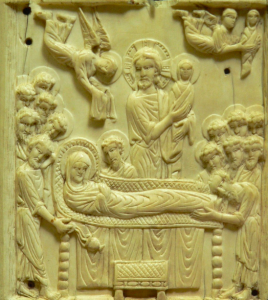
Ivory plaque depicting the Dormition of the
Virgin, late 10th-early 11th cent. Photo by
Wikimedia contributor Clio20, used under a
CC BY-SA 3.0 license (source).

What other meanings may be at work in this stretch of the calendar, I can’t say. I’ll keep thinking.
*If there are any conventional nicknames for the first and second parts of Trinitytide, I don’t know them.
**The tradition of assigning the start of the four seasons to the solstices and equinoxes (approximately 21 Dec., 20 Mar., 21 Jun., and 22 Sep.), while defensible, is somewhat modern. Many ancient cultures observed the cross-quarters instead, these being the midpoint dates between a solstice and an equinox: roughly, these are 1 Nov., 2 Feb., 1 May, and 1 Aug. (and no, it is not a coincidence that Halloween and Groundhog Day mark out the “old-style” winter). This accordingly made the solstices and equinoxes the midpoints of each season—hence the tradition that Jesus was born “in the bleak midwinter,” which doesn’t make sense at all on our calendar.
Previous Post
June 22, 2024
"His First Mate at the Wheel" (Gospel for 23 June, 2024)
Next Post

July 1, 2024 Daughters (Gospel for 30 June, 2024)
Recent Comments
"On the contrary, such a proclamation, among the Aztecs or Maya, would be disastrously misunderstood. ..."
The Gospel of John: The Bread ..."
"Many thanks for your scholarly study on the Cleansing of the Ten Lepers in the ..."
The Cleansing of the Ten Lepers
"Four Last Things: not the video game, but Death, Judgment, Heaven and Hell.Momento mori. Remember, ..."
"I am going by the time that these sayings began to be converted into written ..."
Are Our Bibles in the Wrong ..."
Browse Our Archives
Select a Category abuse antifascism art bad Catholic celibacy chastity Church crucifixion culture war eros forgiveness gay gender homophobia ikons language liturgy peace poems politics Pope Francis prayer pro-life race recommendations reform repentance review sacraments saints satire scandal schism scripture sex suffering theology Uncategorized violence
Select a Month October 2026 September 2026 August 2026 July 2026 June 2026 May 2026 April 2026 March 2026 February 2026 January 2026 December 2025 November 2025 October 2025 September 2025 August 2025 July 2025 June 2025 May 2025 April 2025 March 2025 February 2025 January 2025 December 2024 November 2024 October 2024 September 2024 August 2024 July 2024 June 2024 May 2024 April 2024 March 2024 February 2024 January 2024 December 2023 November 2023 October 2023 September 2023 August 2023 July 2023 June 2023 May 2023 April 2023 March 2023 February 2023 January 2023 December 2022 November 2022 October 2022 September 2022 August 2022 July 2022 June 2022 May 2022 April 2022 March 2022 February 2022 January 2022 December 2021 November 2021 October 2021 September 2021 August 2021 July 2021 June 2021 May 2021 April 2021 March 2021 February 2021 January 2021 December 2020 November 2020 October 2020 September 2020 August 2020 July 2020 June 2020 May 2020 April 2020 March 2020 February 2020 January 2020 December 2019 November 2019 October 2019 September 2019 August 2019 July 2019
Follow Us!
TAKE THE
Religious Wisdom Quiz
How many years between the exodus of the Children of Israel and construction of the temple?
Select your answer to see how you score.
400 years 450 years 480 years 500 years
Related posts from Mudblood Catholic

The Sermon on the Mount, Part I: Matthew...

The Gospel of Matthew: Christ and Antichrist

John the Baptist and the Winnowing Fork: Matthew...

The Gospel of Matthew: The Coventry Carol
TRENDING AT PATHEOS Catholic

Letters on Living the Faith by C.S. Lewis
Most of us met C.S. Lewis as a public intellectual. Mere Christianity....

When Halloween Unmasks Married Hearts
Written by Dr. David K. Ewen from Eternal Truth Bible College Behind...

Aristotle. He’s been called the father of logic, the father of the...

Methodist Central Hall and Westminster Abbey
Situated on the same square is Methodist Central Hall and Westminster Abbey. ...

57th Dove Awards Honor Dolly Parton, Crown New...
On gospel music’s biggest night, the 57th annual GMA Dove Awards honored...

The First Eucharistic Controversy: Christ’s Real Presence
For Catholics, the Eucharist is the source and summit of the Christian...
view all Catholic blogs
What Are Your Thoughts?leave a comment
Ad-Free & Subscriber Log-In Subscription Support
- About Us
- 2026 Calendar
- Videos
- Podcasts
- Library of World Religions
- Faith In Media Tracker
- Advertise With Us
- Write for Us
- Privacy Policy
- Terms of Service
- Do Not Sell My Data
- Contact Us
- Radiant Digital
- Manage Newsletter Subscriptions
- Unsubscribe From Notifications
- Sitemap
Copyright 2008-2026, Patheos. All rights reserved.
Subscription Support Ad-Free & Subscriber Log-In
Follow Patheos