
BuddhistCatholicContemplativeEvangelicalGeneral ChristianHinduJewishLatter-day SaintMuslimNew VisionsProgressive Christian
Beliefs
- Buddhist
- Catholic
- Contemplative
- Evangelical
- General Christian
- Hindu
- Jewish
- Latter-day Saint
- More Voices
- Muslim
- New Visions
- Pagan
- Progressive Christian
Topics
- Religion News
- Food and Religion
- Sports and Religion
- Religious Art
- Religious Music and Entertainment
- Religious Events
- History and Religion
- Style and Religion
- Politics and Religion
- Women in Religion
- Recreation Outdoors and Religion
- Business Finance and Religion
- Careers Workplace and Religion
- Education and Religion
- Family Parenting and Religion
- Health Fitness and Religion
- Home and Religion
- Relationships and Religion
- Technology and Religion
- Travel and Religion
Columnists
- Buddhist Columnists
- Business Finance and Religion Columnists
- Careers Workplace and Religion Columnists
- Catholic Columnists
- Contemplative Columnists
- Education and Religion Columnists
- Evangelists Columnists
- Family Parenting and Religion Columnists
- General Christian Columnists
- Health Fitness and Religion Columnists
- Hindu Columnists
- History and Religion Columnists
- Home and Religion Columnists
- Jewish Columnists
- More Voices Columnists
- Latter Day Columnists
- Muslim Columnists
- New Visions Columnists
- Nonreligious Columnists
- Pagan Columnists
- Politics and Religion Columnists
- Progressive Columnists
- Recreation Outdoors and Religion Columnists
- Relationships and Religion Columnists
- Religion News Columnists
- Religious Art Columnists
- Religious Events Columnists
- Religious Music and Entertainment Columnists
- Sports and Religion Columnists
- Style and Religion Columnists
- Technology and Religion Columnists
- Travel and Religion Columnists
- Women in Religion Columnists
Resource Library
- 2026 Calendar
- Library of World Religions
- The 100 Most Holy Places on Earth
- Patheos Answers
- Podcasts
- Videos
- Faith Leaders Database
- Anglican Episcopalian
- Bahai
- Baptist
- Buddhism
- Christianity
- Confucianism
- Eastern Orthodoxy
- Hinduism
- Holiness and Pentecostal
- ISKCON
- Islam
- Judaism
- Lutheran
- Methodist
- The Church of Jesus Christ of Latter-day Saints
- New Age
- Paganism
- Presbytarian and Reformed
- Protestantism
- Religion Behind the Scenes
- Roman Catholic
- Scientology
- Shia Islam
- Sikhism
- Sufism
- Sunni Islam
- Taoism
- Zen
- See all religions
Research Tools
 Ad-Free & Subscriber Log-In Subscription Support
Ad-Free & Subscriber Log-In Subscription Support
Follow Patheos 

- Trending:
- Forgiveness
- |
- Marriage
- |
- Consciousness
- |
- Death Penalty
- |
- Election
- |
- Halloween

- Home
- Catholic
- “His First Mate at the Wheel” (Gospel for 23 June, 2024)
“His First Mate at the Wheel” (Gospel for 23 June, 2024)
Last updated on: June 22, 2024 at 3:02 am by Gabriel Blanchard
“His First Mate at the Wheel” (Gospel for 23 June, 2024) 2024-06-22T03:02:31-04:00 Gabriel Blanchard
Patheos Explore the world's faith through different perspectives on religion and spirituality! Patheos has the views of the prevalent religions and spiritualities of the world.
A Thimbleful of Fire
There’s a band out of Philly that I like, mewithoutYou [sic], that just wrapped up their farewell tour a couple years ago. Their musical style was a weird blend of lo-fi folk with punk that sometimes approaches screamo (which of course means they’re generally described as “rock”). But what’s stranger than that was their lyrics.
The band’s core members and lyricists, Aaron and Michael Weiss, are brothers: their father was Jewish, and their mother had grown up Episcopal, so obviously the couple converted to Sufi Islam, and raised Aaron and Michael in that faith; allusions to all three Abrahamic religions are strewn throughout their music. They’re one of few religious bands I’ve ever encountered (Psalters and Sufjan Stevens are also examples) who write songs like they’re actually relating to God, instead of writing like they’re thinking Other people are going to listen to this and form opinions about me from the lyrics. One of their songs addresses him, “Your flavor in my mind goes back and forth between / Sweeter than any wine, as bitter as mustard greens / And it’s light and dark as honeydew and pumpernickel bread” (note that mustard greens are one of the plants that can be used as maror, the “bitter herbs” of the Passover seder). In one of my favorite songs of theirs, “Four Fires,” the final, polyphonic movement juxtaposes the Hebrew hymn “Ein Keloheinu“ with the Weisses’ own lyrics:
Mama, sing my favorite hymn
Where we make plowshares from our swords
And the mason’s barber trims our Christmas tree
In the Oneness of Our Lord
What grace surrounds! What strange perfection!
Mama, sing my favorite hymn
And remind me
Everyone is Him*

Cover art of the album Ten Stories,
the deluxe edition of which features
“Four Fires”
But this wasn’t even the song of theirs that I meant to share beside this Gospel! Several songs on their album Brother, Sister allude to the life of Jesus and the apostles. Its opening track, “Messes of Men,” is another long-time favorite of mine. I’m not even sure I can articulate its relation to the text; feel free to decide for yourself.
“I do not exist,” we faithfully insist,
Sailing in our separate ships and from each tiny caravel.
Tiring of trying, there’s a necessary dying,
Like the horseshoe crab in its proper season to shed its shell.
Such distance from our friends, like a scratch across a lens
Made everything look wrong from anywhere we stood.
Our paper blew away before we’d left the bay,
So half-blind, we wrote these songs on sheets of salty wood.
They caught me making eyes at the other boatmen’s wives,
And heard me laughing louder at the jokes told by their daughters.
I’d set my course for land, but you well understand
It takes a steady hand to navigate adulterous waters.
The propeller’s spinning blades held acquaintance with the waves,
‘Cause there’s mistakes I’ve made no rowing could outrun.
A tall glow on the mast, I say I’ve got no past;
I’m nonetheless the librarian and secretary’s son.
With tarnish on my brass, with mildew on my glass,
I’d never want someone so crass as to want someone like me,
But a few leagues off from shore, I bit a flashing lure,
And I assure you it was not what I expected it to be.
I still taste its kiss, that dull hook in my lip
Is a memory as useless as a rod without a reel
To an anchor-ever-dropped, seasick-yet-still-docked
Captain spotted napping with his first mate at the wheel.
Floating forgetfully along, with no need to be strong,
We keep our confessions long, and when we pray we keep it short.
I drank a thimbleful of fire; I’m not ever coming back
OH MY G-D
“I do not exist,” we faithfully insist
While watching sink the heavy ship of everything we knew,
And if ever You come near, I’ll hold up high a mirror—
Lord, I could never show You anything as beautiful as You.*
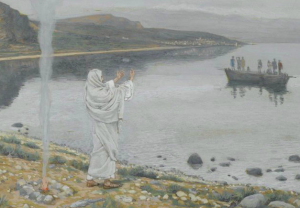
Jesus Appears on the Shore of Lake
Tiberias (1850), James Tissot
Mark. 4.35-41, RSV-CE
On that day, when evening had come, he said to them, “Let us go across to the other side.”a And leaving the crowd, they took him with them, just as he was,b in the boat. And other boats were with him. And a great stormc of wind arose, and the waves beat into the boat, so that the boat was already filling. But he was in the stern, asleepd on the cushion; and they woke him and said to him, “Teacher, do you not care if we perish?”e And he awokef and rebukedg the wind, and said to the sea, “Peace! Be still!” And the wind ceased, and there was a great calm. He said to them, “Why are you afraid?h Have you no faith?”i And they were filled with awe,j and said to one another, “Who then is this, that even wind and sea obey him?”
Mark 4.35-41, my translation
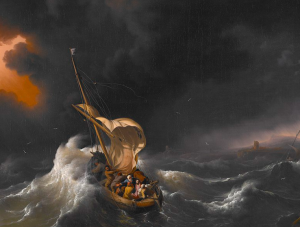
Christ in the Storm on the Sea of Galilee
(1695), by Ludolf Backhuysen
And he says to them as the evening of that day was coming on: “Let’s cross to the other side.”a And, leaving the crowd, they received him as he wasb in the boat, and other boats came with his. And a big cyclonec of wind began, and the waves were falling onto the boat, so that the boat was already filling. But he was in the stern, lying downd on a pillow; and they roused him and say to him: “Teacher, is it no concern of yours that we’re being destroyed?”e And, having been woken up,f he reprimandedg the wind and told the sea: “Be silent, be muzzled.” And the wind wore out, and a big calm began. And he told them: “Why are you being cowardly?h Do you still have no faith?”i And they were immensely afraid,j and began saying to each other: “What kind of man is this, then, that even the wind and the sea listen to him?”
Textual Notes
a. the other side: In this case, they seem to be traveling from Capernaum, which was Peter’s home and Jesus’ Galilean “HQ”; the next chapter takes place in the city of Gadara (near the modern village of Umm Qays in the extreme northwest of Jordan), which was part of a region known as the Decapolis or “Ten Cities.”** This was a league of city-states founded in the wake of Alexander the Great, most of which lay east of the Jordan River, though in Scythopolis the region had land on the western bank as well. The Jews regarded most of the Decapolis, outside of Damascus and its environs, as rightfully their territory, since these cities occupied lands that had traditionally been assigned to Issachar, Manasseh, and Naphtali. However, this was now a majority-Gentile area, albeit with Jewish minorities—mostly Greek, with some admixture of Syrians. Also unlike Judæa proper, which was a client kingdom of Rome (meaning it was technically autonomous), the Decapolis was directly subject to the Empire.
b. just as he was/as he was: This phrase really puzzles me. It’s just such an odd thing to bother saying; I mean, how else were they going to take him? The only thing I can think of is that Mark is thus specifying that they didn’t go back for any possessions they may have left behind; if so, this seems to suggest that they left quite abruptly. On the other hand, the evangelist notes in 3.9 that “he spake to his disciples, that a small ship should wait on him because of the multitude, lest they should throng him.” If this was a standing arrangement, then presumably this represents Jesus availing himself of it.
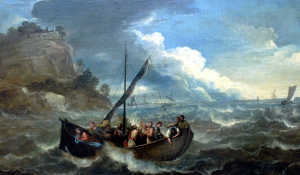
Calming the Storm (1630), by Cornelis de Wael
c. storm/cyclone: Abrupt storms are common on the Sea of Galilee. It neighbors the foothills of the Lebanon Mountains to its north, but is surrounded by land that’s mostly Mediterranean or desiccated in climate; add in that this Sea is several hundred feet below sea level, and any time the wind is coming at all from the north, you’re apt to get large masses of cool, damp air being poured into terrain that amounts to a hot funnel. The Greek term here, λαῖλαψ [lailaps], refers specifically to a whirlwind or a tornado (I chose “cyclone” as a suitably ambiguous term in English). I wasn’t able to find much on this specifically, but, as far as I can tell, it is possible that the boat was threatened by a waterspout.
d. asleep/lying down: The verb here just means “to lie down” if taken flat-footedly, but of course, in English as in Greek, “I’m going to have a lie down” does mean sleeping.
e. do you not care if we perish/is it no concern of yours that we’re being destroyed: I may have interpreted the apostles a little unkindly here, I’m not sure. However, the impression I get from this part of the text is one not so much of abject terror, but of angrily panicked sarcasm. The mention of the waves breaking over the boat suggests that their craft was flooding to the point of sinking (a possibility corroborated by Matthew and Luke); it’s possible they were waking him up because they wanted another pair of hands bailing water out of the boat.
f. he awoke/having been woken up: Mood.
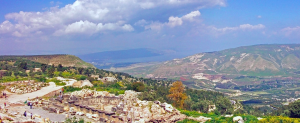
View to the north from Umm Qays, Jordan;
the Sea of Galilee is dimly visible in the
center-distance. Photo by Daniel Case, used
under a CC BY-SA 3.0 license (source).

g. rebuked/reprimanded: I spent a while trying to figure out how to render this word, and I’m pretty dissatisfied with my eventual choice. The verb in question is ἐπιτιμάω [epitimaō], a derivative of τιμάω, “to honor” (the name “Timothy” is related). It can be either used in its straightforward sense, or in the opposite, a little like the English word “cleave.” The trouble is that I couldn’t think of an English word with the right meaning that is its own antonym, or anything close to one of those, or anything ambiguous in the appropriate way. (The closest I got was “sanction,” which isn’t really close enough, and also “he sanctioned the storm” sounded much too ridiculous to use.) I finally settled on “reprimand” as having a slight resemblance in sound to “commend,” which is great, nobody say anything.
h. afraid/being cowardly: “Cowardly” may seem a bit harsh on our Lord’s part, but it is what the text says—δειλός [deilos] has none of the potential sympathy in it that the English “afraid” carries. This is one of a few examples in Mark where Jesus shows his temper with the apostles in ways we may find puzzling. G. K. Chesterton put it very well in The Everlasting Man:
The Church can reasonably be justified … if she turns the most merciful face or aspect [of Jesus] towards men; but it is certainly … very much more specially and exclusively merciful than any impression that could be formed by a man merely reading the New Testament for the first time. A man simply taking the words of the story as they stand would form quite another impression … It would be intensely interesting; but part of the interest would consist in its leaving a good deal to be guessed at or explained. It is full of sudden gestures evidently significant except that we hardly know what they signify; of enigmatic silences; of ironical replies. The outbreaks of wrath, like storms above our atmosphere, do not seem to break out exactly where we should expect them, but to follow some higher weather-chart of their own.†
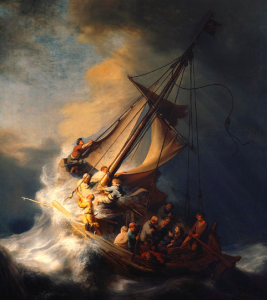
The Storm on the Sea of Galilee
(1633), by Rembrandt (his only
painting of a seascape)
i. Have you no faith?/Do you still have no faith?: I’m mildly puzzled that the RSV chose to eliminate the “still” or “yet” carried by the negating word in this question. It definitely seems to be implying that by now the disciples should have seen enough from Jesus to know better than to panic.
j. filled with awe/immensely afraid: “Frightened with great fear” would be the flat-footedly literal translation. Though the divergence is less severe, this is not unlike the alteration from back in chapter 1 (textual note b in this post), where a verb meaning “to be angered” was bent to breaking point by being rendered “to be moved with pity.”
Now, to be clear, there is a theological case to be made here for interpreting the disciples’ fear here as awe. Personally, I would guess their response was neither garden-variety fear (the way they were afraid of the storm), nor—as yet—awe in the strictly religious sense (a.k.a. “the fear of the Lord”); my hunch is that this is describing them being unnerved, a feeling which is more like the former than the latter but is akin to both. I might be mistaken, but it seems to me like it tracks with the details and is psychologically more plausible than the alternatives. However, like the idea that it was religious awe they were feeling, my idea is an interpretation of the text. Not only are many readings all consistent with this text, which is nearly always true: many readings are consistent with rigorous Nicene orthodoxy, a much more stringent criterion that a lot of verses in the New Testament have difficulty meeting!
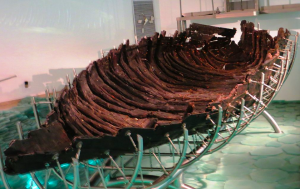
Remains of a Galilean boat preserved at
Kibbutz Ginosar (on the western shore of the
Sea), photographed by Yehudit Garinkol and
used under a CC BY 2.5 license (source).

Accordingly, as I’ve said, I dislike the tendency to interpret under the name of translating. I’m not saying that parameters for what interpretations are acceptable are bad or superfluous (I mean, I’m a Catholic!), or even that they shouldn’t be printed alongside the text: on the contrary, glosses and notes and commentaries have a long history in the Church and specifically in the many scriptoria that the Bible was copied in over the centuries. What I object to is printing these things instead of the text, as the text.
However, as a final note (one that both addresses the subject of religious awe and also brings it back to songs, like we opened with): while I feel sure it must have happened at some point, I’d be fascinated to know just when the apostles noticed the echo in this story of Psalm 107.23-31.
*Lyrics to “Four Fires” and “Messes of Men” obtained courtesy of genius.com. The style “G-d” is a borrowing from Judaic customs, analogous to replacing the Tetragrammaton in lection with “Adonai” or “ha-Shem.”
**What cities exactly the Decapolis consisted in is not universally agreed, due to conflicting evidence in ancient sources. The most typical list of the ten cities has: Canatha (now Qanawat, Syria); Damascus (now the capital of Syria); Dion; Hippus, also known as Sussita; Gadara; Gerasa (now Jerash, Jordan); Pella; Philadelphia (now Amman, the capital of Jordan); Raphana; and Scythopolis (now Beyt She’an, Israel). Damascus predated the others, having been occupied since the Bronze Age, and is absent from Josephus’ list of Decapolitan cities.
†TEM Part II: On the Man Called Christ, Chapter 2: The Riddles of the Gospel.
Previous Post

June 19, 2024
Two Marcan Parables (Gospel for 16 June, 2024)
Next Post
June 24, 2024 Trinitytide: The End of the Beginning
Recent Comments
"On the contrary, such a proclamation, among the Aztecs or Maya, would be disastrously misunderstood. ..."
The Gospel of John: The Bread ..."
"Many thanks for your scholarly study on the Cleansing of the Ten Lepers in the ..."
The Cleansing of the Ten Lepers
"Four Last Things: not the video game, but Death, Judgment, Heaven and Hell.Momento mori. Remember, ..."
"I am going by the time that these sayings began to be converted into written ..."
Are Our Bibles in the Wrong ..."
Browse Our Archives
Select a Category abuse antifascism art bad Catholic celibacy chastity Church crucifixion culture war eros forgiveness gay gender homophobia ikons language liturgy peace poems politics Pope Francis prayer pro-life race recommendations reform repentance review sacraments saints satire scandal schism scripture sex suffering theology Uncategorized violence
Select a Month October 2026 September 2026 August 2026 July 2026 June 2026 May 2026 April 2026 March 2026 February 2026 January 2026 December 2025 November 2025 October 2025 September 2025 August 2025 July 2025 June 2025 May 2025 April 2025 March 2025 February 2025 January 2025 December 2024 November 2024 October 2024 September 2024 August 2024 July 2024 June 2024 May 2024 April 2024 March 2024 February 2024 January 2024 December 2023 November 2023 October 2023 September 2023 August 2023 July 2023 June 2023 May 2023 April 2023 March 2023 February 2023 January 2023 December 2022 November 2022 October 2022 September 2022 August 2022 July 2022 June 2022 May 2022 April 2022 March 2022 February 2022 January 2022 December 2021 November 2021 October 2021 September 2021 August 2021 July 2021 June 2021 May 2021 April 2021 March 2021 February 2021 January 2021 December 2020 November 2020 October 2020 September 2020 August 2020 July 2020 June 2020 May 2020 April 2020 March 2020 February 2020 January 2020 December 2019 November 2019 October 2019 September 2019 August 2019 July 2019
Follow Us!
TAKE THE
Religious Wisdom Quiz
Which book is known as the "Weeping Prophet's" book?
Select your answer to see how you score.
Ezekiel Isaiah Jeremiah Lamentations
Related posts from Mudblood Catholic

The Sermon on the Mount, Part I: Matthew...

The Gospel of Matthew: Christ and Antichrist

John the Baptist and the Winnowing Fork: Matthew...

The Gospel of Matthew: The Coventry Carol
TRENDING AT PATHEOS Catholic

Emotion in Early Christianity by Andrew Crislip
Andrew Crislip’s Emotion in Early Christianity examines an often overlooked dimension of...

16 Spiritual Touchstones for a More Grounded Life
After decades of spiritual study, here are 16 principles I try...

Catholic Evangelization: Sharing Your Faith Every Day
Welcome back to the Graceful Awakening mini-series called, “From Faith to Mission.” ...

The Pillar of the Boatmen: the Ancient Monument...
The Pillar of the Boatmen is a Romano-Gaulish sculpture that dates from...

In one sense walking into Westminster Abbey is like walking down the...

'Super Scam Me' Exposes AI Jon Bon Jovi...
Leslie Pickett believed she was in a relationship with Jon Bon Jovi....
view all Catholic blogs
What Are Your Thoughts?leave a comment
Ad-Free & Subscriber Log-In Subscription Support
- About Us
- 2026 Calendar
- Videos
- Podcasts
- Library of World Religions
- Faith In Media Tracker
- Advertise With Us
- Write for Us
- Privacy Policy
- Terms of Service
- Do Not Sell My Data
- Contact Us
- Radiant Digital
- Manage Newsletter Subscriptions
- Unsubscribe From Notifications
- Sitemap
Copyright 2008-2026, Patheos. All rights reserved.
Subscription Support Ad-Free & Subscriber Log-In
Follow Patheos