
BuddhistCatholicContemplativeEvangelicalGeneral ChristianHinduJewishLatter-day SaintMuslimNew VisionsProgressive Christian
Beliefs
- Buddhist
- Catholic
- Contemplative
- Evangelical
- General Christian
- Hindu
- Jewish
- Latter-day Saint
- More Voices
- Muslim
- New Visions
- Pagan
- Progressive Christian
Topics
- Religion News
- Food and Religion
- Sports and Religion
- Religious Art
- Religious Music and Entertainment
- Religious Events
- History and Religion
- Style and Religion
- Politics and Religion
- Women in Religion
- Recreation Outdoors and Religion
- Business Finance and Religion
- Careers Workplace and Religion
- Education and Religion
- Family Parenting and Religion
- Health Fitness and Religion
- Home and Religion
- Relationships and Religion
- Technology and Religion
- Travel and Religion
Columnists
- Buddhist Columnists
- Business Finance and Religion Columnists
- Careers Workplace and Religion Columnists
- Catholic Columnists
- Contemplative Columnists
- Education and Religion Columnists
- Evangelists Columnists
- Family Parenting and Religion Columnists
- General Christian Columnists
- Health Fitness and Religion Columnists
- Hindu Columnists
- History and Religion Columnists
- Home and Religion Columnists
- Jewish Columnists
- More Voices Columnists
- Latter Day Columnists
- Muslim Columnists
- New Visions Columnists
- Nonreligious Columnists
- Pagan Columnists
- Politics and Religion Columnists
- Progressive Columnists
- Recreation Outdoors and Religion Columnists
- Relationships and Religion Columnists
- Religion News Columnists
- Religious Art Columnists
- Religious Events Columnists
- Religious Music and Entertainment Columnists
- Sports and Religion Columnists
- Style and Religion Columnists
- Technology and Religion Columnists
- Travel and Religion Columnists
- Women in Religion Columnists
Resource Library
- 2026 Calendar
- Library of World Religions
- The 100 Most Holy Places on Earth
- Patheos Answers
- Podcasts
- Videos
- Faith Leaders Database
- Anglican Episcopalian
- Bahai
- Baptist
- Buddhism
- Christianity
- Confucianism
- Eastern Orthodoxy
- Hinduism
- Holiness and Pentecostal
- ISKCON
- Islam
- Judaism
- Lutheran
- Methodist
- The Church of Jesus Christ of Latter-day Saints
- New Age
- Paganism
- Presbytarian and Reformed
- Protestantism
- Religion Behind the Scenes
- Roman Catholic
- Scientology
- Shia Islam
- Sikhism
- Sufism
- Sunni Islam
- Taoism
- Zen
- See all religions
Research Tools
 Ad-Free & Subscriber Log-In Subscription Support
Follow Patheos 

- Trending:
- Advent
- |
- Forgiveness
- |
- Thanksgiving
- |
- Election
- |
- Seasonal Holidays
- |
- Marriage

- Home
- Catholic
- Mark: Catching Up to Chapter One
Mark: Catching Up to Chapter One
Last updated on: February 18, 2024 at 10:19 am by Gabriel Blanchard
Mark: Catching Up to Chapter One 2024-02-18T10:19:53-04:00 Gabriel Blanchard
Patheos Explore the world's faith through different perspectives on religion and spirituality! Patheos has the views of the prevalent religions and spiritualities of the world.
Sexagesima and Quinquagesima
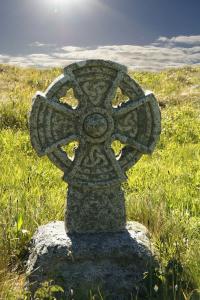
These are the names of the second and third Sundays in Shrovetide, which were on 4 and 11 February in 2024—in other words, the next-to-last and last Sundays before Lent, respectively. Rendered literally from the Latin, they mean “sixtieth” and “fiftieth.” Because Sundays are counted out for the forty days’ fast of Lent, the Sunday right before Ash Wednesday is fifty days before Easter. The names of Sexagesima and Seputagesima are derived by rounding the seven days of each preceding week up to a nice simple ten—as one often does, in the frequent practice of counting things by sevens.
Anyway, now that that more pressing a universal concern is out of the way, let’s get back into the Gospel for Year B! Mark is famous for being briskly paced, and it lives up to its reputation in these two readings. Jesus, having performed one of his first miracles, performs a whole bunch more in rapid succession. He also shows his first flash of odd, quick temper; we’ll get to that.
EDIT: I had originally been planning to combine these two Gospel readings (which are both short) into a single post, in the desperate hope of getting a little closer to where we actually are in Mark at this point. I don’t know how, but somehow, this post contrived to get itself published before I had finished it. I was then unable to figure out how to un-publish it in order to actually finish it. Increasingly exasperated, and unable to rectify the situation before I need to leave for Mass, I’ve settled for splitting the post in two, correcting the finished part that is already a published post (for the reading from Sexagesima), waiting to finish the rest, and being in a bad mood about it.
Mark 1.29-39, RSV-CE
And immediatelya he left the synagogue, and entered the house of Simon and Andrew, with James and John. Now Simon’s mother-in-law lay sick with a fever, and immediately they told him of her. And he came and took her by the hand and lifted her up, and the fever left her; and she served them.
That evening, at sundown,b they brought to him all who were sickc or possessed with demons.d And the whole city was gathered together about the door. And he healed many who were sick with various diseases,e and cast out many demons; and he would not permit the demons to speak, because they knew him.
And in the morning, a great while before day,f he rose and went out to a lonelyg place, and there he prayed. And Simon and those who were with him followedh him, and they found him and said to him, “Every one is searching for you.” And he said to them, “Let us go on to the next towns,i that I may preach there also; for that is why I came out.” And he went throughout all Galilee, preaching in their synagogues and casting out demons.
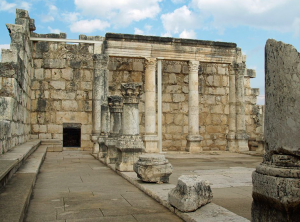
Remains of the fourth-century synagogue
at Capernaum. Photo by David Shankbone,
taken in 2007 and used under a CC BY-SA 3.0
license (source).

Mark 1.29-39, my translation
Going out of the synagogue, he went right awaya to the house of Simon and Andrew with Jacob and John. Simon’s mother-in-law was lying down with a fever, and right away they spoke to him about her. Coming to her, he raised her, holding her by the hand; and the fever released her, and she served them. When dusk came on and the sun sank,b they were carrying everyone to him who was doing badlyc and the demon-possessed,d and the whole city was assembled at the door. And he healed many who were doing badly with rashes or illnesses,e and cast out many demons (and he did not permit the demons to talk, because they knew him).
Now, getting up very first thing in the dark of the morning,f he went and got out to a desertedg place, where he prayed. Simon and those who were with him pursuedh him and found him, and said to him, “Everyone is searching for you.” And he said to them: “Let us go elsewhere, to the village holdings,i so that I may preach there too; I came out for this.” And he went preaching in their synagogues in the whole Galilee and casting out demons.
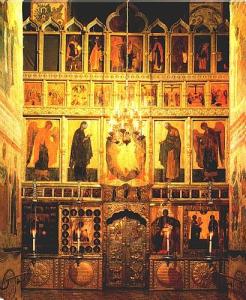
The ikonostasis in the Cathedral of the Annunciation
in Moscow. (An ikonostasis is a structural element
in Orthodox churches: it separates the nave, where
the congregants stand or sit, from the sanctuary proper,
where the altar is located.)
Textual Notes, vv. 29-39
a. immediately he left the synagogue/Going out of the synagogue, he went right away: Ah, εὐθύς,1 Mark’s favorite adverb: it means “immediately, directly, right away.” There’s a YouTuber I like who unluckily has a verbal tic which drives me crazy, and that verbal tic is that he says “whenever” every time he simply means “when”; this has actually inspired me to wonder whether Mark says εὐθύς whenever he simply means “then.” As for whether the adverb applies to how Jesus left the synagogue or how he progressed from there to Peter’s house (RSV takes it to be the former, while I’ve taken it to be the latter), I don’t know that either interpretation is less likely than the other, and obviously very little rides on the difference!
b. That evening, at sundown/When dusk came on and the sun sank: Mark here shows a surprisingly poetic turn of phrase, which I found charming and preferred to preserve.
c. sick/doing badly: “doing badly” is an almost comically literal translation of the Greek (“having badly” would be absolutely literal—have, like do and make, is one of those words whose uses in many languages tend to inflate and get oddly specific over time).
d. demons: This word is striking. Mark has already used a different term for this type of being; only a few verses ago he called it an “unclean spirit.” In Judaic usage, at this time, these two terms were synonyms. However, outside the sui generis monotheistic context of Judaism, a daimōn [δαίμων] in Greek was not generally thought of as a negative or hostile force. If anything, quite the contrary was true; the original sense of the word, centuries earlier, had been that of a tutelary spirit (not unlike the Christian belief in guardian angels), and in Plato’s Apologia, Socrates describes what is to all appearances his conscience as his daimōn. By this time, in most of the Greek-speaking world, it meant something like “demigod”; daimōnes were widely interpreted as intermediary spirits that aided humans’ attempts to appeal to the gods. I gather it was with the production of the Septuagint that daimōnes became more sinister in Semitic usage, as it then began to be used to translate the Hebrew word shed’yim [שֵׁדִים]—a term for the class of seemingly monstrous deities of the neighboring peoples, like Molech.
e. various diseases/rashes or illnesses: I decided to use “rashes” to translate poikilais [ποικίλαις], which I think must be the word the RSV chose to render as “various.” It literally means something like painted or speckled.2 I suppose “a smattering of diseases” might be the gist of the phrase, but to me, it more immediately suggested a rash or pockmarks.

Sunrise over the Sea of Galilee
f. in the morning, a great while before day/very first thing in the dark of the morning: The Greek here has a sequence of words that mean “in the morning,” “at night,” and “exceedingly.” I chose the translation I did because I feel it conveys something of the vividness of the original, but obviously nothing but tone hangs on this difference. (It is, however, rather striking that here at the beginning of Mark, right after Jesus’ first sermon and first miracle, we essentially get a repetition of “And there was evening, and there was morning.”)
g. lonely/deserted: The Greek here is the adjective erēmos [ἔρημος], which is the source of our eremitic and hermit; the word can describe either a place that is a wilderness or a place greatly isolated from people. As “deserted” hints at both, I decided to use that rather than “over-determine” the translation.
h. followed/pursued: The verb here is, strictly, the same one (or a derivative of the same on) used in other passages to talk about persecution. I therefore opted for pursued over followed, since the latter is neutral whereas the former can be strictly descriptive but carries connotations of enmity or “giving chase” to a quarry.
i. next towns/village holdings: “Village holdings” is a fairly literal translation. I gather this phrase indicates the district around a village that would be considered as “belonging to” it. Here again, the sense is little different between the RSV and mine.
1I don’t know why you would, but if you’re reading this aloud for some reason and want to know how to say εὐθύς, try this. Say “eh” (the vowel of egg), then “oo” (as in food), then “th” as in thing, then “ü” the German way, and lastly “s” as in this. Then run the first two vowels together (they’re a diphthong in Greek) and say the whole sequence in order, stressing the second syllable: eu-thüs. That’s pretty nearly it. (Also all the ancient Greeks are dead and the modern ones have their own pronunciation so who cares.)
2The Stoics were so named because they originally met in a colonnade north of the Athenian marketplace, called the Poikilē Stoa [Ποικίλη Στοά] or “Painted Portico.”
Previous Post
February 9, 2024
The Gospel for Septuagesima Sunday, 2024
Next Post
March 4, 2024 The Cleansing of the Leper (Mark 1.40-45)
Recent Comments
"That is indeed a lovely version of "Idumea."For a different effect, (with additional verses) can ..."
"This Mudblood Catholic post examines why Jesus avoids giving direct answers to questions like whether ..."
Why Won’t Jesus Give Us a ..."
"On the contrary, such a proclamation, among the Aztecs or Maya, would be disastrously misunderstood. ..."
The Gospel of John: The Bread ..."
"Many thanks for your scholarly study on the Cleansing of the Ten Lepers in the ..."
The Cleansing of the Ten Lepers
Browse Our Archives
Select a Category abuse antifascism art bad Catholic celibacy chastity Church crucifixion culture war eros forgiveness gay gender homophobia ikons language liturgy peace poems politics Pope Francis prayer pro-life race recommendations reform repentance review sacraments saints satire scandal schism scripture sex suffering theology Uncategorized violence
Select a Month November 2026 October 2026 September 2026 August 2026 July 2026 June 2026 May 2026 April 2026 March 2026 February 2026 January 2026 December 2025 November 2025 October 2025 September 2025 August 2025 July 2025 June 2025 May 2025 April 2025 March 2025 February 2025 January 2025 December 2024 November 2024 October 2024 September 2024 August 2024 July 2024 June 2024 May 2024 April 2024 March 2024 February 2024 January 2024 December 2023 November 2023 October 2023 September 2023 August 2023 July 2023 June 2023 May 2023 April 2023 March 2023 February 2023 January 2023 December 2022 November 2022 October 2022 September 2022 August 2022 July 2022 June 2022 May 2022 April 2022 March 2022 February 2022 January 2022 December 2021 November 2021 October 2021 September 2021 August 2021 July 2021 June 2021 May 2021 April 2021 March 2021 February 2021 January 2021 December 2020 November 2020 October 2020 September 2020 August 2020 July 2020 June 2020 May 2020 April 2020 March 2020 February 2020 January 2020 December 2019 November 2019 October 2019 September 2019 August 2019 July 2019
Follow Us!
TAKE THE
Religious Wisdom Quiz
Which Jewish festival commemorates the defeat of Haman?
Select your answer to see how you score.
Purim Pentecost Passover Booths
Related posts from Mudblood Catholic
Book III, Chapter 3: Christ "Classic" (Matt. 9:9-34)
What Kind of Man Do Wind and Sea...
The Sermon on the Mount, Part IV: Matthew...
TRENDING AT PATHEOS Catholic

We Can Trust That God Will Use Our...
A Jesus-loving young friend who is going through deep suffering sent me...

Everything is worship for Quakers. The Quakers emphasize contemplation, equality, pacifism and...

Happy Thanksgiving! I published this Thanksgiving column back in 2017 in...

More Than a Meal: A Messianic Thanksgiving
A Messianic Thanksgiving What if Thanksgiving became more than a meal to...

The Darkening of the Sun, Moon, and Stars
The darkening of the sun and moon and the falling of stars...

Gratitude as the Parent of All Virtues
Giving thanks stems from gratitude. Cicero said that gratitude is the parent...
view all Catholic blogs
What Are Your Thoughts?leave a comment
Ad-Free & Subscriber Log-In Subscription Support
- About Us
- 2026 Calendar
- Videos
- Podcasts
- Library of World Religions
- Faith In Media Tracker
- Advertise With Us
- Write for Us
- Privacy Policy
- Terms of Service
- Do Not Sell My Data
- Contact Us
- Radiant Digital
- Manage Newsletter Subscriptions
- Unsubscribe From Notifications
- Sitemap
Copyright 2008-2026, Patheos, part of the Radiant Digital network of media brands. All rights reserved.
Subscription Support Ad-Free & Subscriber Log-In
Follow Patheos