
BuddhistCatholicContemplativeEvangelicalGeneral ChristianHinduJewishLatter-day SaintMuslimNew VisionsProgressive Christian
Beliefs
- Buddhist
- Catholic
- Contemplative
- Evangelical
- General Christian
- Hindu
- Jewish
- Latter-day Saint
- More Voices
- Muslim
- New Visions
- Pagan
- Progressive Christian
Topics
- Religion News
- Food and Religion
- Sports and Religion
- Religious Art
- Religious Music and Entertainment
- Religious Events
- History and Religion
- Style and Religion
- Politics and Religion
- Women in Religion
- Recreation Outdoors and Religion
- Business Finance and Religion
- Careers Workplace and Religion
- Education and Religion
- Family Parenting and Religion
- Health Fitness and Religion
- Home and Religion
- Relationships and Religion
- Technology and Religion
- Travel and Religion
Columnists
- Buddhist Columnists
- Business Finance and Religion Columnists
- Careers Workplace and Religion Columnists
- Catholic Columnists
- Contemplative Columnists
- Education and Religion Columnists
- Evangelists Columnists
- Family Parenting and Religion Columnists
- General Christian Columnists
- Health Fitness and Religion Columnists
- Hindu Columnists
- History and Religion Columnists
- Home and Religion Columnists
- Jewish Columnists
- More Voices Columnists
- Latter Day Columnists
- Muslim Columnists
- New Visions Columnists
- Nonreligious Columnists
- Pagan Columnists
- Politics and Religion Columnists
- Progressive Columnists
- Recreation Outdoors and Religion Columnists
- Relationships and Religion Columnists
- Religion News Columnists
- Religious Art Columnists
- Religious Events Columnists
- Religious Music and Entertainment Columnists
- Sports and Religion Columnists
- Style and Religion Columnists
- Technology and Religion Columnists
- Travel and Religion Columnists
- Women in Religion Columnists
Resource Library
- 2026 Calendar
- Library of World Religions
- The 100 Most Holy Places on Earth
- Patheos Answers
- Podcasts
- Videos
- Faith Leaders Database
- Anglican Episcopalian
- Bahai
- Baptist
- Buddhism
- Christianity
- Confucianism
- Eastern Orthodoxy
- Hinduism
- Holiness and Pentecostal
- ISKCON
- Islam
- Judaism
- Lutheran
- Methodist
- The Church of Jesus Christ of Latter-day Saints
- New Age
- Paganism
- Presbytarian and Reformed
- Protestantism
- Religion Behind the Scenes
- Roman Catholic
- Scientology
- Shia Islam
- Sikhism
- Sufism
- Sunni Islam
- Taoism
- Zen
- See all religions
Research Tools
 Ad-Free & Subscriber Log-In Subscription Support
Ad-Free & Subscriber Log-In Subscription Support
Follow Patheos 

- Trending:
- Forgiveness
- |
- Marriage
- |
- Consciousness
- |
- Death Penalty
- |
- Election
- |
- Halloween

- Home
- Catholic
- The Epiphany Epistle: Ephesians 3.2-6
The Epiphany Epistle: Ephesians 3.2-6
Last updated on: January 7, 2024 at 6:50 pm by Gabriel Blanchard
The Epiphany Epistle: Ephesians 3.2-6 2024-01-07T18:50:19-04:00 Gabriel Blanchard
Patheos Explore the world's faith through different perspectives on religion and spirituality! Patheos has the views of the prevalent religions and spiritualities of the world.
The Pretext
I’m once again offering a translation of the epistle instead of the gospel reading, mainly so that I can take this opportunity to complain.
A few things bug me about the way liturgical readings are handled in the Roman Rite. Most of them boil down to our normal translation (which I’ve discussed elsewhere). Some of them, it bears saying, are truly silly: for instance, I hate that our lectionary inserts the phrase “brothers and sisters” at the beginning of almost every epistle reading, even though it’s a stock phrase that roughly signals the historical and in-document context. Historically, only the Apostles have reason to address others as “brothers and sisters,” and only after Pentecost: the authors of the Hebrew Bible mostly address themselves to “Israel,” and Jesus “to his disciples” (with important exceptions). Furthermore, none of the New Testament letters actually begins with this phrase, so it signals that we are picking up somewhere within the letter in question. The addition bugs me purely for the technicality’s sake, purely on the basis that the original text did not have ὦ ἀδελφοί in these places. To adapt a statement from Natalie Wynn of YouTube’s Contrapoints channel: I think, on some level, my feelings are “correct,” but this situation is so inconsequential, any amount of emotional energy spent on it is too much.
That said, there are cases where I think my irritation is less unreasonable. Our readings could stand to be more varied, for one thing, in both the Mass and the Office.* There are several books in the Bible that even a regular Sunday Mass-goer will never hear proclaimed during the liturgy—not just relatively minor writings like Judith, Obadiah, or III John, but more important books like Ruth, Esther, I Maccabees, even the Song of Solomon.
And of the books we do read from, it bothers me that the chosen texts seem so omission-happy. The Gospels and Ephesians are the only books of which we hear more than half,* and even the parts that do see liturgical use often skip segments. It’s not uncommon for readings to have verses and half-verses picked here and there from the flow of a passage, until the reference looks like an unattended chocolate chip muffin that a child has lit upon to relieve of its chocolate chips. (And when hee hath the kernell eate, / Who doth not fling away the shell?)
The idea makes sense in principle; some pericopes** are on the long side, and would make a liturgy unduly long in turn. This holds in some specific cases. Genealogies, for instance, play little role in our culture—certainly not the kind they played in the ancient Near East—and so leaving most of those out and spending our time on other texts is logical. What’s weird is that the lectionary’s omissions often serve no clear purpose. Our epistle for Epiphany is a textbook example; in the title, I have listed as the reading as Ephesians 3.2-6, but that’s not strictly true: it is Ephesians 3.2-3a and 5-6. Is a verse and a half really an amount of time worth saving? Why not have a longer selection? In this particular example, very little of significance is lost, but still, a tiny bit is; besides which, it makes things slightly confusing for those who do crack open their Bibles at home, only to find the text doesn’t seem to match what they remember from Mass. Why not just keep it intact? We can handle Ephesians 3.3b-4, USCCB. I promise.
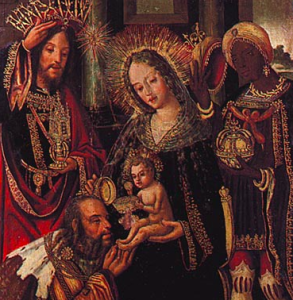
Happy Epiphany, by the way! (Adoraçao dos Magos, post-12th century)
Ephesians 3.2-6, RSV-CE
Both for illustrative purposes, and because it was actually less irritating than working out where to place the division of v. 3a from v. 3b in my version, I’ve included the text that is not used in the liturgy (presented in grey type).
Surely you have heard about the administration1 of God’s grace that was given to me for you, that is, the mystery made known to me by revelation, as I have already written briefly. In reading this, then, you will be able to understand my insight into the mystery of Christ, which was not made known to people in other generations as it has now been revealed by the Spirit to God’s holy apostles2 and prophets. This mystery is that through the gospel the Gentiles are heirs together with Israel,3 members together of one body, and sharers together in the promise in Christ Jesus.
Ephesians 3.2-6, my translation
Surely, you have heard of the management1 of the grace of God given to me over you, because by revelation the mystery has been made known to me—just as I have hitherto written in brief, so that you might recognize and conceive my grasp of this mystery of Christ, which in other generations was not made known to the sons of men, as it has now been revealed in the Spirit to his holy emissaries2 and prophets. It is that the nations3 are co-heirs and co-embodied and co-citizens of his promise in Christ, on account of the good news.
Textual Notes
Note 1: administration/management. The Greek here is oikonomia [οἰκονομία], literally “house-law.” This had the meaning not of “house rules” in the Monopoly! sense, but of how to run a household or estate. This was the base “unit of production” in the ancient world (as opposed to the individual, the base unit in our own day), which is why this word is the ultimate ancestor of our word economy. In wealthier households especially, the management of production might be placed under the direction of a trusted slave.
Note 2: apostles/emissaries. Apostle is the conventional rendering, but its meaning is purely religious: that is, it is now, and I’m not clear that it was ever used in a non-religious sense in either Latin or English. In Greek, however, apostolos [ἀπόστολος] was a normal word for an official representative; envoy, ambassador, messenger, and legate would all be serviceable translations, depending on the context. I chose emissary on the grounds that it implies formal representation without specifying a context, in contrast to e.g. ambassador, a specifically international and diplomatic role.
Note 3 the Gentiles … together with Israel/the nations. The phrase “with Israel” is, in this case, an insertion on the part of the RSV; its repeated phrases containing “together” are actually phrasal renderings of one-word adjectives in the Greek, all beginning with the element sün [σύν], “with” (which is actually related to our prefix co-: it is derived from cum, the Latin cognate of sün).
The term “the nations,” while a more literal rendering of the Greek, was and is a stock expression in Judaic literature, indicating all ethnicities other than the Jewish people, exactly as goyyim [גויים] does; in Latin, “the nations” would be the gentes or, with a substantive adjective, the gentiles. Early Christians adopted and adapted the usage, assigning the status of goyyim to non-Christians rather than non-Israelites. This meaning remained current for an extremely long time—St. Thomas’s Summa Contra Gentiles, an apologetic text aimed against atheism, paganism, and the other two Abrahamic faiths, was written in the thirteenth century, and the novel Silence, set in the seventeenth century and based in part on documents from that period, alludes to the Japanese crypto-Catholic community describing the rest of the Japanese as “the Gentiles.” Indeed, while I can guess at reasons why, I cannot offer a certain explanation of why Western Christians no longer use the word Gentiles in this sense.
*I say these things in reference to the Sunday lectionary, which sets the readings for Sundays and solemnities. (I got my data from this handy little site, and so it may be slightly out of date; I don’t recall hearing of any substantial changes to the lectionary since the turn of the century, but I might be mistaken.) The weekday lectionary is a good deal more balanced: the only books wholly omitted from its two-year cycle are I Chronicles, Judith, and Obadiah, while on the other hand we get the entirety of I John and miss less than a tenth of Mark, John, and James, as well as Ephesians. However, compared with Sundays and holy days of obligation, weekday Masses are poorly attended in most places. I put this down less to the impious indifference of Kids Today than to the reality that, for most people, the practical time to do anything other than school or work is during the only part of the day not claimed by those things, i.e. the evening; and yet most weekly liturgies continue to be scheduled in the dawn-to-noon range. After all, when else would we do things, living as we do in nineteenth-century Belgium. (Okay, that isn’t fair; I have seen encouraging signs of change on this point here and there, e.g. that evening Masses for holy days seem to be getting a little more common.)
**Pericope is a common term in biblical studies, indicating a natural unit of thought, narration, or argument. A good example is the “adulteress pericope” of John 7.53-8.11. This is more or less universally agreed not to be part of the original text of John (one theory being that it was accidentally inserted there from its right place in Luke); even though it cuts across our conventional divisions into chapters and verses, as we can see just from the reference, its textual or conceptual unity is easy to contrast with the first fifty-two verses of John 7, and with the remaining forty-eight verses of John 8, which are about quite unrelated events and topics.
Previous Post

December 25, 2023
The Christmas Epistle: Hebrews 1.1-6
Next Post
January 14, 2024 The Gospel for the Second Sunday after Epiphany, 2024
Recent Comments
"On the contrary, such a proclamation, among the Aztecs or Maya, would be disastrously misunderstood. ..."
The Gospel of John: The Bread ..."
"Many thanks for your scholarly study on the Cleansing of the Ten Lepers in the ..."
The Cleansing of the Ten Lepers
"Four Last Things: not the video game, but Death, Judgment, Heaven and Hell.Momento mori. Remember, ..."
"I am going by the time that these sayings began to be converted into written ..."
Are Our Bibles in the Wrong ..."
Browse Our Archives
Select a Category abuse antifascism art bad Catholic celibacy chastity Church crucifixion culture war eros forgiveness gay gender homophobia ikons language liturgy peace poems politics Pope Francis prayer pro-life race recommendations reform repentance review sacraments saints satire scandal schism scripture sex suffering theology Uncategorized violence
Select a Month October 2026 September 2026 August 2026 July 2026 June 2026 May 2026 April 2026 March 2026 February 2026 January 2026 December 2025 November 2025 October 2025 September 2025 August 2025 July 2025 June 2025 May 2025 April 2025 March 2025 February 2025 January 2025 December 2024 November 2024 October 2024 September 2024 August 2024 July 2024 June 2024 May 2024 April 2024 March 2024 February 2024 January 2024 December 2023 November 2023 October 2023 September 2023 August 2023 July 2023 June 2023 May 2023 April 2023 March 2023 February 2023 January 2023 December 2022 November 2022 October 2022 September 2022 August 2022 July 2022 June 2022 May 2022 April 2022 March 2022 February 2022 January 2022 December 2021 November 2021 October 2021 September 2021 August 2021 July 2021 June 2021 May 2021 April 2021 March 2021 February 2021 January 2021 December 2020 November 2020 October 2020 September 2020 August 2020 July 2020 June 2020 May 2020 April 2020 March 2020 February 2020 January 2020 December 2019 November 2019 October 2019 September 2019 August 2019 July 2019
Follow Us!
TAKE THE
Religious Wisdom Quiz
What symbol is most commonly associated with Christianity worldwide?
Select your answer to see how you score.
The lamb The cross The fish The dove
Related posts from Mudblood Catholic

The Sermon on the Mount, Part I: Matthew...

The Gospel of Matthew: Christ and Antichrist

John the Baptist and the Winnowing Fork: Matthew...

The Gospel of Matthew: The Coventry Carol
TRENDING AT PATHEOS Catholic

Emotion in Early Christianity by Andrew Crislip
Andrew Crislip’s Emotion in Early Christianity examines an often overlooked dimension of...

16 Spiritual Touchstones for a More Grounded Life
After decades of spiritual study, here are 16 principles I try...

Catholic Evangelization: Sharing Your Faith Every Day
Welcome back to the Graceful Awakening mini-series called, “From Faith to Mission.” ...

The Pillar of the Boatmen: the Ancient Monument...
The Pillar of the Boatmen is a Romano-Gaulish sculpture that dates from...

In one sense walking into Westminster Abbey is like walking down the...

'Super Scam Me' Exposes AI Jon Bon Jovi...
Leslie Pickett believed she was in a relationship with Jon Bon Jovi....
view all Catholic blogs
What Are Your Thoughts?leave a comment
Ad-Free & Subscriber Log-In Subscription Support
- About Us
- 2026 Calendar
- Videos
- Podcasts
- Library of World Religions
- Faith In Media Tracker
- Advertise With Us
- Write for Us
- Privacy Policy
- Terms of Service
- Do Not Sell My Data
- Contact Us
- Radiant Digital
- Manage Newsletter Subscriptions
- Unsubscribe From Notifications
- Sitemap
Copyright 2008-2026, Patheos. All rights reserved.
Subscription Support Ad-Free & Subscriber Log-In
Follow Patheos