
BuddhistCatholicContemplativeEvangelicalGeneral ChristianHinduJewishLatter-day SaintMuslimNew VisionsProgressive Christian
Beliefs
- Buddhist
- Catholic
- Contemplative
- Evangelical
- General Christian
- Hindu
- Jewish
- Latter-day Saint
- More Voices
- Muslim
- New Visions
- Pagan
- Progressive Christian
Topics
- Religion News
- Food and Religion
- Sports and Religion
- Religious Art
- Religious Music and Entertainment
- Religious Events
- History and Religion
- Style and Religion
- Politics and Religion
- Women in Religion
- Recreation Outdoors and Religion
- Business Finance and Religion
- Careers Workplace and Religion
- Education and Religion
- Family Parenting and Religion
- Health Fitness and Religion
- Home and Religion
- Relationships and Religion
- Technology and Religion
- Travel and Religion
Columnists
- Buddhist Columnists
- Business Finance and Religion Columnists
- Careers Workplace and Religion Columnists
- Catholic Columnists
- Contemplative Columnists
- Education and Religion Columnists
- Evangelists Columnists
- Family Parenting and Religion Columnists
- General Christian Columnists
- Health Fitness and Religion Columnists
- Hindu Columnists
- History and Religion Columnists
- Home and Religion Columnists
- Jewish Columnists
- More Voices Columnists
- Latter Day Columnists
- Muslim Columnists
- New Visions Columnists
- Nonreligious Columnists
- Pagan Columnists
- Politics and Religion Columnists
- Progressive Columnists
- Recreation Outdoors and Religion Columnists
- Relationships and Religion Columnists
- Religion News Columnists
- Religious Art Columnists
- Religious Events Columnists
- Religious Music and Entertainment Columnists
- Sports and Religion Columnists
- Style and Religion Columnists
- Technology and Religion Columnists
- Travel and Religion Columnists
- Women in Religion Columnists
Resource Library
- 2026 Calendar
- Library of World Religions
- The 100 Most Holy Places on Earth
- Patheos Answers
- Podcasts
- Videos
- Faith Leaders Database
- Anglican Episcopalian
- Bahai
- Baptist
- Buddhism
- Christianity
- Confucianism
- Eastern Orthodoxy
- Hinduism
- Holiness and Pentecostal
- ISKCON
- Islam
- Judaism
- Lutheran
- Methodist
- The Church of Jesus Christ of Latter-day Saints
- New Age
- Paganism
- Presbytarian and Reformed
- Protestantism
- Religion Behind the Scenes
- Roman Catholic
- Scientology
- Shia Islam
- Sikhism
- Sufism
- Sunni Islam
- Taoism
- Zen
- See all religions
Research Tools
 Ad-Free & Subscriber Log-In Subscription Support
Follow Patheos 

- Trending:
- Advent
- |
- Forgiveness
- |
- Thanksgiving
- |
- Election
- |
- Seasonal Holidays
- |
- Marriage

- Home
- Catholic
- An Introduction to the Gospel of Mark
An Introduction to the Gospel of Mark
Last updated on: January 26, 2024 at 2:27 am by Gabriel Blanchard
An Introduction to the Gospel of Mark 2024-01-26T02:27:51-04:00 Gabriel Blanchard
Patheos Explore the world's faith through different perspectives on religion and spirituality! Patheos has the views of the prevalent religions and spiritualities of the world.
The First Gospel

A statue of St. Mark the Evangelist, surmounting
his basilica in Venice. (Used under a Creative Commons
Attribution Share-Alike 4.0 license—source.)

We’re now in the more ordinary part of the Lectionary; in fact, this season is literally called Ordinary Time in most churches. Its Sunday readings are arranged on a three-year cycle. That cycle is known as Years A, B, and C: each year in turn draws chiefly from one of the Synoptics, Matthew, Mark, and Luke respectively. 2024, as it happens, is a Year B, and that means Mark. (Because Mark is much shorter than the other two, we also dip into John rather more during Year B—I believe about a month of summer is spent in the “Bread of Life” discourse.)
Mainstream scholarship considers Mark the first Gospel, chronologically speaking: it’s the shortest, the least detailed, and the one with the strangest ending—it technically doesn’t feature any post-resurrection appearances of Jesus; verses 9-20 of chapter 16 were added later by another hand. Mark is also the Gospel most concerned to repudiate the doctrine of the Sadducees. This sect existed chiefly among the priesthood in Jerusalem (though many priests were Pharisees instead), and rejected a number of key beliefs shared by Pharisees and Christians, including the immortality of the soul, the future resurrection, and the existence of angels. They also subscribed to a far more limited canon, accepting only the Torah as inspired and not the prophets or the writings. The Sadducees declined rapidly in importance after the destruction of the Temple, so that—even if we assume that Jesus’ prophecy of that destruction must be post-facto (which is not something most scholars insist on, if only because predicting that Jerusalem would be besieged and ruined is never much of a stretch if you know your Near Eastern history)—Mark could hardly be later than around the year 75, and it makes more sense to place it far earlier, in the 60s or possibly even the 50s.
The Second Gospel
The traditional view, explained by St. Augustine of Hippo in The Agreement of the Evangelists [De Consensu Evangelistarum], is a little different. Just to be clear, when I say “traditional” here, I’m not using that word in a capital-T sense. I mean this view has a long history behind it and was generally accepted before the advent of higher criticism in the nineteenth century; that, by itself, does not make this view correct, and it is not a dogmatic claim made by the Church. I personally am inclined to accept it, but it is perfectly licit to think that this small-t tradition is silly and prefer the current majority view among scholars.

St. Augustine, though he later came to endorse what’s now known as the Griesbach hypothesis, set out what was at the time the general Christian view of the Gospels: that they were written by the saints they’re named for and in the order in which they appear in the Bible. However, besides this, Mark and Luke were held to have been written under the ægis of the two most celebrated Apostles, Peter and Paul. St. Luke was of course a long-time companion of Paul, as we know from both men’s writings. The much smaller output of both St. Mark and St. Peter—a maximum of just two letters from the latter, or only one if the majority view of II Peter is correct—makes it harder to evaluate what their relationship was on a strictly textual basis. However, there’s a very ancient tradition that Mark was Peter’s protégé; indeed, it was partly for this reason that the See of Alexandria, of which Mark was the first bishop, was from the beginning considered one of the “Petrine” sees along with Rome and Antioch.
Augustine did modify the conventional theory slightly, by arguing that each evangelist was aware of his predecessors and used their work. Before then, this had not been the general opinion (to whatever extent the question was raised at all, which I couldn’t tell you). Mark is nevertheless shorter than Matthew; on this view, that’s because it is essentially Peter’s memoirs, and Peter deliberately excluded things he had not personally seen.
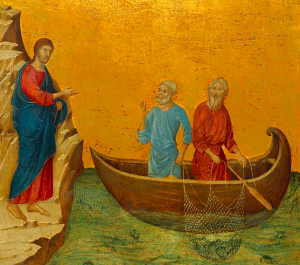
The Calling of the Apostles Peter and Andrew.
Duccio di Buoninsegna, c. 1308-1311.
I think there’s something in this. For one thing, epitomes, or summaries of longer works, were actually fairly common in the ancient world; remember, we’re dealing with a world in which, if you want a copy of a book, you need to either make it by hand or pay someone else to do that. Epitomes were less costly to make as well as to read, and were therefore pretty appealing for a lot of purposes. For another, Mark’s chronology is particularly careful. To take just one example, where Matthew presents the blasting of the fig tree in a single passage, and Luke doesn’t contain it at all (only a parable of a similar drift), Mark alone distinguishes that the curse was pronounced on one day and the tree withered the next. And this is within the wider context of the triumphal entry and the cleansing of the Temple, where again Mark is the only one of the Synoptics* to make it clear that these took place on two successive days. Jesus did not enter Jerusalem in triumph and then immediately chase out the moneychangers; he “looked round about upon all things, and now the eventide was come, he went out unto Bethany with the twelve,” returning in the morning—suggesting the cleansing of the Temple was planned, rather than being an angry outburst as it’s frequently depicted.
The Gospel According to Some Weirdos
I think Mark might be my favorite of the Synoptics.** Its Greek is a little clumsy, which I find strangely endearing. So is the constant use of the adverb euthüs [εὐθὺς], “immediately” or “right away”; taking the passage I had originally planned to discuss in this post, in the space of a mere fifteen verses, the word occurs four times. It’s a rather breathless piece of writing! (Which, when you think about it, tracks with the tradition—such an impetuous personality, Peter would narrate like that.)
Also, Mark has these weird little tidbits and asides that I find reminiscent of the Old Testament. Often, this is precisely because of their weirdness (people forget sometimes how bizarre and cryptic the Old Testament often is, Genesis especially). Mark 14.51-52, about the young man who “left the linen cloth, and fled from them naked” in Gethsemane, is a classic example. I tend to think the author (or amanuensis†) put it in on recognizing its striking similarity to the end of Amos 2; I’m also charmed by how it comes from absolutely nowhere and is never picked up again afterwards, not even in other New Testament books—a genuine “big-lipped alligator moment.” In this, it’s not unlike the account of one of the lesser-known among the twelve champions of the Book of Judges‡: my favorite judge (though Ehud is a very close second, because how can you not love that story), Shamgar. I suspect a number of characters in that book of having been dragged in by the heels to bring the total number of champions to a mythically-significant twelve, my boy Shamgar included. Below, I have given the account of him contained in the Book of Judges, full and unabridged:
And after him was Shamgar the son of Anath, which slew of the Philistines six hundred men with an ox goad: and he also delivered Israel. —Judges 3.31
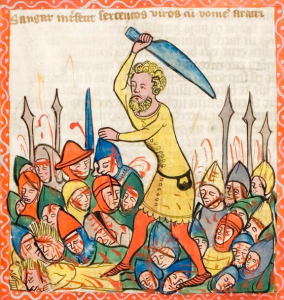
An illumination from a manuscript of the Speculum
Humanæ Salvationis, created in the mid-fourteenth century:
it depicts Shamgar son of Anath, who slew six hundred
Philistines with an ox-goad (and also delivered Israel).
Just as often as weirdness, though, it’s the incredible tenderness of these moments that gets to me. It’s in Mark, for instance, that we’re told that Jesus’ reply to the rich young ruler (10.17-31) is not a “gotcha.” I low-key hate the way R. C. Sproul§ characterized this exchange (I forget where): the rich young ruler says that he has kept the Torah all his life, and I’ll agree with Sproul so far as to call that a likely story. But he then describes the instructions Jesus gives him (“sell that thou hast,” etc.) as being essentially a way of saying “Okay, let’s see how you do with number one,” i.e. the First Commandment, Thou shalt have no other gods before me. Now, given the young man “went away grieved,” it clearly is true in some sense that he made an idol of is wealth. That’s not my problem. My problem is the tone Sproul brought to it—the “gotcha,” the I’ll cut you down to size (as if God Almighty had something to prove), the … there’s no other word, the mean-spiritedness of it. You could maybe read that into Luke’s account of the same event, or Matthew’s; but it is not what we read in Mark:
There came one running, and kneeled to him, and asked him, “Good Master, what shall I do that I may inherit eternal life?” And Jesus said unto him, “Why callest thou me good? there is none good but one, that is, God. Thou knowest the commandments, ‘Do not commit adultery,’ ‘Do not kill,’ ‘Do not steal,’ ‘Do not bear false witness,’ ‘Defraud not,’ ‘Honor thy father and mother.'” And he answered and said unto him, “Master, all these have I observed from my youth.” Then Jesus beholding him loved him, and said unto him, “One thing thou lackest: go thy way, sell whatsoever thou hast, and give to the poor, and thou shalt have treasure in heaven: and come, take up the cross, and follow me.” And he was sad at that saying, and went away grieved: for he had great possessions. And Jesus looked round about, and saith unto his disciples, “How hardly shall they that have riches enter into the kingdom of God!”
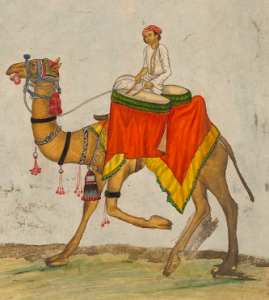
A 19th-century illustration of a camel. (And don’t
come at me with any of that “Needle’s-Eye Gate”
nonsense, by the way. It’s made up.)
But, that isn’t the passage we’re on about here. Initially, I planned to do both Gospels from this past Sunday and the upcoming, as both are short and in immediate succession: that was before I realized how long my mere intro would be! Those two posts (because I also didn’t realize just how many textual notes I’d be making on a mere fifteen verses) will be out soon.
Footnotes
*John does depict them separately, but he puts the cleansing all the way back in chapter 2 of his Gospel.
**Sorry boys, but John is my all-timer.
†An amanuensis in the ancient world was essentially a professional secretary—a profession more in demand in societies with far lower literacy rates than we have today, but in which writing was legally and culturally important nonetheless.
‡Fun fact about the Book of Judges (known in Hebrew as the Sepher Šoph’thiym [סֵפֶר שֹֽׁפְטִ֑ים]): a judge, a šowpheth [שׁוֹפֵט] (more conventionally shophet, and related to the name Jehoshaphat), was not quite what we mean by the word “judge” today. It could encompass deciding disputes within a community, but it was broader; šoph’thiym led the community in warfare as well—if you like, they directed violence outside the community and prevented or resolved violence within it. It’s for this reason that, of the twelve judges in the book, many of them—e.g., Samson—seem do little in the way of adjudicating disputes, and a lot more in the way of leading battles or even being individual strong-men. “Champions” has been proposed as an alternate translation, though realistically “judges” is still probably the best word. (This does make me wonder about the Greek title paraklētos [παράκλητος] for the Holy Ghost, borrowed via Latin as Paraclete and rendered “Comforter” in the King James. Many of us have heard in sermons that “Comforter” is, now at least, a bad translation, and that a paraklētos was really an advocate, almost amounting to “counsel for the defense.” I don’t know Aramaic, and am therefore in no position to say; but it’d be fascinating if this represented an Aramaic word either related to or with the same meaning as šowpheth.)
§I grew up with Sproul’s stuff, but it occurs to me now that I don’t know how familiar he is outside Reformed circles. R. C. Sproul (1939-2017) was an influential theologian and author of the Presbyterian Church in America (or PCA)—this is the denomination I was raised in. He emphasized traditional Reformed beliefs, such as the inerrancy and exclusive authority of Scripture and justification by faith alone. It’s no coincidence these are among the venerable slogans of the Protestant Reformation, sola Scriptura and sola fide—Sproul was not happy about the (relative) theological détente reached between the Catholic Church and many Protestants around the 1990s, especially the JDDJ. My feelings on him are pretty mixed. I think he did many thousands of Christians a great deal of harm, via the concept of God his theology inculcated. I haven’t been a Calvinist in nearly twenty years, and I still struggle not to believe God both hates and scorns me, largely because of how Sproul thought the atonement—and, therefore, human sinfulness and our relation to God—needed to be taught. But I think he did good as well, both accidental and intentional. His book on sola fide almost singlehandedly convinced me that the Catholic doctrine of justification was correct. (This was partly because his objections to the Catholic doctrine were so hopelessly technical as to reach the point of utter silliness.) And much to his credit, he did take Scripture seriously and did want every Christian to read and understand it. A large proportion of his writing consisted in commentaries, notes for study Bibles, that kind of thing: as an older kid I had part of his output, a New Geneva Study Bible, and this included introductions to each book and theological commentary on them—partisan, yes, but it isn’t like the New Geneva Study Bible didn’t tell you exactly what it was on the tin. Yet it went far further. Historical, linguistic, and archæological information were included; there were explanations of textual variants in the margins of every page; this was a man who wanted you to read the Bible, not just take his word for it!
Previous Post
January 14, 2024
The Gospel for the Second Sunday after Epiphany, 2024
Next Post
January 29, 2024 The Gospel for the Sunday of the Word of God: Mark 1.14-20
Recent Comments
"That is indeed a lovely version of "Idumea."For a different effect, (with additional verses) can ..."
"This Mudblood Catholic post examines why Jesus avoids giving direct answers to questions like whether ..."
Why Won’t Jesus Give Us a ..."
"On the contrary, such a proclamation, among the Aztecs or Maya, would be disastrously misunderstood. ..."
The Gospel of John: The Bread ..."
"Many thanks for your scholarly study on the Cleansing of the Ten Lepers in the ..."
The Cleansing of the Ten Lepers
Browse Our Archives
Select a Category abuse antifascism art bad Catholic celibacy chastity Church crucifixion culture war eros forgiveness gay gender homophobia ikons language liturgy peace poems politics Pope Francis prayer pro-life race recommendations reform repentance review sacraments saints satire scandal schism scripture sex suffering theology Uncategorized violence
Select a Month November 2026 October 2026 September 2026 August 2026 July 2026 June 2026 May 2026 April 2026 March 2026 February 2026 January 2026 December 2025 November 2025 October 2025 September 2025 August 2025 July 2025 June 2025 May 2025 April 2025 March 2025 February 2025 January 2025 December 2024 November 2024 October 2024 September 2024 August 2024 July 2024 June 2024 May 2024 April 2024 March 2024 February 2024 January 2024 December 2023 November 2023 October 2023 September 2023 August 2023 July 2023 June 2023 May 2023 April 2023 March 2023 February 2023 January 2023 December 2022 November 2022 October 2022 September 2022 August 2022 July 2022 June 2022 May 2022 April 2022 March 2022 February 2022 January 2022 December 2021 November 2021 October 2021 September 2021 August 2021 July 2021 June 2021 May 2021 April 2021 March 2021 February 2021 January 2021 December 2020 November 2020 October 2020 September 2020 August 2020 July 2020 June 2020 May 2020 April 2020 March 2020 February 2020 January 2020 December 2019 November 2019 October 2019 September 2019 August 2019 July 2019
Follow Us!
TAKE THE
Religious Wisdom Quiz
Which Christian tradition is most noted for the use of incense and elaborate liturgy?
Select your answer to see how you score.
Methodist Presbyterian Eastern Orthodox Baptist
Related posts from Mudblood Catholic
Book III, Chapter 3: Christ "Classic" (Matt. 9:9-34)
What Kind of Man Do Wind and Sea...
The Sermon on the Mount, Part IV: Matthew...
TRENDING AT PATHEOS Catholic

Thomas Paine, the Smiths, the apostles in England,...
I'm pleased to announce that the Becoming Brigham Black Friday Sale,...

CatholicTV Series: Six Black Catholics on Path to...
WATERTOWN, Mass., November 9, 2026 – In recognition of Black Catholic History...

New Advent Journal Invites Catholics to Be Pilgrims
Florissant, MO, November 16, 2026— What if Advent were more than a...

INNER CIRCLE: John's Quantum Gospel
INTRODUCTION In this next Inner Circle series, which I anticipate will...
"Three B's" of My Apologetics Ministry (+ VIDEO)
In early December 2026 (less than a week from the time...

James Ishmael Ford's books on Zen
James Ishmael Ford's Official Website provides the most complete annotated list of...
view all Catholic blogs
What Are Your Thoughts?leave a comment
Ad-Free & Subscriber Log-In Subscription Support
- About Us
- 2026 Calendar
- Videos
- Podcasts
- Library of World Religions
- Faith In Media Tracker
- Advertise With Us
- Write for Us
- Privacy Policy
- Terms of Service
- Do Not Sell My Data
- Contact Us
- Radiant Digital
- Manage Newsletter Subscriptions
- Unsubscribe From Notifications
- Sitemap
Copyright 2008-2026, Patheos, part of the Radiant Digital network of media brands. All rights reserved.
Subscription Support Ad-Free & Subscriber Log-In
Follow Patheos