
BuddhistCatholicContemplativeEvangelicalGeneral ChristianHinduJewishLatter-day SaintMuslimNew VisionsProgressive Christian
Beliefs
- Buddhist
- Catholic
- Contemplative
- Evangelical
- General Christian
- Hindu
- Jewish
- Latter-day Saint
- More Voices
- Muslim
- New Visions
- Pagan
- Progressive Christian
Topics
- Religion News
- Food and Religion
- Sports and Religion
- Religious Art
- Religious Music and Entertainment
- Religious Events
- History and Religion
- Style and Religion
- Politics and Religion
- Women in Religion
- Recreation Outdoors and Religion
- Business Finance and Religion
- Careers Workplace and Religion
- Education and Religion
- Family Parenting and Religion
- Health Fitness and Religion
- Home and Religion
- Relationships and Religion
- Technology and Religion
- Travel and Religion
Columnists
- Buddhist Columnists
- Business Finance and Religion Columnists
- Careers Workplace and Religion Columnists
- Catholic Columnists
- Contemplative Columnists
- Education and Religion Columnists
- Evangelists Columnists
- Family Parenting and Religion Columnists
- General Christian Columnists
- Health Fitness and Religion Columnists
- Hindu Columnists
- History and Religion Columnists
- Home and Religion Columnists
- Jewish Columnists
- More Voices Columnists
- Latter Day Columnists
- Muslim Columnists
- New Visions Columnists
- Nonreligious Columnists
- Pagan Columnists
- Politics and Religion Columnists
- Progressive Columnists
- Recreation Outdoors and Religion Columnists
- Relationships and Religion Columnists
- Religion News Columnists
- Religious Art Columnists
- Religious Events Columnists
- Religious Music and Entertainment Columnists
- Sports and Religion Columnists
- Style and Religion Columnists
- Technology and Religion Columnists
- Travel and Religion Columnists
- Women in Religion Columnists
Resource Library
- 2026 Calendar
- Library of World Religions
- The 100 Most Holy Places on Earth
- Patheos Answers
- Podcasts
- Videos
- Faith Leaders Database
- Anglican Episcopalian
- Bahai
- Baptist
- Buddhism
- Christianity
- Confucianism
- Eastern Orthodoxy
- Hinduism
- Holiness and Pentecostal
- ISKCON
- Islam
- Judaism
- Lutheran
- Methodist
- The Church of Jesus Christ of Latter-day Saints
- New Age
- Paganism
- Presbytarian and Reformed
- Protestantism
- Religion Behind the Scenes
- Roman Catholic
- Scientology
- Shia Islam
- Sikhism
- Sufism
- Sunni Islam
- Taoism
- Zen
- See all religions
Research Tools
 Ad-Free & Subscriber Log-In Subscription Support
Ad-Free & Subscriber Log-In Subscription Support
Follow Patheos 

- Trending:
- Forgiveness
- |
- Marriage
- |
- Consciousness
- |
- Death Penalty
- |
- Election
- |
- Halloween

- Home
- Catholic
- St. John of the Cross, 2023 (MMXXIV)
St. John of the Cross, 2023 (MMXXIV)
Last updated on: December 14, 2023 at 11:20 pm by Gabriel Blanchard
St. John of the Cross, 2023 (MMXXIV) 2023-12-14T23:20:24-04:00 Gabriel Blanchard
Patheos Explore the world's faith through different perspectives on religion and spirituality! Patheos has the views of the prevalent religions and spiritualities of the world.
(Those who read Roman numerals easily may have spotted that the Arabic and Roman numerals in the title are misaligned, and can’t I count? The answer is: yes, but the liturgical year changed on 3 December. See my post on the Feast of St. Andrew for further details.)
The Moment of the Rose
This coming Sunday will be the Third Sunday of Advent, known as Gaudete, or Rose, Sunday. The name comes from the text of Philippians 4.4, which forms the beginning of the introit for this Sunday’s Mass: Gaudete in Domino semper; iterum dico, gaudete; “Rejoice in the Lord always; again I say, rejoice.”
You may know already that there is another Rose Sunday, the Fourth Sunday in Lent, or Lætare Sunday (lætare means “to be glad”). Both take place during the penitential seasons of Advent and Lent. The vestments used throughout these seasons in the Roman rite are normally purple; this is meant to evoke the purple robe in which Christ was arrayed to be mocked by the soldiers during the Passion. Rose vestments are allowed for Gaudete and Lætare Sundays partly because these roughly mark the halfway points of each season. The idea is that rose represents a relief of the rich darkness of purple, a brief glimpse of the light that is approaching.
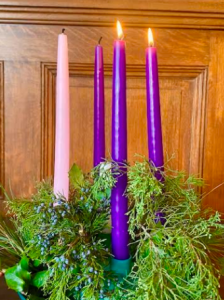
A conventional Advent wreath, with three purple candles
and one rose (the white Christ candle is often left out
until Christmas Day, when it is lit for the first time).
This meaning is especially well-suited to Advent, a season focused on the symbolism of light. Several of the saints we commemorate in December are tied into the imagery of light in one way or another, and in fact this week has three in a row. First there is the feast of Our Lady of Guadalupe on 12 December: in her image on the tilma,1 her blue-green mantle is decorated with golden stars, evoking the imagery of Revelation 12.1.
The following day is the memorial of St. Lucy, a consecrated virgin from Syracuse in Sicily. Lucy is one of the saints from the Roman canon—you know the bit; the one that goes Felicity Perpetua Agatha Lucy Agnes Cecilia Anastasia Andofallthysaints? Like most of the women in that list, St. Lucy was martyred in the Diocletianic Persecution of 303-311. Her name, Lucia (the feminine form of the Roman name Lucius), means “light”; she is a patron saint for people with weak eyesight, and features in the Divine Comedy as a symbol of illuminating grace. Lucy was long a key saint in the Advent season, not unlike St. Andrew himself, if perhaps for practical rather than devotional reasons; however, since the Ember days were dropped,2 St. Lucy’s day has lost something of its importance.
Finally, on the fourteenth, we have St. John of the Cross, one of the two great founders of the Discalced Carmelites.3 His alignment with Advent is a little paradoxical—which, incidentally, is perfect for Advent. Please allow me, in explaining why, a short and yet unnecessary detour of around four hundred years and a mere eighteen hundred kilometers.
Flyte in Fatigues

Dana Gioia and Eve Tushnet have covered Dunstan Thompson better than I can. The short version is, he was one of our boys in the European theater during World War II, and after the armistice, as a gay boy will, he both fell in love with an Englishman and rediscovered his Catholic faith. He and the Englishman made a home together in the east of England for about thirty years, until Thompson’s death. His poetry, which before then had been tortured, confessional stuff thick with veiled homoeroticism, became much more tranquil and “classical” in both form and matter, rather reminiscent of fellow expatriate T. S. Eliot. Take the dark flourish and assertively anatomical quality of this stanza from one of his first poems, “Lament for the Sleepwalker”:
See, like a rajah, how he ravens fine food.
The long claws fork their lightning; diamond, his teeth,
Glitter of jewel jaws, dazzle—glaze their mirrors
Black blood and purple, stained points of glass. Beneath
Lascivious fur, his regal muscles flex,
Digesting fire, the marrow root of sex.
And now compare this with a stanza from “The Moment of the Rose,” one of his later poems, written after the war and his reversion to his childhood faith. (I’m especially struck by a sensation that air and light have taken the place that before was clotted black with blood.)
The end of love is that the heart is still
As the rose no wind distresses, still as light
On the unmoved grass, or as the humming bird
Poised the pure moment by an act of will.
Death may be like this, but here before night
Send us to sleep murmuring a drowsy word
Of prayer, affection, or the idle flight
Of fancy, let us praise the rose and light.

Dunstan Thompson was not a mystic (or if he was, he did a good job of keeping it quiet); he is not an English version of St. John of the Cross, or anything like that. But he shared certain interests and traits with the great Spanish Carmelite—not least, a certain hard-headed common sense, expressed by the Englishman in “The Halfway House”:
This ordered life is not for everyone.
Never, to their surprise, for those who run
Away from love. …
You see, we are not playroom monks. Our hearts
Are in this, or we go. If not, the starts
And stops tell all the others what we ought
To do, and they persuade us. Had you thought
We stayed because we liked the quiet at night?
One feels that could sit pretty comfortably in the early chapters of The Dark Night of the Soul, where St. John discusses the spiritual forms taken by the capital sins in the lives of beginners.
“Dark With Excessive Bright Thy Skirts Appear”
That famous title, The Dark Night of the Soul—it fits into a larger theory of the spiritual life put forth by its author. That theory need not detain us in full, but one of its important details is that the “dark night” for which the book is named is not, from the heavenly perspective, darkness at all: not because God is all-knowing, but because what is (metaphorically) happening to a soul in the “dark night” is that they are being dazzled. They have emerged from a cavern with scanty, terrestrial light, of a kind they were used to, into the blazing noonday sun of celestial wisdom. Of course their vision fails for a while.
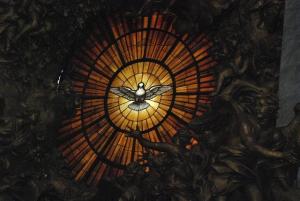
This is not the same pattern as Christ humbling himself in the flesh, ultimately submitting to the Passion and obtaining the Resurrection. It think it’s more that the two concepts rhyme with one another; both express something, a volta not unlike Tolkien’s explanation of eucatastrophe. Speaking of whom, the salutation of Eärendil4 in the final chapter of The Silmarillion is one of my favorite examples of this. Perhaps I could resist the urge to quote it; however, I don’t want to:
Hail Eärendil, of mariners most renowned, the looked for that cometh at unawares, the longed for that cometh beyond hope! Hail Eärendil, bearer of light before the Sun and Moon! Splendor of the Children of Earth, star in the darkness, jewel in the sunset, radiant in the morning!
“The looked for that cometh at unawares”; I love that phrase. (Among other things, very apt for Christmas.)
Speaking of voltas, the life of St. John of the Cross seems to have been composed from an unusually high proportion of abrupt turnings and even disasters. John—like St. Teresa, the other and elder founding figure of the Discalced—was a child of conversos; that is, Spanish Jews who had converted to Catholicism5 rather than be expelled from Spain after the cruel Alhambra Decree of 1492, and who continued to be monitored by the Spanish Inquisition and restricted in rights by the Spanish crown. To my mind, a less-likely environment in which to foster sincere love of Christ and obedience to the Church is almost impossible to imagine!
And his order treated him far worse than his country already had. The Discalced branch was quite unpopular with a great many Carmelites, despite already having the formal approval of the Church. At one point, St. John was kidnapped—actually kidnapped—and imprisoned in a cell in a convent belonging to the “calced,” who subjected him to public lashings, refused to give him a lamp even to read his breviary6 by, and fed him scraps. He endured this treatment for eight months.
Eventually he escaped, on the Solemnity of the Assumption. Yet it was not then, but while he had been locked up, hungry, humiliated, and beaten, that he composed some of his most celebrated mystical poetry, all about the unspeakable sweetness of intimacy with God.
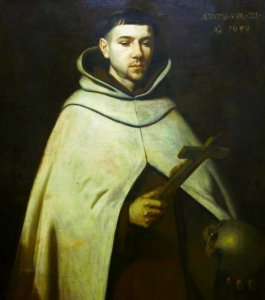
Anonymous portrait (attributed to Francisco de Zurbarán) of St. John of the Cross,
1656. The saint died in 1591, so it is possible—though entirely conjectural—
that the painter consulted living people who remembered what he looked like.
O Night, thou wast my guide!
O Night more loving than the rising sun!
O Night that joined the Lover to the Beloved one,
Transforming each of them into the other.
And what else is the imagery of Advent? As the days come to their very shortest, we proclaim that the light is nearer; we “anticipate” a birth that happened thousands of years ago; we “commemorate” the union of time with eternity.
Footnotes
1A tilma was a kind of cloak worn in Mexico (I understand that both the word and the garment originate in Aztec civilization). The tilma in question belonged to St. Juan Diego; according to some accounts of the apparition, the image of Our Lady of Guadalupe on his tilma, which now hangs in the Guadalupe Basilica and is the basis for depictions of the Guadalupana generally, appeared there miraculously as a sign to Juan Diego and his bishop.
2The Ember days were the Wednesday, Friday, and Saturday of four weeks of the year, roughly corresponding to the beginnings of the meteorological seasons; they were set aside for abstention from meat, light fasting, prayer (especially for the clergy), and ordinations. The spring Ember week was the first (full) week of Lent; the summer, the Octave of Pentecost; the autumn, the week following 14 September; and the winter, the third week of Advent, which always falls after St. Lucy’s day, 13 December.
3The Carmelites are a small family of religious orders and houses, certainly in existence by no later than the end of the twelfth century, and possibly in existence earlier. In the sixteenth century, a nun named Teresa Sánchez wanted to found a reformed branch that practiced greater austerity; this branch became known as the Discalced Carmelites (from a Latin word meaning “barefoot,” indicating their extreme poverty). Teresa, the foundress, was eventually canonized; most people know her as of Ávila, though her name in religion was Teresa of Jesus.
4Eärendil was a hero of Middle-earth in the First Age, so rather more than six thousand years before the lives of Bilbo and Frodo; he was one of the Half-Elven, and in fact was Elrond’s father. He was renowned for sailing to Aman, the realm of the Valar (the “lower-case ‘g’ gods”: benevolent, powerful, and wise, but neither omnipotent nor all-knowing), and winning mercy for the Elves in exile and their Mannish allies. Both kindreds had been devastated in a centuries-long war against Morgoth, a corrupt former member of the Valar—indeed, originally the most powerful Vala—who had stolen the Silmarils, three magical gems that preserved the holy Light which had existed “before the Sun and Moon” were made. One Silmaril had been stolen back by the Elvish princess Lúthien and the Mannish hero Beren, who were the grandmother and grandfather of Eärendil’s wife Elwing (so that Elwing was also Half-Elven). When she brought the holy jewel to her husband’s ship, its light pierced through the enchantments that turned ships away from Aman. When Eärendil first landed, the place seemed empty; the quoted lines were the first words spoken to him in Aman, by Eönwë, the herald of the Valar.
5Some of these Jews continued to practice Judaism in secret—sometimes for many generations.
6A breviary is a book containing the Liturgy of the Hours, the daily prayer of the Catholic Church, consisting principally in psalms and other passages of Scripture. Monastics are bound by canon law to recite the Hours (also known as the Office, from the Latin officium “duty”) every day; the mainstream Carmelites here forced him to use a small, fickle patch of light that filtered into his cell to read his breviary, which would teach him to have the audacity to … not try to impose the Discalced reform on any Carmelite house except the ones who specifically requested it.
Previous Post
December 6, 2023
You're a Sweet One, Bishop Nick
Next Post
December 17, 2023 Gaudete Sunday 2024
Recent Comments
"On the contrary, such a proclamation, among the Aztecs or Maya, would be disastrously misunderstood. ..."
The Gospel of John: The Bread ..."
"Many thanks for your scholarly study on the Cleansing of the Ten Lepers in the ..."
The Cleansing of the Ten Lepers
"Four Last Things: not the video game, but Death, Judgment, Heaven and Hell.Momento mori. Remember, ..."
"I am going by the time that these sayings began to be converted into written ..."
Are Our Bibles in the Wrong ..."
Browse Our Archives
Select a Category abuse antifascism art bad Catholic celibacy chastity Church crucifixion culture war eros forgiveness gay gender homophobia ikons language liturgy peace poems politics Pope Francis prayer pro-life race recommendations reform repentance review sacraments saints satire scandal schism scripture sex suffering theology Uncategorized violence
Select a Month October 2026 September 2026 August 2026 July 2026 June 2026 May 2026 April 2026 March 2026 February 2026 January 2026 December 2025 November 2025 October 2025 September 2025 August 2025 July 2025 June 2025 May 2025 April 2025 March 2025 February 2025 January 2025 December 2024 November 2024 October 2024 September 2024 August 2024 July 2024 June 2024 May 2024 April 2024 March 2024 February 2024 January 2024 December 2023 November 2023 October 2023 September 2023 August 2023 July 2023 June 2023 May 2023 April 2023 March 2023 February 2023 January 2023 December 2022 November 2022 October 2022 September 2022 August 2022 July 2022 June 2022 May 2022 April 2022 March 2022 February 2022 January 2022 December 2021 November 2021 October 2021 September 2021 August 2021 July 2021 June 2021 May 2021 April 2021 March 2021 February 2021 January 2021 December 2020 November 2020 October 2020 September 2020 August 2020 July 2020 June 2020 May 2020 April 2020 March 2020 February 2020 January 2020 December 2019 November 2019 October 2019 September 2019 August 2019 July 2019
Follow Us!
TAKE THE
Religious Wisdom Quiz
Who said, "Am I not sending you?"
Select your answer to see how you score.
Elijah Jesus God Moses
Related posts from Mudblood Catholic

The Sermon on the Mount, Part I: Matthew...

The Gospel of Matthew: Christ and Antichrist

John the Baptist and the Winnowing Fork: Matthew...

The Gospel of Matthew: The Coventry Carol
TRENDING AT PATHEOS Catholic

Emotion in Early Christianity by Andrew Crislip
Andrew Crislip’s Emotion in Early Christianity examines an often overlooked dimension of...

16 Spiritual Touchstones for a More Grounded Life
After decades of spiritual study, here are 16 principles I try...

Catholic Evangelization: Sharing Your Faith Every Day
Welcome back to the Graceful Awakening mini-series called, “From Faith to Mission.” ...

The Pillar of the Boatmen: the Ancient Monument...
The Pillar of the Boatmen is a Romano-Gaulish sculpture that dates from...

In one sense walking into Westminster Abbey is like walking down the...

'Super Scam Me' Exposes AI Jon Bon Jovi...
Leslie Pickett believed she was in a relationship with Jon Bon Jovi....
view all Catholic blogs
What Are Your Thoughts?leave a comment
Ad-Free & Subscriber Log-In Subscription Support
- About Us
- 2026 Calendar
- Videos
- Podcasts
- Library of World Religions
- Faith In Media Tracker
- Advertise With Us
- Write for Us
- Privacy Policy
- Terms of Service
- Do Not Sell My Data
- Contact Us
- Radiant Digital
- Manage Newsletter Subscriptions
- Unsubscribe From Notifications
- Sitemap
Copyright 2008-2026, Patheos. All rights reserved.
Subscription Support Ad-Free & Subscriber Log-In
Follow Patheos