
BuddhistCatholicContemplativeEvangelicalGeneral ChristianHinduJewishLatter-day SaintMuslimNew VisionsProgressive Christian
Beliefs
- Buddhist
- Catholic
- Contemplative
- Evangelical
- General Christian
- Hindu
- Jewish
- Latter-day Saint
- More Voices
- Muslim
- New Visions
- Pagan
- Progressive Christian
Topics
- Religion News
- Food and Religion
- Sports and Religion
- Religious Art
- Religious Music and Entertainment
- Religious Events
- History and Religion
- Style and Religion
- Politics and Religion
- Women in Religion
- Recreation Outdoors and Religion
- Business Finance and Religion
- Careers Workplace and Religion
- Education and Religion
- Family Parenting and Religion
- Health Fitness and Religion
- Home and Religion
- Relationships and Religion
- Technology and Religion
- Travel and Religion
Columnists
- Buddhist Columnists
- Business Finance and Religion Columnists
- Careers Workplace and Religion Columnists
- Catholic Columnists
- Contemplative Columnists
- Education and Religion Columnists
- Evangelists Columnists
- Family Parenting and Religion Columnists
- General Christian Columnists
- Health Fitness and Religion Columnists
- Hindu Columnists
- History and Religion Columnists
- Home and Religion Columnists
- Jewish Columnists
- More Voices Columnists
- Latter Day Columnists
- Muslim Columnists
- New Visions Columnists
- Nonreligious Columnists
- Pagan Columnists
- Politics and Religion Columnists
- Progressive Columnists
- Recreation Outdoors and Religion Columnists
- Relationships and Religion Columnists
- Religion News Columnists
- Religious Art Columnists
- Religious Events Columnists
- Religious Music and Entertainment Columnists
- Sports and Religion Columnists
- Style and Religion Columnists
- Technology and Religion Columnists
- Travel and Religion Columnists
- Women in Religion Columnists
Resource Library
- 2026 Calendar
- Library of World Religions
- The 100 Most Holy Places on Earth
- Patheos Answers
- Podcasts
- Videos
- Faith Leaders Database
- Anglican Episcopalian
- Bahai
- Baptist
- Buddhism
- Christianity
- Confucianism
- Eastern Orthodoxy
- Hinduism
- Holiness and Pentecostal
- ISKCON
- Islam
- Judaism
- Lutheran
- Methodist
- The Church of Jesus Christ of Latter-day Saints
- New Age
- Paganism
- Presbytarian and Reformed
- Protestantism
- Religion Behind the Scenes
- Roman Catholic
- Scientology
- Shia Islam
- Sikhism
- Sufism
- Sunni Islam
- Taoism
- Zen
- See all religions
Research Tools
 Ad-Free & Subscriber Log-In Subscription Support
Ad-Free & Subscriber Log-In Subscription Support
Follow Patheos 

- Trending:
- Forgiveness
- |
- Marriage
- |
- Consciousness
- |
- Death Penalty
- |
- Election
- |
- Halloween

- Home
- Catholic
- Solemnity of Christ the King, 2023
Solemnity of Christ the King, 2023
Last updated on: December 3, 2023 at 11:19 pm by Gabriel Blanchard
Solemnity of Christ the King, 2023 2023-12-03T23:19:16-04:00 Gabriel Blanchard
Patheos Explore the world's faith through different perspectives on religion and spirituality! Patheos has the views of the prevalent religions and spiritualities of the world.
Note on the Scripture
Reviewing my first post of this type, I decided it was probably kind of bonkers to offer four translations of the gospel text; no one is likely to use that many, nor to get very much out of the differences even if they do. I’ve therefore decided to reduce it to two: the RSV-CE (used by the Ordinariate) and my own. I dropped the NAB and the King James (though it is my sentimental favorite) on the grounds that, as the one is the standard Catholic translation and the other the most influential English translation, they’re the likeliest for readers to have at home, or already be otherwise familiar with.
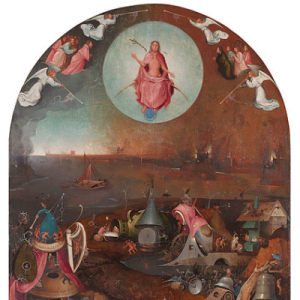
Detail from the central panel of Hieronymus
Bosch’s triptych The Last Judgment, ca. 1486.
A Reading from the Holy Gospel According to Saint Matthew
Here beginneth the twenty-fifth chapter at the thirty-first verse.
RSV-CE
“When the Son of man comes in his glory, and all the angels1 with him, then he will sit on his glorious throne. Before him will be gathered all the nations, and he will separate them one from another as a shepherd separates the sheep from the goats, and he will place the sheep at his right hand, but the goats at the left.2
“Then the King will say to those at his right hand, ‘Come, O blessed of my Father, inherit the kingdom prepared for you from3 the foundation of the world; for I was hungry and you gave me food, I was thirsty and you gave me drink, I was a stranger and you welcomed me, I was naked and you clothed me, I was sick and you visited me, I was in prison and you came to me.’ Then the righteous4 will answer him, ‘Lord, when did we see thee5 hungry and feed thee, or thirsty and give thee drink? And when did we see thee a stranger and welcome thee, or naked and clothe thee? And when did we see thee sick or in prison and visit thee?’ And the King will answer them, ‘Truly, I say to you, as you did it to one of the least of these my brethren, you did it to me.’
“Then he will say to those at his left hand, ‘Depart from me, you cursed, into the eternal6 fire prepared for the devil7 and his angels; for I was hungry and you gave me no food, I was thirsty and you gave me no drink, I was a stranger and you did not welcome me, naked and you did not clothe me, sick and in prison and you did not visit me.’ Then they also will answer, ‘Lord, when did we see thee hungry or thirsty or a stranger or naked or sick or in prison, and did not minister to thee?’ Then he will answer them, ‘Truly, I say to you, as you did it not to one of the least of these, you did it not to me.’
“And they will go away into eternal punishment,8 but the righteous into eternal life.”9
My translation
“And whenever the Son of Man comes in his glory, and all the messengers1 with him, then he will sit on the throne of his glory, and every nation will also be brought together before him, and he will distinguish between them just like a shepherd distinguishes sheep from goats, and he will stand the sheep on his right, but the goats on the southpaw side.2
“Then the king will tell those on his right: ‘Come, you who are blessed by my father, you will inherit the kingdom prepared for you from3 the foundation of the world. For I was hungry and you gave me something to eat, thirsty and you gave me something to drink, a stranger and you brought me in among you, naked and you clothed me, sick and you visited me, in custody and you came to me.’ Then the just4 will answer him, saying, “Lord, when did we see you5 hungry and tend to you, or thirsty and give you something to drink? When did we see you as a stranger and bring you in, or naked and clothe you? When did we see you sick or in custody and come to you?’ And answering, the king will tell them: ‘Amen, I say to you: whatever you have done to one of these, the smallest of my brothers, you have done to me.’
“Then he will also tell those on the southpaw side: ‘Get away from me, into the eternal6 fire prepared for the accuser7 and his messengers. For I was hungry and you did not give me anything to eat, thirsty and you did not give me anything to drink, a stranger and you did not bring me in among you, naked and you did not clothe me, sick and in custody and you did not visit me.’ Then they too will answer, saying: ‘Lord, when did we see you hungry or thirsty or a stranger or naked or sick or in custody, and not serve you?’ Then he will answer them, saying: ‘Amen, I say to you: whatever you have not done to one of these, the smallest of my brothers, you have not done to me.’
“And they will go away to eternal punishment,8 but the just to eternal life.”9
Textual Commentary
1angels/messengers: The Greek word ἄγγελος [angelos] literally means “messenger,” and would be used of an ordinary, human message-bearer just as much as of that order of spirits we normally call “angels.” Like a handful of other Greek terms (Christ is the most familiar), it was transliterated from Greek rather than translated into Latin, and thus, when the Latin was translated into English, the Greek-like form was preserved. In most cases, it is clear from the context whether the word refers to a literal messenger or to the spiritual being; however, there are a few places (like Acts 12.13-17) where the meaning is ambiguous.
2left/southpaw: “Southpaw” is my best effort at translating εὐώνυμος [euōnümos], a conventional euphemism for the word “left” in the sense of left-hand. (The Greek literally means well-named, along the same lines as the euphemism Εὐμενίδες [Eumenides], “Kindly Ones,” indicating the Furies.) English does not have, or no longer has, such a strong aversion to the left hand, and is correspondingly short on euphemistic synonyms, but, since the standard word for left (ἀριστερός [aristeros]) is not used here, some kind of synonym seemed appropriate.
3from: The word “from” is not in itself unusual! But it is interesting to note that the text does not specify whether this “preparation from the foundation” is to be taken in a temporal sense (“prepared since the beginning”) or a “constitutive” sense (“prepared out of the beginning,” i.e. “part of the original plan,” as it were). Either or both meanings may be here present.
4righteous/just: Neither word is especially common in spoken English today, but I have preferred “just” on two grounds: first, that δίκαιος [dikaios] refers particularly to δίκη [dikē], “justice,” rather than virtue in general (whereas the English righteousness, though it does somewhat tend toward the meaning “justice” through the influence of the term “rights,” can suggest a broader, vaguer idea of goodness); and second, that, while we don’t often speak of justice or describe people as just in ordinary speech, we still do so occasionally, whereas righteous and related words have been relegated exclusively to the religious register, which δίκαιος had not.

5thee/you: Though not an especially important discrepancy here, it is worthwhile to take note of for general purposes. English is at something of a disadvantage in rendering the Greek here. Many languages exhibit what is called the T-V distinction, a differentiation in how pronouns are used intended to show courtesy; a common strategy across many languages is to use the plural when addressing a single person (along the same lines as the “royal ‘we'”). The reason most dialects of English originally lost the second-person singular pronoun thou was the increasing use of the courteous plural—which is also why you always takes the verb are, even when the “you” in question is singular. Because ritual language tends to be conservative even of obsolete forms, this meant that thou took on religious connotations for most English speakers; and this puts us in the ridiculous position of having a courteous singular instead of a courteous plural, and also no other type of distinct second-person singular. The upshot in this text is that there is no way to represent the difference between the sheep and the goats saying “[second-person singular pronoun]” to the king, and him saying “you [plural]” to them, except by introducing a suggestion of reverence via the word thou—a suggestion which is not only not present in the original text, but couldn’t have been, since Greek at the time did not have the T-V distinctionl!*
*EDIT: I should have re-edited this paragraph for clarity before publishing. If there’s any confusion, Greek did have different pronouns for singular and plural “you” at this time; what it didn’t have was specialized courteous word forms (which just means that if you wanted to show courtesy, you did it by using titles or circumlocutions, by tone, posture, and gesture, and so forth).
6eternal: The Greek word αἰώνιος [aiōnios] is a serious pain in the neck to translate. Every choice to render it is a little bit wrong, as touched upon in my Thanksgiving post: an αἰών [aiōn] is an “age,” but in some contexts it can also mean “lifetime, generation,” or “life [as a thing or ‘possession’],” or “world [in either the temporal or spatial senses, or both].” The old-fashioned translation world without end (accenting the temporal meaning of “world”) was honestly a pretty good one, and so, of course, is now so obsolete as to be nearly incomprehensible. Unto ages of ages would be tolerably correct, but we never talk like that (and I aim in my translations for colloquial-ness when a text is informal, which on the whole the New Testament is); I toyed with everlasting, but decided that it was a little bit too free (there is no corresponding verbal element like “lasting” in αἰώνιος), and also with perennial, about which I decided, perhaps mistakenly, that “perennial life” in the last verse sounded too unnatural.
7devil/accuser: The word διάβολος [diabolos] could be rendered “slanderer,” but, since διάβολος seems to be counterposed elsewhere to παράκλητος [paraklētos] (meaning “one called to help; advocate, [defendant’s] counsel” and from which we get the title Paraclete), accuser seemed like a slightly more appropriate translation. (Also, the rhythm of “the accuser and his messengers” seemed nearly as good as the incredibly satisfying phrase “the devil and his angels,” which was certainly a plus.)

A painting of a devil holding a lectionary for a saint,
thought to be St. Augustine. (Note the second, false
face on the devil’s rump, referred to in witchcraft trials
as its “fundament.”)
8punishment: This translates the word κόλασις [kolasis], meaning “correction, punishment, chastisement,” but originating in a verb meaning “to curb, check.” Obviously this raises the old controversy over universalism. Personally I don’t think the text tells us much one way or the other, and wished to preserve such ambiguity as the text conveys; since the term punishment (unlike, e.g., words such as revenge) does normally imply some good purpose, but not necessarily the reform of the one punished, it seemed like the best rendering of κόλασις here.
9life: As many readers know, Greek has two words for “life”: βίος [bios] and ζωή [zōē]. The difference between the two has often been exaggerated, and the significance of ζωή given an artificially mystical meaning that it did not necessarily possess in Greek. The fact that we get the words biology and zoology from them suggests something closer to their real relation; but this relation really was one of different connotations, and ζωή really did suggest something “higher” (in however vague a sense) than βίος.
Previous Post
November 23, 2023
Two Collects, Annotated
Next Post
November 30, 2023 Epistle for the (Second) Feast of St. Andrew, 2023
Recent Comments
"On the contrary, such a proclamation, among the Aztecs or Maya, would be disastrously misunderstood. ..."
The Gospel of John: The Bread ..."
"Many thanks for your scholarly study on the Cleansing of the Ten Lepers in the ..."
The Cleansing of the Ten Lepers
"Four Last Things: not the video game, but Death, Judgment, Heaven and Hell.Momento mori. Remember, ..."
"I am going by the time that these sayings began to be converted into written ..."
Are Our Bibles in the Wrong ..."
Browse Our Archives
Select a Category abuse antifascism art bad Catholic celibacy chastity Church crucifixion culture war eros forgiveness gay gender homophobia ikons language liturgy peace poems politics Pope Francis prayer pro-life race recommendations reform repentance review sacraments saints satire scandal schism scripture sex suffering theology Uncategorized violence
Select a Month October 2026 September 2026 August 2026 July 2026 June 2026 May 2026 April 2026 March 2026 February 2026 January 2026 December 2025 November 2025 October 2025 September 2025 August 2025 July 2025 June 2025 May 2025 April 2025 March 2025 February 2025 January 2025 December 2024 November 2024 October 2024 September 2024 August 2024 July 2024 June 2024 May 2024 April 2024 March 2024 February 2024 January 2024 December 2023 November 2023 October 2023 September 2023 August 2023 July 2023 June 2023 May 2023 April 2023 March 2023 February 2023 January 2023 December 2022 November 2022 October 2022 September 2022 August 2022 July 2022 June 2022 May 2022 April 2022 March 2022 February 2022 January 2022 December 2021 November 2021 October 2021 September 2021 August 2021 July 2021 June 2021 May 2021 April 2021 March 2021 February 2021 January 2021 December 2020 November 2020 October 2020 September 2020 August 2020 July 2020 June 2020 May 2020 April 2020 March 2020 February 2020 January 2020 December 2019 November 2019 October 2019 September 2019 August 2019 July 2019
Follow Us!
TAKE THE
Religious Wisdom Quiz
Where was Jesus Born?
Select your answer to see how you score.
Shiloh Bethlehem Jerusalem Nazareth
Related posts from Mudblood Catholic

The Sermon on the Mount, Part I: Matthew...

The Gospel of Matthew: Christ and Antichrist

John the Baptist and the Winnowing Fork: Matthew...

The Gospel of Matthew: The Coventry Carol
TRENDING AT PATHEOS Catholic

The Problem with False Prophets
Miller’s Station UMC| 10/18/26| Anchor Verse: Jeremiah 23: 1, 9-23 I...

Emotion in Early Christianity by Andrew Crislip
Andrew Crislip’s Emotion in Early Christianity examines an often overlooked dimension of...

16 Spiritual Touchstones for a More Grounded Life
After decades of spiritual study, here are 16 principles I try...

Catholic Evangelization: Sharing Your Faith Every Day
Welcome back to the Graceful Awakening mini-series called, “From Faith to Mission.” ...

The Pillar of the Boatmen: the Ancient Monument...
The Pillar of the Boatmen is a Romano-Gaulish sculpture that dates from...

In one sense walking into Westminster Abbey is like walking down the...
view all Catholic blogs
What Are Your Thoughts?leave a comment
Ad-Free & Subscriber Log-In Subscription Support
- About Us
- 2026 Calendar
- Videos
- Podcasts
- Library of World Religions
- Faith In Media Tracker
- Advertise With Us
- Write for Us
- Privacy Policy
- Terms of Service
- Do Not Sell My Data
- Contact Us
- Radiant Digital
- Manage Newsletter Subscriptions
- Unsubscribe From Notifications
- Sitemap
Copyright 2008-2026, Patheos. All rights reserved.
Subscription Support Ad-Free & Subscriber Log-In
Follow Patheos