
BuddhistCatholicContemplativeEvangelicalGeneral ChristianHinduJewishLatter-day SaintMuslimNew VisionsProgressive Christian
Beliefs
- Buddhist
- Catholic
- Contemplative
- Evangelical
- General Christian
- Hindu
- Jewish
- Latter-day Saint
- More Voices
- Muslim
- New Visions
- Pagan
- Progressive Christian
Topics
- Religion News
- Food and Religion
- Sports and Religion
- Religious Art
- Religious Music and Entertainment
- Religious Events
- History and Religion
- Style and Religion
- Politics and Religion
- Women in Religion
- Recreation Outdoors and Religion
- Business Finance and Religion
- Careers Workplace and Religion
- Education and Religion
- Family Parenting and Religion
- Health Fitness and Religion
- Home and Religion
- Relationships and Religion
- Technology and Religion
- Travel and Religion
Columnists
- Buddhist Columnists
- Business Finance and Religion Columnists
- Careers Workplace and Religion Columnists
- Catholic Columnists
- Contemplative Columnists
- Education and Religion Columnists
- Evangelists Columnists
- Family Parenting and Religion Columnists
- General Christian Columnists
- Health Fitness and Religion Columnists
- Hindu Columnists
- History and Religion Columnists
- Home and Religion Columnists
- Jewish Columnists
- More Voices Columnists
- Latter Day Columnists
- Muslim Columnists
- New Visions Columnists
- Nonreligious Columnists
- Pagan Columnists
- Politics and Religion Columnists
- Progressive Columnists
- Recreation Outdoors and Religion Columnists
- Relationships and Religion Columnists
- Religion News Columnists
- Religious Art Columnists
- Religious Events Columnists
- Religious Music and Entertainment Columnists
- Sports and Religion Columnists
- Style and Religion Columnists
- Technology and Religion Columnists
- Travel and Religion Columnists
- Women in Religion Columnists
Resource Library
- 2026 Calendar
- Library of World Religions
- The 100 Most Holy Places on Earth
- Patheos Answers
- Podcasts
- Videos
- Faith Leaders Database
- Anglican Episcopalian
- Bahai
- Baptist
- Buddhism
- Christianity
- Confucianism
- Eastern Orthodoxy
- Hinduism
- Holiness and Pentecostal
- ISKCON
- Islam
- Judaism
- Lutheran
- Methodist
- The Church of Jesus Christ of Latter-day Saints
- New Age
- Paganism
- Presbytarian and Reformed
- Protestantism
- Religion Behind the Scenes
- Roman Catholic
- Scientology
- Shia Islam
- Sikhism
- Sufism
- Sunni Islam
- Taoism
- Zen
- See all religions
Research Tools
 Ad-Free & Subscriber Log-In Subscription Support
Ad-Free & Subscriber Log-In Subscription Support
Follow Patheos 

- Trending:
- Forgiveness
- |
- Marriage
- |
- Consciousness
- |
- Death Penalty
- |
- Election
- |
- Halloween

- Home
- Catholic
- Proud and Prejudiced, Part II: I Answer That
Proud and Prejudiced, Part II: I Answer That
Last updated on: June 28, 2023 at 2:49 pm by Gabriel Blanchard
Proud and Prejudiced, Part II: I Answer That 2023-06-28T14:49:33-04:00 Gabriel Blanchard
Patheos Explore the world's faith through different perspectives on religion and spirituality! Patheos has the views of the prevalent religions and spiritualities of the world.
This continues my discussion of Pride celebrations from last week.
Ye Have Heard That It Was Said
To review, the objection to Pride celebrations we had next to consider ran along these lines:
What about all the sexual immorality? You make such a virtue of accepting Catholic teaching about homosexuality—which is the least you should be doing, and you’ve admitted many times to not actually observing this teaching. Can’t you at least admit that the “identity” Pride festivals celebrate is rooted in sexual sin? And that people gather at them precisely to indulge in sexual sin and in public impenitence for it?
Stripped of its verbiage, the underlying syllogism appears to be something like this.
Premise 1. To celebrate something is implicitly to celebrate what it is rooted in.
Premise 2. Queer identity is rooted in sexual sin.
Premise 3. Pride celebrates queer identity.
Conclusion. Therefore, all Pride festivals implicitly celebrate sexual sin (even if any do not do so explicitly).
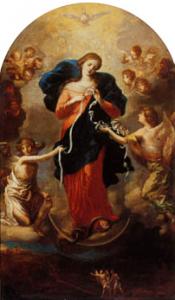
Ora pro nobis.
What part of this, pray tell, do I propose to deny? Only the first two premises and the conclusion, I promise; I’ll happily grant the third premise.
A Vote of Thanks to Judas
The first premise there is a strange and quite serious error for any Christian to make. Yet many do, and, from my experience discussing and writing about LGBTQ issues, Catholics seem almost addicted to making it. This honestly alarms me a little, because it suggests that something has either replaced the Catholic scheme of values in their minds—or, less worryingly, that they have never really digested it in the first place. I can’t be sure which (and in a way it’s not really my business). For now I’ll simply examine the error.
In substance, Premise 1 is a form of the post hoc fallacy1: the idea that bad things have bad results, and good things have good results. This may sound like a reasonable rule of thumb; in some contexts, maybe: theology, morals, and politics are not among those contexts. “The ends do not justify the means” is an important rebuttal. T. S. Eliot put a more eloquent one in the mouth of St. Thomas à Becket. As the knights are battering on the door of the cathedral to come in and kill him, he demands that the doors be opened, because he is about to say Vespers and the evening prayer of the Church must be open to all unconditionally.
PRIEST
aaaaaYou would bar the door
Against the lion, the leopard, the wolf or the boar,
Why not more
Against beasts with the souls of damned men, against men
Who would damn themselves to beasts. My Lord! My Lord!
THOMAS
You think me reckless, desperate and mad.
You argue by results, as this world does,
To settle if an act be good or bad.
—Murder in the Cathedral, Act II
Now, this may not seem like a big deal. Catholics forget the finer points of abstract theology all the time. But really, this is not one of the finer points. It is a basic assumption of the gospel. The whole idea of redemption and forgiveness, the most elementary understanding of the cross itself, requires good to be planted in the soil of evil: logically speaking, forgiveness could not exist, if there were no sins to forgive.2 To kiss the crucifix is to give thanks to Judas.
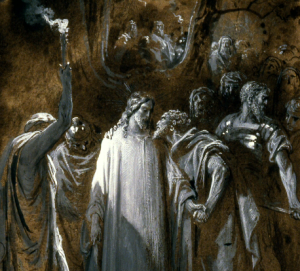
Study for The Kiss of Judas by Gustave Doré, 1865
The implications here are inscribed in both the liturgy and the New Testament. I will therefore glory in my weaknesses—oh, you’d better not if you’re a contemporary Catholic, St. Paul; that would GIVE SCANDAL, by implying that the strength we naturally desire is bad, wouldn’t it? (It wouldn’t.) O happy sin, O necessary fault that gained for us so great a Redeemer—and the surest signs of redemption are to care fervently about what others think of us and the people we associate with, and to in turn police the vocabulary, behavior, and decisions of our neighbor. (God, I gather, is busy.)
This is by far the more important of the two errors, as it has implications for the entire Christian schema. However, the other error is by far the more loudly and insistently repeated. Which brings us to Premise 2, Queer identity is rooted in sexual sin.
Sed Contra
My rebuttal runs as follows: No it’s not.
I mean, what else am I even supposed to say to a person being so confidently and entirely incorrect?
To generalize: LGBTQ terminology describes people whose bodies and/or erotic3 interests vary from the majority of people. Most people exhibit the characteristics of only one sex (endosex); most people’s sex aligns with their sense of self (cisgender); most people feel erotic interest (allosexual), and feel it only for people of the opposite sex (heterosexual). When used as an umbrella term, queer just means “at least one of those four ‘mosts’ doesn’t apply,” and the only thing the other words for queer identities do is get more specific about which ones don’t apply and how. They are not descriptions of behavior; for that, we use, you know, words and phrases that describe behavior, like “sexually active.” Nor are these words philosophical positions, still less political ones. They’re just how some people are, not in some esoteric way but in terms of daily life; it is not “ideology” to have words for that.
Nevertheless, Catholics have been asserting for years that queer identities are sinful and do not exist.4 They base this on an idea of queerness that is defined strictly by behavior, resolutely ignoring anything else LGBTQ terminology could mean, as well as how those words are used and defined by queer-identifying people. Many Catholics also propose the corollaries that (i) we should not use LGBTQ language, and (ii) anyone who does use it may be presumed to live in impenitent sexual sin5—sometimes accompanied by (iii) the very cute assertion that using this language is “against Catholic teaching.” All of these assumptions are unwarranted, intrusive, and rude, and there’s no amount of repeating false claims about what other people’s words mean that will make them anything else. Indeed, while (i) here is merely obnoxious, (ii) and (iii) actually cross into out-and-out slander, insofar as they implicitly accuse people of unchastity and heresy based on deliberately misinterpreted “evidence” that is, in truth, irrelevant.

The Audacity
But these people have already rejected the truth about sex, and Catholics have special access to the truth; that’s what the Church is for. Their sexual morality doesn’t even accept that sex should be reserved for marriage, or that—
Okay, first of all, my ass is one of “these people,” and I am a Catholic. A lot of Catholics are queer. You can’t invalidate my baptism based on that—not can’t as in “have no right to,” but as in “it’s absolutely beyond your power to”—and the same goes for anyone who’s been baptized.
Secondly, I do agree that Catholicism is the Truth-with-a-capital-T, in a way that no other school of thought in the world is. But being a Catholic does not entitle you to inform other people of what they mean—especially not the words they choose to describe themselves. If you tell someone you’re a Catholic Christian, and they reply “No, Catholics aren’t Christians,” do you not find that rude? Do you see how the same principle applies here? Doing these things implies such a gross lack of respect for the autonomy and intelligence of the person you’re speaking to, it’s little better than a slap in the face!
The same “don’t say ‘gay'” argument, consistently applied, should in theory make us object to words like straight and heterosexual, and to assume that anyone who describes themselves in those words is claiming to have an active sex life. Yet, in the twenty-ish years I’ve spent reading and writing about this stuff, the list of Christians I’ve come across who really do that begins and ends with Marc Barnes, author of the (apparently defunct) blog Bad Catholic. And why? Because that’s not what anybody means by “straight” or “heterosexual.” Those words, just like LGBTQ terminology, are talking about a disposition—what we might call an orientation, if it wouldn’t bring on its own avalanche of bad-faith objections.
It’s almost incredible to me that we are still having this (very boring!) conversation. When I first got to college, some time in the late 1940s, I was surprised we were having it at all, since it was so transparently stupid to pretend that queer people meant what Christians were saying they meant. I thought that laying it out logically and clearly would resolve the issue, except for maybe a few stubborn people.

Photo of me, taken ca. 1948
As usual, I underestimated the numbers of stubborn people relative to the numbers of those who would accept the standard definition of normal words.
Of course, where it gets breathtakingly insulting is when straight Catholics talk about how we “make everything about our sexuality.” Despite the fact that this stuff has a big impact on how we live, we can’t mention it in passing without being lectured, by you, on our vocabulary if not our very existence—and you have the gall to say we’re the ones making a big deal about this? Do you own a mirror?
Still, I did say there was a kernel of truth at the heart of the standard Catholic critique of Pride, didn’t I? No, I didn’t. What I did say was that not everything about that critique is irrational or unfair, so, yes, we’ll be having a Part III—after Pride month ends.
Footnotes
1The name comes from the Latin phrase post hoc ergo propter hoc, “after this therefore because of this.” The statistician’s weary maxim Correlation does not equal causation is related.
2This doesn’t mean we could not have a good world without evil. Indeed, we could still have a world full of undeserved grace (since grace, i.e. a creaturely share in the life of the Trinity, is something no being but God can deserve, ontologically). But we could not have the specific good thing we call “forgiveness,” except on the condition that evil be first permitted by God, and then made actual by some creature or creatures.
3I mean erotic here as a category covering both “romantic” and “sexual.” Not every person experiences both, and the relationship between them can be complex; however, and especially since I’m so prone to digressions, I wanted a word that would suggest both meanings without taking the discussion elsewhere. Erotic definitely isn’t a perfect term for that purpose, as it does give more weight to the sexual than the romantic, but I couldn’t think of a more satisfactory alternative—hence the footnote.
4Why yes, this does sound like a contradiction in terms. To be quite fair, it doesn’t logically have to be: pretending something exists when it doesn’t can be a form of lying. (For example, while it’s real enough as a vague cultural category, pretending that the racial idea of “whiteness” is metaphysically real is quite wrong and silly, and is the false basis on which most racism is built.) However, Catholics themselves don’t show a consistent line on the meaning of the word identity: at one moment they’ll say the only identities that exist are “human being” and “male versus female,” but at another they’ll be deeply concerned with “Catholic identity,” or discuss various national and ethnic identities without expressing any reservations.
5I don’t know of evidence that either of these issues were commonplace concerns in Catholic circles before the ’80s. This may only represent a gap in my own researches, of course. Still, on analogy with certain other aspects of American Catholicism (like its strange predilection for young-earth creationism), it makes me wonder whether this is another “perennial teaching of the Church” that we somehow only picked up from Protestants in the last thirty years.
Previous Post

June 24, 2023
Proud and Prejudiced, Part I: Catholics and Gay Pride
Next Post
July 10, 2023 The Sons of Levi
Recent Comments
"On the contrary, such a proclamation, among the Aztecs or Maya, would be disastrously misunderstood. ..."
The Gospel of John: The Bread ..."
"Many thanks for your scholarly study on the Cleansing of the Ten Lepers in the ..."
The Cleansing of the Ten Lepers
"Four Last Things: not the video game, but Death, Judgment, Heaven and Hell.Momento mori. Remember, ..."
"I am going by the time that these sayings began to be converted into written ..."
Are Our Bibles in the Wrong ..."
Browse Our Archives
Select a Category abuse antifascism art bad Catholic celibacy chastity Church crucifixion culture war eros forgiveness gay gender homophobia ikons language liturgy peace poems politics Pope Francis prayer pro-life race recommendations reform repentance review sacraments saints satire scandal schism scripture sex suffering theology Uncategorized violence
Select a Month October 2026 September 2026 August 2026 July 2026 June 2026 May 2026 April 2026 March 2026 February 2026 January 2026 December 2025 November 2025 October 2025 September 2025 August 2025 July 2025 June 2025 May 2025 April 2025 March 2025 February 2025 January 2025 December 2024 November 2024 October 2024 September 2024 August 2024 July 2024 June 2024 May 2024 April 2024 March 2024 February 2024 January 2024 December 2023 November 2023 October 2023 September 2023 August 2023 July 2023 June 2023 May 2023 April 2023 March 2023 February 2023 January 2023 December 2022 November 2022 October 2022 September 2022 August 2022 July 2022 June 2022 May 2022 April 2022 March 2022 February 2022 January 2022 December 2021 November 2021 October 2021 September 2021 August 2021 July 2021 June 2021 May 2021 April 2021 March 2021 February 2021 January 2021 December 2020 November 2020 October 2020 September 2020 August 2020 July 2020 June 2020 May 2020 April 2020 March 2020 February 2020 January 2020 December 2019 November 2019 October 2019 September 2019 August 2019 July 2019
Follow Us!
TAKE THE
Religious Wisdom Quiz
Who was the wise woman who saved her city from Joab by throwing a man's head over the wall?
Select your answer to see how you score.
Bathsheba A woman of Abel Abigail Michal
Related posts from Mudblood Catholic

The Sermon on the Mount, Part I: Matthew...

The Gospel of Matthew: Christ and Antichrist

John the Baptist and the Winnowing Fork: Matthew...

The Gospel of Matthew: The Coventry Carol
TRENDING AT PATHEOS Catholic

Emotion in Early Christianity by Andrew Crislip
Andrew Crislip’s Emotion in Early Christianity examines an often overlooked dimension of...

16 Spiritual Touchstones for a More Grounded Life
After decades of spiritual study, here are 16 principles I try...

Catholic Evangelization: Sharing Your Faith Every Day
Welcome back to the Graceful Awakening mini-series called, “From Faith to Mission.” ...

The Pillar of the Boatmen: the Ancient Monument...
The Pillar of the Boatmen is a Romano-Gaulish sculpture that dates from...

In one sense walking into Westminster Abbey is like walking down the...

'Super Scam Me' Exposes AI Jon Bon Jovi...
Leslie Pickett believed she was in a relationship with Jon Bon Jovi....
view all Catholic blogs
What Are Your Thoughts?leave a comment
Ad-Free & Subscriber Log-In Subscription Support
- About Us
- 2026 Calendar
- Videos
- Podcasts
- Library of World Religions
- Faith In Media Tracker
- Advertise With Us
- Write for Us
- Privacy Policy
- Terms of Service
- Do Not Sell My Data
- Contact Us
- Radiant Digital
- Manage Newsletter Subscriptions
- Unsubscribe From Notifications
- Sitemap
Copyright 2008-2026, Patheos. All rights reserved.
Subscription Support Ad-Free & Subscriber Log-In
Follow Patheos