
BuddhistCatholicContemplativeEvangelicalGeneral ChristianHinduJewishLatter-day SaintMuslimNew VisionsProgressive Christian
Beliefs
- Buddhist
- Catholic
- Contemplative
- Evangelical
- General Christian
- Hindu
- Jewish
- Latter-day Saint
- More Voices
- Muslim
- New Visions
- Pagan
- Progressive Christian
Topics
- Religion News
- Food and Religion
- Sports and Religion
- Religious Art
- Religious Music and Entertainment
- Religious Events
- History and Religion
- Style and Religion
- Politics and Religion
- Women in Religion
- Recreation Outdoors and Religion
- Business Finance and Religion
- Careers Workplace and Religion
- Education and Religion
- Family Parenting and Religion
- Health Fitness and Religion
- Home and Religion
- Relationships and Religion
- Technology and Religion
- Travel and Religion
Columnists
- Buddhist Columnists
- Business Finance and Religion Columnists
- Careers Workplace and Religion Columnists
- Catholic Columnists
- Contemplative Columnists
- Education and Religion Columnists
- Evangelists Columnists
- Family Parenting and Religion Columnists
- General Christian Columnists
- Health Fitness and Religion Columnists
- Hindu Columnists
- History and Religion Columnists
- Home and Religion Columnists
- Jewish Columnists
- More Voices Columnists
- Latter Day Columnists
- Muslim Columnists
- New Visions Columnists
- Nonreligious Columnists
- Pagan Columnists
- Politics and Religion Columnists
- Progressive Columnists
- Recreation Outdoors and Religion Columnists
- Relationships and Religion Columnists
- Religion News Columnists
- Religious Art Columnists
- Religious Events Columnists
- Religious Music and Entertainment Columnists
- Sports and Religion Columnists
- Style and Religion Columnists
- Technology and Religion Columnists
- Travel and Religion Columnists
- Women in Religion Columnists
Resource Library
- 2026 Calendar
- Library of World Religions
- The 100 Most Holy Places on Earth
- Patheos Answers
- Podcasts
- Videos
- Faith Leaders Database
- Anglican Episcopalian
- Bahai
- Baptist
- Buddhism
- Christianity
- Confucianism
- Eastern Orthodoxy
- Hinduism
- Holiness and Pentecostal
- ISKCON
- Islam
- Judaism
- Lutheran
- Methodist
- The Church of Jesus Christ of Latter-day Saints
- New Age
- Paganism
- Presbytarian and Reformed
- Protestantism
- Religion Behind the Scenes
- Roman Catholic
- Scientology
- Shia Islam
- Sikhism
- Sufism
- Sunni Islam
- Taoism
- Zen
- See all religions
Research Tools
 Ad-Free & Subscriber Log-In Subscription Support
Ad-Free & Subscriber Log-In Subscription Support
Follow Patheos 

- Trending:
- Forgiveness
- |
- Marriage
- |
- Consciousness
- |
- Death Penalty
- |
- Election
- |
- Halloween

- Home
- Catholic
- Bleed
Bleed
Last updated on: October 5, 2022 at 8:51 am by Gabriel Blanchard
Bleed 2022-10-05T08:51:21-04:00 Gabriel Blanchard
Patheos Explore the world's faith through different perspectives on religion and spirituality! Patheos has the views of the prevalent religions and spiritualities of the world.
Forty Lashes, Minus One
I’ve found more than once in the history of Mudblood Catholic1 that, when I run into writer’s block, it’s usually because there’s something I need to put down here that’s very vulnerable and raw, and I’m resisting. That certainly seems true with my current series. That is, I say “current series,” but I’ve published a grand total of two posts in it, and have had a second not-quite-finished one in my drafts for over a month.
I’ve put a lot out there. My doubts and difficulties—some of them, anyway, since a lot of them are recurring, and repeating them would get boring. The slow crumbling of my attempts at chastity into less than nothing. The loss of friends and fellow Catholics, usually in slow-motion car-crash form, occasionally much more suddenly. The sexual abuse I experienced in my teens.
But there are things I’ve held back too. There’s only so much self-exposure a person can take; we all need a little privacy. And besides the stuff that I have published, I’ve got a few secrets that I am really not proud of—stuff only my close friends know, or that even they don’t know. There are some rooms in my memory that I do not lightly unlock.
Yet … here I’ve been, for months. With writer’s block. Putting up a post or two a month. That’s never not been a signal that it’s time to let something go.
Zero Lashes, Plus One
But I’m scared, so we’re gonna start small: I think maybe I kind of hate God.
(Yes, this is me starting small. Don’t worry, though; it’s not that any other stuff I might admit here is objectively worse than the possibility I hate God; it’s only that my priorities are out of whack. I’m way more frightened of people mocking or despising me than I am of being hostile to the Source of all being and goodness.)
Which prompts the—well, it prompts lots of questions. But the one that feels obvious to me is, Why would you hate God?
A Chapel of Cards
Growing up evangelical, I had a fairly straightforward image of what it meant to lead a Christian life. Once you grew up, you did two things. One was to get married and have kids. The other was to either devote yourself to professional ministry of some kind—maybe as a pastor or a missionary, sure, but there were a lot of options; someone with a brainiac bent like me might make a good theology professor or Bible translator, for example—or, you chose some more clearly secular profession, and devoted a good chunk of your income and/or free time to supporting people who were in full-time ministry.
When I became a Catholic, my concept of what “full-time ministry” means admittedly changed, but not as much as you might think. A priest isn’t quite the same thing as an evangelical pastor (and neither is the same thing as a religious brother), but they do a lot of the same stuff and play a lot of the same social roles. The chief difference is celibacy, but even that was something I’d been toying with for years. Realizing I was gay had something to do with that, sure; however, I’d grown up believing that celibacy was something some people did for God, based on, well, the New Testament. The aversion, if not outright hostility, to celibacy that many of my fellow Protestants evinced always both annoyed and confused me. It wasn’t like the Scriptures recommending it were that ambiguous!
In any case, I had this picture of adulthood. It was, if anything, one that entering the Catholic Church broadened somewhat, since joining a religious order was now a recognized thing as well. And then … well, it all came down.
Paternity Test
Came down how? Well, I am gay. That tends to make marrying a woman not work. And I went through the whole ex-gay business for several years before swimming the Tiber—that was a clear fraud. That’s alright though. Yes, I had wanted children, so giving up that idea was sad. I didn’t want to be the last of my name, but I’m an only son with just two male cousins; a silly thing to worry about, maybe, but I did. That and, well, don’t most people want kids? Raising a family, while obviously a hassle (I mean, I grew up in one!), sounded a little magical.
Then again, it wasn’t like celibacy would have been easy in any case. At least Rome had a clear role for celibates to play in the Church, indeed a respected one. I converted in college, and lots of Catholics think hard about the priesthood or the religious life at that age, so I wasn’t alone—I might even have one or two people I knew around if I entered the Dominican House or something. Such vocations, especially the priesthood, promised spiritual children; the difference was bittersweet, but doubtless it had deeper joys than I could perceive from without, and I could see something of them even from here. And presumably Catholics, who were so proud of maintaining a distinct identity and marching to the beat of their own drum, weren’t going to get on my case for admitting a simple truth about myself while pursuing celibacy?
Ha. Ha. I don’t know how prevalent it was before, but not long after I converted, the Catholic Church was actively taking all the identity politics of evangelicalism on board. Suddenly, I was once more awash in all the same pseudo-Biblical language about “your identity is in Christ” (which apparently meant I wasn’t allowed to say “I’m gay” for some reason? even though no other sentences starting with “I’m” were thus proscribed?). What was more, canon law was made stricter: gay men were effectively barred from the priesthood now, at least on paper. Religious houses wouldn’t necessarily follow suit, since most do have lay brothers, but they probably would, and for a lot of the same ostensible reasons.
The idea of adoption, with or without a partner—of either sex—did cross my mind. But even if I could afford to adopt (and I can’t afford to adopt a cat), what would the future of our family be like? It’s not like diocesan policies towards LGBTQ people have been getting more generous lately. My children could be refused a Catholic education because of their father’s sexuality; I wasn’t even sure they’d have access to the sacraments. And the vitriol so many Catholics poured on the mere idea of gay couples adopting, to say nothing of the incessant vicious remarks that we’re all secretly child molesters … How could I possibly raise a child in the faith in an environment like that?
“Midway This Way of Life We’re Bound Upon …”
Okay. Marriage, children, the priesthood, and the religious life were all effectively out. Problem was, that was every version of an adult life I knew about. What was left?
It’s been ten years, or a little less, since this realization crystallized for me. I still don’t have an answer to that question. With neither ministry nor family, I’ll be blunt, my life feels horribly empty sometimes. Not that there’s no fun in life, or that I don’t have friends and loved ones who care deeply about me. But I thought I’d have a purpose, a point. I didn’t think I’d hit 35 with so little to show for it.
I’ve basically given up all efforts at chastity at this point. Who or what am I doing this for? I’ve heard a number of Side B people, like Bridget Rivera or Grant Hartley, talk about the fulfillment they find in celibacy; good for them (sincerely!), but it’s completely opaque to me.
For a long time I thought doing it for Christ was the answer. I was, somehow, reserving my body for him. But it turns out that when a duty is this abstract, I just do not care about that answer. What does it mean that I’m “reserving my body for him”? Is he benefiting by it? Am I? The only answers I’ve ever heard are the kind of things a person can obviously do just as well if they do have a sexually active relationship as if they don’t—in other words, they weren’t answers at all. I’ve had gay sex plenty of times,3 and I’m taking it completely on faith that it’s wrong at this point: I genuinely can’t see what harm it does, and I can’t make non-harm-based reasons for thinking that it’s wrong feel like they matter. In my less charitable moments, I wonder whether the reason most straight people do find it easy to accept this teaching is quite simply that it doesn’t affect them.
Crooked Trees
There are answers to these kinds of bewilderment, offered by theologians and mystics. Yesterday I reread John Donne’s Letter to Lady Kingsmel on the Death of Her Husband. It’s a potent piece; Donne always overpowers me. Here is a selection.
We would wonder, to see a man, who in a wood were left to his liberty, to fell what trees he would, take only the crooked, and leave the straightest trees; but that man hath perchance a ship to build, and not a house, and so hath use of that kind of timber: let not us, who know that in God’s house there are many Mansions, but yet have no model, no design of the form of that building, wonder at his taking in of his materials, why he takes the young, and leaves the old, or why the sickly over-live those, that had better health. We are not bound to think that souls departed, have divested all affections towards them, whom they left here; but we are bound to think, that for all their loves they would not be here again: Then is the will of God done in Earth, as it is in Heaven, when we neither pretermit his actions, nor resist them; neither pass them over in an inconsideration, as though God had no hand in them, nor go about to take them out of his hands, as though we could direct him to do them better.
… But Madame, you who willingly sacrificed your self to God, in your obedience to him, in your own sickness, cannot be doubted to dispute with him, about any part of you, which he shall be pleased to require at your hands. The difference is great in the loss, of an arm, or a head; of a child, or a husband: but to them, who are incorporated into Christ, their head, there can be no beheading; upon you, who are a member of the spouse of Christ the Church, there can fall no widowhood, nor orphanage upon those children, to whom God is father.
Odio Theologico
Donne’s beautiful. I’m glad to have his words; it’s nice to flatter myself by imagining that one day, I’ll be able to read them not just with admiration, but with recognition. It helps—genuinely it does—but it isn’t enough. Moral knowledge elegantly expressed is good; but it hasn’t made me stop hating.
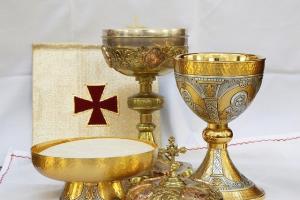
I don’t know what to do. I drag myself to Mass each Sunday. Most of the time I can’t seriously regard myself as repentant and, therefore, can’t confess or receive. I just sit there, my eyes on the altar, resenting him.
I feel like he’s taken everything away from me. These longings for intimacy and family and touch, that I’ve been told over and over are things God put there in my heart, yet I get this cold, immovable No. And in return he’s given me—just nothing.
1I don’t think I’ve mentioned this before, but I’ve wanted for some time to rename my blog. I chose the name back in 2012; I thought the idea of a Mudblood was a nice “between two worlds” image. However, this was years before J. K. Rowling turned out to be a rampaging TERF2, and I’ve gotten pretty uncomfortable since then with the impression the title might give my readers: that I don’t know or, far worse, don’t care about her views, demeanor, and politics. I tried to get in touch with Patheos about changing the title (perhaps to Our Lady of Antifa, to align with my Twitter account), but they never got back to me.
2For those who aren’t familiar, this acronym stands for Trans-Exclusionary Radical Feminist, indicating feminists who oppose many political rights (and much if not all social recognition) for gender minorities, especially trans women. The US and Great Britain have seen a major rise in transphobic rhetoric and politics over the last few years, of which Mrs Rowling has been a small but attention-grabbing part.
3In testing a hypothesis it’s ideal to have a large sample size
Previous Post

September 30, 2022
Five Quick Takes
Next Post
October 19, 2022 The Fog
Browse Our Archives
Select a Category abuse antifascism art bad Catholic celibacy chastity Church crucifixion culture war eros forgiveness gay gender homophobia ikons language liturgy peace poems politics Pope Francis prayer pro-life race recommendations reform repentance review sacraments saints satire scandal schism scripture sex suffering theology Uncategorized violence
Select a Month October 2026 September 2026 August 2026 July 2026 June 2026 May 2026 April 2026 March 2026 February 2026 January 2026 December 2025 November 2025 October 2025 September 2025 August 2025 July 2025 June 2025 May 2025 April 2025 March 2025 February 2025 January 2025 December 2024 November 2024 October 2024 September 2024 August 2024 July 2024 June 2024 May 2024 April 2024 March 2024 February 2024 January 2024 December 2023 November 2023 October 2023 September 2023 August 2023 July 2023 June 2023 May 2023 April 2023 March 2023 February 2023 January 2023 December 2022 November 2022 October 2022 September 2022 August 2022 July 2022 June 2022 May 2022 April 2022 March 2022 February 2022 January 2022 December 2021 November 2021 October 2021 September 2021 August 2021 July 2021 June 2021 May 2021 April 2021 March 2021 February 2021 January 2021 December 2020 November 2020 October 2020 September 2020 August 2020 July 2020 June 2020 May 2020 April 2020 March 2020 February 2020 January 2020 December 2019 November 2019 October 2019 September 2019 August 2019 July 2019
Follow Us!
TAKE THE
Religious Wisdom Quiz
Who was the first man created, according to the Bible?
Select your answer to see how you score.
Abraham Jacob Moses Adam
Related posts from Mudblood Catholic

The Sermon on the Mount, Part I: Matthew...

The Gospel of Matthew: Christ and Antichrist

John the Baptist and the Winnowing Fork: Matthew...

The Gospel of Matthew: The Coventry Carol
TRENDING AT PATHEOS Catholic

The Iron Gates and the Lion of the...
Yesterday, I didn't finish my report about, well, yesterday. So I'll...

Dolly Parton’s Last Song Wins Dove Award with...
Bluegrass band The Grascals, speaking on the red carpet at the 57th...

The Image: On the Horror of Capitalism and...
The Image Then went the Pharisees, and took counsel how they might...

We are approaching the date of our new American national holiday: October...

Letters on Living the Faith by C.S. Lewis
Most of us met C.S. Lewis as a public intellectual. Mere Christianity....

When Halloween Unmasks Married Hearts
Written by Dr. David K. Ewen from Eternal Truth Bible College Behind...
view all Catholic blogs
Ad-Free & Subscriber Log-In Subscription Support
- About Us
- 2026 Calendar
- Videos
- Podcasts
- Library of World Religions
- Faith In Media Tracker
- Advertise With Us
- Write for Us
- Privacy Policy
- Terms of Service
- Do Not Sell My Data
- Contact Us
- Radiant Digital
- Manage Newsletter Subscriptions
- Unsubscribe From Notifications
- Sitemap
Copyright 2008-2026, Patheos. All rights reserved.
Subscription Support Ad-Free & Subscriber Log-In
Follow Patheos