
BuddhistCatholicContemplativeEvangelicalGeneral ChristianHinduJewishLatter-day SaintMuslimNew VisionsProgressive Christian
Beliefs
- Buddhist
- Catholic
- Contemplative
- Evangelical
- General Christian
- Hindu
- Jewish
- Latter-day Saint
- More Voices
- Muslim
- New Visions
- Pagan
- Progressive Christian
Topics
- Religion News
- Food and Religion
- Sports and Religion
- Religious Art
- Religious Music and Entertainment
- Religious Events
- History and Religion
- Style and Religion
- Politics and Religion
- Women in Religion
- Recreation Outdoors and Religion
- Business Finance and Religion
- Careers Workplace and Religion
- Education and Religion
- Family Parenting and Religion
- Health Fitness and Religion
- Home and Religion
- Relationships and Religion
- Technology and Religion
- Travel and Religion
Columnists
- Buddhist Columnists
- Business Finance and Religion Columnists
- Careers Workplace and Religion Columnists
- Catholic Columnists
- Contemplative Columnists
- Education and Religion Columnists
- Evangelists Columnists
- Family Parenting and Religion Columnists
- General Christian Columnists
- Health Fitness and Religion Columnists
- Hindu Columnists
- History and Religion Columnists
- Home and Religion Columnists
- Jewish Columnists
- More Voices Columnists
- Latter Day Columnists
- Muslim Columnists
- New Visions Columnists
- Nonreligious Columnists
- Pagan Columnists
- Politics and Religion Columnists
- Progressive Columnists
- Recreation Outdoors and Religion Columnists
- Relationships and Religion Columnists
- Religion News Columnists
- Religious Art Columnists
- Religious Events Columnists
- Religious Music and Entertainment Columnists
- Sports and Religion Columnists
- Style and Religion Columnists
- Technology and Religion Columnists
- Travel and Religion Columnists
- Women in Religion Columnists
Resource Library
- 2026 Calendar
- Library of World Religions
- The 100 Most Holy Places on Earth
- Patheos Answers
- Podcasts
- Videos
- Faith Leaders Database
- Anglican Episcopalian
- Bahai
- Baptist
- Buddhism
- Christianity
- Confucianism
- Eastern Orthodoxy
- Hinduism
- Holiness and Pentecostal
- ISKCON
- Islam
- Judaism
- Lutheran
- Methodist
- The Church of Jesus Christ of Latter-day Saints
- New Age
- Paganism
- Presbytarian and Reformed
- Protestantism
- Religion Behind the Scenes
- Roman Catholic
- Scientology
- Shia Islam
- Sikhism
- Sufism
- Sunni Islam
- Taoism
- Zen
- See all religions
Research Tools
 Ad-Free & Subscriber Log-In Subscription Support
Ad-Free & Subscriber Log-In Subscription Support
Follow Patheos 

- Trending:
- Forgiveness
- |
- Marriage
- |
- Consciousness
- |
- Death Penalty
- |
- Election
- |
- Halloween

- Home
- Catholic
- Rosary Meditations: Intro
Rosary Meditations: Intro
Last updated on: March 29, 2022 at 4:37 pm by Gabriel Blanchard
Rosary Meditations: Intro 2022-03-29T16:37:09-04:00 Gabriel Blanchard
Patheos Explore the world's faith through different perspectives on religion and spirituality! Patheos has the views of the prevalent religions and spiritualities of the world.
Some years ago, I adopted the practice of using Scripture passages as meditations on each mystery of the rosary. Lent being a devotional season, I thought I’d share some of those meditations with you all. Before I do, though:
The Rosary: A Crash Course
The rosary is of course one of the most popular Catholic devotions, but it isn’t equally familiar to everyone. Here’s how it works. A rosary is a chain of prayer beads, shaped kind of like a lasso with a huge loop and a small tail.
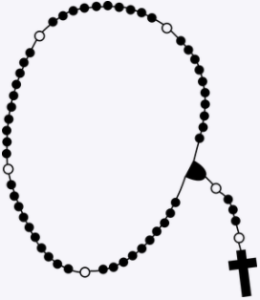
At the end of the tail is a crucifix; the point where the tail joins the loop is typically adorned with some type of religious medal, often an image of the Mother of God. It has two types of beads, often called “large” and “small” (in fact they are often all the same size, and the “large” beads are set off from the “small” ones by spacing instead). The sequence of the beads is always as in the picture: between the crucifix and the medal are one large bead, three small beads, and one large bead; on the loop are five sets of ten small beads, called “decades,” with large beads in between each decade.
The prayers go like this (all can be found in the section at the bottom):
- Holding the crucifix, make the sign of the cross and say the Apostles’ Creed.
- On the first large bead, say the Our Father, and on the three small beads, say one Hail Mary each.
- On the next large bead, announce the first mystery from the set you are meditating on (we’ll get to these later), and say an Our Father. (You’ll skip the medal until you come back to it at the end.)
- Say one Hail Mary on each of the ten beads in the following decade, and a Glory Be at the end of the set.
- Repeat steps 2 and 3 for the other four mysteries.
- When you get back to the medal, say the Hail, Holy Queen.
- Close with the Rosary Collect and the sign of the cross.
There are a number of optional additions and alternatives, but this is the “skeleton” form that, as far as I know, is common to pretty much all versions of the rosary.
Where Does the Rosary Come From?
The origins of the rosary lie in the Psalter. From the early days of monasticism, there was a practice of reciting all one hundred and fifty psalms every day, and reciting an Our Father in between each set of ten psalms. Devout laity who didn’t have that kind of time adopted the practice of replacing the psalms with Hail Marys; there is an ancient custom of concluding psalms with the Glory Be, so this was incorporated at the end of each set of prayers. Thus the rosary decade still in use today: one Our Father, ten Hail Marys, and one Glory Be. You can still occasionally see a fifteen-decade “full size” rosary today, generally as part of a monastic habit, but the commonest form is the five-decade rosary depicted above.
In order to make the repetition more of a vehicle for reflection, events from the lives of Christ and the Virgin were added as meditations—originally, fifteen such events, until five more were added by St. John Paul II. These are arranged into four sets of five, each set arranged around a theme. The original mysteries were drawn from episodes surrounding the Incarnation, the Passion, and the Resurrection; the newer set are drawn from Christ’s earthly ministry.
The Mysteries
The mysteries are as follows, with some conventional Scripture passages:
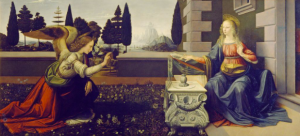
The Joyful Mysteries
1. The Annunciation to the Virgin by St. Gabriel (Luke 1.26-38)
2. The Visitation of the Virgin to St. Elizabeth (Luke 1.39-56)
3. The Nativity of Christ at Bethlehem (Luke 2.1-21)
4. The Presentation of Christ in the Temple (Luke 2.22-40)
5. The Finding of Christ in the Temple (Luke 2.41-52)
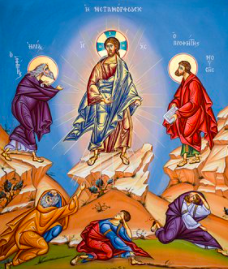
The Luminous Mysteries
1. The Baptism of Christ in the Jordan (Matthew 3.1-17)
2. The Miracle of Christ at Cana (John 2.1-11)
3. The Proclamation by Christ of the Kingdom (Matthew 4.12-17)
4. The Transfiguration of Christ on Tabor (Matthew 17.1-9)
5. The Institution by Christ of the Eucharist (Matthew 26.26-29)
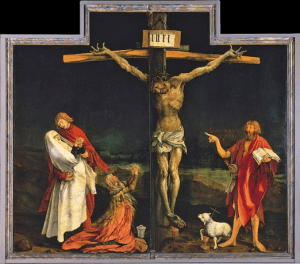
The Sorrowful Mysteries
1. The Agony of Christ in Gethsemane (Luke 22.39-46)
2. The Flogging of Christ at the Pillar (Mark 15.6-15)
3. The Crowning of Christ with Thorns (Matthew 27.27-31)
4. The Bearing by Christ of the Cross (Mark 15.21-23)
5. The Death of Christ on the Cross (Mark 15.33-39)
The Glorious Mysteries
1. The Resurrection of Christ from the Dead (John 20.1-18)
2. The Ascension of Christ into Heaven (Acts 1.1-11)
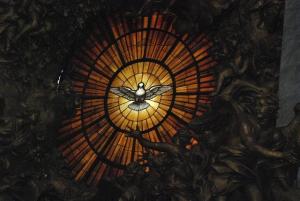
3. The Sending by Christ of the Paraclete (Acts 2.1-4)
4. The Assumption of the Virgin into Heaven (Revelation 11.19)
5. The Crowning of the Virgin as Queen (Revelation 12.1)
The Prayers
These are the texts of the prayers that compose the rosary. I’ve followed the usual Anglican (and therefore Ordinariate) wording, which I prefer; many Catholics use slightly different phrases at some points.
The Sign of the Cross
In the name of the Father [touch forehead], and of the Son [touch breastbone], and of the Holy [touch left shoulder] Ghost [touch right shoulder], amen.
The Apostles’ Creed
I believe in God the Father Almighty, Maker of heaven and earth.
And in his only Son, Jesus Christ our Lord, who was conceived by the Holy Ghost, born of the Virgin Mary, suffered under Pontius Pilate, was crucified, died, and was buried. He descended into hell; on the third day he rose again from the dead. He ascended into heaven, and sitteth at the right hand of God the Father Almighty; from thence he shall come to judge the quick and the dead.
I believe in the Holy Ghost, the holy Catholic Church, the communion of saints, the forgiveness of sins, the resurrection of the body, and the life everlasting. Amen.
The Our Father
Our Father, who art in heaven, hallowed be thy name. Thy kingdom come. Thy will be done, on earth as it is in heaven. Give us this day our daily bread, and forgive us our trespasses, as we forgive them that trespass against us. And lead us not into temptation, but deliver us from evil. Amen.
The Hail Mary
Hail Mary, full of grace; the Lord is with thee. Blessed art thou amongst women, and blessed is the fruit of thy womb, Jesus. Holy Mary, Mother of God, pray for us sinners, now and at the hour of our death. Amen.
The Glory Be
Glory be to the Father, and to the Son, and to the Holy Ghost, as it was in the beginning, is now, and ever shall be, world without end. Amen.
At the end of each decade of the rosary, many Catholics add this optional prayer, reportedly delivered by Our Lady to the visionaries at Fátima in 1917:
O my Jesus, forgive us our sins, save us from the fires of hell; lead all souls to heaven, especially those most in need of thy mercy.
The Hail Holy Queen
Hail, holy Queen, Mother of mercy, our life, our sweetness, and our hope. To thee do we cry, poor banished children of Eve; to thee do we send up our sighs, mourning and weeping in this valley of tears. Turn then, most gracious advocate, thine eyes of mercy towards us; and after this, our exile, show unto us the blessed fruit of thy womb, Jesus, O clement, O loving, O sweet Virgin Mary. Pray for us, O most holy Mother of God, that we may be made worthy of the promises of Christ.
The Rosary Collect
Let us pray: O God, whose only-begotten Son, by his life, death, and resurrection hath purchased for us the rewards of eternal life: grant, we beseech thee, that by meditating upon these mysteries of the most holy rosary of the Blessed Virgin Mary, we may imitate what they contain and obtain what they promise; through the same Christ our Lord. Amen.
Previous Post

March 21, 2022
With My Body, I Thee Worship: Part Six
Next Post
March 31, 2022 Rosary Meditations: The Joyful Mysteries
Browse Our Archives
Select a Category abuse antifascism art bad Catholic celibacy chastity Church crucifixion culture war eros forgiveness gay gender homophobia ikons language liturgy peace poems politics Pope Francis prayer pro-life race recommendations reform repentance review sacraments saints satire scandal schism scripture sex suffering theology Uncategorized violence
Select a Month October 2026 September 2026 August 2026 July 2026 June 2026 May 2026 April 2026 March 2026 February 2026 January 2026 December 2025 November 2025 October 2025 September 2025 August 2025 July 2025 June 2025 May 2025 April 2025 March 2025 February 2025 January 2025 December 2024 November 2024 October 2024 September 2024 August 2024 July 2024 June 2024 May 2024 April 2024 March 2024 February 2024 January 2024 December 2023 November 2023 October 2023 September 2023 August 2023 July 2023 June 2023 May 2023 April 2023 March 2023 February 2023 January 2023 December 2022 November 2022 October 2022 September 2022 August 2022 July 2022 June 2022 May 2022 April 2022 March 2022 February 2022 January 2022 December 2021 November 2021 October 2021 September 2021 August 2021 July 2021 June 2021 May 2021 April 2021 March 2021 February 2021 January 2021 December 2020 November 2020 October 2020 September 2020 August 2020 July 2020 June 2020 May 2020 April 2020 March 2020 February 2020 January 2020 December 2019 November 2019 October 2019 September 2019 August 2019 July 2019
Follow Us!
TAKE THE
Religious Wisdom Quiz
Who said, "Lord, why do you stand far off?"
Select your answer to see how you score.
Jeremiah Job David Moses
Related posts from Mudblood Catholic

The Sermon on the Mount, Part I: Matthew...

The Gospel of Matthew: Christ and Antichrist

John the Baptist and the Winnowing Fork: Matthew...

The Gospel of Matthew: The Coventry Carol
TRENDING AT PATHEOS Catholic

The Iron Gates and the Lion of the...
Yesterday, I didn't finish my report about, well, yesterday. So I'll...

Dolly Parton’s Last Song Wins Dove Award with...
Bluegrass band The Grascals, speaking on the red carpet at the 57th...

The Image: On the Horror of Capitalism and...
The Image Then went the Pharisees, and took counsel how they might...

We are approaching the date of our new American national holiday: October...

Letters on Living the Faith by C.S. Lewis
Most of us met C.S. Lewis as a public intellectual. Mere Christianity....

When Halloween Unmasks Married Hearts
Written by Dr. David K. Ewen from Eternal Truth Bible College Behind...
view all Catholic blogs
Ad-Free & Subscriber Log-In Subscription Support
- About Us
- 2026 Calendar
- Videos
- Podcasts
- Library of World Religions
- Faith In Media Tracker
- Advertise With Us
- Write for Us
- Privacy Policy
- Terms of Service
- Do Not Sell My Data
- Contact Us
- Radiant Digital
- Manage Newsletter Subscriptions
- Unsubscribe From Notifications
- Sitemap
Copyright 2008-2026, Patheos. All rights reserved.
Subscription Support Ad-Free & Subscriber Log-In
Follow Patheos