
BuddhistCatholicContemplativeEvangelicalGeneral ChristianHinduJewishLatter-day SaintMuslimNew VisionsProgressive Christian
Beliefs
- Buddhist
- Catholic
- Contemplative
- Evangelical
- General Christian
- Hindu
- Jewish
- Latter-day Saint
- More Voices
- Muslim
- New Visions
- Pagan
- Progressive Christian
Topics
- Religion News
- Food and Religion
- Sports and Religion
- Religious Art
- Religious Music and Entertainment
- Religious Events
- History and Religion
- Style and Religion
- Politics and Religion
- Women in Religion
- Recreation Outdoors and Religion
- Business Finance and Religion
- Careers Workplace and Religion
- Education and Religion
- Family Parenting and Religion
- Health Fitness and Religion
- Home and Religion
- Relationships and Religion
- Technology and Religion
- Travel and Religion
Columnists
- Buddhist Columnists
- Business Finance and Religion Columnists
- Careers Workplace and Religion Columnists
- Catholic Columnists
- Contemplative Columnists
- Education and Religion Columnists
- Evangelists Columnists
- Family Parenting and Religion Columnists
- General Christian Columnists
- Health Fitness and Religion Columnists
- Hindu Columnists
- History and Religion Columnists
- Home and Religion Columnists
- Jewish Columnists
- More Voices Columnists
- Latter Day Columnists
- Muslim Columnists
- New Visions Columnists
- Nonreligious Columnists
- Pagan Columnists
- Politics and Religion Columnists
- Progressive Columnists
- Recreation Outdoors and Religion Columnists
- Relationships and Religion Columnists
- Religion News Columnists
- Religious Art Columnists
- Religious Events Columnists
- Religious Music and Entertainment Columnists
- Sports and Religion Columnists
- Style and Religion Columnists
- Technology and Religion Columnists
- Travel and Religion Columnists
- Women in Religion Columnists
Resource Library
- 2026 Calendar
- Library of World Religions
- The 100 Most Holy Places on Earth
- Patheos Answers
- Podcasts
- Videos
- Faith Leaders Database
- Anglican Episcopalian
- Bahai
- Baptist
- Buddhism
- Christianity
- Confucianism
- Eastern Orthodoxy
- Hinduism
- Holiness and Pentecostal
- ISKCON
- Islam
- Judaism
- Lutheran
- Methodist
- The Church of Jesus Christ of Latter-day Saints
- New Age
- Paganism
- Presbytarian and Reformed
- Protestantism
- Religion Behind the Scenes
- Roman Catholic
- Scientology
- Shia Islam
- Sikhism
- Sufism
- Sunni Islam
- Taoism
- Zen
- See all religions
Research Tools
 Ad-Free & Subscriber Log-In Subscription Support
Ad-Free & Subscriber Log-In Subscription Support
Follow Patheos 

- Trending:
- Forgiveness
- |
- Marriage
- |
- Consciousness
- |
- Death Penalty
- |
- Election
- |
- Halloween

- Home
- Catholic
- Creation
Creation
Last updated on: November 29, 2021 at 5:50 pm by Gabriel Blanchard
Creation 2021-11-29T17:50:20-04:00 Gabriel Blanchard
Patheos Explore the world's faith through different perspectives on religion and spirituality! Patheos has the views of the prevalent religions and spiritualities of the world.

A week or two ago, I was leafing through an old journal I used to keep and came across the following. I didn’t date it, but I think it must have been in 2013 or thereabouts, after my ex and I broke up.
Now we are without one another, and each crucified upon the absence of the other; our very lonelinesses coinhere.
Our hearts were ripped, each from the other; and the wound is inconsolable: blood flows more freely than tears ever did.
Every penstroke is a thorn in the flesh.
All for beauty. It is unbearable, an outrage and a horror; the beauty is no answer, and is the only and wholly adequate vindication of the suffering.
I behold the face of God in the negative shape of this anguish, as in a glass darkly.
Lamentation is consolation. After articulation comes a refractory period where the heart sleeps.
“When I am from him I am dead till I be with him.”1
Of course, the wound was not inconsolable in the end. I’ve recovered, and, while he and I don’t talk much, I have gotten less prone to projecting my feelings onto him. Hardly surprising: a bout of severe depression in one’s mid-twenties is not, as a rule, the pinnacle of one’s moderation and detachment.
All the same, I think there’s something in this—the turn from theodicy towards beauty. I’ve written often enough before of my suspicion of theodicy, rooted in my reading of the book of Job. I have, at times, tried reframing the problem of evil as a question of artistic creation. Beauty is “no answer,” i.e., it’s not a solution to the philosophic problem of evil in the terms in which it is set. But any artist will tell you that the limitations of the material, and even its flaws, are part of the work—things pregnant with magnificence, in the hands of a master. Michelangelo’s David is famous for being made out of a slab of marble previous sculptors had rejected; the Scriptural parallel rises almost unbidden to our lips.
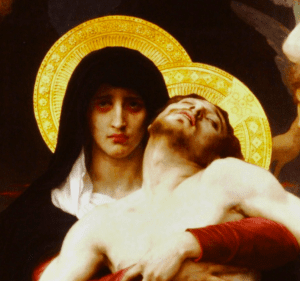
Dorothy Sayers (one of my favorite authors) addresses the issue in Gaudy Night, a novel about her long-running detective, Peter Wimsey, and a mystery writer, Harriet Vane. Harriet is having difficulty with her latest, and specifically with the character of a certain Wilfrid.
“Couldn’t you make Wilfrid one of those morbidly conscientious people, who have been brought up to think that anything pleasant must be wrong … He’d still be a goop, and a pathological goop, but he would be a bit more consistent.”
“Yes—he’d be interesting. But if I give Wilfrid all those violent and lifelike feelings, he’ll throw the whole book out of balance.”
“You would have to abandon the jig-saw kind of story and write a book about human beings for a change.”
“I’m afraid to try that, Peter. It might go too near the bone.”
“It might be the wisest thing you could do.”
“Write it out and get rid of it?”
“Yes.”
“I’ll think about that. It would hurt like hell!”
“What would that matter, if it made a good book?”
The idea that art, beauty, is worth the incredible amount of suffering we see in the world may seem offensive. It may seem irrelevant as well, since most people aren’t artists. Or rather, most people don’t think of themselves as artists; which isn’t the same thing. Dipping out for one more extended quotation, this time from Thomas Merton in Contemplative Prayer:
What am I? I am myself a word spoken by God. Can God speak a word that does not have any meaning?
Yet am I sure that the meaning of my life is the meaning God intends for it? Does God impose a meaning on my life from the outside, through event, custom, routine, law, system, impact from others in society? Or am I called to create from within, with him, with his grace, a meaning which reflects his truth and makes me his “word” spoken freely in my personal context? My true identity lies hidden in God’s call to my freedom and my response to him.
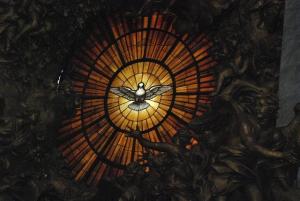
To be clear, Merton was not such a fool as to think that customs and rules were in themselves opposed to interior creation: a large chunk of Contemplative Prayer (and one immediately preceding this passage) is precisely about how liturgical prayer is not in any way opposed to personal prayer. Most people who have an issue with rules as such don’t become Trappists! But they will not do the work of self-creation for us, even if they help. And they are not the point of the Christian life; “the sabbath was made for man, not man for the sabbath.” The great temptation of habitually pious people (like me) is to think that following the rules is enough, which is a little like thinking that keeping your flesh on your bones is enough to be healthy.
I don’t have a definite idea of what this “theodicy of beauty” would look like, at least not yet. But it intrigues me. It certainly seems to fit into the crucifixion better than the alternatives I know of. And if (as I’ve written many times before) we are made in the image of God, and the main thing we know about God in Genesis 1 is that he makes things—then creation is everyone’s concern, not just that of “professional” artists.
1From Religio Medici 2.VI, by Sir Thomas Browne: “There are wonders in true affection: it is a body of Enigma’s, mysteries, and riddles; wherein two so become one, as they both become two. I love my friend before my self, and yet methinks I do not love him enough: some few months hence my multiplied affection will make me believe I have not loved him at all. When I am from him, I am dead till I be with him; when I am with him, I am not satisfied, but would still be nearer him. United souls are not satisfied with imbraces, but desire to be truly each other; which being impossible, their desires are infinite, and must proceed without a possibility of satisfaction.”
I got interested in the book after reading C. S. Lewis’ reference to its minor role in his conversion in Surprised by Joy. Religio is a an odd, charming, very rambling book, a little reminiscent of Donne it its style, though it lacks his clear and consistent purpose.
Previous Post

November 20, 2021
Sempiternam Requiem
Next Post
December 3, 2021 Peace on Earth—War on Twitter
Browse Our Archives
Select a Category abuse antifascism art bad Catholic celibacy chastity Church crucifixion culture war eros forgiveness gay gender homophobia ikons language liturgy peace poems politics Pope Francis prayer pro-life race recommendations reform repentance review sacraments saints satire scandal schism scripture sex suffering theology Uncategorized violence
Select a Month October 2026 September 2026 August 2026 July 2026 June 2026 May 2026 April 2026 March 2026 February 2026 January 2026 December 2025 November 2025 October 2025 September 2025 August 2025 July 2025 June 2025 May 2025 April 2025 March 2025 February 2025 January 2025 December 2024 November 2024 October 2024 September 2024 August 2024 July 2024 June 2024 May 2024 April 2024 March 2024 February 2024 January 2024 December 2023 November 2023 October 2023 September 2023 August 2023 July 2023 June 2023 May 2023 April 2023 March 2023 February 2023 January 2023 December 2022 November 2022 October 2022 September 2022 August 2022 July 2022 June 2022 May 2022 April 2022 March 2022 February 2022 January 2022 December 2021 November 2021 October 2021 September 2021 August 2021 July 2021 June 2021 May 2021 April 2021 March 2021 February 2021 January 2021 December 2020 November 2020 October 2020 September 2020 August 2020 July 2020 June 2020 May 2020 April 2020 March 2020 February 2020 January 2020 December 2019 November 2019 October 2019 September 2019 August 2019 July 2019
Follow Us!
TAKE THE
Religious Wisdom Quiz
Which Psalm is often read at funerals: "Even though I walk through the valley..."?
Select your answer to see how you score.
Psalm 23 Psalm 90 Psalm 137 Psalm 51
Related posts from Mudblood Catholic


With My Body, I Thee Worship: Part One


TRENDING AT PATHEOS Catholic

When Halloween Unmasks Married Hearts
Written by Dr. David K. Ewen from Eternal Truth Bible College Behind...

Aristotle. He’s been called the father of logic, the father of the...

Methodist Central Hall and Westminster Abbey
Situated on the same square is Methodist Central Hall and Westminster Abbey. ...

57th Dove Awards Honor Dolly Parton, Crown New...
On gospel music’s biggest night, the 57th annual GMA Dove Awards honored...

The First Eucharistic Controversy: Christ’s Real Presence
For Catholics, the Eucharist is the source and summit of the Christian...

What a Stop Sign Can Teach Us About...
How to Make a Decision When You Can't Hear God Main point:...
view all Catholic blogs
Ad-Free & Subscriber Log-In Subscription Support
- About Us
- 2026 Calendar
- Videos
- Podcasts
- Library of World Religions
- Faith In Media Tracker
- Advertise With Us
- Write for Us
- Privacy Policy
- Terms of Service
- Do Not Sell My Data
- Contact Us
- Radiant Digital
- Manage Newsletter Subscriptions
- Unsubscribe From Notifications
- Sitemap
Copyright 2008-2026, Patheos. All rights reserved.
Subscription Support Ad-Free & Subscriber Log-In
Follow Patheos