
BuddhistCatholicContemplativeEvangelicalGeneral ChristianHinduJewishLatter-day SaintMuslimNew VisionsProgressive Christian
Beliefs
- Buddhist
- Catholic
- Contemplative
- Evangelical
- General Christian
- Hindu
- Jewish
- Latter-day Saint
- More Voices
- Muslim
- New Visions
- Pagan
- Progressive Christian
Topics
- Religion News
- Food and Religion
- Sports and Religion
- Religious Art
- Religious Music and Entertainment
- Religious Events
- History and Religion
- Style and Religion
- Politics and Religion
- Women in Religion
- Recreation Outdoors and Religion
- Business Finance and Religion
- Careers Workplace and Religion
- Education and Religion
- Family Parenting and Religion
- Health Fitness and Religion
- Home and Religion
- Relationships and Religion
- Technology and Religion
- Travel and Religion
Columnists
- Buddhist Columnists
- Business Finance and Religion Columnists
- Careers Workplace and Religion Columnists
- Catholic Columnists
- Contemplative Columnists
- Education and Religion Columnists
- Evangelists Columnists
- Family Parenting and Religion Columnists
- General Christian Columnists
- Health Fitness and Religion Columnists
- Hindu Columnists
- History and Religion Columnists
- Home and Religion Columnists
- Jewish Columnists
- More Voices Columnists
- Latter Day Columnists
- Muslim Columnists
- New Visions Columnists
- Nonreligious Columnists
- Pagan Columnists
- Politics and Religion Columnists
- Progressive Columnists
- Recreation Outdoors and Religion Columnists
- Relationships and Religion Columnists
- Religion News Columnists
- Religious Art Columnists
- Religious Events Columnists
- Religious Music and Entertainment Columnists
- Sports and Religion Columnists
- Style and Religion Columnists
- Technology and Religion Columnists
- Travel and Religion Columnists
- Women in Religion Columnists
Resource Library
- 2026 Calendar
- Library of World Religions
- The 100 Most Holy Places on Earth
- Patheos Answers
- Podcasts
- Videos
- Faith Leaders Database
- Anglican Episcopalian
- Bahai
- Baptist
- Buddhism
- Christianity
- Confucianism
- Eastern Orthodoxy
- Hinduism
- Holiness and Pentecostal
- ISKCON
- Islam
- Judaism
- Lutheran
- Methodist
- The Church of Jesus Christ of Latter-day Saints
- New Age
- Paganism
- Presbytarian and Reformed
- Protestantism
- Religion Behind the Scenes
- Roman Catholic
- Scientology
- Shia Islam
- Sikhism
- Sufism
- Sunni Islam
- Taoism
- Zen
- See all religions
Research Tools
 Ad-Free & Subscriber Log-In Subscription Support
Ad-Free & Subscriber Log-In Subscription Support
Follow Patheos 

- Trending:
- Forgiveness
- |
- Marriage
- |
- Consciousness
- |
- Death Penalty
- |
- Election
- |
- Halloween

- Home
- Catholic
- Thirteen Creepy Saints
Thirteen Creepy Saints
Last updated on: October 19, 2021 at 9:13 pm by Gabriel Blanchard
Thirteen Creepy Saints 2021-10-19T21:13:45-04:00 Gabriel Blanchard
Patheos Explore the world's faith through different perspectives on religion and spirituality! Patheos has the views of the prevalent religions and spiritualities of the world.
It is spooky season, and there’s nothing Catholics do better than chopping up our dead friends and sharing them around. I think it has something to do with belief in the Resurrection; “O death, where is thy sting?” So, I decided to list thirteen saints I like, in order of how severely metal they are.
13. St. John the Divine
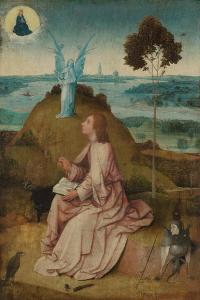
John the Divine, or John the Theologian, was the author of the book of Revelation; he is widely identified (including by me) with St. John the Apostle, though this is disputed. Though it’s pretty confusing to modern audiences, who often lack the background in Jewish apocalyptic theology and imagery that the book takes for granted, I honestly think it’s an artistic achievement of the first order; the structure is elegant, recursive yet avoiding monotony through strategic breaks in its pattern. St. John himself might be higher on this list if he had been martyred, but he’s certainly earned a spot on it by writing Revelation.
12. St. Anthony of Lisbon
Anthony of Lisbon (or of Padua) is best known today as the saint you pray to when you’ve lost something; he was one of the first Franciscans, and famed for his preaching. He makes this list as being a sort of twist on the incorruptible tradition. If you haven’t heard of these, incorruptibles are saints who are found after their death to decay with miraculous slowness, or even not at all. St. Edward the Confessor was one of the first incorruptibles in the West (when he was exhumed two hundred years after his death, he appeared to be sleeping, and the abbot who was in charge of the transfer of his relics had to rebuke one of his monks for tugging the king’s beard!); St. Bernadette, the visionary of Lourdes, is among the most famous. But St. Anthony is a twist, in that he was found incorrupt … but only in his tongue and vocal chords, which were removed for separate veneration, while the rest of his body crumbled into dust.
11. St. Pio
In a list like this, you have to have a stigmatic. The fact that he could read souls, prophesy, levitate, and bilocate does elevate him to an exceptional stature even among stigmatics! He too was a Franciscan; their founder is widely thought to be the first stigmatic (although some interpretations of Galatians 6.17 assign this honor to St. Paul). The blood which flowed from his wounds reputedly smelled sweet, like flowers, and he generally covered his hands with fingerless gloves, even when saying Mass.
10. St. Anthony of Egypt
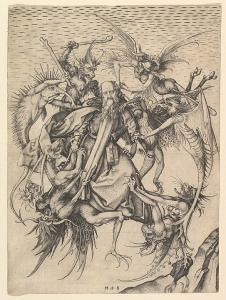
Also known as St. Anthony the Great, he lived from the mid-third to the mid-fourth century, and was perhaps the first Christian to practice the life of a hermit. He lived alone in the desert, where he reputedly spent hours in prayer and fasting, doing battle with demons. Many of his sayings survive, and his life and teaching became a major influence in all subsequent monasticism. The woodcut above, The Temptation of Saint Anthony by Martin Schongauer (executed in the early 1470s), became the basis for an early painting of Michelangelo.
9. St. Januarius
Januarius (Gennaro in Italian) was a bishop martyred during the Diocletian Persecution, around the year 305. According to legend, a woman named Eusebia saved a vial of his blood, which, despite being many centuries old at this point, regularly continues to liquefy to this day. Direct scientific study of St. Januarius’ blood is not possible, as the Church, fearing irreparable damage to the relic, will not permit the vial to be opened; however, the phenomenon of liquefaction is apparently not in dispute, since scientists have advanced a number of theories as to why the blood liquefies. It regularly does so on September 19th, his feast day; December 16th, the celebration of his patronage over Naples; and on the Saturday before the first Sunday of May, the anniversary of his relics being reunited. It also reportedly liquefies “spontaneously” on other occasions. St. Januarius’ blood apparently failed to liquefy last December, which was widely perceived as a bad omen, but resumed its usual “schedule” this year.
8. St. Christina the Astonishing
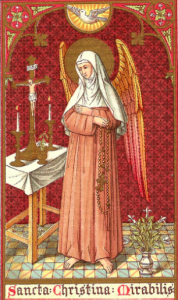
Christina the Astonishing was a Belgian peasant girl who lived in the late twelfth and early thirteenth centuries. Her story is just what you’d expect: she collapsed one day in her early twenties, was thought dead, and was lying in her coffin in church when she sat up and then levitated into the rafters, saying she could not bear the smell of the people’s sins, as one does. She then related a vision she had been given of hell, purgatory, and heaven, and explained that she had been allowed to return to life to do penance for the souls in purgatory. She would throw herself into fires or bathe in the freezing waters of the Meuse in winter, yet always emerged unharmed. She was suspected of being possessed by some, and was jailed twice, but others revered her as a saint even in her own lifetime; she died in 1224 at a Dominican convent, where the prioress reported that, for all her bizarre practices, Christina was always obedient and meek.
7. St. Isaac Jogues
Isaac Jogues is actually celebrated today as one of the “North American Martyrs”—a group of eight Jesuit missionaries to First Nations, principally in Canada and northern New York. Isaac was a priest among the Huron people when he was captured by a Mohawk community; the Mohawk, an Iroquois people, did not wage war to kill, but to capture, often as a way of increasing the numbers of their community. However, this much gentler version of war did not mean that captives were well-treated: torture of these captives, to test whether they were worth accepting as new Mohawks, was frequent. Isaac had hot coals thrown on his body, had his fingernails ripped out and his fingers cut or gnawed off, was beaten and stabbed with sticks, and went underfed and inadequately clothed throughout the severity of winter; all the while he comforted other prisoners, heard their confessions, and baptized them. After a year in captivity, a Dutch trader helped him escape, and the priest returned to Europe—but not for any weaksauce reason like “not wanting to be tortured horribly,” but to get a dispensation from the Pope to say Mass without a thumb and forefingers (as canon law at the time only permitted priests to touch the Host with the thumb and forefinger). This dispensation was granted, and less than two years later, St. Isaac Jogues was serving as a missionary to the Mohawk again. Outbreaks of smallpox and measles from European sources were blamed by the Mohawk on the supposed black magic of the Jesuits, and he was killed with a tomahawk in 1646.
6. St. Denis
His story dates to the third century; St. Denis is famous for being one of the first “cephalophores,” saints traditionally depicted carrying their own heads. He was evangelizing in the area of Paris, and certain local authorities (possibly Druids) didn’t like that, so they took him to the summit of Montmartre and chopped his head off. St. Denis then bent down, picked up his head, and walked away, continuing to preach a sermon for several miles. He was especially popular in the Medieval period, esteemed as one of the Fourteen Holy Helpers.
5. St. Agatha
Agatha is a virgin martyr commemorated in the Roman canon. According to the Golden Legend, she made a vow of celibacy at 15, then considered a highly marriageable age, and spurned the advances of a prefect; he knew she was a Christian, so he turned state authority against her, thinking she would fold. She did not. He tried imprisoning her in a brothel, to no effect; she was then tortured, including having her breasts cut off. She is often depicted carrying her breasts on a plate, which may have inspired or been inspired by the pastry made by Sicilians in her honor, minni di virgini or “virgin’s breasts,” which, well, here’s a tray of them:

4. St. Bartholomew
One of the original Twelve Apostles, Bartholomew (who may have been the same person as Nathanael; Bartholomew is the English version of bar Tolmai, “son of Tolmai”) is honored as one of the founders of the Armenian Apostolic Church; Armenia was the first nation to adopt Christianity as its official religion, doing so between about 301 and 314, during the last and worst of the Roman persecutions. Despite this later success, however, St. Bartholomew himself was exceptionally unlucky in his martyrdom. He often appears with what seems to be some sort of lumpy and voluminous drapery hanging from one hand; that’s his skin, of which he was deprived before being beheaded.
3. St. Lawrence
St. Lawrence had a gift for smart remarks. Lost of people know his most famous line: while being roasted alive, he reportedly told his executioners, “Have a bite, it’s done!” But he got into this situation in the first place with another piece of sass. A local Roman official knew he was a Christian, but offered to ignore it in exchange for a hefty bribe from the Church. Lawrence asked for a three days to gather their riches, which he was granted; he then showed up before the official with a great mass of the poor of Rome and told him, “Here are the riches of the Church.” Despite the example of Cornelia to which the saint may have been alluding, the official was apparently unamused and did some torture instead.
2. St. Joseph, Terror of Demons
This is easily the most badass of St. Joseph’s titles, and appears in the Litany of St. Joseph, which was approved in 1909. It makes sense he would be terrifying to demons—he was one of two people chosen by God to be his own parents, and specifically the man God chose to marry His mother. That certainly suggests a formidable degree of holiness; that is, love, the thing demons can’t stand, like rebellious adolescents. And in fact, I almost put St. Joseph at the top of this list, before learning just recently about a title that’s even more metal than this …
1. St. Mary, Empress of Hell
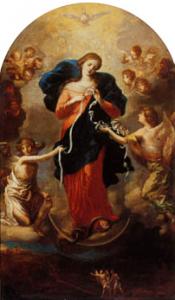
Queen of heaven and queen of angels are commonplace titles of Our Lady. But imagery of the Mother of God trampling on Satan is very old, and the title “Empress of Hell” speaks to that reality; apparently the phrase goes back to St. Alphonsus Liguori. Hell itself has been placed under her feet, as it is beneath her Son’s, and even in calling her the queen of angels, we implicitly say that she has authority over demons, who are after all nothing but evil angels. Halloween itself is, among other things, a ridicule of demons and witchcraft, turning them into a game and an entertainment and a joke, because, as St. Thomas More said, “The prowde spirit cannot endure to be mocked.”
Previous Post

October 6, 2021
Review: "Midnight Mass"
Next Post
October 31, 2021 Sneak Preview: "The Book of Salt"
Browse Our Archives
Select a Category abuse antifascism art bad Catholic celibacy chastity Church crucifixion culture war eros forgiveness gay gender homophobia ikons language liturgy peace poems politics Pope Francis prayer pro-life race recommendations reform repentance review sacraments saints satire scandal schism scripture sex suffering theology Uncategorized violence
Select a Month October 2026 September 2026 August 2026 July 2026 June 2026 May 2026 April 2026 March 2026 February 2026 January 2026 December 2025 November 2025 October 2025 September 2025 August 2025 July 2025 June 2025 May 2025 April 2025 March 2025 February 2025 January 2025 December 2024 November 2024 October 2024 September 2024 August 2024 July 2024 June 2024 May 2024 April 2024 March 2024 February 2024 January 2024 December 2023 November 2023 October 2023 September 2023 August 2023 July 2023 June 2023 May 2023 April 2023 March 2023 February 2023 January 2023 December 2022 November 2022 October 2022 September 2022 August 2022 July 2022 June 2022 May 2022 April 2022 March 2022 February 2022 January 2022 December 2021 November 2021 October 2021 September 2021 August 2021 July 2021 June 2021 May 2021 April 2021 March 2021 February 2021 January 2021 December 2020 November 2020 October 2020 September 2020 August 2020 July 2020 June 2020 May 2020 April 2020 March 2020 February 2020 January 2020 December 2019 November 2019 October 2019 September 2019 August 2019 July 2019
Follow Us!
TAKE THE
Religious Wisdom Quiz
True or False: The Thessalonians were told that the day of the Lord will come like a thief in the night.
Select your answer to see how you score.
FALSE TRUE
Related posts from Mudblood Catholic


Vile Bodies, Part Two: The Dream of Burning...

Vile Bodies, Part One: Give or Take
TRENDING AT PATHEOS Catholic

Letters on Living the Faith by C.S. Lewis
Most of us met C.S. Lewis as a public intellectual. Mere Christianity....

When Halloween Unmasks Married Hearts
Written by Dr. David K. Ewen from Eternal Truth Bible College Behind...

Aristotle. He’s been called the father of logic, the father of the...

Methodist Central Hall and Westminster Abbey
Situated on the same square is Methodist Central Hall and Westminster Abbey. ...

57th Dove Awards Honor Dolly Parton, Crown New...
On gospel music’s biggest night, the 57th annual GMA Dove Awards honored...

The First Eucharistic Controversy: Christ’s Real Presence
For Catholics, the Eucharist is the source and summit of the Christian...
view all Catholic blogs
Ad-Free & Subscriber Log-In Subscription Support
- About Us
- 2026 Calendar
- Videos
- Podcasts
- Library of World Religions
- Faith In Media Tracker
- Advertise With Us
- Write for Us
- Privacy Policy
- Terms of Service
- Do Not Sell My Data
- Contact Us
- Radiant Digital
- Manage Newsletter Subscriptions
- Unsubscribe From Notifications
- Sitemap
Copyright 2008-2026, Patheos. All rights reserved.
Subscription Support Ad-Free & Subscriber Log-In
Follow Patheos