
BuddhistCatholicContemplativeEvangelicalGeneral ChristianHinduJewishLatter-day SaintMuslimNew VisionsProgressive Christian
Beliefs
- Buddhist
- Catholic
- Contemplative
- Evangelical
- General Christian
- Hindu
- Jewish
- Latter-day Saint
- More Voices
- Muslim
- New Visions
- Pagan
- Progressive Christian
Topics
- Religion News
- Food and Religion
- Sports and Religion
- Religious Art
- Religious Music and Entertainment
- Religious Events
- History and Religion
- Style and Religion
- Politics and Religion
- Women in Religion
- Recreation Outdoors and Religion
- Business Finance and Religion
- Careers Workplace and Religion
- Education and Religion
- Family Parenting and Religion
- Health Fitness and Religion
- Home and Religion
- Relationships and Religion
- Technology and Religion
- Travel and Religion
Columnists
- Buddhist Columnists
- Business Finance and Religion Columnists
- Careers Workplace and Religion Columnists
- Catholic Columnists
- Contemplative Columnists
- Education and Religion Columnists
- Evangelists Columnists
- Family Parenting and Religion Columnists
- General Christian Columnists
- Health Fitness and Religion Columnists
- Hindu Columnists
- History and Religion Columnists
- Home and Religion Columnists
- Jewish Columnists
- More Voices Columnists
- Latter Day Columnists
- Muslim Columnists
- New Visions Columnists
- Nonreligious Columnists
- Pagan Columnists
- Politics and Religion Columnists
- Progressive Columnists
- Recreation Outdoors and Religion Columnists
- Relationships and Religion Columnists
- Religion News Columnists
- Religious Art Columnists
- Religious Events Columnists
- Religious Music and Entertainment Columnists
- Sports and Religion Columnists
- Style and Religion Columnists
- Technology and Religion Columnists
- Travel and Religion Columnists
- Women in Religion Columnists
Resource Library
- 2026 Calendar
- Library of World Religions
- The 100 Most Holy Places on Earth
- Patheos Answers
- Podcasts
- Videos
- Faith Leaders Database
- Anglican Episcopalian
- Bahai
- Baptist
- Buddhism
- Christianity
- Confucianism
- Eastern Orthodoxy
- Hinduism
- Holiness and Pentecostal
- ISKCON
- Islam
- Judaism
- Lutheran
- Methodist
- The Church of Jesus Christ of Latter-day Saints
- New Age
- Paganism
- Presbytarian and Reformed
- Protestantism
- Religion Behind the Scenes
- Roman Catholic
- Scientology
- Shia Islam
- Sikhism
- Sufism
- Sunni Islam
- Taoism
- Zen
- See all religions
Research Tools
 Ad-Free & Subscriber Log-In Subscription Support
Ad-Free & Subscriber Log-In Subscription Support
Follow Patheos 

- Trending:
- Forgiveness
- |
- Marriage
- |
- Consciousness
- |
- Death Penalty
- |
- Election
- |
- Halloween

- Home
- Catholic
- Thoughts on National Repentance, Part III: A Sample Case
Thoughts on National Repentance, Part III: A Sample Case
Last updated on: August 6, 2021 at 8:43 pm by Gabriel Blanchard
Thoughts on National Repentance, Part III: A Sample Case 2021-08-06T20:43:47-04:00 Gabriel Blanchard
Patheos Explore the world's faith through different perspectives on religion and spirituality! Patheos has the views of the prevalent religions and spiritualities of the world.
Go here for Part I and Part II.
Repenting of centuries of racism and genocide is not an easy thing to do. Part of the problem is that it’s kind of vague; another is that the things we usually think of here, like the trans-Atlantic slave trade, are far enough in the past that it’s difficult to connect with them on an emotional level. They not only aren’t things we personally did, they aren’t things our grandparents did. Repentance is easier—and harder—when we can focus on something concrete.
Seventy-six years ago, we gave ourselves something very concrete to repent of as a nation. Namely, in a matter of seconds, we obliterated two cities, full of unarmed civilians of both sexes, from the unborn baby to the octogenarian.
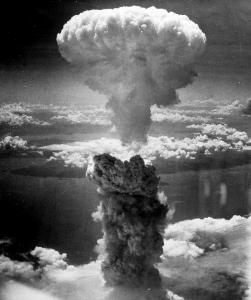
The Bombings Were Sins
It still surprises me a little that so many Catholics in this country are fine with what the US did at Hiroshima and Nagasaki. Part of it’s misinformation, to be sure. For instance, only a few years ago a saw a pious person circulating a nice story about the bombing of Nagasaki in particular; it’s been the center of Japanese Catholicism for hundreds of years, and the bomb hit the ground less than half a mile from Urakami Cathedral. The story stated, correctly, that the cathedral was full, even though it was a weekday—people were getting ready for Assumption in a week and a half. It also said that the people in the cathedral remained safe, hinting that this was a miracle. This is a comforting lie. What actually happened is that the cathedral was destroyed and everyone inside was killed.
What’s surprising is that so many Catholics casually accept these acts, when the bombings are such obvious, textbook violations of the Church’s teaching about justice in war. Some passages in the Catechism read like they were written at the US:
The strict conditions for legitimate defense by military force require rigorous consideration. The gravity of such a decision makes it subject to rigorous conditions of moral legitimacy. … [T]he use of arms must not produce evils and disorders graver than the evil to be eliminated. The power of modern means of destruction weighs very heavily in evaluating this condition. … Non-combatants, wounded soldiers, and prisoners must be respected and treated humanely. Actions deliberately contrary to the law of nations and to its universal principles are crimes, as are the orders that command such actions. … “Every act of war directed to the indiscriminate destruction of whole cities or vast areas with their inhabitants is a crime against God and man, which merits firm and unequivocal condemnation.”1
There’s no ambiguity here. There are no mitigating factors or technical exceptions. It should not be difficult for any Catholic to grasp the implications of this teaching.
The Rationalizations Are Crap
For a Catholic who believes that the Church is the bearer of divine revelation, that should settle the matter. But Americans, papist or not, really don’t like admitting that our country has ever done anything bad. We’re the good guys. So if we did this it must have been good somehow.
The most common justification for the bombings is that it saved lives by ending the war faster. But that’s really not an argument for any act of war; what it’s an argument for is immediate ceasefire on any terms whatever. That really does stop people from killing each other, and it even does it without killing tens of thousands of people and giving the rest radiation poisoning.
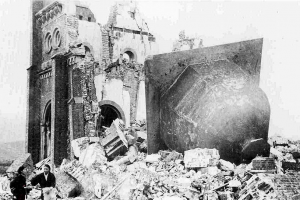
Wreckage of Urakami Cathedral
Then there’s the claim that Japan would never have surrendered, that they would have fought literally to the last man, woman, and child. Setting aside the fact that that’s brain-meltingly unlikely (I’m aware that child soldiers are a thing, but the idea that you could have an entire nation with zero non-soldier children makes me skeptical), the Japanese were probably going to surrender anyway. Their only real ally had been punched in the face so hard the fist came out the back of their skull, and the Soviet Union had just declared war on them, something they’d been counting on avoiding. Contemptible lib-cucks like MacArthur and Eisenhower said, both at the time and afterwards, that the bombings were totally unnecessary. If anything, the Allied insistence on an unconditional surrender from Japan (itself a needlessly humiliating demand that complicated the whole process) prolonged the war more than Japanese stubbornness did.
A lot of people try to bring in Japanese war crimes at this point, as if they have anything to do with this. There isn’t a threshold of awfulness past which it’s okay to do war crimes on them; there isn’t even a threshold of the other guy doing war crimes past which it’s okay. That’s not how evil works.
The Point
Okay, but so what? Am I trying to make people feel guilty about heroizing their granddads or something? Feeling bad about Hiroshima and Nagasaki isn’t going to bring anybody back from the dead.
Of course not. And I’m sure your granddad was a lovely man, but that’s really not what this is about. To approve of an evil act is, itself, evil. It both comes from and causes a warped idea of right and wrong. For Catholics, that is and should be a really big deal.
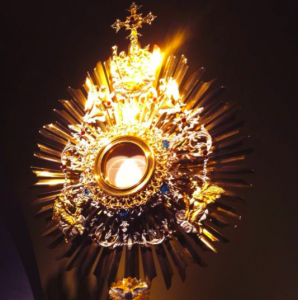
What’s more, Catholics do believe we can do something about the tragedies of history; that’s what the atonement is. We offer reparations in the form of fasts and holy hours and rosaries and so on, because we trust that God, in a mysterious way we rarely understand, will use those things to heal the damage done in the world by evil. Feeling vaguely guilty doesn’t do much good, no; but if we take that opportunity to do penance, we can help bring Christ into those torn-up places.
1Catechism of the Catholic Church §§2309, 2313-2314. The quotation is from Gaudium et Spes, the pastoral constitution on the Church in the modern world from the Second Vatican Council, composed less than twenty years after the atomic bombs were dropped.
Previous Post

July 31, 2021
Review: "The Green Knight"
Next Post
August 11, 2021 Five Quick Takes
Browse Our Archives
Select a Category abuse antifascism art bad Catholic celibacy chastity Church crucifixion culture war eros forgiveness gay gender homophobia ikons language liturgy peace poems politics Pope Francis prayer pro-life race recommendations reform repentance review sacraments saints satire scandal schism scripture sex suffering theology Uncategorized violence
Select a Month October 2026 September 2026 August 2026 July 2026 June 2026 May 2026 April 2026 March 2026 February 2026 January 2026 December 2025 November 2025 October 2025 September 2025 August 2025 July 2025 June 2025 May 2025 April 2025 March 2025 February 2025 January 2025 December 2024 November 2024 October 2024 September 2024 August 2024 July 2024 June 2024 May 2024 April 2024 March 2024 February 2024 January 2024 December 2023 November 2023 October 2023 September 2023 August 2023 July 2023 June 2023 May 2023 April 2023 March 2023 February 2023 January 2023 December 2022 November 2022 October 2022 September 2022 August 2022 July 2022 June 2022 May 2022 April 2022 March 2022 February 2022 January 2022 December 2021 November 2021 October 2021 September 2021 August 2021 July 2021 June 2021 May 2021 April 2021 March 2021 February 2021 January 2021 December 2020 November 2020 October 2020 September 2020 August 2020 July 2020 June 2020 May 2020 April 2020 March 2020 February 2020 January 2020 December 2019 November 2019 October 2019 September 2019 August 2019 July 2019
Follow Us!
TAKE THE
Religious Wisdom Quiz
I am a day when tongues of fire appeared and people spoke in languages they had never learned. Three thousand believed that day. What am I?
Select your answer to see how you score.
Easter Pentecost The Day of Atonement Passover
Related posts from Mudblood Catholic
With My Body, I Thee Worship: Part One



TRENDING AT PATHEOS Catholic

Letters on Living the Faith by C.S. Lewis
Most of us met C.S. Lewis as a public intellectual. Mere Christianity....

When Halloween Unmasks Married Hearts
Written by Dr. David K. Ewen from Eternal Truth Bible College Behind...

Aristotle. He’s been called the father of logic, the father of the...

Methodist Central Hall and Westminster Abbey
Situated on the same square is Methodist Central Hall and Westminster Abbey. ...

57th Dove Awards Honor Dolly Parton, Crown New...
On gospel music’s biggest night, the 57th annual GMA Dove Awards honored...

The First Eucharistic Controversy: Christ’s Real Presence
For Catholics, the Eucharist is the source and summit of the Christian...
view all Catholic blogs
Ad-Free & Subscriber Log-In Subscription Support
- About Us
- 2026 Calendar
- Videos
- Podcasts
- Library of World Religions
- Faith In Media Tracker
- Advertise With Us
- Write for Us
- Privacy Policy
- Terms of Service
- Do Not Sell My Data
- Contact Us
- Radiant Digital
- Manage Newsletter Subscriptions
- Unsubscribe From Notifications
- Sitemap
Copyright 2008-2026, Patheos. All rights reserved.
Subscription Support Ad-Free & Subscriber Log-In
Follow Patheos