
BuddhistCatholicContemplativeEvangelicalGeneral ChristianHinduJewishLatter-day SaintMuslimNew VisionsProgressive Christian
Beliefs
- Buddhist
- Catholic
- Contemplative
- Evangelical
- General Christian
- Hindu
- Jewish
- Latter-day Saint
- More Voices
- Muslim
- New Visions
- Pagan
- Progressive Christian
Topics
- Religion News
- Food and Religion
- Sports and Religion
- Religious Art
- Religious Music and Entertainment
- Religious Events
- History and Religion
- Style and Religion
- Politics and Religion
- Women in Religion
- Recreation Outdoors and Religion
- Business Finance and Religion
- Careers Workplace and Religion
- Education and Religion
- Family Parenting and Religion
- Health Fitness and Religion
- Home and Religion
- Relationships and Religion
- Technology and Religion
- Travel and Religion
Columnists
- Buddhist Columnists
- Business Finance and Religion Columnists
- Careers Workplace and Religion Columnists
- Catholic Columnists
- Contemplative Columnists
- Education and Religion Columnists
- Evangelists Columnists
- Family Parenting and Religion Columnists
- General Christian Columnists
- Health Fitness and Religion Columnists
- Hindu Columnists
- History and Religion Columnists
- Home and Religion Columnists
- Jewish Columnists
- More Voices Columnists
- Latter Day Columnists
- Muslim Columnists
- New Visions Columnists
- Nonreligious Columnists
- Pagan Columnists
- Politics and Religion Columnists
- Progressive Columnists
- Recreation Outdoors and Religion Columnists
- Relationships and Religion Columnists
- Religion News Columnists
- Religious Art Columnists
- Religious Events Columnists
- Religious Music and Entertainment Columnists
- Sports and Religion Columnists
- Style and Religion Columnists
- Technology and Religion Columnists
- Travel and Religion Columnists
- Women in Religion Columnists
Resource Library
- 2026 Calendar
- Library of World Religions
- The 100 Most Holy Places on Earth
- Patheos Answers
- Podcasts
- Videos
- Faith Leaders Database
- Anglican Episcopalian
- Bahai
- Baptist
- Buddhism
- Christianity
- Confucianism
- Eastern Orthodoxy
- Hinduism
- Holiness and Pentecostal
- ISKCON
- Islam
- Judaism
- Lutheran
- Methodist
- The Church of Jesus Christ of Latter-day Saints
- New Age
- Paganism
- Presbytarian and Reformed
- Protestantism
- Religion Behind the Scenes
- Roman Catholic
- Scientology
- Shia Islam
- Sikhism
- Sufism
- Sunni Islam
- Taoism
- Zen
- See all religions
Research Tools
 Ad-Free & Subscriber Log-In Subscription Support
Ad-Free & Subscriber Log-In Subscription Support
Follow Patheos 

- Trending:
- Forgiveness
- |
- Marriage
- |
- Consciousness
- |
- Death Penalty
- |
- Election
- |
- Halloween

- Home
- Catholic
- Review: “The Green Knight”
Review: “The Green Knight”
Last updated on: August 1, 2021 at 12:06 am by Gabriel Blanchard
Review: “The Green Knight” 2021-08-01T00:06:29-04:00 Gabriel Blanchard
Patheos Explore the world's faith through different perspectives on religion and spirituality! Patheos has the views of the prevalent religions and spiritualities of the world.
Arthuriana
I have always loved the Arthurian cycle. It has everything: history, magic, chivalry, romance, tragedy, and the greatest relic in Christendom. And the mysterious ending, the king who has disappeared but not died, is perfect. Charles Williams’ Taliessin Through Logres and The Region of the Summer Stars are some of my favorite books of poetry, as well as my favorite Arthurian literature.
Arthurian films, in my experience, are generally something of a disappointment. I want to like them. But they tend to be either over-the-top and goofy, like Excalibur, or try too hard for the historical angle and rip out all the magical and sacred content, like 2004’s King Arthur. The one really satisfying Arthurian movie I can think of is The Sword in the Stone, and that only covers Arthur’s childhood with Merlin.
Literally Who?
The Green Knight (so named because his hair and skin, as well as his clothes and armor, are green) is a particularly weird figure in the mythos. The story comes from a single manuscript from the late fourteenth century, Sir Gawayn and the Grene Knyght. Gawain has a long history; before Lancelot and later Galahad were invented, Gawain was the knight with the greatest military prowess. He is also Arthur’s nephew, son of his half-sister Morgause (some later versions, including this film, combine her with Morgan le Fay, Arthur’s other half-sister).
Synopsis of the Original
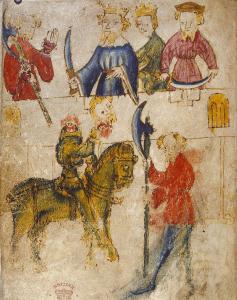
On Christmas Day, the mysterious Green Knight comes to Camelot and proposes a game: any knight present may take his axe and deal him any blow they desire. However, they must agree to come to his residence (the Green Chapel) one year later and accept the same blow in turn. Gawain accepts the challenge and strikes off the stranger’s head. The Green Knight then picks up his head, reminds Gawain of his promise, and rides off.
One year later, Gawain rides out to fulfill his vow. On his way he comes to the castle of Lord Bercilak, who says the Green Chapel is close by and invites him to rest there before meeting the Green Knight. Bercilak proposes a game: for the next three days, whatever he wins out hunting, he will exchange it for anything Gawain may win staying at the castle. Gawain accepts. His wife tries each morning to seduce Gawain, but he refuses her; each evening, Bercilak brings home his kill, and Gawain in return gives him a kiss. But on the third morning, Bercilak’s wife begs Gawain to take her enchanted green sash, which will protect him from all physical harm. He accepts, and conceals the gift from Bercilak, too afraid of dying to surrender it.
The next morning he meets the Green Knight, who feints twice to test Gawain’s nerve, but lets the third blow fall—and barely nicks his neck. The Green Knight now reveals that he is Bercilak, put under a spell by Morgan le Fay, who wanted to test Arthur’s knights and also frighten Guinevere to death. Ashamed of his deceit and cowardice, Gawain confesses to using the sash, but Bercilak laughs and says he is the most blameless knight in the realm. The end.
Sounds … Fun?
It’s an extremely weird story, even for a Medieval fairy-tale. That this hot nonsense was Morgan’s evil plan makes it seem like the Green Knight must be an older figure, perhaps from some forgotten branch of Celtic myth, whom the author jammed in and then needed to integrate into the larger cycle somehow. In some ways that makes it an obvious pick for film adaptation. The Arthurian cycle as a whole is too long for a single movie—ignoring this was one of Excalibur‘s many mistakes. The Green Knight episode is compact enough to work, and the backstory is vague enough that you can do almost anything you want with the premise.
So how’d they do?
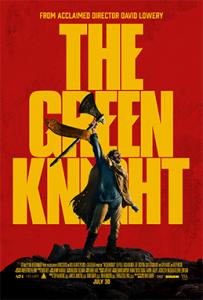
Image provided for under fair use.
The Strong Points
I mean, the popcorn was good.
Okay, that’s underselling it. There are some things I really liked about the film. Some of the costumes and makeup choices were really good; the sun-crowns Arthur and Guinevere wore were particularly striking (which the designers clearly knew, since they’re all over the trailers). Some of the music was quite lovely too, with a weird dissonance that supported the tone they were clearly going for. The depiction of Morgan1 casting her spell at the beginning was really good—only a few special effect flourishes, relying more on creepy ingredients like teeth and sinister chanting from Morgan’s maids. Dev Patel and Ralph Ineson, who carry most of the film, were fine. There was also a shot I loved at the beginning of Gawain’s stay in Bercilak’s2 castle, looking down on him from a great height, asleep in a four-poster bed enclosed by curtains on all sides; it lends a delicious claustrophobia to the scene.
Warning: the paragraph below contains spoilers.
The structure of the film, at least in the second half, is also pretty good. Most of the last half-hour is a sort of “last temptation of Christ” type thing: Gawain breaks his promise and runs away from the Green Chapel, returning to Camelot, and ultimately becoming king after Arthur’s death. Finally, as his realm is collapsing around him, he removes the sash (which he has been wearing ever since) and his head falls off. All of this is played straight, but then, at the end, it’s revealed that it was a fantasy that flashed through his mind after the second blow. Before the Green Knight strikes for the third time, Gawain tells him to wait—and removes the sash. And there, ambiguously, the film ends. That part is a really strong move, and I applaud David Lowery for going for it.
The Weak Points
Unfortunately, the bad aspects dragged the good ones down pretty, uh, badly. The dialogue is forgettably mediocre, but that doesn’t kill a film—Gladiator had a pretty weak script, but the plot as such worked fine and the acting and directing were superb, so you hardly notice the bad dialogue unless you pay deliberate attention. Unfortunately for The Green Knight, while Patel and Ineson are fine, most of the other actors are noticeably weaker and thus expose the bad writing.
I mentioned that I liked one shot; that’s partly because I didn’t like almost any of the other ones. The cinematography drew attention to itself in a number of annoying ways, from random upside-down or twisting shots that had no clear motivation, to the fact that half the movie was so dark you couldn’t see anything, to the fact that half the parts you could see were done in that weird pale grey-wash that every movie in the mid-2000s had.
The film was also stuffed to the gills with weird stuff that didn’t go anywhere (which did nothing to help its abysmal pacing). Near the beginning, when an enchanted letter arrives for King Arthur, Guinevere stops him and opens it, and her eyes glow green and she does the “voice of Legion” thing as she reads it aloud. Is Guinevere a witch too? Has she been cursed? We never find out, and it never happens again! There’s a bad CGI talking fox that accompanies the protagonist part of the way, whose identity and motives are never made clear. There’s a pair of bewildering subplots in the front half, one about some bandits who rob Gawain and the other about a ghost who begs Gawain to fetch her head out of a spring for her. The former adds nothing except a baffling moment in which one bandit says he’s going to go fulfill Gawain’s quest for him; this does not come back in any way later in the film. The latter plot cul-de-sac actively makes things worse, as the ghost tells Gawain “The Green Knight is someone you know.” Who? We never find out, and it’s never mentioned again! Different actors play Bercilak and the Green Knight, which suggests she doesn’t mean that—and in fact she couldn’t mean that, because he hasn’t met Bercilak yet!
Motivation is also sorely lacking for, uh, everyone. Gawain isn’t yet a knight at all in this version, and they’re clearly trying to set him up as being on a quest for honor. Okay; what is this version’s concept of what honor means? No one explains it, not even Arthur (who delivers a bunch of clunky, irrelevant exposition near the start of the film). Why does Morgan summon the Green Knight when she is Arthur’s own sister? Is she nursing a grudge, or power-hungry, or what? Presumably her motives also govern the Green Knight’s behavior—unless he is meant to be Bercilak, and they just kind of have different actors playing the two roles for no reason? Bercilak’s wife does try to seduce Gawain, but judging from her dialogue, she’s more interested in corrupting or discouraging him than in just breaking off a piece. Okay, fine, but why? What reason does she have to be invested in this? Say it with me now: we never find out, and it never comes up again.
Of course, a lot of the weird things in the film, including Morgan’s plan, are partly an inheritance from the original. But what works for an eerie fairy-tale in writing doesn’t necessarily work on a screen. And to be honest, it isn’t clear that it really worked in writing, either. Lowery had a chance to lend Morgan a lot more force by articulating or at least hinting at her motive, and he didn’t take advantage of the opportunity. That particularly weakens a film, because films have a really low threshold for the suspension of disbelief: the audio and visual components are happening in front of you, in real time, and special effects can make things look literally real instead of just symbolically real. A book can afford to be a lot vaguer, because so much more depends on the audience filling in the details with their imaginations. A movie has to be more explicit and direct, and The Green Knight largely isn’t.
Warning: the paragraphs below contain gross sex things.
The worst parts were two extremely weird sexual scenes. As in the original story, Bercilak’s wife tries to seduce Gawain; in this version, she succeeds. Again, fine—it’s clearly meant to be a flaw in the world of the film, and heroes having flaws (especially flaws related to the plot or theme) is a good thing. But this then leads to two seriously baffling consequences. One is a scene in which Gawain, ashamed of his adultery, flees to the Green Chapel early, before his game with Bercilak is complete. Bercilak meets him in the forest, and vaguely implies that he knows about Gawain’s unchastity; then the film’s version of the kisses takes place. I think it’s supposed to be a little homoerotic? But I’m sorry, not even the outstanding snack that is Dev Patel can make Joel Edgerton’s weak chin and little rat eyes attractive to me, and it has a seriously creepy vibe that I’m not sure was deliberate.
But the worst part is the seduction itself and the handover of the sash. It’s very oddly shot, and I think what Gawain and Bercilak’s wife share is meant to be not sex per se but a handjob? Whatever precisely happens, here’s what shouldn’t have happened: no one wants to see Dev Patel’s sash-holdin’ hand covered in fresh jism. Nobody wants this! Why did you show it to us, David Lowery? Why did you think this would enrich our lives? It adds nothing! It’s just gross!
Should You Go See It?
Nah, don’t bother. I wouldn’t call it garbage exactly; there are parts of it that work; but the piece as a whole just isn’t worth the time. I think Lowery has plenty of potential as a director, but uh, he still needs to grow into it. That, or he might become the next Joel Schumacher, if he and we are unlucky.
1In my original release of this review, I identified Gawain’s mother in the film as Morgause, as she is in the original sources. However, imdb identifies her merely as “Mother,” and the Wikipedia page on the film calls her “Mother/Morgan,” so apparently Lowery is using one of the later forms of the mythos.
2Bercilak is not named as such in the film; I use the name here for convenience. (Bercilak’s wife is named neither in the film nor in Sir Gawayn and the Grene Knyght.)
Previous Post

July 23, 2021
"I Confess" Versus "Rear Window"
Next Post
August 6, 2021 Thoughts on National Repentance, Part III: A Sample Case
Browse Our Archives
Select a Category abuse antifascism art bad Catholic celibacy chastity Church crucifixion culture war eros forgiveness gay gender homophobia ikons language liturgy peace poems politics Pope Francis prayer pro-life race recommendations reform repentance review sacraments saints satire scandal schism scripture sex suffering theology Uncategorized violence
Select a Month October 2026 September 2026 August 2026 July 2026 June 2026 May 2026 April 2026 March 2026 February 2026 January 2026 December 2025 November 2025 October 2025 September 2025 August 2025 July 2025 June 2025 May 2025 April 2025 March 2025 February 2025 January 2025 December 2024 November 2024 October 2024 September 2024 August 2024 July 2024 June 2024 May 2024 April 2024 March 2024 February 2024 January 2024 December 2023 November 2023 October 2023 September 2023 August 2023 July 2023 June 2023 May 2023 April 2023 March 2023 February 2023 January 2023 December 2022 November 2022 October 2022 September 2022 August 2022 July 2022 June 2022 May 2022 April 2022 March 2022 February 2022 January 2022 December 2021 November 2021 October 2021 September 2021 August 2021 July 2021 June 2021 May 2021 April 2021 March 2021 February 2021 January 2021 December 2020 November 2020 October 2020 September 2020 August 2020 July 2020 June 2020 May 2020 April 2020 March 2020 February 2020 January 2020 December 2019 November 2019 October 2019 September 2019 August 2019 July 2019
Follow Us!
TAKE THE
Religious Wisdom Quiz
Whom did Paul leave sick at Miletus, showing that early Christians sometimes suffered illness?
Select your answer to see how you score.
Silas Timothy Barnabas Trophimus
Related posts from Mudblood Catholic



TRENDING AT PATHEOS Catholic

When Halloween Unmasks Married Hearts
Written by Dr. David K. Ewen from Eternal Truth Bible College Behind...

Aristotle. He’s been called the father of logic, the father of the...

Methodist Central Hall and Westminster Abbey
Situated on the same square is Methodist Central Hall and Westminster Abbey. ...

57th Dove Awards Honor Dolly Parton, Crown New...
On gospel music’s biggest night, the 57th annual GMA Dove Awards honored...

The First Eucharistic Controversy: Christ’s Real Presence
For Catholics, the Eucharist is the source and summit of the Christian...

What a Stop Sign Can Teach Us About...
How to Make a Decision When You Can't Hear God Main point:...
view all Catholic blogs
Ad-Free & Subscriber Log-In Subscription Support
- About Us
- 2026 Calendar
- Videos
- Podcasts
- Library of World Religions
- Faith In Media Tracker
- Advertise With Us
- Write for Us
- Privacy Policy
- Terms of Service
- Do Not Sell My Data
- Contact Us
- Radiant Digital
- Manage Newsletter Subscriptions
- Unsubscribe From Notifications
- Sitemap
Copyright 2008-2026, Patheos. All rights reserved.
Subscription Support Ad-Free & Subscriber Log-In
Follow Patheos