
BuddhistCatholicContemplativeEvangelicalGeneral ChristianHinduJewishLatter-day SaintMuslimNew VisionsProgressive Christian
Beliefs
- Buddhist
- Catholic
- Contemplative
- Evangelical
- General Christian
- Hindu
- Jewish
- Latter-day Saint
- More Voices
- Muslim
- New Visions
- Pagan
- Progressive Christian
Topics
- Religion News
- Food and Religion
- Sports and Religion
- Religious Art
- Religious Music and Entertainment
- Religious Events
- History and Religion
- Style and Religion
- Politics and Religion
- Women in Religion
- Recreation Outdoors and Religion
- Business Finance and Religion
- Careers Workplace and Religion
- Education and Religion
- Family Parenting and Religion
- Health Fitness and Religion
- Home and Religion
- Relationships and Religion
- Technology and Religion
- Travel and Religion
Columnists
- Buddhist Columnists
- Business Finance and Religion Columnists
- Careers Workplace and Religion Columnists
- Catholic Columnists
- Contemplative Columnists
- Education and Religion Columnists
- Evangelists Columnists
- Family Parenting and Religion Columnists
- General Christian Columnists
- Health Fitness and Religion Columnists
- Hindu Columnists
- History and Religion Columnists
- Home and Religion Columnists
- Jewish Columnists
- More Voices Columnists
- Latter Day Columnists
- Muslim Columnists
- New Visions Columnists
- Nonreligious Columnists
- Pagan Columnists
- Politics and Religion Columnists
- Progressive Columnists
- Recreation Outdoors and Religion Columnists
- Relationships and Religion Columnists
- Religion News Columnists
- Religious Art Columnists
- Religious Events Columnists
- Religious Music and Entertainment Columnists
- Sports and Religion Columnists
- Style and Religion Columnists
- Technology and Religion Columnists
- Travel and Religion Columnists
- Women in Religion Columnists
Resource Library
- 2026 Calendar
- Library of World Religions
- The 100 Most Holy Places on Earth
- Patheos Answers
- Podcasts
- Videos
- Faith Leaders Database
- Anglican Episcopalian
- Bahai
- Baptist
- Buddhism
- Christianity
- Confucianism
- Eastern Orthodoxy
- Hinduism
- Holiness and Pentecostal
- ISKCON
- Islam
- Judaism
- Lutheran
- Methodist
- The Church of Jesus Christ of Latter-day Saints
- New Age
- Paganism
- Presbytarian and Reformed
- Protestantism
- Religion Behind the Scenes
- Roman Catholic
- Scientology
- Shia Islam
- Sikhism
- Sufism
- Sunni Islam
- Taoism
- Zen
- See all religions
Research Tools
 Ad-Free & Subscriber Log-In Subscription Support
Ad-Free & Subscriber Log-In Subscription Support
Follow Patheos 

- Trending:
- Forgiveness
- |
- Marriage
- |
- Consciousness
- |
- Death Penalty
- |
- Election
- |
- Halloween

- Home
- Catholic
- FASH 103: Infiltration
FASH 103: Infiltration
Last updated on: February 13, 2021 at 12:14 pm by Gabriel Blanchard
FASH 103: Infiltration 2021-02-13T12:14:35-04:00 Gabriel Blanchard
Patheos Explore the world's faith through different perspectives on religion and spirituality! Patheos has the views of the prevalent religions and spiritualities of the world.
Earlier assignments in this course: I Can’t Believe It’s Not Fascism, Good Country Volk
There are a few traits that fascism and Catholicism share (or seem to share) that can make Catholics easy prey to fascist propaganda. These vary a little, depending on the time and place the fascists are operating in. Here are six key ones.
1. Heritage

Both Catholicism and fascism lay great emphasis upon what we have inherited from the past. Catholics believe in a sacred tradition of beliefs and sacraments, sustained by a lineage of priests that can trace themselves back thousands of years. Fascists believe in a racial identity—sometimes concentrated into something specific like being “Aryan” or “Nordic,” often just “white”—that has a heroic history behind it and a destiny before it. The fact that a lot of motifs (like crosses) fit easily into the paraphernalia of both groups certainly helps.
Nonetheless, there are subtle yet vital differences. Note, for instance, the difference between “heritage” and “tradition.” Heritage implies something you have a right to, based on your family. Tradition suggests something closer to an idea (or even a story), passed on from one generation to the next, yes, but not necessarily with the restrictions a heritage might carry.
In the US, there’s also a slight catch with this one, at least in theory. In terms of culture and history, this country is overwhelmingly Protestant, and harbors a lot of anti-Catholicism. (Besides Blacks and Jews, Catholics were a common target of the Klan.) However, plenty of fascists are capable of putting anti-Catholicism on the back burner, at least long enough to recruit Catholics.
2. Style
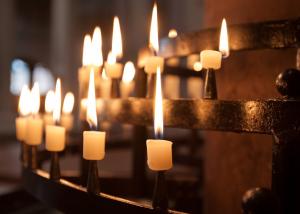
I chose the word style instead of beauty here. Some fascist motifs, like some Catholic relics, are rather ugly. However, they’re ugly in a way that commands attention. Fascists operate on, and often have a good grasp of, the importance of æsthetics. Nazi propaganda against Jews and “degenerates” was not meant to be attractive, but it was meant to be eye-catching; beautiful might feel like the wrong word for Hugo Boss, but stylish or sexy would definitely do. The point of all this is that it encourages emotions that fit comfortably with fascist rhetoric. Stirring up hatred against your Jewish neighbor works a lot better if, when you look at him, you’re imagining a hunchbacked, smiling figure with a giant hooked nose who seems at once vile and ridiculous. Images bypass reason pretty easily, and most people have not been trained to reason well in the first place.
Obviously, Catholicism has similar ties to æsthetics. Art and ritual are key to Catholic life, worship, and thought, and the Catholic “brand” is pretty recognizable. The role of the Middle Ages—to be more accurate, the role of how we today imagine the Middle Ages—is also important. It’s attractive to a certain kind of Catholic because it represents an age when Europe was Catholic; it’s attractive to fascists because it represents an age when Europe was white.1
Note, an accent on style is not itself bad. Every movement, school, idea, or institution that has any appreciable social success and history is going to have a style; that’s how human beings are. What is bad is when (a) æsthetics replace thought, and/or (b) they promote something that is false, destructive, or toxic. If you fill a high-end wine bottle with arsenic, the wine bottle is not the real problem: the relationship between the bottle and its contents is the problem.
3. Family

The culture war for the last forty years has been about two main things, gay marriage and abortion. Catholic teaching on the right to life and the nature of marriage sets them in opposition to both these things. Non-fascist conservatives, Catholic or not, tend to frame both of these issues in terms of family values (and the GOP has made a decreasingly convincing pretense of caring about these family values, as a way to secure themselves a voting bloc).
Fascists also tend to hate these things, but for different reasons. Racism and paranoia tend to go hand in hand, and, as we discussed briefly last time, a standard element of fascism is the belief that the “white race” is in danger of extinction. Therefore, fascists typically object to both abortion and non-procreative sexuality (including celibacy), if we’re talking about white people. But, if they’re talking to a Catholic, they’re going to stress the superficial agreement and not mention the racial qualifier.
4. Authority
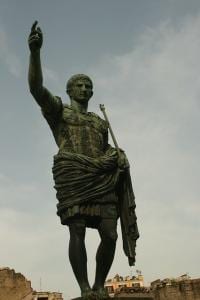
The Catholic Church obviously has kind of an authority thing. Christ, who was literally God, gave authority to the apostles; bishops are the apostles’s heirs, and the prince of bishops, the Pope, is infallible.2 The power to define religious and moral truth, in a way that (according to the Church) has the right to shape the consciences of others, is colossal. And let’s face it: having an authority feels really nice sometimes. It gives you a sense of security, safety, discipline, and purpose.
Fascism has the same atmosphere. The difference is that the atmosphere comes first. Authority in fascist groups usually comes from personal charisma, not institutional procedure. (Incidentally, this is partly why fascists can so handily manipulate democratic societies; it’s easy to win elections of charisma, and once you’re in power it’s usually easy to tweak the very structures of institutions to align with your goals.) But people who are hungry for an authority figure don’t tend to care a lot about procedures. The hunger is an emotional need, not an idea.
5. Conspiracies
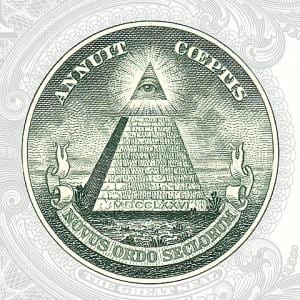
Catholics and fascists both have a long history of scapegoating certain groups of people. Conveniently enough, they are in several cases the same groups of people: Freemasons, Jews, and (occasionally, as a treat) capitalists.
Catholics do this partly for ideological reasons. The theological basis of Christianity, the Incarnation, is something that most Jews reject; Masonry tends to be indifferentist about religion; and, though this is a well-kept secret in the US, the Church rejects capitalism. But there is also just the normal human tendency to blame other people for problems, and to believe that people you don’t like dislike you back. Rationalization and self-justification are among man’s most enduring and universal hobbies.
This doesn’t make Catholicism inherently conspiratorial. The Church teaches that certain ideas are wrong, but she does not teach that specific groups of people are to blame.3
But fascists do. Jews and non-white races are, they claim, conspiring against white people. Fascism not only inflames the human taste for witch hunts, but plays on the witch-hunting past of Catholicism, trying to paint it in the most positive light possible: first by downplaying it (“No one’s saying the Holocaust didn’t happen, it just wasn’t six million people”), then by excusing it (“In a way, the Crusades were self-defense”), ultimately by glorifying it (“Franco brought Spain back from the brink of atheism”).
6. Heroism
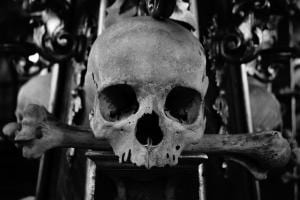
There was much merriment on Twitter a while back when someone contemptuously described Catholicism as a “gold-encrusted death cult.” Sounds badass, right? Well, there’s a double edge here.
The Catholic version of being badass finds its pinnacle in martyrdom—dying for faith, hope, and love. The cult of the saints memorializes them, and a lot of macabre elements in Catholicism come in through their stories and relics.
The fascist, however, has a cult of the warrior. Death in battle is the ideal: a death for nation, destiny, and glory. The warrior and the martyr are superficially similar in their courage and (in a sense) their selflessness. If you frame the warrior as defending his people—whether he really is or not makes no difference—you can even get the images of warrior and martyr to coalesce. And this, again, has a long history in Catholic culture, starting with the Crusades and the Reconquista. It’s easy to make fascistic violence morally plausible by framing it in these terms.
Later assignments: Children of the Sun, “The Great Replacement”
Footnotes
1Both of these ideas are somewhat mythical. It’s true that Catholicism was culturally and politically powerful in the Middle Ages, but Christians then as now were incessantly complaining about the shocking decline of religion. As for race, it’s true that Europe was less diverse. But there is no time in recorded history when any society was completely homogeneous, racially or otherwise. And any “white” person from the Mediæval period would have laughed in your face if you’d told them that the English and the Irish were “the same race,” let alone peoples more distant.
2Under specific conditions, yes, but even that is a pretty shocking assertion.
3I say this not to minimize the real damaging conduct of many prelates, but simply to distinguish that conduct from the belief of Catholics.
Previous Post

January 22, 2021
The Future of the Pro-Life Movement
Next Post
February 2, 2021 FASH 104: Children of the Sun
Browse Our Archives
Select a Category abuse antifascism art bad Catholic celibacy chastity Church crucifixion culture war eros forgiveness gay gender homophobia ikons language liturgy peace poems politics Pope Francis prayer pro-life race recommendations reform repentance review sacraments saints satire scandal schism scripture sex suffering theology Uncategorized violence
Select a Month October 2026 September 2026 August 2026 July 2026 June 2026 May 2026 April 2026 March 2026 February 2026 January 2026 December 2025 November 2025 October 2025 September 2025 August 2025 July 2025 June 2025 May 2025 April 2025 March 2025 February 2025 January 2025 December 2024 November 2024 October 2024 September 2024 August 2024 July 2024 June 2024 May 2024 April 2024 March 2024 February 2024 January 2024 December 2023 November 2023 October 2023 September 2023 August 2023 July 2023 June 2023 May 2023 April 2023 March 2023 February 2023 January 2023 December 2022 November 2022 October 2022 September 2022 August 2022 July 2022 June 2022 May 2022 April 2022 March 2022 February 2022 January 2022 December 2021 November 2021 October 2021 September 2021 August 2021 July 2021 June 2021 May 2021 April 2021 March 2021 February 2021 January 2021 December 2020 November 2020 October 2020 September 2020 August 2020 July 2020 June 2020 May 2020 April 2020 March 2020 February 2020 January 2020 December 2019 November 2019 October 2019 September 2019 August 2019 July 2019
Follow Us!
TAKE THE
Religious Wisdom Quiz
Why did God command the Israelites to eat unleavened bread?
Select your answer to see how you score.
It was a symbol of humility It was the only bread they knew how to make Yeast was considered unclean They had to leave Egypt quickly
Related posts from Mudblood Catholic

With My Body, I Thee Worship: Part Two

With My Body, I Thee Worship: Part One

TRENDING AT PATHEOS Catholic

Letters on Living the Faith by C.S. Lewis
Most of us met C.S. Lewis as a public intellectual. Mere Christianity....

When Halloween Unmasks Married Hearts
Written by Dr. David K. Ewen from Eternal Truth Bible College Behind...

Aristotle. He’s been called the father of logic, the father of the...

Methodist Central Hall and Westminster Abbey
Situated on the same square is Methodist Central Hall and Westminster Abbey. ...

57th Dove Awards Honor Dolly Parton, Crown New...
On gospel music’s biggest night, the 57th annual GMA Dove Awards honored...

The First Eucharistic Controversy: Christ’s Real Presence
For Catholics, the Eucharist is the source and summit of the Christian...
view all Catholic blogs
Ad-Free & Subscriber Log-In Subscription Support
- About Us
- 2026 Calendar
- Videos
- Podcasts
- Library of World Religions
- Faith In Media Tracker
- Advertise With Us
- Write for Us
- Privacy Policy
- Terms of Service
- Do Not Sell My Data
- Contact Us
- Radiant Digital
- Manage Newsletter Subscriptions
- Unsubscribe From Notifications
- Sitemap
Copyright 2008-2026, Patheos. All rights reserved.
Subscription Support Ad-Free & Subscriber Log-In
Follow Patheos