
BuddhistCatholicContemplativeEvangelicalGeneral ChristianHinduJewishLatter-day SaintMuslimNew VisionsProgressive Christian
Beliefs
- Buddhist
- Catholic
- Contemplative
- Evangelical
- General Christian
- Hindu
- Jewish
- Latter-day Saint
- More Voices
- Muslim
- New Visions
- Pagan
- Progressive Christian
Topics
- Religion News
- Food and Religion
- Sports and Religion
- Religious Art
- Religious Music and Entertainment
- Religious Events
- History and Religion
- Style and Religion
- Politics and Religion
- Women in Religion
- Recreation Outdoors and Religion
- Business Finance and Religion
- Careers Workplace and Religion
- Education and Religion
- Family Parenting and Religion
- Health Fitness and Religion
- Home and Religion
- Relationships and Religion
- Technology and Religion
- Travel and Religion
Columnists
- Buddhist Columnists
- Business Finance and Religion Columnists
- Careers Workplace and Religion Columnists
- Catholic Columnists
- Contemplative Columnists
- Education and Religion Columnists
- Evangelists Columnists
- Family Parenting and Religion Columnists
- General Christian Columnists
- Health Fitness and Religion Columnists
- Hindu Columnists
- History and Religion Columnists
- Home and Religion Columnists
- Jewish Columnists
- More Voices Columnists
- Latter Day Columnists
- Muslim Columnists
- New Visions Columnists
- Nonreligious Columnists
- Pagan Columnists
- Politics and Religion Columnists
- Progressive Columnists
- Recreation Outdoors and Religion Columnists
- Relationships and Religion Columnists
- Religion News Columnists
- Religious Art Columnists
- Religious Events Columnists
- Religious Music and Entertainment Columnists
- Sports and Religion Columnists
- Style and Religion Columnists
- Technology and Religion Columnists
- Travel and Religion Columnists
- Women in Religion Columnists
Resource Library
- 2026 Calendar
- Library of World Religions
- The 100 Most Holy Places on Earth
- Patheos Answers
- Podcasts
- Videos
- Faith Leaders Database
- Anglican Episcopalian
- Bahai
- Baptist
- Buddhism
- Christianity
- Confucianism
- Eastern Orthodoxy
- Hinduism
- Holiness and Pentecostal
- ISKCON
- Islam
- Judaism
- Lutheran
- Methodist
- The Church of Jesus Christ of Latter-day Saints
- New Age
- Paganism
- Presbytarian and Reformed
- Protestantism
- Religion Behind the Scenes
- Roman Catholic
- Scientology
- Shia Islam
- Sikhism
- Sufism
- Sunni Islam
- Taoism
- Zen
- See all religions
Research Tools
 Ad-Free & Subscriber Log-In Subscription Support
Ad-Free & Subscriber Log-In Subscription Support
Follow Patheos 

- Trending:
- Forgiveness
- |
- Marriage
- |
- Consciousness
- |
- Death Penalty
- |
- Election
- |
- Halloween

- Home
- Catholic
- Freedom of Screech, Part One
Freedom of Screech, Part One
Last updated on: July 17, 2020 at 9:49 pm by Gabriel Blanchard
Freedom of Screech, Part One 2020-07-17T21:49:23-04:00 Gabriel Blanchard
Patheos Explore the world's faith through different perspectives on religion and spirituality! Patheos has the views of the prevalent religions and spiritualities of the world.
The recent Harper’s Letter and Bari Weiss’ resignation from the New York Times have everybody talking about how cancel culture, and the Left in general, are endangering free speech. These next two posts are about why that’s fucking stupid. I’m going to try and approach things solely from the perspective of a classical Liberal in this first post, and get into some of the free speech issues that leftists are concerned with in my next.

Forward, men, and water the tree of liberty with the tears of bloggers
First of all, what is the right to free speech in the first place? The text of the First Amendment states the following: “Congress shall make no law … abridging the freedom of speech, or of the press”. Now, strictly speaking, this doesn’t even forbid the states from making such a law, it just says Congress can’t—but obviously no one is gunning for that interpretation. The gist that most of us (including me) accept and support is that the government, at whatever level, has no right to punish anyone for expressing their beliefs. 1
But this is a legal matter. It does not apply to non-government institutions or social mores; it isn’t designed to. Colleges, businesses, charities, religious organizations, and so forth frequently have codes of conduct, including codes of permissible speech, that not only employees but even patrons may be expected to abide by, and these are not infringements of the constitutional right to free speech, because these organizations aren’t the government. A few years ago, when the new hotness was Milo Yiannopoulos getting blackballed from speaking events at colleges, I was still a classical liberal, yet I had no objection to what was happening. Why? Because neither he nor anyone else has a right to appear at a private institution and give a lecture. He’s free to express his views, but he does not have the right to demand that another person or institution host those views. We might think it’s shitty or hypocritical or cowardly for a college to make such a refusal, since they’re supposed to be about free inquiry—but being shitty or hypocritical or cowardly is not, in itself, relevant to the free speech issue. And when we come to things like social media platforms of publications, they have posting standards and content guidelines; they always have. You can’t post porn on YouTube; you can’t tell people to kill themselves on Twitter (not in theory, anyway); the New York Times, even at its free-speechiest, isn’t likely to publish an op-ed advocating the right for adult men to have sex with preteen boys. The people who own those platforms don’t owe you the use of them. Hell, they can ban you if you violate their rules egregiously or persistently enough. Everyone has a right to free speech, but nobody has an inherent right to a megaphone. If you want a megaphone, and you can’t persuade anybody to let you use theirs, then buy one yourself.
Now, when we’re talking about something like social media or print publication, telling somebody to “buy their own megaphone” by designing their own social media platform or founding their own publishing company is obviously pretty prohibitive. It takes a lot of money to do those things, which means that only powerful people (which usually means the rich here), or people backed by the powerful, are likely to be able to. Which results in practical limits on the principle of free speech. But is that the public’s problem? Is the state responsible to promote your voice as well as protect it? A classical Liberal would certainly say “No” to both questions. A leftist might say the same, but they’d also draw attention to the way this illustrates how wealth and power influence our ideas and our culture—points of analysis I’ll be returning to in my next.
But above all, the obnoxious thing about the Harper’s Letter, and Bari Weiss’ resignation post, and in fact most complaints about cancel culture, is that being criticized is not being silenced. I am not the first person to note the irony that the signatories of the Harper’s Letter include some of the most successful, prominent writers in the English-speaking world, from Malcolm Gladwell to J. K. Rowling. Yeah, the left-wing cancellers have really ruined you guys—no one will publish you or employ you or even let you use your Twitter account, with all their … telling you you’re wrong. That’s what a censorship is, right? It’s when people say you’re wrong?
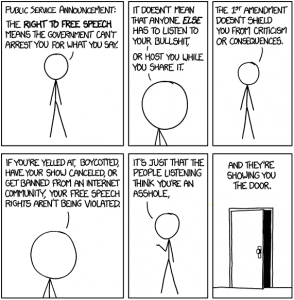
xkcd 1357: Free Speech, by Randall Munroe
I don’t mean to minimize the real harm that targeted harassment can do. I’ve been harassed online myself, and it can take a real toll on your mental health. But most complaints made against “cancel culture”—aside from some I’ve seen made by leftists who explicitly support deplatforming problematic views as a legitimate tactic—are so vague that it’s difficult to take them seriously, especially when you set them beside the things that these people were being criticized for in the first place: for example, Bari Weiss’ decision to publish Tom Cotton’s2 infamous op-ed, which advocated the government using military force against its own citizens. But to deal with that contrast adequately, we’re going to need to get into some leftist shit …
1 Even this summary is oversimplified; the right to free speech doesn’t mean you can always express your beliefs in any way you want: for instance, if I were to express my belief that health care should be universal by marching into the House of Representatives, standing on the Speaker’s desk, and yelling at the assembled Congresshumans with a lot of swearing (to nick an example from Philosophy Tube), I’d expect to be shown out with extreme prejudice. Obscenity and incitements to violence are also commonly restricted forms of speech, depending on jurisdiction and context.
2 I honestly still cannot believe his name is Tom Cotton. Tom Cotton. Surely he has a brother-in-law named James Crow.
Previous Post

July 14, 2020
Ever After
Next Post
July 21, 2020 Freedom of Screech, Part Two
Browse Our Archives
Select a Category abuse antifascism art bad Catholic celibacy chastity Church crucifixion culture war eros forgiveness gay gender homophobia ikons language liturgy peace poems politics Pope Francis prayer pro-life race recommendations reform repentance review sacraments saints satire scandal schism scripture sex suffering theology Uncategorized violence
Select a Month October 2026 September 2026 August 2026 July 2026 June 2026 May 2026 April 2026 March 2026 February 2026 January 2026 December 2025 November 2025 October 2025 September 2025 August 2025 July 2025 June 2025 May 2025 April 2025 March 2025 February 2025 January 2025 December 2024 November 2024 October 2024 September 2024 August 2024 July 2024 June 2024 May 2024 April 2024 March 2024 February 2024 January 2024 December 2023 November 2023 October 2023 September 2023 August 2023 July 2023 June 2023 May 2023 April 2023 March 2023 February 2023 January 2023 December 2022 November 2022 October 2022 September 2022 August 2022 July 2022 June 2022 May 2022 April 2022 March 2022 February 2022 January 2022 December 2021 November 2021 October 2021 September 2021 August 2021 July 2021 June 2021 May 2021 April 2021 March 2021 February 2021 January 2021 December 2020 November 2020 October 2020 September 2020 August 2020 July 2020 June 2020 May 2020 April 2020 March 2020 February 2020 January 2020 December 2019 November 2019 October 2019 September 2019 August 2019 July 2019
Follow Us!
TAKE THE
Religious Wisdom Quiz
What empire was in power when Jesus was born?
Select your answer to see how you score.
Babylonian Greek Persian Roman
Related posts from Mudblood Catholic



Thoughts on "Traditionis Custodes"

A Fisking of John Thiel's "The New Donatism"
TRENDING AT PATHEOS Catholic

The Image: On the Horror of Capitalism and...
The Image Then went the Pharisees, and took counsel how they might...

We are approaching the date of our new American national holiday: October...

Letters on Living the Faith by C.S. Lewis
Most of us met C.S. Lewis as a public intellectual. Mere Christianity....

When Halloween Unmasks Married Hearts
Written by Dr. David K. Ewen from Eternal Truth Bible College Behind...

Aristotle. He’s been called the father of logic, the father of the...

Methodist Central Hall and Westminster Abbey
Situated on the same square is Methodist Central Hall and Westminster Abbey. ...
view all Catholic blogs
Ad-Free & Subscriber Log-In Subscription Support
- About Us
- 2026 Calendar
- Videos
- Podcasts
- Library of World Religions
- Faith In Media Tracker
- Advertise With Us
- Write for Us
- Privacy Policy
- Terms of Service
- Do Not Sell My Data
- Contact Us
- Radiant Digital
- Manage Newsletter Subscriptions
- Unsubscribe From Notifications
- Sitemap
Copyright 2008-2026, Patheos. All rights reserved.
Subscription Support Ad-Free & Subscriber Log-In
Follow Patheos