
BuddhistCatholicContemplativeEvangelicalGeneral ChristianHinduJewishLatter-day SaintMuslimNew VisionsProgressive Christian
Beliefs
- Buddhist
- Catholic
- Contemplative
- Evangelical
- General Christian
- Hindu
- Jewish
- Latter-day Saint
- More Voices
- Muslim
- New Visions
- Pagan
- Progressive Christian
Topics
- Religion News
- Food and Religion
- Sports and Religion
- Religious Art
- Religious Music and Entertainment
- Religious Events
- History and Religion
- Style and Religion
- Politics and Religion
- Women in Religion
- Recreation Outdoors and Religion
- Business Finance and Religion
- Careers Workplace and Religion
- Education and Religion
- Family Parenting and Religion
- Health Fitness and Religion
- Home and Religion
- Relationships and Religion
- Technology and Religion
- Travel and Religion
Columnists
- Buddhist Columnists
- Business Finance and Religion Columnists
- Careers Workplace and Religion Columnists
- Catholic Columnists
- Contemplative Columnists
- Education and Religion Columnists
- Evangelists Columnists
- Family Parenting and Religion Columnists
- General Christian Columnists
- Health Fitness and Religion Columnists
- Hindu Columnists
- History and Religion Columnists
- Home and Religion Columnists
- Jewish Columnists
- More Voices Columnists
- Latter Day Columnists
- Muslim Columnists
- New Visions Columnists
- Nonreligious Columnists
- Pagan Columnists
- Politics and Religion Columnists
- Progressive Columnists
- Recreation Outdoors and Religion Columnists
- Relationships and Religion Columnists
- Religion News Columnists
- Religious Art Columnists
- Religious Events Columnists
- Religious Music and Entertainment Columnists
- Sports and Religion Columnists
- Style and Religion Columnists
- Technology and Religion Columnists
- Travel and Religion Columnists
- Women in Religion Columnists
Resource Library
- 2026 Calendar
- Library of World Religions
- The 100 Most Holy Places on Earth
- Patheos Answers
- Podcasts
- Videos
- Faith Leaders Database
- Anglican Episcopalian
- Bahai
- Baptist
- Buddhism
- Christianity
- Confucianism
- Eastern Orthodoxy
- Hinduism
- Holiness and Pentecostal
- ISKCON
- Islam
- Judaism
- Lutheran
- Methodist
- The Church of Jesus Christ of Latter-day Saints
- New Age
- Paganism
- Presbytarian and Reformed
- Protestantism
- Religion Behind the Scenes
- Roman Catholic
- Scientology
- Shia Islam
- Sikhism
- Sufism
- Sunni Islam
- Taoism
- Zen
- See all religions
Research Tools
 Ad-Free & Subscriber Log-In Subscription Support
Ad-Free & Subscriber Log-In Subscription Support
Follow Patheos 

- Trending:
- Forgiveness
- |
- Marriage
- |
- Consciousness
- |
- Death Penalty
- |
- Election
- |
- Halloween

- Home
- Catholic
- Three Myths About Antifa
Three Myths About Antifa
Last updated on: May 31, 2020 at 9:03 pm by Gabriel Blanchard
Three Myths About Antifa 2020-05-31T21:03:07-04:00 Gabriel Blanchard
Patheos Explore the world's faith through different perspectives on religion and spirituality! Patheos has the views of the prevalent religions and spiritualities of the world.
President Trump recently tweeted that he’s going to designate antifa a terrorist organization. Plenty of misconceptions about antifa have been in the air for years anyway; the very word makes it sound like a gang or a political party, when in fact it’s just an abbreviation of the word antifascist. (1) Being anti-antifascist sounds an awful lot like being a fascist, but let’s ignore that for the present.
I’ve decided to do a quick write-up to dispel three big myths about antifa. If you’d like a more in-depth look, I can hardly recommend Philosophy Tube’s video on antifa highly enough.

Image via Pixabay
1. Antifa are terrorists.
Terrorism is a word that usually lacks a clearly defined meaning, beyond “violence meant to intimidate people into complying with the terrorist’s goals”—a description that applies just as much to law enforcement and the military as it does to ISIS. Generally, terrorists want three things: a political response (just like any political actor), a reputation (which is why they will take credit for acts of violence, sometimes even falsely), and symbolic revenge for some perceived injury (which is why they choose not only violence but specifically spectacular violence). This third criterion is especially pertinent; the 9/11 hijackers targeted the WTC and the Pentagon not because the individual people in them had hurt them as individuals, but because they symbolized American economic and military dominance.
Now, antifa are interested in a political response: they want to shut down fascism. How much they want a reputation doubtless varies, group to group and person to person. However, antifascist activism is not about revenge. It is directed not against symbolic targets, but against people who are actually building fascist structures and doing fascist things, like attacking racial, sexual, or religious minorities; and if and when the fascists stop doing those things, antifascists generally leave them alone.

Image courtesy of Jsymmetry at Wikimedia Commons

2. Antifa are violent.
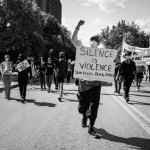
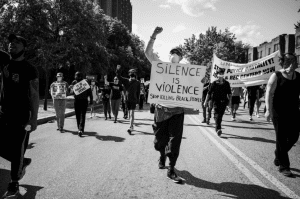
This is less false than the other two, but, as a talking point, it’s designed to give a misleading impression. It implies that antifa are primarily violent, prefer violence to other means of getting their way, or something along those lines. This isn’t true at all. Antifascists will sometimes use violence, both in self-defense and in defense of others; but the point of antifa activism is to stop the spread and power of fascism.
That comes in a lot of forms, most of which aren’t violent and some of which aren’t even confrontational. Sending a mole into a fascist group online to identify and expose fascists to the public is a form of nonviolent antifascist action; so is phoning a hotel or a convention center to inform them that an event they’re hosting is being run by fascists, in order to get the event shut down. Running an after-school program to help prevent teens from being recruited by fascist groups is a form of antifa activism that doesn’t even directly confront fascists, and so is running a voter registration drive that helps disenfranchised communities claim their democratic voice.
But antifa can include violence. Trying to obstruct a neo-Nazi march can lead to violence, whether from antifascists physically blocking the Nazis or from Nazis attacking the antifascists. Destroying the sound system at a fascist political rally could arguably be classified as violent. Pulling attackers off of a victim could easily involve violence, or be described that way, especially if the attackers are cops. Whenever an ideology, like fascism, explicitly advocates targeted hatred and its adherents often put that hatred into practice, defensive violence against that ideology will frequently occur—and it’s a completely false equivalence to say that defensive violence is just as bad as the original aggression. (2)
3. Antifa are a group.
Antifa is not even a thing—not the way the police or the Democratic Party are things. You can’t “join” it, or be a “member,” or anything like that (media that use words like these are either misinformed or lying). Antifa is, simply, active opposition to fascism. Now, that does imply certain viewpoints, priorities, and methods; and obviously people can form groups that are philosophically antifascist, and even perhaps use the word in their names. But antifa, as such, is not an institution or an organization.
Which provokes the question of why and how Donald Trump wants to designate antifa a terrorist organization. The obvious reason is that he doesn’t know any better. A more relevant reason might be, if a nebulous non-organization is declared terroristic, the Trump administration can then turn that policy on any political dissident, anyone who vocally or visibly advocates against fascism, or even just anyone who opposes the administration. The blueprint for demonizing and disposing of political inconveniences is thus drafted, and ready to be applied at will.
(1) It may seem silly to abbreviate a word by a single syllable, and it is. However, I gather the abbreviation itself goes back to German activism, and was originally coined to refer to the group Antifaschistiche Aktion (i.e. Antifascist Action), later coming to be used about antifascists more generally. And abbreviating a phrase by six syllables does make more sense.
(2) It does not follow that all violence done in the name of antifa is therefore legitimate. Not only is plenty of violence falsely attributed to antifa, but it’s absolutely possible for violence that started out in self-defense to go too far; there are also real discussions to be had about what is and isn’t self-defensive in some circumstances. But these secondary questions should not distract from the point, which is that equating self-defense with unjust aggression is wrong.
Previous Post

May 30, 2020
Poem: Whitsunday Eve
Next Post
June 2, 2020 CST 101: A Crash Course in Leftism
Browse Our Archives
Select a Category abuse antifascism art bad Catholic celibacy chastity Church crucifixion culture war eros forgiveness gay gender homophobia ikons language liturgy peace poems politics Pope Francis prayer pro-life race recommendations reform repentance review sacraments saints satire scandal schism scripture sex suffering theology Uncategorized violence
Select a Month October 2026 September 2026 August 2026 July 2026 June 2026 May 2026 April 2026 March 2026 February 2026 January 2026 December 2025 November 2025 October 2025 September 2025 August 2025 July 2025 June 2025 May 2025 April 2025 March 2025 February 2025 January 2025 December 2024 November 2024 October 2024 September 2024 August 2024 July 2024 June 2024 May 2024 April 2024 March 2024 February 2024 January 2024 December 2023 November 2023 October 2023 September 2023 August 2023 July 2023 June 2023 May 2023 April 2023 March 2023 February 2023 January 2023 December 2022 November 2022 October 2022 September 2022 August 2022 July 2022 June 2022 May 2022 April 2022 March 2022 February 2022 January 2022 December 2021 November 2021 October 2021 September 2021 August 2021 July 2021 June 2021 May 2021 April 2021 March 2021 February 2021 January 2021 December 2020 November 2020 October 2020 September 2020 August 2020 July 2020 June 2020 May 2020 April 2020 March 2020 February 2020 January 2020 December 2019 November 2019 October 2019 September 2019 August 2019 July 2019
Follow Us!
TAKE THE
Religious Wisdom Quiz
What food did Elijah eat in the wilderness?
Select your answer to see how you score.
Bread and meat Figs and wine Manna Fish and honey
Related posts from Mudblood Catholic


TRENDING AT PATHEOS Catholic

We are approaching the date of our new American national holiday: October...

Letters on Living the Faith by C.S. Lewis
Most of us met C.S. Lewis as a public intellectual. Mere Christianity....

When Halloween Unmasks Married Hearts
Written by Dr. David K. Ewen from Eternal Truth Bible College Behind...

Aristotle. He’s been called the father of logic, the father of the...

Methodist Central Hall and Westminster Abbey
Situated on the same square is Methodist Central Hall and Westminster Abbey. ...

57th Dove Awards Honor Dolly Parton, Crown New...
On gospel music’s biggest night, the 57th annual GMA Dove Awards honored...
view all Catholic blogs
Ad-Free & Subscriber Log-In Subscription Support
- About Us
- 2026 Calendar
- Videos
- Podcasts
- Library of World Religions
- Faith In Media Tracker
- Advertise With Us
- Write for Us
- Privacy Policy
- Terms of Service
- Do Not Sell My Data
- Contact Us
- Radiant Digital
- Manage Newsletter Subscriptions
- Unsubscribe From Notifications
- Sitemap
Copyright 2008-2026, Patheos. All rights reserved.
Subscription Support Ad-Free & Subscriber Log-In
Follow Patheos