
BuddhistCatholicContemplativeEvangelicalGeneral ChristianHinduJewishLatter-day SaintMuslimNew VisionsProgressive Christian
Beliefs
- Buddhist
- Catholic
- Contemplative
- Evangelical
- General Christian
- Hindu
- Jewish
- Latter-day Saint
- More Voices
- Muslim
- New Visions
- Pagan
- Progressive Christian
Topics
- Religion News
- Food and Religion
- Sports and Religion
- Religious Art
- Religious Music and Entertainment
- Religious Events
- History and Religion
- Style and Religion
- Politics and Religion
- Women in Religion
- Recreation Outdoors and Religion
- Business Finance and Religion
- Careers Workplace and Religion
- Education and Religion
- Family Parenting and Religion
- Health Fitness and Religion
- Home and Religion
- Relationships and Religion
- Technology and Religion
- Travel and Religion
Columnists
- Buddhist Columnists
- Business Finance and Religion Columnists
- Careers Workplace and Religion Columnists
- Catholic Columnists
- Contemplative Columnists
- Education and Religion Columnists
- Evangelists Columnists
- Family Parenting and Religion Columnists
- General Christian Columnists
- Health Fitness and Religion Columnists
- Hindu Columnists
- History and Religion Columnists
- Home and Religion Columnists
- Jewish Columnists
- More Voices Columnists
- Latter Day Columnists
- Muslim Columnists
- New Visions Columnists
- Nonreligious Columnists
- Pagan Columnists
- Politics and Religion Columnists
- Progressive Columnists
- Recreation Outdoors and Religion Columnists
- Relationships and Religion Columnists
- Religion News Columnists
- Religious Art Columnists
- Religious Events Columnists
- Religious Music and Entertainment Columnists
- Sports and Religion Columnists
- Style and Religion Columnists
- Technology and Religion Columnists
- Travel and Religion Columnists
- Women in Religion Columnists
Resource Library
- 2026 Calendar
- Library of World Religions
- The 100 Most Holy Places on Earth
- Patheos Answers
- Podcasts
- Videos
- Faith Leaders Database
- Anglican Episcopalian
- Bahai
- Baptist
- Buddhism
- Christianity
- Confucianism
- Eastern Orthodoxy
- Hinduism
- Holiness and Pentecostal
- ISKCON
- Islam
- Judaism
- Lutheran
- Methodist
- The Church of Jesus Christ of Latter-day Saints
- New Age
- Paganism
- Presbytarian and Reformed
- Protestantism
- Religion Behind the Scenes
- Roman Catholic
- Scientology
- Shia Islam
- Sikhism
- Sufism
- Sunni Islam
- Taoism
- Zen
- See all religions
Research Tools
 Ad-Free & Subscriber Log-In Subscription Support
Ad-Free & Subscriber Log-In Subscription Support
Follow Patheos 

- Trending:
- Forgiveness
- |
- Marriage
- |
- Consciousness
- |
- Death Penalty
- |
- Election
- |
- Halloween

- Home
- Catholic
- The Ascension and the Eucharist
The Ascension and the Eucharist
Last updated on: May 20, 2020 at 11:30 pm by Gabriel Blanchard
The Ascension and the Eucharist 2020-05-20T23:30:28-04:00 Gabriel Blanchard
Patheos Explore the world's faith through different perspectives on religion and spirituality! Patheos has the views of the prevalent religions and spiritualities of the world.
Tonight is the vigil of Christ’s Ascension. Forty days after he rose from the grave, he rose from the earth itself and went bodily into heaven. Most dioceses in the US transfer this solemnity to the following Sunday, but the Ordinariate observes it on the traditional date, the sixth Thursday in the Easter season.

Interestingly, this aligns Ascension with two other festivals also celebrated on Thursdays—Maundy Thursday and Corpus Christi. (1) The first opens the Triduum, commemorating the institution of the Eucharist and the new law, Love one another as I have loved you; the second, at two months’ remove from the intense drama of the Passion, focuses on the Eucharist itself, allowing a more lingering, deeper contemplation of the mystery that the dramatic rhythm of the Triduum is less suited for.
I’ve long felt that there is something fitting in linking the Ascension with the Blessed Sacrament. In the gospel of John, the most ostentatiously liturgical and eucharistic of the four, the Crucifixion, Resurrection, and Ascension are treated virtually as a single act, a single movement of exaltation. The Son of Man must be lifted up is one of the recurring themes throughout the whole book. The Ascension is not directly depicted in John—only Luke’s two accounts do that (2)—but it is implied, and on the same day as the Resurrection itself. When St Mary Magdalene meets him, Jesus tells her Touch me not, for I am not yet ascended to my Father, but only three verses later, on the evening of the very same day, he is showing the disciples his hands and his side, presumably in much the same way he does with St Thomas the next week. And at the same time, John is the gospel of the Bread of Life discourse, where he tells the crowds that they must chew on his flesh in order to have life, (3) the one where he compares himself to the seed that must die to bear fruit and the vine that the branches must remain upon. Maundy Thursday, Ascension, and Corpus Christi, taken together, accent the celestialization of matter and of the body that the Incarnation accomplished.
This context also gives the significance of the Ascension itself something of a twist. It’s easy to see the Ascension as a rather melancholy feast. It may have been for the infant Church. After the single most traumatic, horrible event of their lives, set in motion by a traitor whom they’d trusted and during which they had nearly all proven failures, their rabbi had come back to them from the dead. And then they had seen him intermittently for about a month, while they had returned to their old careers as fishermen (you can practically hear the “Well, I guess” before St Peter’s I’m going fishing in John 21). And then—majestically, thrillingly, yet for all that, again—he was gone. That first novena, the nine days between the Ascension and the outburst of Pentecost, sound to me like a quietly but intensely apprehensive time.
But the link with the Blessed Sacrament changes that. The last thing Jesus told them in the gospel of Matthew is Lo, I am with you always. Without the sacraments, that sounds like a mere sentiment. Not that there’s anything wrong with mere sentiment, but it’s a sorry-looking substitute for the Shekinah brooding upon the Ark of the Covenant, the literal divine luminosity that could speak or kill or transfigure, and which possessed a “with you” that could be straight up found on a map. That real presence is returned by the Real Presence, and now It can be anywhere, not just metaphorically but literally and visibly there. The boundary between earth and heaven, never intended to be permanent, is suddenly pierced at a million points in space-time—and every one of those points a single point, the same little piece of bread and cup of wine, as if a needle pulled a single golden thread through a million points of fabric and tugged them all together.
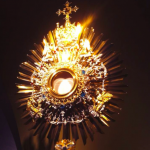
(1) Corpus Christi was originally instituted in the thirteenth century, set for the Thursday after Trinity Sunday. It is now typically transferred to the following Sunday, except in a handful of countries where it is a holy day of obligation.
(2) With apologies to the shorter and longer endings of Mark, now universally judged by scholars to be later additions.
(3) This is a feature of the Greek text that most English translations fail to convey—perhaps out of a misplaced sense of delicacy. In John 6, Jesus says repeatedly and in various ways “You must eat my flesh”; in verse 54, the author moves from using an ordinary word for “eat” to a word that specifically means “gnaw, chew.”
Previous Post

May 13, 2020
New Book Excerpt
Next Post
May 28, 2020 Catholic Social Teaching—An Incomplete Index
Browse Our Archives
Select a Category abuse antifascism art bad Catholic celibacy chastity Church crucifixion culture war eros forgiveness gay gender homophobia ikons language liturgy peace poems politics Pope Francis prayer pro-life race recommendations reform repentance review sacraments saints satire scandal schism scripture sex suffering theology Uncategorized violence
Select a Month October 2026 September 2026 August 2026 July 2026 June 2026 May 2026 April 2026 March 2026 February 2026 January 2026 December 2025 November 2025 October 2025 September 2025 August 2025 July 2025 June 2025 May 2025 April 2025 March 2025 February 2025 January 2025 December 2024 November 2024 October 2024 September 2024 August 2024 July 2024 June 2024 May 2024 April 2024 March 2024 February 2024 January 2024 December 2023 November 2023 October 2023 September 2023 August 2023 July 2023 June 2023 May 2023 April 2023 March 2023 February 2023 January 2023 December 2022 November 2022 October 2022 September 2022 August 2022 July 2022 June 2022 May 2022 April 2022 March 2022 February 2022 January 2022 December 2021 November 2021 October 2021 September 2021 August 2021 July 2021 June 2021 May 2021 April 2021 March 2021 February 2021 January 2021 December 2020 November 2020 October 2020 September 2020 August 2020 July 2020 June 2020 May 2020 April 2020 March 2020 February 2020 January 2020 December 2019 November 2019 October 2019 September 2019 August 2019 July 2019
Follow Us!
TAKE THE
Religious Wisdom Quiz
What famous garden did God place Adam and Eve in?
Select your answer to see how you score.
Bethel Sinai Gethsemane Eden
Related posts from Mudblood Catholic
With My Body, I Thee Worship: Part One


Vile Bodies, Part One: Give or Take
TRENDING AT PATHEOS Catholic

When Halloween Unmasks Married Hearts
Written by Dr. David K. Ewen from Eternal Truth Bible College Behind...

Aristotle. He’s been called the father of logic, the father of the...

Methodist Central Hall and Westminster Abbey
Situated on the same square is Methodist Central Hall and Westminster Abbey. ...

57th Dove Awards Honor Dolly Parton, Crown New...
On gospel music’s biggest night, the 57th annual GMA Dove Awards honored...

The First Eucharistic Controversy: Christ’s Real Presence
For Catholics, the Eucharist is the source and summit of the Christian...

What a Stop Sign Can Teach Us About...
How to Make a Decision When You Can't Hear God Main point:...
view all Catholic blogs
Ad-Free & Subscriber Log-In Subscription Support
- About Us
- 2026 Calendar
- Videos
- Podcasts
- Library of World Religions
- Faith In Media Tracker
- Advertise With Us
- Write for Us
- Privacy Policy
- Terms of Service
- Do Not Sell My Data
- Contact Us
- Radiant Digital
- Manage Newsletter Subscriptions
- Unsubscribe From Notifications
- Sitemap
Copyright 2008-2026, Patheos. All rights reserved.
Subscription Support Ad-Free & Subscriber Log-In
Follow Patheos