
BuddhistCatholicContemplativeEvangelicalGeneral ChristianHinduJewishLatter-day SaintMuslimNew VisionsProgressive Christian
Beliefs
- Buddhist
- Catholic
- Contemplative
- Evangelical
- General Christian
- Hindu
- Jewish
- Latter-day Saint
- More Voices
- Muslim
- New Visions
- Pagan
- Progressive Christian
Topics
- Religion News
- Food and Religion
- Sports and Religion
- Religious Art
- Religious Music and Entertainment
- Religious Events
- History and Religion
- Style and Religion
- Politics and Religion
- Women in Religion
- Recreation Outdoors and Religion
- Business Finance and Religion
- Careers Workplace and Religion
- Education and Religion
- Family Parenting and Religion
- Health Fitness and Religion
- Home and Religion
- Relationships and Religion
- Technology and Religion
- Travel and Religion
Columnists
- Buddhist Columnists
- Business Finance and Religion Columnists
- Careers Workplace and Religion Columnists
- Catholic Columnists
- Contemplative Columnists
- Education and Religion Columnists
- Evangelists Columnists
- Family Parenting and Religion Columnists
- General Christian Columnists
- Health Fitness and Religion Columnists
- Hindu Columnists
- History and Religion Columnists
- Home and Religion Columnists
- Jewish Columnists
- More Voices Columnists
- Latter Day Columnists
- Muslim Columnists
- New Visions Columnists
- Nonreligious Columnists
- Pagan Columnists
- Politics and Religion Columnists
- Progressive Columnists
- Recreation Outdoors and Religion Columnists
- Relationships and Religion Columnists
- Religion News Columnists
- Religious Art Columnists
- Religious Events Columnists
- Religious Music and Entertainment Columnists
- Sports and Religion Columnists
- Style and Religion Columnists
- Technology and Religion Columnists
- Travel and Religion Columnists
- Women in Religion Columnists
Resource Library
- 2026 Calendar
- Library of World Religions
- The 100 Most Holy Places on Earth
- Patheos Answers
- Podcasts
- Videos
- Faith Leaders Database
- Anglican Episcopalian
- Bahai
- Baptist
- Buddhism
- Christianity
- Confucianism
- Eastern Orthodoxy
- Hinduism
- Holiness and Pentecostal
- ISKCON
- Islam
- Judaism
- Lutheran
- Methodist
- The Church of Jesus Christ of Latter-day Saints
- New Age
- Paganism
- Presbytarian and Reformed
- Protestantism
- Religion Behind the Scenes
- Roman Catholic
- Scientology
- Shia Islam
- Sikhism
- Sufism
- Sunni Islam
- Taoism
- Zen
- See all religions
Research Tools
 Ad-Free & Subscriber Log-In Subscription Support
Ad-Free & Subscriber Log-In Subscription Support
Follow Patheos 

- Trending:
- Forgiveness
- |
- Marriage
- |
- Consciousness
- |
- Death Penalty
- |
- Election
- |
- Halloween

- Home
- Catholic
- Saint Michael’s Lent
Saint Michael’s Lent
Last updated on: July 28, 2019 at 10:07 pm by Gabriel Blanchard
Saint Michael’s Lent 2019-07-28T22:07:11-04:00 Gabriel Blanchard
Patheos Explore the world's faith through different perspectives on religion and spirituality! Patheos has the views of the prevalent religions and spiritualities of the world.
In just under three weeks, an unofficial sort of season starts in the Church’s calendar for the Ordinariates. (1) (This is one of the ways that the Anglican Use (2) resembles the calendars of the East, alternating between fasting and feasting pretty regularly.)

The upcoming season, which begins on the day after Assumption and runs through the vigil of Michaelmas, is known as St Michael’s Lent. It doesn’t have official status—there are no special readings at Mass, and the liturgical color is still green—but it has some small weight of custom behind it, and it helps give variety to the long Trinity season. (3)
This semi-season apparently originates with St Francis, who observed the forty days between Assumption and Michaelmas as a time of fasting and prayer. He loved Our Lady, as we all know, but apparently he was pretty enthusiastic about St Michael as well.
Franciscan spirituality seems to have been specially influential in Mediæval England. It certainly produced great luminaries, including Roger Bacon, William of Ockham, and Bl John Duns Scotus, arguably the only Scholastic who could hold a candle to Aquinas. The spirit of cheerfulness, gentleness, and courtesy that animated Francis seems to have suited the English temperament better than the steely, almost rationalistic clarity of the Dominicans; you see something of the same sweet tranquility in Dame Julian. (That’s my pet theory, at least, which will likely be quite exploded in two years.)
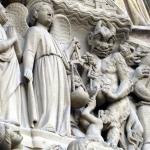
Anyway, St Michael’s Lent follows the festivities of summer, and leads us right up to the feast of St Michael. Michaelmas in turn precedes quite a clutch of saints’ days in October, culminating in the ‘Hallowtide triduum’ of Halloween, All Hallows, and All Souls, which ushers in the very end of the liturgical year. It also incorporates three thematic holy days: the Passion of St John the Baptist on 29th August; the Exaltation of the Cross on 14th September; and the Ember week following the Exaltation. All of these accent the idea of the Christian carrying his own cross, penitentially and gloriously at the same time.
It isn’t meant to be as rigorous as Lent proper; e.g., if you go meatless throughout Lent, something like just meatless Wednesdays and Fridays (traditional fasting days) would be appropriate. Or adding something, like a Divine Mercy chaplet every evening.
I only started practicing St Michael’s Lent last year. I hadn’t heard of it before 2018: our pastor mentioned it in a sermon, recommending it. So I can’t say much about its benefits as a seasonal thing, not yet anyway. But fasting’s a good thing, and we don’t do much of it communally here in the West. So, if I may be so bold, give some thought to joining me in it this year. Justice for immigrants to the US, and reform of sexual and financial abuses in the clergy, are two excellent causes to devote prayer and penance to.
(1) The Ordinariates are a small collection of formerly Anglican churches who have been reconciled to the Catholic Church, but have maintained our own spiritual and ritual style. Pope Benedict XVI gave them official status in 2011; individual parishes and religious houses had been coming in under similar terms for decades. The Ordinariates are roughly equivalent to dioceses, defined by shared spiritual heritage more than by territory. There are three: Our Lady of Walsingham in the British Isles, Our Lady of the Southern Cross in the Pacific (mostly Australasia but also Japan), and Chair of Peter here in North America.
(2) Technically we’re supposed to say Divine Worship now instead of Anglican Use, but my counter-offer is that no one cares.
(3) The calendar of the Anglican Use does not employ Ordinary Time as in the Novus Ordo. Instead, the time following the octave of Pentecost, beginning with Trinity Sunday and running all the way to the end of the year, is known as Sundays in Trinity, or Trinitytide. The period between Epiphany and Ash Wednesday is mostly Epiphanytide, plus a brief preparatory period of two and a half weeks before the start of Lent, called Shrovetide. (Shrive is an obsolete word for ‘confess’—hence also the expression short shrift, meaning the rushed confession that might be given to a criminal before execution. Shrove was the past tense of shrive.)
Images via Pixabay
Previous Post

July 25, 2019
Gender Jamboree, Part Three
Next Post
July 31, 2019 Gender Jamboree, Part Four
Browse Our Archives
Select a Category abuse antifascism art bad Catholic celibacy chastity Church crucifixion culture war eros forgiveness gay gender homophobia ikons language liturgy peace poems politics Pope Francis prayer pro-life race recommendations reform repentance review sacraments saints satire scandal schism scripture sex suffering theology Uncategorized violence
Select a Month October 2026 September 2026 August 2026 July 2026 June 2026 May 2026 April 2026 March 2026 February 2026 January 2026 December 2025 November 2025 October 2025 September 2025 August 2025 July 2025 June 2025 May 2025 April 2025 March 2025 February 2025 January 2025 December 2024 November 2024 October 2024 September 2024 August 2024 July 2024 June 2024 May 2024 April 2024 March 2024 February 2024 January 2024 December 2023 November 2023 October 2023 September 2023 August 2023 July 2023 June 2023 May 2023 April 2023 March 2023 February 2023 January 2023 December 2022 November 2022 October 2022 September 2022 August 2022 July 2022 June 2022 May 2022 April 2022 March 2022 February 2022 January 2022 December 2021 November 2021 October 2021 September 2021 August 2021 July 2021 June 2021 May 2021 April 2021 March 2021 February 2021 January 2021 December 2020 November 2020 October 2020 September 2020 August 2020 July 2020 June 2020 May 2020 April 2020 March 2020 February 2020 January 2020 December 2019 November 2019 October 2019 September 2019 August 2019 July 2019
Follow Us!
TAKE THE
Religious Wisdom Quiz
Blessed are the poor in spirit, for theirs is the kingdom of ____.
Select your answer to see how you score.
Grace God Truth Heaven
Related posts from Mudblood Catholic
Thoughts on "Traditionis Custodes"

Meditations for Holy Week 2021
TRENDING AT PATHEOS Catholic

Methodist Central Hall and Westminster Abbey
Situated on the same square is Methodist Central Hall and Westminster Abbey. ...

57th Dove Awards Honor Dolly Parton, Crown New...
On gospel music’s biggest night, the 57th annual GMA Dove Awards honored...

The First Eucharistic Controversy: Christ’s Real Presence
For Catholics, the Eucharist is the source and summit of the Christian...

What a Stop Sign Can Teach Us About...
How to Make a Decision When You Can't Hear God Main point:...

Archdiocese Hosts Military Marriage Retreat in Germany
RASTATT, Germany — The transient military lifestyle, with its frequent deployments and...

Nearly every morning, I make the drive to Detroit with my high-school-age...
view all Catholic blogs
Ad-Free & Subscriber Log-In Subscription Support
- About Us
- 2026 Calendar
- Videos
- Podcasts
- Library of World Religions
- Faith In Media Tracker
- Advertise With Us
- Write for Us
- Privacy Policy
- Terms of Service
- Do Not Sell My Data
- Contact Us
- Radiant Digital
- Manage Newsletter Subscriptions
- Unsubscribe From Notifications
- Sitemap
Copyright 2008-2026, Patheos. All rights reserved.
Subscription Support Ad-Free & Subscriber Log-In
Follow Patheos