
BuddhistCatholicContemplativeEvangelicalGeneral ChristianHinduJewishLatter-day SaintMuslimNew VisionsProgressive Christian
Beliefs
- Buddhist
- Catholic
- Contemplative
- Evangelical
- General Christian
- Hindu
- Jewish
- Latter-day Saint
- More Voices
- Muslim
- New Visions
- Pagan
- Progressive Christian
Topics
- Religion News
- Food and Religion
- Sports and Religion
- Religious Art
- Religious Music and Entertainment
- Religious Events
- History and Religion
- Style and Religion
- Politics and Religion
- Women in Religion
- Recreation Outdoors and Religion
- Business Finance and Religion
- Careers Workplace and Religion
- Education and Religion
- Family Parenting and Religion
- Health Fitness and Religion
- Home and Religion
- Relationships and Religion
- Technology and Religion
- Travel and Religion
Columnists
- Buddhist Columnists
- Business Finance and Religion Columnists
- Careers Workplace and Religion Columnists
- Catholic Columnists
- Contemplative Columnists
- Education and Religion Columnists
- Evangelists Columnists
- Family Parenting and Religion Columnists
- General Christian Columnists
- Health Fitness and Religion Columnists
- Hindu Columnists
- History and Religion Columnists
- Home and Religion Columnists
- Jewish Columnists
- More Voices Columnists
- Latter Day Columnists
- Muslim Columnists
- New Visions Columnists
- Nonreligious Columnists
- Pagan Columnists
- Politics and Religion Columnists
- Progressive Columnists
- Recreation Outdoors and Religion Columnists
- Relationships and Religion Columnists
- Religion News Columnists
- Religious Art Columnists
- Religious Events Columnists
- Religious Music and Entertainment Columnists
- Sports and Religion Columnists
- Style and Religion Columnists
- Technology and Religion Columnists
- Travel and Religion Columnists
- Women in Religion Columnists
Resource Library
- 2026 Calendar
- Library of World Religions
- The 100 Most Holy Places on Earth
- Patheos Answers
- Podcasts
- Videos
- Faith Leaders Database
- Anglican Episcopalian
- Bahai
- Baptist
- Buddhism
- Christianity
- Confucianism
- Eastern Orthodoxy
- Hinduism
- Holiness and Pentecostal
- ISKCON
- Islam
- Judaism
- Lutheran
- Methodist
- The Church of Jesus Christ of Latter-day Saints
- New Age
- Paganism
- Presbytarian and Reformed
- Protestantism
- Religion Behind the Scenes
- Roman Catholic
- Scientology
- Shia Islam
- Sikhism
- Sufism
- Sunni Islam
- Taoism
- Zen
- See all religions
Research Tools
 Ad-Free & Subscriber Log-In Subscription Support
Ad-Free & Subscriber Log-In Subscription Support
Follow Patheos 

- Trending:
- Forgiveness
- |
- Marriage
- |
- Consciousness
- |
- Death Penalty
- |
- Election
- |
- Halloween
 Mostly Muslim
-
Faith & Spirituality
-
Personal/Life
-
Society & Culture
- Home
- Muslim
- What Being an Artist Means to Me as a Muslim — Mostly Muslim
What Being an Artist Means to Me as a Muslim — Mostly Muslim
Last updated on: March 6, 2019 at 11:28 am by Stephenie Bushra Khan
What Being an Artist Means to Me as a Muslim — Mostly Muslim 2019-03-06T11:28:18-06:00 Stephenie Bushra Khan
Patheos Explore the world's faith through different perspectives on religion and spirituality! Patheos has the views of the prevalent religions and spiritualities of the world.
I always knew that I wanted to be an artist, ever since I was very young. It all started with competition with my brother. My relatives would give him children’s paint supplies for Christmas, and I would be envious. I wanted to have my own art supplies.
I actually started drawing and writing when I was seven years old. My great-grandmother took care of my brother and I when my grandmother went to work. She lived in an apartment building with a big parking lot, and somehow wanted to keep me inside. She did not want me to go out to play because she was afraid of me getting hurt. So she would give me letter paper that she had, and she would sharpen pencils with a knife, and I would spend hours just occupying myself. Even at that age, I would tear out pictures and stories from magazines and try to copy them. I did my first attempts at figure drawing at this age.
At around this time, I entered my first art contest. I drew Santa Claus for a local children’s television show. I won first prize, which was a free trip to an amusement park close by. I was afraid to ask anyone to take me, though. I hung on two those tickets for years, as proof that I won the contest and that I was an artist. My early drawings were very immature. The usual childhood drawings of dogs and cats, and sketches for homework assignments.
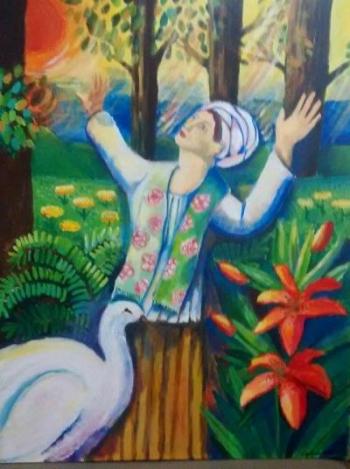
Painting by Stephenie Bushra Khan
My family supplied me with paint by numbers. Also, my grandmother had a collection of embroidery books, which I would draw out the designs from and make placards using markers. Both my grandmother and great-grandmother were skilled knitters and skilled at crochet. My grandmother would knit these complicated sweaters for me and sew my dresses. My great-grandmother would crochet these very eloquent beds spreads, individual squares with roses in the center, which would take six months to make. My grandmother could not afford new furniture, so she refinished our furniture herself, sewing the covers for the cushions with piping. My grandmother didn’t hang photos or art on the wall; our walls were paneled and plain.
I did not inherit my grandmother and great-grandmother’s skills, although they did try to teach me. I could knit a basic sweater with changing colors and design, but I could never sew or crochet. These are truly the way they created their own art. My grandmother was also an excellent cook and could make croissants, and very elaborate deserts and foods. My aunt could cook elaborate gourmet food. My grandmother did not let me cook in the kitchen for fear that I would make a mess, but as I got older, I learned how to cook elaborate meals like her. I am writing all this because these are forms of art.
Being an artist, one looks around, not only at the cycle of nature, but at the intrinsic beauty of what it means to be a human being.
As I grew up, I saw the world differently than those around me. My companions were nature and light. I could tell what time of day it was and the season, by the slant and color of the light. Being here in California, the light is very different than it is in New England. The way that light hit an object and its shadows had a very spiritual significance to me. I reveled in the world around me, in its different shades of colors: like how the light shone through the leaves, especially in the early morning; how it danced through a sheer curtain; and how shadows and light danced on the floor as light shined through the window. Each dust molecule had significance for me, each dark corner I imagined had saints who meditated and had cloisters there.
I saw something nostalgic and magical about the woods behind my house, especially around the evening time, within the light of a full moon. For me, the angels existed there, and another place where saints had visions, and lovers met there.
I felt that I did not fit into the world of people, but into the world of nature. Since a very young age, I struggled with mathematics. If I could have accomplished mathematics, I would be telling a different story. I would have been a scientist; I loved astronomy and could tell the different constellations at night, and where the planets were. I was very interested in how the universe worked. I also loved physics and meteorology. I liked cracking open rocks so I could see the mica within them, and the beauty of white quartz.
As I got older, spirituality became a central part of my life. My grandfather instilled his faith into me as a child. I would pray the Our Father and Hail Mary every night before him. I was so touched by going to church, seeing the golden alter with multi-winged angels who folded their wings around Christ in the center. The gold in the alter had swirling white clouds, and the ceiling of the church had an azure sky with silver stars. I never listened to the sermon as a girl of age six; instead, I reveled in the beauty around me, especially at the brilliant stain glass. This, besides nature, also made me an artist.
Through the arts, we have a great duty to point out the injustices around us.
As I became older, my work took on a spiritual meaning and I became interested in dreams images through reading Carl Jung and books on mysticism. Soon, my poetry and art wove images and became very symbolic. Many times, what was going on beneath my subconscious came out in the paintings.
I used art and poetry as a way to heal myself, as a way of survival, when I was at the most desperate and loneliest times of my life. My expression gave me the validity to live and survive the traumas that I had been through. It was comforting to me to be able to create. As I became older, it became extremely healing. I worked out my train of thoughts through my art and poetry, and it helped me deal with grief through every brush stroke and every mark of the pen.
For many years, I did art for myself. I became very attached to my paintings, as if I had given birth to more children. Art saved my life. Music was very important to me as well. Even though I was not a musician, I drew much inspiration from classical, sitar, and baroque music.
Art is very solitary work. Many times I had to give up time with my friends to do it. There is a great impulse in me to create art, as if like eating and sleeping. Many times there is not recognition or monetary gain. One does it because of the satisfaction for the soul. I also do it for the sense of legacy, what I will leave behind after I am gone to leave an imprint on this earth, and to my family so that I will not be forgotten.
I knew as a Muslim influenced by Sufism and Transcendentalism, that I wanted to celebrate the intrinsic beauty of what I visualized around me and what had spiritually influenced me. One reason that the Qur’an influences me is how scientifically it describes the laws of nature, and with such beauty. There is a Oneness of God through the laws of nature that is written in the Qur’an.
Being an artist, one looks around, not only at the cycle of nature, but at the intrinsic beauty of what it means to be a human being. That as humans, we are all beautiful in the sight of God. He made us so beautiful and perfect in how our bodies are shaped, and how our bodies work. There is also perfections in the beauty of emotions and thoughts that we have in ourselves, and for those around this.
I used art and poetry as a way to heal myself, as a way of survival, when I was at the most desperate and loneliest times of my life.
Through the arts, we have a great duty to point out the injustices around us. I know as a writer, many times I have defended Islam and its misunderstanding. I stood up against how members of my own family were mistreated, and others around me. I cannot bear injustice. Each human being is so beautiful, and should be given the same chances at life as anyone else. There is much evil in the world, and it is our duty to condemn it. We should condemn man’s inhumanity to man, as someone said to me, and make our corner bright.
Many artists commit their lives to the arts out of dedication. Like a vocation in life, this is how they need at times to earn their livelihood. Recognition for one’s work is an essential part of it. It is validation at times for what we do. We do not want our work to be sitting in a closet, unnoticed. This is our life work. We put so much of our time into it. Many times, we are so different in the way that we look at life. Sometimes we are on the outskirts of society. We need validation in our lives for what we are doing and what we accomplish as artists. We work alone, and are sometimes very isolated. But the arts are very spiritual type of work, and a form of worship. It makes everything we go through worth it.
The arts are a form of prayer. Each brush stroke we make, each letter we write, even some music and other forms of art, is meditation. Even our everyday chores are an art and a form of meditation, when we truly take the time to pay attention to what we are doing. When we live each second throughout our day, we are truly living.
Stephenie Bushra Khan is a converted Muslim, a poet, and local artist in Temecula, California. She is originally from Winchendon, Massachusetts.
Follow Mostly Muslim on Facebook HERE.
Want your voice to be heard? JOIN OUR TEAM or send your guest submission to [email protected]! Visit the “Contribute to MM” page for more details.
Previous Post
December 20, 2017
Confession: I Wish Eid Could Be More Like Christmas
Next Post
December 29, 2017 Taqwa, Not Identity | Finding Meaning and Consistency in Faith
Browse Our Archives
Select a Category Afterlife Culture Dealing with Others English Faith & Spirituality Inspiration Letters to the Ummah Personal / Life Poetry Ramadan Reality Check Reflections Relationships Religion Society & Culture Uncategorized Urdu Women
Select a Month September 2020 May 2020 April 2020 March 2020 January 2020 December 2019 October 2019 September 2019 August 2019 July 2019 June 2019 May 2019 April 2019 March 2019 February 2019 January 2019 December 2018 November 2018 October 2018 September 2018 August 2018 July 2018 June 2018 May 2018 April 2018 March 2018 February 2018 January 2018 December 2017 November 2017 October 2017 September 2017 August 2017 July 2017 June 2017 May 2017 April 2017 March 2017 February 2017 January 2017 December 2016 November 2016 October 2016 September 2016 August 2016 July 2016 June 2016 March 2016 November 2015 October 2015 June 2015 May 2015 February 2015 July 2014 June 2014 May 2014 April 2014 March 2014
Follow Us!
TAKE THE
Religious Wisdom Quiz
In Hebrews, Abel's blood spoke, but what does Jesus' blood speak?
Select your answer to see how you score.
Words of warning A better word than the blood of Abel The same message as Abel's Words of judgment
Related posts from Mostly Muslim
My Journey to Self-Expression and Interfaith Love as...
Solitude and the Virus | An Unexpected Silver...
Finding Meaning and Gratitude When Dealing with Loss
Reflections on Life on My Way to Bangladesh
TRENDING AT PATHEOS Muslim

25 Years Later: How Much Has Changed for...
As we approach the 25th anniversary of September 11th, I’ve found myself...

Podcast: Third Spaces & The Rise of Yemeni...
In the latest episode of The Artistic Foodies Podcast, hosts Abbas...

HalalFest Picks: Best 60 Halal Spots for Super...
Back in 2016, I came up with a list of 29...

Unity Is America’s Strength — Division Is Its...
by Hidayatullah Ahsan When Valentina Gomez, a Republican candidate for Congress in...

Zohran Mamdani and New York’s Fight Against Islamophobia
This past June, against all odds, Zohran Mamdani won the Democratic primary...

What the Fourth of July Means to a...
As we mark another Fourth of July, millions of Americans will celebrate...
view all Muslim blogs
Ad-Free & Subscriber Log-In Subscription Support
- About Us
- 2026 Calendar
- Videos
- Podcasts
- Library of World Religions
- Faith In Media Tracker
- Advertise With Us
- Write for Us
- Privacy Policy
- Terms of Service
- Do Not Sell My Data
- Contact Us
- Radiant Digital
- Manage Newsletter Subscriptions
- Unsubscribe From Notifications
- Sitemap
Copyright 2008-2026, Patheos. All rights reserved.
Subscription Support Ad-Free & Subscriber Log-In
Follow Patheos