
BuddhistCatholicContemplativeEvangelicalGeneral ChristianHinduJewishLatter-day SaintMuslimNew VisionsProgressive Christian
Beliefs
- Buddhist
- Catholic
- Contemplative
- Evangelical
- General Christian
- Hindu
- Jewish
- Latter-day Saint
- More Voices
- Muslim
- New Visions
- Pagan
- Progressive Christian
Topics
- Religion News
- Food and Religion
- Sports and Religion
- Religious Art
- Religious Music and Entertainment
- Religious Events
- History and Religion
- Style and Religion
- Politics and Religion
- Women in Religion
- Recreation Outdoors and Religion
- Business Finance and Religion
- Careers Workplace and Religion
- Education and Religion
- Family Parenting and Religion
- Health Fitness and Religion
- Home and Religion
- Relationships and Religion
- Technology and Religion
- Travel and Religion
Columnists
- Buddhist Columnists
- Business Finance and Religion Columnists
- Careers Workplace and Religion Columnists
- Catholic Columnists
- Contemplative Columnists
- Education and Religion Columnists
- Evangelists Columnists
- Family Parenting and Religion Columnists
- General Christian Columnists
- Health Fitness and Religion Columnists
- Hindu Columnists
- History and Religion Columnists
- Home and Religion Columnists
- Jewish Columnists
- More Voices Columnists
- Latter Day Columnists
- Muslim Columnists
- New Visions Columnists
- Nonreligious Columnists
- Pagan Columnists
- Politics and Religion Columnists
- Progressive Columnists
- Recreation Outdoors and Religion Columnists
- Relationships and Religion Columnists
- Religion News Columnists
- Religious Art Columnists
- Religious Events Columnists
- Religious Music and Entertainment Columnists
- Sports and Religion Columnists
- Style and Religion Columnists
- Technology and Religion Columnists
- Travel and Religion Columnists
- Women in Religion Columnists
Resource Library
- 2026 Calendar
- Library of World Religions
- The 100 Most Holy Places on Earth
- Patheos Answers
- Podcasts
- Videos
- Faith Leaders Database
- Anglican Episcopalian
- Bahai
- Baptist
- Buddhism
- Christianity
- Confucianism
- Eastern Orthodoxy
- Hinduism
- Holiness and Pentecostal
- ISKCON
- Islam
- Judaism
- Lutheran
- Methodist
- The Church of Jesus Christ of Latter-day Saints
- New Age
- Paganism
- Presbytarian and Reformed
- Protestantism
- Religion Behind the Scenes
- Roman Catholic
- Scientology
- Shia Islam
- Sikhism
- Sufism
- Sunni Islam
- Taoism
- Zen
- See all religions
Research Tools
 Ad-Free & Subscriber Log-In Subscription Support
Ad-Free & Subscriber Log-In Subscription Support
Follow Patheos 

- Trending:
- Forgiveness
- |
- Marriage
- |
- Consciousness
- |
- Death Penalty
- |
- Election
- |
- Halloween
 Mostly Muslim
-
Faith & Spirituality
-
Personal/Life
-
Society & Culture
- Home
- Muslim
- Red Pill or Blue Pill? | Accepting the Reality of the Afterlife
Red Pill or Blue Pill? | Accepting the Reality of the Afterlife
Last updated on: December 26, 2019 at 9:31 am by Iman
Red Pill or Blue Pill? | Accepting the Reality of the Afterlife 2019-12-26T09:31:06-06:00 Iman
Patheos Explore the world's faith through different perspectives on religion and spirituality! Patheos has the views of the prevalent religions and spiritualities of the world.
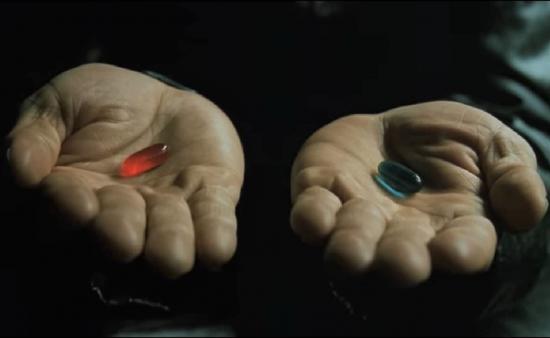
Photo from The Matrix (1999 film)
In a famous scene from the movie “The Matrix,” the main character is offered two pills: a Red pill and a Blue pill. He is told that he can take one or the other, and that his decision will affect him for the rest of his life. The Blue pill will keep him living blindly, like the rest of humankind. The Red pill will show him the reality of their existence. The man picked the Red pill.
Many of us would not have been so brave.
We’re all faced with a similar choice in our lives. There comes a time when we realize that there is more to life than school, work, and entertainment. That there will be accountability for even our smallest choices, and an eternity of recompense for our actions.
Most of us run the other way when we’re presented with this truth; we take the Blue pill and hope it will kick in quickly, so we can keep living a life of deception. And then there are those who take the Red pill – meaning, they accept the reality and decide to prepare for it, undaunted by the sheer number of those who are working hard to ignore it.
The Qur’an, when truly pondered upon, is the ultimate Red pill. It is full of reminders about God, the Afterlife, and the impermanence of the dunya (wordly life). Not everyone contemplates while reading the Qur’an, because the reality of the Day of Judgment is a hard pill to swallow. But I’m here to say, we must swallow it nonetheless.
In the same scene from “The Matrix,” the man who is explaining about the pills also says that we are all slaves who were “born into a prison.” I can’t help but think of the hadith where the Prophet (saws) said, “The dunya (world) is a prison for the believer and a paradise for the disbeliever/rejecter” [Narrated in Sahih Muslim].
It makes sense that this world would be paradise for those who don’t believe, because even if it’s not perfect, this is as good as it is going to get (whether in reality or in their perception). Whereas for those who truly believe (meaning, they take the “Red pill” and live with the Afterlife in mind), this world is a prison because we feel trapped in this imperfect life. We are all slaves of Allah, ready and eager to get to Jennah (paradise) inshaAllah.
Not everyone contemplates while reading the Qur’an, because the reality of the Day of Judgment is a hard pill to swallow. But I’m here to say, we must swallow it nonetheless.
For those of us who believe that we have taken the Red pill and are already aware of and preparing for the Afterlife, there is a simple litmus test: congruence between thoughts and actions. Meaning, do our thoughts match up with what we do? Do our choices represent our intention to please and worship Allah (swt)? It’s easy to say we believe in the message, but do we act in accordance with it? Once we know that Allah has told us to do something, do we actually do it, or do we cop out by saying that all that matters is what’s in our hearts? Does what we do or don’t do with our time reflect our faith in a beautiful way?
In Islam, actions and intentions both hold a lot of weight. For example, a person can have the purest character, but if they are not praying their five daily prayers, that is still a major sin which is written in their book of deeds (and vice versa). Accepting this is part of taking the Red pill. If we are convincing ourselves that Allah will forgive our sins even though we are choosing not to obey His commands, we are still living a life of deception which will inevitably catch up with us. You and I need to judge ourselves by a higher standard.
As ‘Umar ibn al-Khattab said, “Hold yourself to account before you are judged, and weigh your actions before they are weighed against you.”
“Know that the life of this world is but amusement and diversion and adornment and boasting to one another and competition in increase of wealth and children – like the example of a rain whose [resulting] plant growth pleases the farmers; then it dries and you see it turned yellow; then it becomes [scattered] debris. And in the Hereafter is severe punishment and forgiveness from Allah and approval. And what is the worldly life except the enjoyment of delusion?” [Qur’an 57:20]
Follow Mostly Muslim on Facebook HERE.
Previous Post

November 10, 2017
Finding Strength in God
Next Post

November 17, 2017 Fighting the Stigma of Mental Illness: This is My Story
Browse Our Archives
Select a Category Afterlife Culture Dealing with Others English Faith & Spirituality Inspiration Letters to the Ummah Personal / Life Poetry Ramadan Reality Check Reflections Relationships Religion Society & Culture Uncategorized Urdu Women
Select a Month September 2020 May 2020 April 2020 March 2020 January 2020 December 2019 October 2019 September 2019 August 2019 July 2019 June 2019 May 2019 April 2019 March 2019 February 2019 January 2019 December 2018 November 2018 October 2018 September 2018 August 2018 July 2018 June 2018 May 2018 April 2018 March 2018 February 2018 January 2018 December 2017 November 2017 October 2017 September 2017 August 2017 July 2017 June 2017 May 2017 April 2017 March 2017 February 2017 January 2017 December 2016 November 2016 October 2016 September 2016 August 2016 July 2016 June 2016 March 2016 November 2015 October 2015 June 2015 May 2015 February 2015 July 2014 June 2014 May 2014 April 2014 March 2014
Follow Us!
TAKE THE
Religious Wisdom Quiz
Which Psalm did Moses write?
Select your answer to see how you score.
Psalm 23 Psalm 90 Psalm 72 Psalm 119
Related posts from Mostly Muslim

A New Year, Another Opportunity for a Fresh...

The Miracle of the Azaan (Muslim Call to...

Except Those Who Have Faith and Do Good

Saving the Earth, Saving Ourselves
TRENDING AT PATHEOS Muslim

25 Years Later: How Much Has Changed for...
As we approach the 25th anniversary of September 11th, I’ve found myself...

Podcast: Third Spaces & The Rise of Yemeni...
In the latest episode of The Artistic Foodies Podcast, hosts Abbas...

HalalFest Picks: Best 60 Halal Spots for Super...
Back in 2016, I came up with a list of 29...

Unity Is America’s Strength — Division Is Its...
by Hidayatullah Ahsan When Valentina Gomez, a Republican candidate for Congress in...

Zohran Mamdani and New York’s Fight Against Islamophobia
This past June, against all odds, Zohran Mamdani won the Democratic primary...

What the Fourth of July Means to a...
As we mark another Fourth of July, millions of Americans will celebrate...
view all Muslim blogs
Ad-Free & Subscriber Log-In Subscription Support
- About Us
- 2026 Calendar
- Videos
- Podcasts
- Library of World Religions
- Faith In Media Tracker
- Advertise With Us
- Write for Us
- Privacy Policy
- Terms of Service
- Do Not Sell My Data
- Contact Us
- Radiant Digital
- Manage Newsletter Subscriptions
- Unsubscribe From Notifications
- Sitemap
Copyright 2008-2026, Patheos. All rights reserved.
Subscription Support Ad-Free & Subscriber Log-In
Follow Patheos