
BuddhistCatholicContemplativeEvangelicalGeneral ChristianHinduJewishLatter-day SaintMuslimNew VisionsProgressive Christian
Beliefs
- Buddhist
- Catholic
- Contemplative
- Evangelical
- General Christian
- Hindu
- Jewish
- Latter-day Saint
- More Voices
- Muslim
- New Visions
- Pagan
- Progressive Christian
Topics
- Religion News
- Food and Religion
- Sports and Religion
- Religious Art
- Religious Music and Entertainment
- Religious Events
- History and Religion
- Style and Religion
- Politics and Religion
- Women in Religion
- Recreation Outdoors and Religion
- Business Finance and Religion
- Careers Workplace and Religion
- Education and Religion
- Family Parenting and Religion
- Health Fitness and Religion
- Home and Religion
- Relationships and Religion
- Technology and Religion
- Travel and Religion
Columnists
- Buddhist Columnists
- Business Finance and Religion Columnists
- Careers Workplace and Religion Columnists
- Catholic Columnists
- Contemplative Columnists
- Education and Religion Columnists
- Evangelists Columnists
- Family Parenting and Religion Columnists
- General Christian Columnists
- Health Fitness and Religion Columnists
- Hindu Columnists
- History and Religion Columnists
- Home and Religion Columnists
- Jewish Columnists
- More Voices Columnists
- Latter Day Columnists
- Muslim Columnists
- New Visions Columnists
- Nonreligious Columnists
- Pagan Columnists
- Politics and Religion Columnists
- Progressive Columnists
- Recreation Outdoors and Religion Columnists
- Relationships and Religion Columnists
- Religion News Columnists
- Religious Art Columnists
- Religious Events Columnists
- Religious Music and Entertainment Columnists
- Sports and Religion Columnists
- Style and Religion Columnists
- Technology and Religion Columnists
- Travel and Religion Columnists
- Women in Religion Columnists
Resource Library
- 2026 Calendar
- Library of World Religions
- The 100 Most Holy Places on Earth
- Patheos Answers
- Podcasts
- Videos
- Faith Leaders Database
- Anglican Episcopalian
- Bahai
- Baptist
- Buddhism
- Christianity
- Confucianism
- Eastern Orthodoxy
- Hinduism
- Holiness and Pentecostal
- ISKCON
- Islam
- Judaism
- Lutheran
- Methodist
- The Church of Jesus Christ of Latter-day Saints
- New Age
- Paganism
- Presbytarian and Reformed
- Protestantism
- Religion Behind the Scenes
- Roman Catholic
- Scientology
- Shia Islam
- Sikhism
- Sufism
- Sunni Islam
- Taoism
- Zen
- See all religions
Research Tools
 Ad-Free & Subscriber Log-In Subscription Support
Ad-Free & Subscriber Log-In Subscription Support
Follow Patheos 

- Trending:
- Forgiveness
- |
- Marriage
- |
- Consciousness
- |
- Death Penalty
- |
- Election
- |
- Halloween
 The Mormon Therapist
- Home
- Latter-day Saint
- Health, Fitness and Religion
- More Than This: Dealing with Trauma & PTSD
More Than This: Dealing with Trauma & PTSD
Last updated on: February 26, 2018 at 1:53 am by Natasha Helfer
More Than This: Dealing with Trauma & PTSD 2018-02-26T01:53:45-05:00 Natasha Helfer
Patheos Explore the world's faith through different perspectives on religion and spirituality! Patheos has the views of the prevalent religions and spiritualities of the world.
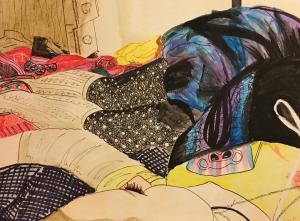
Artwork created by the author.
Another guest post from “Sandy” — who was willing to give an interview to Mormon Mental Health about her experience of childhood sexual assault in the context of worthiness interviews (protectldschildren.org). She can use this blog as a platform for as many writings as she would like to post. She is a powerful writer and I love sharing her pieces.
More Than This:
At therapy this week I was telling my therapist Susan, about how my anxiety has reared its head in a big way recently. I’ve been waking up first thing every morning, before my alarm, with fairly visceral, nausea-inducing anxiety. Heart pounding. Mind racing. Shaking. It’s bad. In discussing coping skills, one suggestion she made really resonated with me. She said since my brain is still very much wired to seek out the negative, (because it’s watching for danger, in order to defend itself) it’s important for me to deliberately spend more time thinking about, and focusing on what’s working, and what’s good, to remind myself of what my brain knows, but my body doesn’t: that I’m okay.
Possibly this seems obvious? People have been telling me to “focus on the positive” for literally as long as I can remember. This advice has been irksome to rage-inducing to receive for all that time. But when she put it that way, reminding me of what I understand about PTSD, I felt like I finally got it. It’s not just ignoring when shit is upsetting; it’s rewiring my broken nervous system.
There’s a Henry David Thoreau quote along these lines: “As a single footstep will not make a path on the Earth, so a single thought will not make a pathway in the mind. To make a deep physical path, we walk again and again. To make a deep mental path, we must think over and over the kind of thoughts we wish to dominate our lives.”
I liked Susan’s approach because it wasn’t “smile that frown away” type of stuff. It was definitely more like, “It’s okay to be upset about this understandably upsetting thing. That’s valid. AND you have good things in your life. Things that are working. You need to remember those, too.” As someone with PTSD, where things tend to feel all or nothing, and either/or, the idea that I’m allowed to hold both truths, and that neither invalidates the other, feels profound.
This idea brought up, for me, a suggestion that I received from Natasha several weeks ago, and had filed away. It was during a conversation where I was lamenting that I was SO exhausted because I feel like I spend the majority of my energy on the work I’m doing to heal. I often feel like my entire life is spent trying to MAKE my life about more than just the worst things that have happened to me. More than just my trauma.
And as I’m learning is her tendency when she smells a steaming pile of bullshit, Natasha spoke truth to it. “Your life already is more than just trauma.” She said, and then added “Just saying.” Which of course I had to laugh at. And then, being me, I asked her if she really thought so.
“Yes. I really think so. And I think it’s really important for you to start thinking so.”
There’s an excerpt from a journal entry that I wrote shortly after I had finally recovered the distinct memories of abuse from when I was little:
“I was faced with the reality that my first and oldest memory was one of violence, and abuse. I felt like, if I had ever been destined to be someone…else, someone better, happier, that flame had been expertly snuffed, leaving me with no option but to become the person I am now, who I mostly view as broken, damaged, deficient in most ways. I realized that I had no concept of who I might have been had I been allowed to flourish. And my heart…shattered.”
For me, recognizing and acknowledging the reality of the abuse I experienced, rather than minimizing the damage that was done to me at such a vulnerable stage, has been, and still is a super important part of my healing journey. Allowing myself to grieve that loss is important. I’m not who I would have been. That’s true. The woman I might have been had I not experienced this developmental trauma is a figment of imagination at this point.
AND I’m starting to think that who I *am* might not be an altogether horrible person. I’ve certainly done a lot of work and experienced a great deal of healing since I described myself as broken, damaged and deficient. I’m colorful, and creative. I’m not unintelligent. If you asked my employers, they’d describe me as reliable, motivated and organized. (Seriously, if you’d known me 5 years ago, you’d be as surprised as I am to hear this assessment.) I’m an artist, a caregiver, an avid documentor. I also have a ridiculous number of people that I love and can rely on, who love and rely on me.
Yes, I’m a trauma survivor. AND I’m okay.
Natasha Helfer Parker, LCMFT, CST runs an online practice, Symmetry Solutions, which focuses on helping families and individuals with faith concerns, sexuality and mental health. She hosts the Mormon Mental Health and Mormon Sex Info Podcasts, writes a regular column for Sunstone Magazine, is the current president of the Mormon Mental Health Association and runs a sex education program, Sex Talk with Natasha. She has over 20 years of experience working with primarily an LDS/Mormon clientele.
Previous Post

February 24, 2018
Thoughts of the Day
Next Post

February 27, 2018 How can I Make Church Worship Meaningful to Me?
Browse Our Archives
Select a Category Abortion Abuse Addiction Adolescents Anger Anxiety BDSM Bipolar Disorder Body Image Boundaries Children Circumcision Civil Rights Consent COVID19-Coronavirus Death Depression Divorce Domestic Violence Emotional Abuse Erectile Dysfunction Faith Crisis/Faith Transition Gender Identity Gender Roles Gospel Teachings Grief Homosexuality Infidelity LGBTQ LGBTQ+ Male Issues Marriage Masturbation Menopause Mental Health Mindfulness Miscarriage Missions Mixed-Faith Obsessive Compulsive Disorder Parenting Perfectionism Physical Abuse Physical Health Pornography Premature Ejaculation PTSD Race Relations Relationships Rest Righteousness Self Care Self Injury Self-Esteem Sexual Abuse Sexual Disorders Sexual Education Sexuality Single Adults Social Media Spirituality Suicide Survey Temple Issues Transgender Health Trauma Uncategorized Violence Women's Issues Word of Wisdom
Select a Month September 2020 August 2020 July 2020 June 2020 May 2020 April 2020 March 2020 February 2020 January 2020 December 2019 November 2019 October 2019 August 2019 July 2019 June 2019 May 2019 April 2019 March 2019 February 2019 December 2018 November 2018 April 2018 March 2018 February 2018 January 2018 December 2017 November 2017 October 2017 September 2017 August 2017 July 2017 June 2017 May 2017 March 2017 January 2017 December 2016 November 2016 October 2016 September 2016 August 2016 July 2016 June 2016 May 2016 April 2016 February 2016 January 2016 December 2015 November 2015 October 2015 July 2015 February 2015 January 2015 November 2014 September 2014 August 2014 July 2014 June 2014 April 2014 February 2014 December 2013 November 2013 October 2013 September 2013 August 2013 July 2013 May 2013 April 2013 March 2013 February 2013 January 2013 November 2012 October 2012 September 2012 August 2012 July 2012 May 2012 April 2012 February 2012 January 2012 December 2011 November 2011 October 2011 September 2011 August 2011 July 2011 June 2011 May 2011 April 2011 March 2011 February 2011 January 2011 December 2010 November 2010 October 2010 September 2010 August 2010 July 2010 June 2010 May 2010 April 2010 March 2010 February 2010 January 2010 December 2009 November 2009 October 2009 September 2009 August 2009 July 2009 June 2009 May 2009 April 2009 March 2009 February 2009
Follow Us!
TAKE THE
Religious Wisdom Quiz
Who did Moses marry in Midian?
Select your answer to see how you score.
Leah Dinah Zipporah Rebekah
Related posts from The Mormon Therapist

Comments on Navigating Mixed Faith Marriages


A Letter to Mixed Faith Couples
TRENDING AT PATHEOS Latter-day Saint

Did Prayer Cure His Cancer? Or Was It...
At 4 AM one morning, Joshua W. Brown’s wife awoke to a...

8 Ways a Near-Death Experience Rewires the Soul
Does Consciousness Survive Physical Death? After 50 Years of Research, Dr. Raymond...

Holy Longing: What Our Restlessness Is Telling Us
“One can find so many pains when the rain is falling.” -John...

What this is NOT about. This blog is definitely not about...

Who said the Israelites were God’s chosen? That’s right, they did. Who...

The Spirit World Is the Real World: God...
A Monk’s Wisdom on Body and Spirit I sit with Brother Martin...
view all Latter-day Saint blogs
Ad-Free & Subscriber Log-In Subscription Support
- About Us
- 2026 Calendar
- Videos
- Podcasts
- Library of World Religions
- Faith In Media Tracker
- Advertise With Us
- Write for Us
- Privacy Policy
- Terms of Service
- Do Not Sell My Data
- Contact Us
- Radiant Digital
- Manage Newsletter Subscriptions
- Unsubscribe From Notifications
- Sitemap
Copyright 2008-2026, Patheos. All rights reserved.
Subscription Support Ad-Free & Subscriber Log-In
Follow Patheos