
BuddhistCatholicContemplativeEvangelicalGeneral ChristianHinduJewishLatter-day SaintMuslimNew VisionsProgressive Christian
Beliefs
- Buddhist
- Catholic
- Contemplative
- Evangelical
- General Christian
- Hindu
- Jewish
- Latter-day Saint
- More Voices
- Muslim
- New Visions
- Pagan
- Progressive Christian
Topics
- Religion News
- Food and Religion
- Sports and Religion
- Religious Art
- Religious Music and Entertainment
- Religious Events
- History and Religion
- Style and Religion
- Politics and Religion
- Women in Religion
- Recreation Outdoors and Religion
- Business Finance and Religion
- Careers Workplace and Religion
- Education and Religion
- Family Parenting and Religion
- Health Fitness and Religion
- Home and Religion
- Relationships and Religion
- Technology and Religion
- Travel and Religion
Columnists
- Buddhist Columnists
- Business Finance and Religion Columnists
- Careers Workplace and Religion Columnists
- Catholic Columnists
- Contemplative Columnists
- Education and Religion Columnists
- Evangelists Columnists
- Family Parenting and Religion Columnists
- General Christian Columnists
- Health Fitness and Religion Columnists
- Hindu Columnists
- History and Religion Columnists
- Home and Religion Columnists
- Jewish Columnists
- More Voices Columnists
- Latter Day Columnists
- Muslim Columnists
- New Visions Columnists
- Nonreligious Columnists
- Pagan Columnists
- Politics and Religion Columnists
- Progressive Columnists
- Recreation Outdoors and Religion Columnists
- Relationships and Religion Columnists
- Religion News Columnists
- Religious Art Columnists
- Religious Events Columnists
- Religious Music and Entertainment Columnists
- Sports and Religion Columnists
- Style and Religion Columnists
- Technology and Religion Columnists
- Travel and Religion Columnists
- Women in Religion Columnists
Resource Library
- 2026 Calendar
- Library of World Religions
- The 100 Most Holy Places on Earth
- Patheos Answers
- Podcasts
- Videos
- Faith Leaders Database
- Anglican Episcopalian
- Bahai
- Baptist
- Buddhism
- Christianity
- Confucianism
- Eastern Orthodoxy
- Hinduism
- Holiness and Pentecostal
- ISKCON
- Islam
- Judaism
- Lutheran
- Methodist
- The Church of Jesus Christ of Latter-day Saints
- New Age
- Paganism
- Presbytarian and Reformed
- Protestantism
- Religion Behind the Scenes
- Roman Catholic
- Scientology
- Shia Islam
- Sikhism
- Sufism
- Sunni Islam
- Taoism
- Zen
- See all religions
Research Tools
 Ad-Free & Subscriber Log-In Subscription Support
Ad-Free & Subscriber Log-In Subscription Support
Follow Patheos 

- Trending:
- Forgiveness
- |
- Marriage
- |
- Consciousness
- |
- Death Penalty
- |
- Election
- |
- Halloween

- Home
- Buddhist
- On Taking Refuge in the Dharma
On Taking Refuge in the Dharma
Last updated on: June 15, 2026 at 10:29 am by James Ford
On Taking Refuge in the Dharma 2026-06-15T10:29:07-07:00 James Ford
Patheos Explore the world's faith through different perspectives on religion and spirituality! Patheos has the views of the prevalent religions and spiritualities of the world.
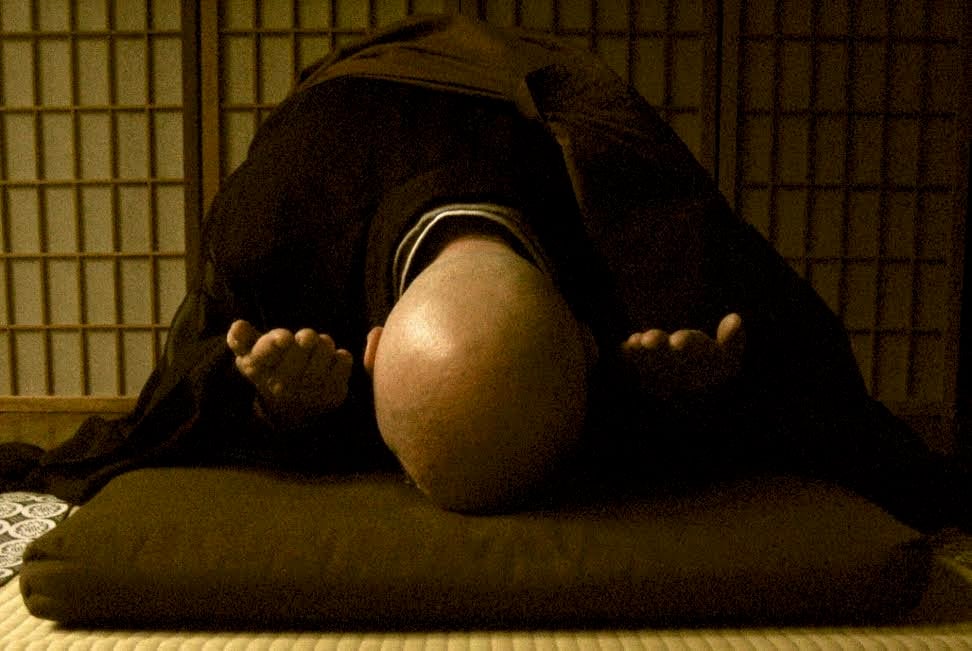
Zen teacher bowing
(Here I continue the feature of sharing talks and essays by teachers within our Empty Moon Zen community. This is a talk by Dharma Holder Tom Wardle. A householder teacher, Tom works as an Executive Coach. He holds a Bachelor’s degree from the University of Michigan and an MBA from Hult International Business School. He is also a graduate of the Zen Peacemaker’s Seminary for Socially Engaged Buddhism. Tom is passionate about koan, lay practice, and the integration of the dharma into daily life.)
Most of us come to practice to improve our lives. Something seems off. Life could be better, unhappiness abounds, and so we look for ways to correct this. Things aren’t exactly how I’d like them to be, so I wrestle with reality itself trying to contort it to fit my preferences. I cling to things that make me happy, and I chase after things I think will make me happier still, while I try hard to avoid the unpleasant things in life, but none of this actually works, I just end up frustrated and exhausted.
Perhaps the problem is me, so I look for ways to become a better person, to reconfigure myself into a mighty achiever so I can conquer life. Often, this leads us to meditation. The benefits are well documented, and Zen is kinda cool, so we walk into a Zen center and learn to meditate. We hope that if we do enough meditation, we’ll become a better version of ourselves, a version that will do the thing, get what we want, and be more successful. Maybe meditation can make us more attractive, purging what we don’t like about ourselves so we can win friends and influence people and whatever else your version of this fantasy happens to be.
Maybe it’s not so grandiose.
Maybe it’s a simple life of contentment that you fantasize about.
Maybe it’s just things not hurting quite so much anymore.
What ever yours happens to be, we all come to practice with fantasies about how our meditation practice will change us, but these fantasies tend to break down pretty quickly because you meditate and then nothing happens.
We might feel some transient peace or relaxation. We might even make sitting into a regular habit, but typically very little changes. We may notice some benefits, but the core problem remains the same: life is a constant struggle and we aren’t getting what we want.
So what went wrong? Why haven’t all our problems gone away? Why do we still struggle?
We struggle because we are still engaging the world in the same way. We continue to navigate our lives by our preferences, chasing our desires and trying to line things up just the way we would like them to be. We are still playing the same game, and it’s a losing one.
You see, my life is a very personal thing. Everything feels like it’s happening to me. This is a totally natural assumption that arises out of the body. All of my myriad senses feed me a constant stream of information, and everything I experience happens to me, so obviously it’s all about me, right?
More to the point, I have feelings about the things I perceive and experience: some I like and some I do not. At the most fundamental level, I experience pleasure and pain in response to the things I encounter: Pleasure good; Pain bad. Moving toward pleasure and away from pain seems the obvious solution, at least until you actually try to do it.
That makes it sound like a rational decision, but most of the time, it isn’t. That movement away from pain and toward pleasure is usually instinctive, a response that arises so seamlessly with our experiences of the world that we don’t even notice the gap. It doesn’t feel like a response or reaction, it feels like a description of reality itself: some things are good, others bad.
But I meditate every day why aren’t I winning life? what’s missing?
Maybe nothing’s missing. Maybe the problems that I see aren’t actually problems at all. Maybe there is entirely something else going on.
When you become a Buddhist, you take refuge in Buddha, Dharma, and Sangha. Often that’s about as much attention as those three get while we hurry on with the more important work of meditation. And look, meditation is important. Zen literally means meditation, after all, and we have that creed about being a “special transmission outside the scriptures, not founded upon words and letters.” This can lead to the distorted view that dharma study is unimportant for Zen practice, maybe even counter-productive. What matters is personal experience, so don’t waste your time with lots of reading and obscure vocabulary, get your butt on the cushion!
The Dharma isn’t in the scriptures and ancestral texts.
Those writings are maps, the Dharma is out here in the world. It’s between you and me right now, it’s within each of us, flowing through and around everything. The challenge of studying the Dharma isn’t learning obscure vocabulary, it’s seeing it out here in the world. It’s not enough to understand the concepts, you have to actually find these things arising in your own life. That is the practice of study in Zen. Connecting the maps in our scriptures and ancestral texts to the world we inhabit is the practice of taking refuge in Dharma.
You have to look for it and see it in your own life, just like the Buddha did. You can and should verify it for yourself, but this is where it gets really tricky because I have stories about who I am, what’s going on and why, how things should actually be, who the villains are and who the heroes, etcetera.
Here’s the thing : Those stories are complete bullshit.
They are driven entirely by the self centeredness of my experience, an experience that is based on selective perception and incomplete information. But still, it feels vividly real. I actually feel things based on my stories, so they are very hard to give up.
These distorted stories that we believe about ourselves and the world, these stories that we inhabit, that we actually live in, these stories are samsara. This is where we are trapped, wandering in circles, chasing the same things again and again, all for nought.
It’s like that old bumper sticker: It Ain’t What You Don’t Know That Gets You Into Trouble. It’s What You Know for Sure That Just Ain’t So.
Dharma is a tool to take apart our stories and see through them. It can help us tell a new, different story, one that might actually be more useful than the ones we currently tell.
So what do we need to know to tell this new story?
Let’s start with karma. This one has seeped into the zeitgeist, so there are a lot of strange ideas out there about karma and the consequences of tipping at the coffee shop. Simply put, karma means “action”, and there is really only one thing you need to understand here: everything happens for reasons. Call it causes and conditions, and use it to hit the reset button on all of your BS stories about why something is the way it is and what that means. Just causes and conditions, beginningless and unknowable. Let go of your whys.
Hopefully that opens up a little working space for you, so let’s go deeper. If we are talking foundational Buddhist teachings, the Four Noble Truths are a great place to start. They were literally the first thing the Buddha taught after his awakening, so let’s give it a go:
The first truth is dukkha, and while this is conventionally translated as “suffering”, that rendering loses much of the nuance. Dukkha includes suffering, but it also includes discomfort, disquiet, imperfection, angst, and feelings of incompleteness; it has many flavours, all at least a little bitter. Dukkha is so important that it is not only the First Noble Truth, it is also one of the Three Marks of Existence that are shared by all things. Whether experiencing physical or mental pain, loss, or existential angst, we inevitably tell stories about why it is happening, what or whom is causing it, why it should end, and so on. You have your routine and I have mine, but the important thing is to notice how those stories carry with them long to-do lists to make things right, with some tasks for ourselves and some for others, but it is all about aligning the world with our preferences. Whether tacit or explicit, the assumption is that if would go the way I think it should, then my dukkha would go away.
When you actually say it out loud, it sounds kind of ridiculous, doesn’t it?
When we remember that dukkha is inherent to existence, we can let go of the assumption that we shouldn’t feel certain things, or that certain feelings mean something is wrong and must be corrected. When we loosen our grip on that story, then we can tell a new one, one without villains and heroes or associated to-do lists: “Ah, right! This isn’t happening for reasons, it is happening because it is the very nature of existence! Dukkha, right here in my own experience.”
Why is dukkha inherent to existence? Because of impermanence, another of the Three Marks of Existence. Everything changes. Nothing lasts. It can be profoundly helpful to remember that the universe is fundamentally unstable and feelings of lack are the norm, not an anomaly.
The second Noble Truth goes deeper: We experience dukkha because we want. We have preferences for how the world should be, including ourselves and our experiences. We want for stability, security, and comfort in an unpredictable, unstable world. This wanting, called tanha or thirst, can show up in three ways: craving, clinging, or aversion, all different forms of the same thing. These reactions arise endlessly, inevitably, and they always carry with them a false promise: If you get what you want, everything will be better.
Again, sounds a little silly when you say it out loud, doesn’t it?
And so it should, but what is even sillier is how we constantly forget how silly it is! Yeah, this is in the dharma, but it is also vividly in our own experience. How many times have you gotten what you want only to find yourself not entirely happy once you got it? I know, I know… but if only it came in red…. Dukkha reminds us that even the red one with all the bells and whistles wouldn’t satisfy us, and when we remember that, it can be a little easier to let things be as they are.
The first and second Noble Truths contain that subtle invitation, which is made explicit in the Third Truth: What if you just let it rest? What if everything is actually OK, even though it feels like it isn’t? What if you don’t actually need to do anything at all? This is the Truth of cessation, and it is the Good News of Buddhism.
The Fourth Noble Truth lays out an Eightfold Path for getting to cessation, but you don’t really need the whole list because there is a unifying theme: pay attention. Pay attention to how you live, what you do and say; pay attention to what you give your time and attention to, where you invest yourself and how you move in the world; most of all, pay attention to the stories you tell.
We are meaning-making creatures, so those stories arise endlessly, but we don’t have to be ruled by them. We tend to want the stories to all stop so we can be free from them, but that isn’t what Zen offers us. That freedom, freedom from, is conditional, so it is very fragile. Zen offers us something much more useful and profound: freedom in. Freedom right here, in the midst of all of our stories, wants, and heartaches. Studying the Dharma can be a powerful way to experience that freedom, just remember that the Dharma isn’t in the text, it’s in you.
New Visions
Previous Post

May 16, 2026
Easy, Right? A Dharma Talk
Next Post

June 29, 2026 The Selling of Zen at the End of Religions
Recent Comments
"Allowing anger to contaminate one's hard disk can be detrimental to one's holistic well being. ..."
Hot Anger: Meeting Anger in Zen ..."
"I love this koan. every which way you turn it bites you, Thirty years on ..."
Nanquan Cuts the Cat: A Jesuit ..."
"As a substitute for religion, Zen is probably better than taking drugs. However, it can ..."
The Selling of Zen at the ..."
"Craving and aversion are detrimental to one's peace and happiness. Easter is a wake up ..."
Easter: A Zen Buddhist Appreciation
Browse Our Archives
Select a Category A Christmas Carol Abolitionist African-American Ahmadiyya Alan Watts Aldous Huxley Allen Ginsberg Amedkar Jayanti American politics American Zen Anaheim Zen Sangha Anglican Annie Besant April Fool Armageddon Art and Religion artificial intellegence Atheist Awakening B R Ambedkar Barlaam & Josaphat Beatnik Between Bhagavad Gita Bible biography birthday bodhisattva Bodhisattva Precepts Book burning Book of Common Prayer Book of Mormon Brahmo Samaj Buddha Buddhism Buddhist Buddhist Lord's Prayer Butterflies Calendars cartoons cat ChatGPT Chicken Tortilla Soup choices Christian atheism Christian mysticism Christian origins Christian Science Christian Zen Christianity Christianity and Buddhism christmas Christmas Truce Christopher Isherwood Church of Later Day Saints Cinco de Mayo circus covenant critical thinking culture D. T. Suzuki Dalit Buddhism Daniel Defoe Desert Fathers and Mothers dharma talk Dogen Donald Trump Dongshan's Five Ranks Dorothy Day dream Duty Easter ecology Edwin Arnold emptiness Empty Moon Zen Network Episcopal Church Eternal Now Ethics evolution existentialism Faith fantasy Fathers Day film film review fire Five Ranks Folk music food Form and emptiness Four Seals Francis of Assisi Francis Xavier Free thinker friendship George MacDonald Gerald Heard Glenn Taylor Webb God Good Friday Gospel of Gospel of Mark Gospel of Thomas grace Graduate Theological Unioin Graduate Theological Union Guanyin H R Blyth Hakuin Ekaku Hanamatsuri Hanukkah Harada Yasutani Zen Heart Sutra Henry David Thoreau Hermann Hesse Hinduism History and Religion history of religion Holy Spirit home Hospitality Icon Ides of March Isaac Newton Islam Islamic mysticism Jack Kerouac James Luther Adams Jiddu Krishnamurti Joan of Arc Johannes Gutenberg John Donne joke Judaism justice karma kensho King James Bible koan Koun Yamada Kyoto School Lewis Carrol Liberal Christianity Liberal Religion Life Plan Community Liminal literature Literature and Religion Liturgy Lord's Prayer Love Mahatma Gandhi Mahayana Martin Luther King Jr Mary Baker Eddy Mary Magdelene Mary Oliver Mayflower Compact Meditation memories memory metaphor money money and religioin Mormons Mother's Day movie review mysticism mythic Neighborhood Unitarian Universalist Church New Thought Nichiren Buddhism Nonduality not knowing Omar Khayyam Pacific School of Religion pagan Palm Sunday Passover peace Pentecost perennialism Phantastes Philip Kapleau philosophy Pilgrimage poetry Poetry and Religion politics Prayer Precepts Printing Press prophecy prophetic spirituality psychology Pure Land Queer religion queering religion Quietism Ram Mohan Roy rebirth recipe Relationships and religion religion religion and history Religious syncretism Resistance Retirement Retreat review Rissho Kosei Kai Ritual Robert Aitken Roshi Robert Ingersoll Rohatsu Romani religion Rosie the Riveter saints samadhi SanboZen Sangha Satyagraha science science and reigion science and religion science fiction seminary sermon Sesshin Sex and Religion Shinran Sikh Sikh tradition silence Social Justice Socially Engaged Buddhism Society and religion Soto Zen soul spiritual community spiritual practice Spirituality Sufism Suicide superstition Taoism Television Teresa of Avila Thanksgiving theological schools Theosophy Thomas Merton Time Transcendentalism Transcendentalist Trinitarian Trinity Uncategorized unitarian Unitarian Christianity Unitarian Universalist Universalism Vajrayana Vedanta Walking war Willa Cather William Ellery Channing wisdom women and religion women in religion World Teacher Writing zazen Zen Zen Center Zen inspired retriement zen meditation Zen Precepts Zen women
Select a Month September 2026 August 2026 July 2026 June 2026 May 2026 April 2026 March 2026 February 2026 January 2026 December 2025 November 2025 October 2025 September 2025 August 2025 July 2025 June 2025 May 2025 April 2025 March 2025 February 2025 January 2025 December 2024 November 2024 October 2024 September 2024 August 2024 July 2024 June 2024 May 2024 April 2024 March 2024 February 2024 January 2024 December 2023 November 2023 October 2023 September 2023 August 2023 July 2023 June 2023 May 2023 April 2023 March 2023 February 2023 January 2023 December 2022 November 2022 October 2022 September 2022 August 2022 July 2022 June 2022 May 2022 April 2022 March 2022 February 2022 January 2022 December 2021 November 2021 October 2021 September 2021 August 2021 July 2021 June 2021 May 2021 April 2021 March 2021 February 2021 January 2021 December 2020 November 2020 October 2020 September 2020 August 2020 July 2020 June 2020 May 2020 April 2020 March 2020 February 2020 January 2020 December 2019 November 2019 October 2019 September 2019 August 2019 July 2019 June 2019 May 2019 April 2019 March 2019 February 2019 January 2019 December 2018 November 2018 October 2018 September 2018 August 2018 July 2018 June 2018 May 2018 April 2018 March 2018 February 2018 January 2018 December 2017 November 2017 October 2017 September 2017 August 2017 July 2017 June 2017 May 2017 April 2017 March 2017 February 2017 January 2017 December 2016 November 2016 October 2016 September 2016 August 2016 July 2016 June 2016 May 2016 April 2016 March 2016 February 2016 January 2016 December 2015 November 2015 October 2015 September 2015 August 2015 July 2015 June 2015 May 2015 April 2015 March 2015 February 2015 January 2015 December 2014 November 2014 October 2014 September 2014 August 2014 July 2014 June 2014 May 2014 April 2014 March 2014 February 2014 January 2014 December 2013 November 2013 October 2013 September 2013 August 2013 July 2013 June 2013 May 2013 April 2013 March 2013 February 2013 January 2013 December 2012 November 2012 October 2012 September 2012 August 2012 July 2012 June 2012 May 2012 April 2012 March 2012 February 2012 January 2012 December 2011 November 2011 October 2011 September 2011 August 2011 July 2011 June 2011 May 2011 April 2011 March 2011 February 2011 January 2011 December 2010 November 2010 October 2010 September 2010 August 2010 July 2010 June 2010 May 2010 April 2010 March 2010 February 2010 January 2010 December 2009 November 2009 October 2009 September 2009 August 2009 July 2009 June 2009 May 2009 April 2009 March 2009 February 2009 January 2009 December 2008 November 2008 October 2008 September 2008 August 2008 July 2008 June 2008 May 2008 April 2008 March 2008 February 2008 January 2008 December 2007 November 2007 October 2007 September 2007 August 2007 July 2007 June 2007 May 2007 April 2007 March 2007 February 2007 January 2007 December 2006 November 2006 October 2006 September 2006
Follow Us!
TAKE THE
Religious Wisdom Quiz
What Christian group is known for avoiding modern technology?
Select your answer to see how you score.
Baptists Methodists Pentecostals Amish
Related posts from Monkey Mind

Keizan Jokin: The Zen Master Ancestor You Don't...

What Zen Practice Actually Does With Anger

Nanquan Cuts the Cat: A Jesuit commentary on...
TRENDING AT PATHEOS Buddhist

I was strolling through the top floor of the brand new Parthenon...

What Does Gêvâh Mean For Kimberley Guifoyle &...
This week, a lot of the news is focused on Kimberly Guilfoyle....

INNER CIRCLE: Profound Mystery (Of Christ In All...
Ephesians 5:31-32 “For this reason, a man will leave his father and...

Do Not Rejoice When Your Enemy Falls: The...
Turning an execution into a public spectacle is a disturbing expression of...

'The Chosen' S6 Trailer: The Passion Gets Very...
Not many watching 'The Chosen' worry about spoilers, but just because they...

The purpose-driven labor priest
A labor activist reads Rick Warren and it gets me wondering about...
view all Buddhist blogs
What Are Your Thoughts?leave a comment
Ad-Free & Subscriber Log-In Subscription Support
- About Us
- 2026 Calendar
- Videos
- Podcasts
- Library of World Religions
- Faith In Media Tracker
- Advertise With Us
- Write for Us
- Privacy Policy
- Terms of Service
- Do Not Sell My Data
- Contact Us
- Radiant Digital
- Manage Newsletter Subscriptions
- Unsubscribe From Notifications
- Sitemap
Copyright 2008-2026, Patheos. All rights reserved.
Subscription Support Ad-Free & Subscriber Log-In
Follow Patheos