
BuddhistCatholicContemplativeEvangelicalGeneral ChristianHinduJewishLatter-day SaintMuslimNew VisionsProgressive Christian
Beliefs
- Buddhist
- Catholic
- Contemplative
- Evangelical
- General Christian
- Hindu
- Jewish
- Latter-day Saint
- More Voices
- Muslim
- New Visions
- Pagan
- Progressive Christian
Topics
- Religion News
- Food and Religion
- Sports and Religion
- Religious Art
- Religious Music and Entertainment
- Religious Events
- History and Religion
- Style and Religion
- Politics and Religion
- Women in Religion
- Recreation Outdoors and Religion
- Business Finance and Religion
- Careers Workplace and Religion
- Education and Religion
- Family Parenting and Religion
- Health Fitness and Religion
- Home and Religion
- Relationships and Religion
- Technology and Religion
- Travel and Religion
Columnists
- Buddhist Columnists
- Business Finance and Religion Columnists
- Careers Workplace and Religion Columnists
- Catholic Columnists
- Contemplative Columnists
- Education and Religion Columnists
- Evangelists Columnists
- Family Parenting and Religion Columnists
- General Christian Columnists
- Health Fitness and Religion Columnists
- Hindu Columnists
- History and Religion Columnists
- Home and Religion Columnists
- Jewish Columnists
- More Voices Columnists
- Latter Day Columnists
- Muslim Columnists
- New Visions Columnists
- Nonreligious Columnists
- Pagan Columnists
- Politics and Religion Columnists
- Progressive Columnists
- Recreation Outdoors and Religion Columnists
- Relationships and Religion Columnists
- Religion News Columnists
- Religious Art Columnists
- Religious Events Columnists
- Religious Music and Entertainment Columnists
- Sports and Religion Columnists
- Style and Religion Columnists
- Technology and Religion Columnists
- Travel and Religion Columnists
- Women in Religion Columnists
Resource Library
- 2026 Calendar
- Library of World Religions
- The 100 Most Holy Places on Earth
- Patheos Answers
- Podcasts
- Videos
- Faith Leaders Database
- Anglican Episcopalian
- Bahai
- Baptist
- Buddhism
- Christianity
- Confucianism
- Eastern Orthodoxy
- Hinduism
- Holiness and Pentecostal
- ISKCON
- Islam
- Judaism
- Lutheran
- Methodist
- The Church of Jesus Christ of Latter-day Saints
- New Age
- Paganism
- Presbytarian and Reformed
- Protestantism
- Religion Behind the Scenes
- Roman Catholic
- Scientology
- Shia Islam
- Sikhism
- Sufism
- Sunni Islam
- Taoism
- Zen
- See all religions
Research Tools
 Ad-Free & Subscriber Log-In Subscription Support
Ad-Free & Subscriber Log-In Subscription Support
Follow Patheos 

- Trending:
- Forgiveness
- |
- Marriage
- |
- Consciousness
- |
- Death Penalty
- |
- Election
- |
- Halloween

- Home
- Buddhist
- The Subtle Art of Bowing: A Dharma Discourse
The Subtle Art of Bowing: A Dharma Discourse
Last updated on: May 7, 2026 at 9:00 am by James Ford
The Subtle Art of Bowing: A Dharma Discourse 2026-05-06T08:36:15-07:00 James Ford
Patheos Explore the world's faith through different perspectives on religion and spirituality! Patheos has the views of the prevalent religions and spiritualities of the world.
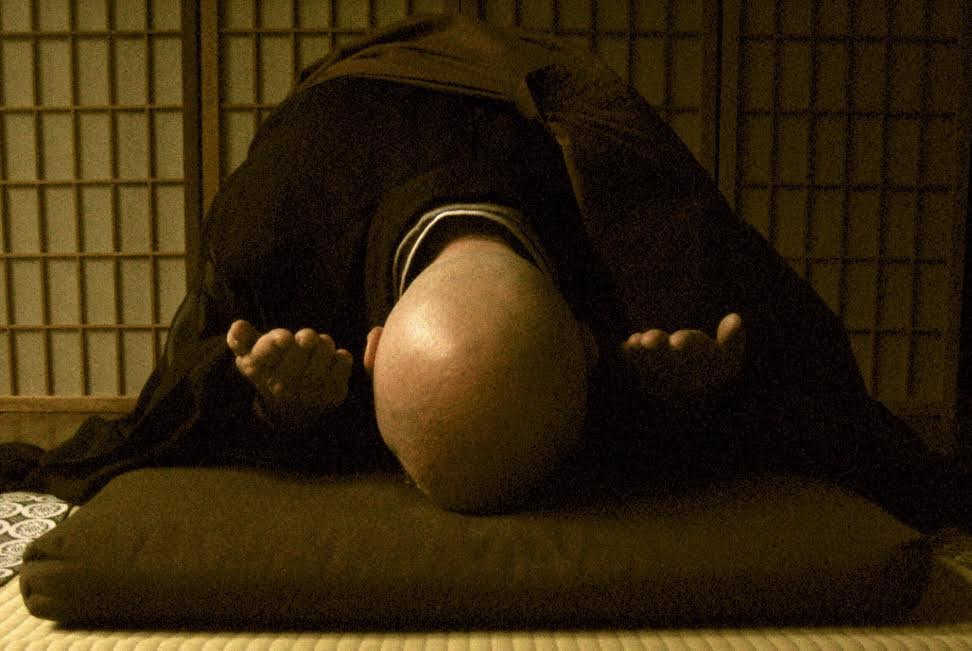
Zen priest Kosho McCall bowing.
(This presentation was first offered by my dear friend Dharma Holder Tom Wardle. He has generously aloud me to reprint it here.)
Tom Wardle is an Executive Coach, Spiritual Director, and Zen Teacher. He holds a Bachelor’s degree from the University of Michigan and an MBA from Hult International Business School. He is also a graduate of the Zen Peacemaker’s Seminary for Socially Engaged Buddhism. Tom is passionate about koan, lay practice, and the integration of the dharma into daily life. He currently teaches with Empty Moon Zen. You can connect with Tom here.)
***
The story of Buddhism coming to the West is a long and ongoing one, and it is important we have some perspective on it because it has greatly coloured our perceptions of what Buddhism is and how it should be practiced.
The history is long and complicated, demanding far more than a brief dharma talk to do it any justice. It has its roots in the latter 19th century, a heady, idealistic and deeply romantic period in Western history. While the Victorian age carried a veneer of conservatism, it was also highly idealistic and experimental. The industrial revolution was in full swing, regularly introducing new technologies that radically changed the lives of Western peoples. Innovations like the steam engine made large scale travel by both land and sea much faster and more accessible. The telegraph enabled communication across distances in ways that seemed almost magical. Industrialization brought about mass urban migration, a trend that continues to this day, and gave rise to corporations in a form we would recognize. Wealth inequality was severe then as now, but the promise of prosperity inspired many.
This was also a time when Western imperialism reached a crescendo, driven by greed and industry’s insatiable appetite for raw materials. While not the subject of this talk, we should all remember the great violence done across South America, Africa, Oceania, and Asia in the name of progress.
In 1854, Japan, a nation that had been almost completely cutoff from the outside world for 250 years, was forcibly opened to the west under threat of violence from the United States. The Americans were quickly followed by the British and the French, and various factions within Japan saw their moment to rise up against the samurai government and the oppressive caste system. There was a bloody war, but the samurai were ultimately defeated and the emperor Meiji restored as head of a modern parliamentary system.
To avoid the horrors inflicted on their Chinese neighbours by western imperial powers, the Japanese adopted nationalism and set about a program of rapid industrialization in order to become an imperial power themselves. In the process, however, great change was necessary, and this began with the construction of a national identity. Buddhism was a Chinese import and subject to aggressive reform and suppression throughout the Meiji period.
It is important to explain here that our Western concepts of religion largely do not apply in Japan. In fact, there was not a native word for the concept of religion as we hold it prior to the arrival of Western missionaries. In Japan, things have always been more fluid. Buddhism had comingled with native belief in kami, gods and divine nature spirits, resulting in a mixture of the two called shinbutsu-shugo, literally “syncretism of kami and buddhas”, or, less charitably “contamination of kami and buddhas”. In Japan, this fluidity between religious systems and practices continues to this day, leading to the contemporary joke that all Japanese are born Shinto, marry Chrsitian, and die Buddhist.
The Meiji government struggled to separate Buddhism from indigenous belief systems but was determined to curtail the power of the monasteries, who had been power brokers throughout history and had often kept large armies of their own. Eventually, Western curiosity about Buddhism would lead the Meiji government to use it as a tool of propaganda, but first it had to be reformed. Laws were passed that required all schools of Buddhism to distinguish themselves through explicit doctrinal differences or else be consolidated.
As applied to Zen, this lead directly to the contemporary misconception that pervades the West that Rinzai do koan and Soto doesn’t, a demonstrable falsehood, historically speaking. As evidence, I offer that not only did Dogen himself write an extensive koan collection, the Shinji Shobogenzo, he may have even held transmission in a Rinzai lineage himself. The picture is nuanced and complicated.
As well as constructing denominational distinctions, total complicity with the Meiji imperialist agenda was prerequisite for all Buddhist clergy, something that would continue through the Second World War and casts shadows across many Zen lineages, including our own. For more on that dark legacy, I refer you to Brian Victoria’s important though controversial book, Zen at War.
Throughout the late Victorian age, there was enormous interest in esoteric ideas, grand theories, and spiritualism, so the ground was ripe for the encounter with Buddhism. The landmark event would be the World Congress of Religions in Chicago in 1893 where Zen quickly became a sensation due to the charisma and fluent English of DT Suzuki, there as translator for his teacher, Soen Shaku. Headed into the conference, Shaku declared “Religion is the only force in which the Western people know that they are inferior to the nations of the East…. Let us wed Buddhism to Western thought… At Chicago next year, the fitting time will come.”
Clearly Shaku and Suzuki had their own agendas. Nonetheless, a meaningful dialogue began that would continue through the 20th century and eventually lead to the “Zen Boom” of the 1950s-1970s. Japanese Zen teachers came to the US, many to initially serve temples in Japanese ethnic enclaves, others specifically to teach Westerners. These men carried varied motivations, but most left behind complex legacies in their native lands. Some fetishized the West much as the West did the East, a case of “the grass being greener.” Others were effectively banished here. At least one was a convicted criminal.
Nonetheless, the engagement between Westerners and Buddhism grew, and inevitably teachings and practices were tailored to the interests of a Western audience. This would lead to many distortions and shifts in emphasis, particularly around meditation, which had traditionally been the purview of monastics. Lay devotees of Zen throughout Japan have typically engaged much more in devotional practices such as prayer, chanting, sutra copying, and making offerings in order to improve their karma. Many hope that by doing so, they will be reborn a monk in future and be able to escape the cycle of suffering from there. Of course, there is also always the hope for blessings here and now.
In the West, we have tended to underprivilege these devotional practices, often looking down upon them as “magical thinking” or just plain foolishness. Perhaps you even noted within yourself a reaction when I brought them up. Good. Stay with that.
Now look, I’m not much of one for any sort of cosmology or magic. While I acknowledge that there are myriad phenomena in this world that I do not understand and may very well be beyond the ken of science and reason, I am very much a rationalist in the Western sense of the word. My father is a physicist and academic; I have a lifelong love of the sciences, and I love to know about things. And that is exactly where the problems start.
Of the three pillars of Zen that are great faith, great doubt, and great effort, I have always preferred the latter two. My dharma name even means “Great Question,” and it is very apt. Faith, however, has been a struggle for me for more reasons than I could politely enumerate here. I’ll spare you. But I do know this: I need it, and for me, faith specifically means bowing.
We are highly individualistic creatures by culture and by nature. If nothing else, I am at the center of my own senses. When you stub your toe, I feel nothing, but when I do, my entire consciousness is coopted by the experience. When you are hungry, again, I feel nothing, but when I am, it becomes increasingly difficult to think of anything else. My experiences insist upon themselves, vivid, urgent, and apparently real. Because it feels like it all comes back to me, I am inevitably the main character of my own story, just as you are of yours. If we are not incredibly careful, we are left feeling like we are the center of the universe.
Meditation can play into this self-centeredness all too easily. I know I started practicing as an exercise in self improvement. As a teenager with a predisposition toward depression, I was clear I needed some work and meditation seemed to make sense. I figured I could fix myself through the practice and become something superior. I’d work out all of my flaws and frustrations with myself, and then this new, superhero self would have a frictionless and glorious life. I figured it would take about five years. I fantasized about flying through the koan curriculum like Koan Jesus, never making a mistake and wowing my teachers with my brilliance. Thank god that isn’t what happened, not at all, and I can see now how intoxicated I was with fantasies about my own splendid specialness.
Those attitudes are the precise opposite of what Zen is about, but they are totally natural. Practiced properly, meditation is an antidote to such thinking, but all too easily it can dangerously reenforce our sense of specialness.
If you have any doubts about how dangerous meditation can be, go read Zen at War, or just look back at the legacy of abuse and hurt left by so many Zen teachers in the last half century. And here’s the really tricky part: some of those abusive, racist bastards were also gifted teachers. Its all so very messy.
Self deception and self-centeredness arise endlessly. Meditation can be a tool to become intimate with these things, to know them when they come knocking and thereby to help us manage them, or it can become another onanistic exercise in self aggrandizement. What do we need to do to tilt it toward intimacy and humility, toward an experience of oneness over selfness?
If we don’t worship something else, we end up worshiping ourselves. We have to submit to something, anything, as greater than ourselves, we have to learn to bow, and we have to keep bowing, because that vivid experience of self insists upon itself relentlessly. It creeps back in again and again, so we must remain vigilant. We can’t do it alone, but Zen provides a toolkit that goes well beyond meditation, and in those other tools, there are refuges for us.
The act of taking refuge is what makes you a Buddhist. It is the act of owning our self-centeredness, of taking responsibility for it, of atoning for the endlessly arising greed, anger, and ignorance that result from the vividness of our personal experience of the world and of this body that always wants for something. We can’t escape it, so we best get real intimate with it so we know it when we meet it. Which we will. Again and again and again.
When we take refuge, we bow to the Buddha, the awakened nature of all beings. That’s how we usually put it, but today I want to invite you to think of bowing to Buddha as acknowledging that every other being experiences things exactly the way you do, struggling with the same self-centeredness, the same craving, the same heartache. In this, we are all the same.
We take refuge in the Dharma, the teachings. The Dharma is how it really is to live this life, my self-centeredness be damned. I may think I get it, but I don’t. I really don’t get it. My views are at best incomplete if not dangerously distorted. If you go read early translations of the sutras, Dharma is often translated as The Law, capital T, capital L. I really like that. I think of it as law in the same sense that gravity is a law: It just is. You can’t fight it.
Bowing to the Dharma, to how things really are, can also reframe our practice of meditation. The Soto missionary Shohaku Okamura reminds us in his brilliant essay, “Those Who Greatly Realize Delusion Are Buddhas”, that “Zazen is not a method of correcting the distortion of our fabricated conceptual maps, but rather is the act of letting go of all maps, and sitting down on the ground of reality. Letting go is at once the complete rejection of any formation arising in our limited karmic mind, and the acceptance of all formations as mere secretions of the mind. We let thoughts come up, and we let them go away. We neither negate nor affirm anything in zazen.”
So I bow. I bow to the Dharma. Again and again.
Finally, and we should never think of the order as any kind of statement of importance or priority, we take refuge in Sangha: The only hope for us is in other beings, in learning from them, being challenged by them, coming to accept them and see them as we see ourselves. If we are to grow beyond our self-centeredness, it must be in community.
So, I invite you, make bowing central to your practice. Do it physically. Do it when you meditate. Bow when you chant, and bow to whatever you encounter in this world. Do it all the time. Just bow. We will all be the better for it.
New Visions
Previous Post
April 17, 2026
STOP THE WAR: Commenting on a Zen koan
Next Post

May 16, 2026 Easy, Right? A Dharma Talk
Recent Comments
"Allowing anger to contaminate one's hard disk can be detrimental to one's holistic well being. ..."
Hot Anger: Meeting Anger in Zen ..."
"I love this koan. every which way you turn it bites you, Thirty years on ..."
Nanquan Cuts the Cat: A Jesuit ..."
"As a substitute for religion, Zen is probably better than taking drugs. However, it can ..."
The Selling of Zen at the ..."
"Craving and aversion are detrimental to one's peace and happiness. Easter is a wake up ..."
Easter: A Zen Buddhist Appreciation
Browse Our Archives
Select a Category A Christmas Carol Abolitionist African-American Ahmadiyya Alan Watts Aldous Huxley Allen Ginsberg Amedkar Jayanti American politics American Zen Anaheim Zen Sangha Anglican Annie Besant April Fool Armageddon Art and Religion artificial intellegence Atheist Awakening B R Ambedkar Barlaam & Josaphat Beatnik Between Bhagavad Gita Bible biography birthday bodhisattva Bodhisattva Precepts Book burning Book of Common Prayer Book of Mormon Brahmo Samaj Buddha Buddhism Buddhist Buddhist Lord's Prayer Butterflies Calendars cartoons cat ChatGPT Chicken Tortilla Soup choices Christian atheism Christian mysticism Christian origins Christian Science Christian Zen Christianity Christianity and Buddhism christmas Christmas Truce Christopher Isherwood Church of Later Day Saints Cinco de Mayo circus covenant critical thinking culture D. T. Suzuki Dalit Buddhism Daniel Defoe Desert Fathers and Mothers dharma talk Dogen Donald Trump Dongshan's Five Ranks Dorothy Day dream Duty Easter ecology Edwin Arnold emptiness Empty Moon Zen Network Episcopal Church Eternal Now Ethics evolution existentialism Faith fantasy Fathers Day film film review fire Five Ranks Folk music food Form and emptiness Four Seals Francis of Assisi Francis Xavier Free thinker friendship George MacDonald Gerald Heard Glenn Taylor Webb God Good Friday Gospel of Gospel of Mark Gospel of Thomas grace Graduate Theological Unioin Graduate Theological Union Guanyin H R Blyth Hakuin Ekaku Hanamatsuri Hanukkah Harada Yasutani Zen Heart Sutra Henry David Thoreau Hermann Hesse Hinduism History and Religion history of religion Holy Spirit home Hospitality Icon Ides of March Isaac Newton Islam Islamic mysticism Jack Kerouac James Luther Adams Jiddu Krishnamurti Joan of Arc Johannes Gutenberg John Donne joke Judaism justice karma kensho King James Bible koan Koun Yamada Kyoto School Lewis Carrol Liberal Christianity Liberal Religion Life Plan Community Liminal literature Literature and Religion Liturgy Lord's Prayer Love Mahatma Gandhi Mahayana Martin Luther King Jr Mary Baker Eddy Mary Magdelene Mary Oliver Mayflower Compact Meditation memories memory metaphor money money and religioin Mormons Mother's Day movie review mysticism mythic Neighborhood Unitarian Universalist Church New Thought Nichiren Buddhism Nonduality not knowing Omar Khayyam Pacific School of Religion pagan Palm Sunday Passover peace Pentecost perennialism Phantastes Philip Kapleau philosophy Pilgrimage poetry Poetry and Religion politics Prayer Precepts Printing Press prophecy prophetic spirituality psychology Pure Land Queer religion queering religion Quietism Ram Mohan Roy rebirth recipe Relationships and religion religion religion and history Religious syncretism Resistance Retirement Retreat review Rissho Kosei Kai Ritual Robert Aitken Roshi Robert Ingersoll Rohatsu Romani religion Rosie the Riveter saints samadhi SanboZen Sangha Satyagraha science science and reigion science and religion science fiction seminary sermon Sesshin Sex and Religion Shinran Sikh Sikh tradition silence Social Justice Socially Engaged Buddhism Society and religion Soto Zen soul spiritual community spiritual practice Spirituality Sufism Suicide superstition Taoism Television Teresa of Avila Thanksgiving theological schools Theosophy Thomas Merton Time Transcendentalism Transcendentalist Trinitarian Trinity Uncategorized unitarian Unitarian Christianity Unitarian Universalist Universalism Vajrayana Vedanta Walking war Willa Cather William Ellery Channing wisdom women and religion women in religion World Teacher Writing zazen Zen Zen Center Zen inspired retriement zen meditation Zen Precepts Zen women
Select a Month September 2026 August 2026 July 2026 June 2026 May 2026 April 2026 March 2026 February 2026 January 2026 December 2025 November 2025 October 2025 September 2025 August 2025 July 2025 June 2025 May 2025 April 2025 March 2025 February 2025 January 2025 December 2024 November 2024 October 2024 September 2024 August 2024 July 2024 June 2024 May 2024 April 2024 March 2024 February 2024 January 2024 December 2023 November 2023 October 2023 September 2023 August 2023 July 2023 June 2023 May 2023 April 2023 March 2023 February 2023 January 2023 December 2022 November 2022 October 2022 September 2022 August 2022 July 2022 June 2022 May 2022 April 2022 March 2022 February 2022 January 2022 December 2021 November 2021 October 2021 September 2021 August 2021 July 2021 June 2021 May 2021 April 2021 March 2021 February 2021 January 2021 December 2020 November 2020 October 2020 September 2020 August 2020 July 2020 June 2020 May 2020 April 2020 March 2020 February 2020 January 2020 December 2019 November 2019 October 2019 September 2019 August 2019 July 2019 June 2019 May 2019 April 2019 March 2019 February 2019 January 2019 December 2018 November 2018 October 2018 September 2018 August 2018 July 2018 June 2018 May 2018 April 2018 March 2018 February 2018 January 2018 December 2017 November 2017 October 2017 September 2017 August 2017 July 2017 June 2017 May 2017 April 2017 March 2017 February 2017 January 2017 December 2016 November 2016 October 2016 September 2016 August 2016 July 2016 June 2016 May 2016 April 2016 March 2016 February 2016 January 2016 December 2015 November 2015 October 2015 September 2015 August 2015 July 2015 June 2015 May 2015 April 2015 March 2015 February 2015 January 2015 December 2014 November 2014 October 2014 September 2014 August 2014 July 2014 June 2014 May 2014 April 2014 March 2014 February 2014 January 2014 December 2013 November 2013 October 2013 September 2013 August 2013 July 2013 June 2013 May 2013 April 2013 March 2013 February 2013 January 2013 December 2012 November 2012 October 2012 September 2012 August 2012 July 2012 June 2012 May 2012 April 2012 March 2012 February 2012 January 2012 December 2011 November 2011 October 2011 September 2011 August 2011 July 2011 June 2011 May 2011 April 2011 March 2011 February 2011 January 2011 December 2010 November 2010 October 2010 September 2010 August 2010 July 2010 June 2010 May 2010 April 2010 March 2010 February 2010 January 2010 December 2009 November 2009 October 2009 September 2009 August 2009 July 2009 June 2009 May 2009 April 2009 March 2009 February 2009 January 2009 December 2008 November 2008 October 2008 September 2008 August 2008 July 2008 June 2008 May 2008 April 2008 March 2008 February 2008 January 2008 December 2007 November 2007 October 2007 September 2007 August 2007 July 2007 June 2007 May 2007 April 2007 March 2007 February 2007 January 2007 December 2006 November 2006 October 2006 September 2006
Follow Us!
TAKE THE
Religious Wisdom Quiz
What Christian group is known for avoiding modern technology?
Select your answer to see how you score.
Baptists Methodists Pentecostals Amish
Related posts from Monkey Mind

Keizan Jokin: The Zen Master Ancestor You Don't...

What Zen Practice Actually Does With Anger

Nanquan Cuts the Cat: A Jesuit commentary on...

On Taking Refuge in the Dharma
TRENDING AT PATHEOS Buddhist

I was strolling through the top floor of the brand new Parthenon...

What Does Gêvâh Mean For Kimberley Guifoyle &...
This week, a lot of the news is focused on Kimberly Guilfoyle....

INNER CIRCLE: Profound Mystery (Of Christ In All...
Ephesians 5:31-32 “For this reason, a man will leave his father and...

Do Not Rejoice When Your Enemy Falls: The...
Turning an execution into a public spectacle is a disturbing expression of...

'The Chosen' S6 Trailer: The Passion Gets Very...
Not many watching 'The Chosen' worry about spoilers, but just because they...

The purpose-driven labor priest
A labor activist reads Rick Warren and it gets me wondering about...
view all Buddhist blogs
What Are Your Thoughts?leave a comment
Ad-Free & Subscriber Log-In Subscription Support
- About Us
- 2026 Calendar
- Videos
- Podcasts
- Library of World Religions
- Faith In Media Tracker
- Advertise With Us
- Write for Us
- Privacy Policy
- Terms of Service
- Do Not Sell My Data
- Contact Us
- Radiant Digital
- Manage Newsletter Subscriptions
- Unsubscribe From Notifications
- Sitemap
Copyright 2008-2026, Patheos. All rights reserved.
Subscription Support Ad-Free & Subscriber Log-In
Follow Patheos