
BuddhistCatholicContemplativeEvangelicalGeneral ChristianHinduJewishLatter-day SaintMuslimNew VisionsProgressive Christian
Beliefs
- Buddhist
- Catholic
- Contemplative
- Evangelical
- General Christian
- Hindu
- Jewish
- Latter-day Saint
- More Voices
- Muslim
- New Visions
- Pagan
- Progressive Christian
Topics
- Religion News
- Food and Religion
- Sports and Religion
- Religious Art
- Religious Music and Entertainment
- Religious Events
- History and Religion
- Style and Religion
- Politics and Religion
- Women in Religion
- Recreation Outdoors and Religion
- Business Finance and Religion
- Careers Workplace and Religion
- Education and Religion
- Family Parenting and Religion
- Health Fitness and Religion
- Home and Religion
- Relationships and Religion
- Technology and Religion
- Travel and Religion
Columnists
- Buddhist Columnists
- Business Finance and Religion Columnists
- Careers Workplace and Religion Columnists
- Catholic Columnists
- Contemplative Columnists
- Education and Religion Columnists
- Evangelists Columnists
- Family Parenting and Religion Columnists
- General Christian Columnists
- Health Fitness and Religion Columnists
- Hindu Columnists
- History and Religion Columnists
- Home and Religion Columnists
- Jewish Columnists
- More Voices Columnists
- Latter Day Columnists
- Muslim Columnists
- New Visions Columnists
- Nonreligious Columnists
- Pagan Columnists
- Politics and Religion Columnists
- Progressive Columnists
- Recreation Outdoors and Religion Columnists
- Relationships and Religion Columnists
- Religion News Columnists
- Religious Art Columnists
- Religious Events Columnists
- Religious Music and Entertainment Columnists
- Sports and Religion Columnists
- Style and Religion Columnists
- Technology and Religion Columnists
- Travel and Religion Columnists
- Women in Religion Columnists
Resource Library
- 2026 Calendar
- Library of World Religions
- The 100 Most Holy Places on Earth
- Patheos Answers
- Podcasts
- Videos
- Faith Leaders Database
- Anglican Episcopalian
- Bahai
- Baptist
- Buddhism
- Christianity
- Confucianism
- Eastern Orthodoxy
- Hinduism
- Holiness and Pentecostal
- ISKCON
- Islam
- Judaism
- Lutheran
- Methodist
- The Church of Jesus Christ of Latter-day Saints
- New Age
- Paganism
- Presbytarian and Reformed
- Protestantism
- Religion Behind the Scenes
- Roman Catholic
- Scientology
- Shia Islam
- Sikhism
- Sufism
- Sunni Islam
- Taoism
- Zen
- See all religions
Research Tools
 Ad-Free & Subscriber Log-In Subscription Support
Ad-Free & Subscriber Log-In Subscription Support
Follow Patheos 

- Trending:
- Forgiveness
- |
- Marriage
- |
- Consciousness
- |
- Death Penalty
- |
- Election
- |
- Halloween

- Home
- Buddhist
- Politics and Religion
- A Zen Buddhist Response to this Moment
A Zen Buddhist Response to this Moment
Last updated on: February 8, 2026 at 8:22 am by James Ford
A Zen Buddhist Response to this Moment 2026-02-08T08:22:13-08:00 James Ford
Patheos Explore the world's faith through different perspectives on religion and spirituality! Patheos has the views of the prevalent religions and spiritualities of the world.
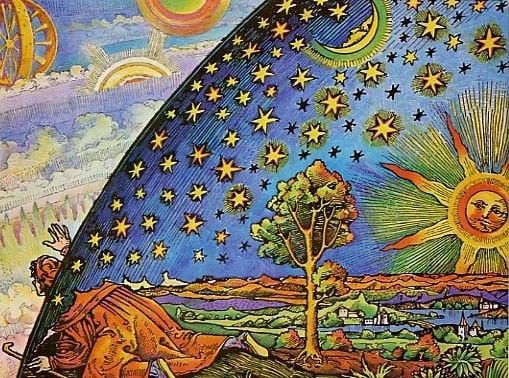
Flammarion Engraving
(The following is a Dharma talk delivered by Dharma Holder Thomas Wardle of the Empty Moon Zen community. Reprinted here with his generous consent.)
If you don’t know the kind of person I am
and I don’t know the kind of person you are
a pattern that others made may prevail in the world
and following the wrong god home we may miss our star.
For there is many a small betrayal in the mind,
a shrug that lets the fragile sequence break
sending with shouts the horrible errors of childhood
storming out to play through the broken dyke.
And as elephants parade holding each elephant’s tail,
but if one wanders the circus won’t find the park,
I call it cruel and maybe the root of all cruelty
to know what occurs but not recognize the fact.
And so I appeal to a voice, to something shadowy,
a remote important region in all who talk:
though we could fool each other, we should consider—
lest the parade of our mutual life get lost in the dark.
For it is important that awake people be awake,
or a breaking line may discourage them back to sleep;
the signals we give – yes or no, or maybe—
should be clear: the darkness around us is deep.
“A Ritual to Read to Each Other” by William Stafford, from The Way It Is: New and Selected Poems © Graywolf Press.
This deep darkness around us all has been a frequent topic in our sangha lately. There is much in our nation and our world that is deeply upsetting, and it leaves us all struggling with how to carry this pain and what we should do. I am struggling with this also, and so today, I’d like to share a little about how I am trying to practice with this and what I have noticed in my own heart.
When I look at our world today, I often struggle to see it as anything other than a world of hurt. Often, it seems that the hurt is caused by us, and my heart breaks. Practice begins when I notice this view. While allowing for that pain, I try to remember that this is just a view, and it depends mightily on where I stand. I try to remember that there are other views to be had.
One of the things that helps me remember comes from the first chapter of the Vimalakirti Sutra, one of the very few texts about a lay practitioner. In the first chapter, the Buddha is hanging out with his disciples and Shariputra asks: “So, you are a Buddha, right?”
“Yes.”
“And all Buddhas have their own Buddha realms?”
“Correct.”
“So that means that all of this is YOUR Buddha realm, then, right?”
“Yes.”
Shariputra looks around: “Uhm… Don’t you think you could have done a little better?”
The Buddha replies, “It is just that your mind has highs and lows and does not rest on Buddha wisdom. Therefore you see this land as impure. Shariputra, the bodhisattva treats all things and beings, each one of them, with perfect equality.” At this point, the Buddha touches the ground with his toe and this world, our world, is revealed to be adorned with countless jewels, The Jeweled Adornment Land of Immeasurable Blessings.
The Vimalakirti Sutra reminds me that the dharma includes everyone. No one and no thing is left out.
Especially when I can’t see it, I try to keep that in mind, even as I care for my breaking heart, and I return to my root practice of paying attention.
When I do, one of the things I keep noticing is fear.
Whether thinking about Ukraine or Greenland, Venezuela or Minnesota, I see and experience so much fear.
I fear for our allies and our alliances, I fear for my friends and family. In this moment, I particularly fear for immigrants, people of colour, and our transgender family. I fear for the future of our nation and this fragile world.
Sometimes, I fear for myself.
Perhaps you share some of these fears. Perhaps you have a few more to add to the list.
In East Asian Buddhism, fear is associated with the hell realms. You may be surprised to learn that Buddhism has the most elaborate and extensive system of hells of any religion, including both hot and cold hells. While I am not much one for constructionism or cosmology, I think this offers us an important pointer: Fear is a sign that we are suffering deeply, like a being trapped in hell.
Without getting into the gory details (and they are very gory, by the way) the hell realms are defined by immense suffering, and it is an observable fact that suffering, when it gets the better of us, tends to divide us, driving us toward us & them thinking. If I am not careful, I can find myself making judgements about whose pain is legitimate and whose is not.
Fear and pain can make us self-centered, shrinking our circle of compassion to ourselves and those with whom we identify while excluding those with whom we do not, especially if we perceive them to be the cause of our fear or our pain.
Already, we are completely lost in stories.
Stories are powerful. Stories are how we understand the world and ourselves. You might say that stories are all we have. I’d rather say that stories are all we are.
Some stories facilitate a kind of intimacy and connection, while others do the opposite, but Zen suggests that true intimacy is found when we cast aside our stories and open our hearts to the whole mess, letting them break if need be.
When we realize that our identities are just stories, that all the categories and characteristics that we use to describe ourselves and differentiate ourselves from others are ultimately meaningless, we find that we are actually empty. Within this emptiness lies a profound experience of oneness with all that is, even those we disagree with, those we don’t like.
Even those we hate.
Even those we fear.
All one family, sheltering under a single tent as the storm rages.
Zenkei Shibayama gives us a good pointer to this deep intimacy: “If you take up a flower, you yourself are a flower; if you see a mountain, you yourself are a mountain; if you look at a pillar, you yourself are a pillar through and through.”
To this I would add, “When you see an ICE agent, you yourself are an ICE agent through and through.”
It is easy to be critical of those working for ICE, all too easy to judge, and parts of me do. Parts of me hurt and rage and talk a bluestreak of shit, but that doesn’t have to be a problem. Zen doesn’t ask us to be perfect, and as I understand it, the goal of practice isn’t to purge these kinds of thoughts and replace them with something nicer. Rather, I think of Zen as a kind of radical responsibility, so I try to take responsibility for those thoughts. They aren’t personal, after all. Thoughts like these arise for myriad reasons, unknowable causes and conditions. My thoughts are not a statement about my character, but what I do with them is.
If you get serious about Zen, you find yourself making a lot of vows. Those vows are not to never have impure thoughts, nor are they to only think good thoughts. For me, those vows basically come down to two things: Taking responsibility for myself, and being useful in this world.
One of my teachers used to say, “Don’t ask if you are stuck, ask where you are stuck.” Our vows can help us keep an eye on the sticky places, and one of the things that helps me remember my vows is remembering that I don’t know.
As objectionable as I may find the actions of ICE, I try to remember that I don’t know who those agents are and I don’t know their stories. From that not knowing, I can imagine other stories, ones that support my vows and help me to see these others as myself.
“He is the same as me, yet I am not he.”
I have found it helpful to remember that some people join ICE to stop the flow of drugs into this country. Some people join ICE to stop human trafficking. I wonder, how might those agents feel being reassigned to hyper-politicized, xenophobic, racist immigration enforcement operations?
There are a lot of very good reasons to criticize law enforcement in this country.
We can do better.
We must do better.
But can we acknowledge that even the puerile “stopping bad guys” motivation has at least some good intention in it?
I want to tell you a secret: Every law enforcement officer in America is terrified. There is a tragic irony here. Many of us object deeply to the gun culture of this country, and with good reason. Law enforcement officers are subject to the consequences of that culture every single day, and they know acutely that any encounter, no matter how banal, could abruptly involve a gun.
They are afraid. Deeply, deeply afraid.
In fact, if you learn about police training, what you find out is that they have been taught to be afraid. To be afraid of everybody and everything. To be afraid that any situation could turn lethal in an instant.
Fear has us all in its grip, and it was behind the deaths of both Renee Good and Alex Pretti.
Did you know that the agent who shot Renee Goode had been dragged by a car in another incident in June?
Fear.
Alex Pretti had a gun. Not in his hand, but on his body.
Fear.
If you look into it, you’ll find that it wasn’t just any gun. It was a customized gun, heavily modified and equipped with a number of features that would make it much more effective for killing. Why? Fear.
It is also a model that is deeply controversial for accidental discharge. Whether this is true or not is still a subject of fraught debate, but multiple law enforcement agencies around the country had already banned the use of that specific gun because of concerns over accidental, unintentional discharge of the weapon. There are hundreds of such reports, and the manufacturer has been sued by police departments and the State of New Jersey, amongst many others.
I’m not going to pretend that I know anything about what actually happened in those moments that led to Alex Pretti’s death, but I see fear all over it.
The fear that motivated him to bring the gun in the first place.
The fear that motivated the officers in their actions.
What fear must law enforcement officers experience, vastly outnumbered as they face crowds of angry people screaming at them and insulting them?
If you can’t admit that facing an angry crowd is fundamentally scary and threatening, then maybe think back to the last time you saw footage of a MAGA rally.
Fear is everywhere in our world right now, and actions taken out of fear tend to only cause more harm. Fear is also a marker of suffering and pain, and perhaps remembering that can help us to open our hearts just a little.
That is a lot to ask.
If you find it too much, can you open to curiosity instead?
I am a big believer in the power of curiosity. Curiosity can lead to intimacy, to connection, and from that intimacy, amazing things are possible.
One of my biggest role models is Daryl Davis, and you may have heard me speak about him before. I think about him almost every day. Daryl is a black man who has helped over 200 people to leave the Ku Klux Klan, and the way he has done this is absolutely extraordinary: by being curious. After his first experience of racism during a public march with his boyscout troop as a child, he was left with the question “How can they hate me if they don’t even know me?”
Daryl went on to become a professional musician, and he held onto that question. It guided him to ask a question of his own one night when a white man paid him a backhanded compliment after a performance. That question led to a conversation, and that conversation eventually revealed that this man was a member of the Ku Klux Klan.
It could have ended there. Daryl could have recoiled in disgust. He could have quite justifiably feared for his life and fled, but he didn’t. Daryl kept talking with the Klansman, and he kept listening, even when he heard things he disagreed with or found ignorant. They ended the night by exchanging contact information, and their relationship developed from there over years, a friendship that would lead to encounters with other klan members. Eventually, Daryl found himself attending klan rallies as the personally invited guest of the Grand Dragon for the state, a man who later became the Klan’s national leader. Despite the obvious risk to his life, Daryl maintained that friendship for 16 years, and eventually that man left the Klan entirely. Through it all, Daryl maintained dialogue, and critically, he was willing to listen and to keep listening, even when something ignorant or hateful was said. He literally invited killers to his table and kept company with them, and for hundreds, it opened their hearts. I can only aspire to that level of bravery.
Now I want to be clear that I am not trying to tell you what you should do, but I am asking you to pay attention. Please, pay attention to how you do what you do. Pay attention to what you say and how you say it. Pay attention to how you treat everyone and pay attention to the stories you tell yourself.
Pay attention to your values and your vows.
And pay attention to the fear, because we are all feeling it together.
Now that I’m done, please take the first opportunity to wash out your ears.
New Visions
Politics and Religion
History and Religion
Previous Post

January 31, 2026
Thomas Merton, Interfaith saint
Next Post

February 21, 2026 Zen and the Broken Places
Recent Comments
"Allowing anger to contaminate one's hard disk can be detrimental to one's holistic well being. ..."
Hot Anger: Meeting Anger in Zen ..."
"I love this koan. every which way you turn it bites you, Thirty years on ..."
Nanquan Cuts the Cat: A Jesuit ..."
"As a substitute for religion, Zen is probably better than taking drugs. However, it can ..."
The Selling of Zen at the ..."
"Craving and aversion are detrimental to one's peace and happiness. Easter is a wake up ..."
Easter: A Zen Buddhist Appreciation
Browse Our Archives
Select a Category A Christmas Carol Abolitionist African-American Ahmadiyya Alan Watts Aldous Huxley Allen Ginsberg Amedkar Jayanti American politics American Zen Anaheim Zen Sangha Anglican Annie Besant April Fool Armageddon Art and Religion artificial intellegence Atheist Awakening B R Ambedkar Barlaam & Josaphat Beatnik Between Bhagavad Gita Bible biography birthday bodhisattva Bodhisattva Precepts Book burning Book of Common Prayer Book of Mormon Brahmo Samaj Buddha Buddhism Buddhist Buddhist Lord's Prayer Butterflies Calendars cartoons cat ChatGPT Chicken Tortilla Soup choices Christian atheism Christian mysticism Christian origins Christian Science Christian Zen Christianity Christianity and Buddhism christmas Christmas Truce Christopher Isherwood Church of Later Day Saints Cinco de Mayo circus covenant critical thinking culture D. T. Suzuki Dalit Buddhism Daniel Defoe Desert Fathers and Mothers dharma talk Dogen Donald Trump Dongshan's Five Ranks Dorothy Day dream Duty Easter ecology Edwin Arnold emptiness Empty Moon Zen Network Episcopal Church Eternal Now Ethics evolution existentialism Faith fantasy Fathers Day film film review fire Five Ranks Folk music food Form and emptiness Four Seals Francis of Assisi Francis Xavier Free thinker friendship George MacDonald Gerald Heard Glenn Taylor Webb God Good Friday Gospel of Gospel of Mark Gospel of Thomas grace Graduate Theological Unioin Graduate Theological Union Guanyin H R Blyth Hakuin Ekaku Hanamatsuri Hanukkah Harada Yasutani Zen Heart Sutra Henry David Thoreau Hermann Hesse Hinduism History and Religion history of religion Holy Spirit home Hospitality Icon Ides of March Isaac Newton Islam Islamic mysticism Jack Kerouac James Luther Adams Jiddu Krishnamurti Joan of Arc Johannes Gutenberg John Donne joke Judaism justice karma kensho King James Bible koan Koun Yamada Kyoto School Lewis Carrol Liberal Christianity Liberal Religion Life Plan Community Liminal literature Literature and Religion Liturgy Lord's Prayer Love Mahatma Gandhi Mahayana Martin Luther King Jr Mary Baker Eddy Mary Magdelene Mary Oliver Mayflower Compact Meditation memories memory metaphor money money and religioin Mormons Mother's Day movie review mysticism mythic Neighborhood Unitarian Universalist Church New Thought Nichiren Buddhism Nonduality not knowing Omar Khayyam Pacific School of Religion pagan Palm Sunday Passover peace Pentecost perennialism Phantastes Philip Kapleau philosophy Pilgrimage poetry Poetry and Religion politics Prayer Precepts Printing Press prophecy prophetic spirituality psychology Pure Land Queer religion queering religion Quietism Ram Mohan Roy rebirth recipe Relationships and religion religion religion and history Religious syncretism Resistance Retirement Retreat review Rissho Kosei Kai Ritual Robert Aitken Roshi Robert Ingersoll Rohatsu Romani religion Rosie the Riveter saints samadhi SanboZen Sangha Satyagraha science science and reigion science and religion science fiction seminary sermon Sesshin Sex and Religion Shinran Sikh Sikh tradition silence Social Justice Socially Engaged Buddhism Society and religion Soto Zen soul spiritual community spiritual practice Spirituality Sufism Suicide superstition Taoism Television Teresa of Avila Thanksgiving theological schools Theosophy Thomas Merton Time Transcendentalism Transcendentalist Trinitarian Trinity Uncategorized unitarian Unitarian Christianity Unitarian Universalist Universalism Vajrayana Vedanta Walking war Willa Cather William Ellery Channing wisdom women and religion women in religion World Teacher Writing zazen Zen Zen Center Zen inspired retriement zen meditation Zen Precepts Zen women
Select a Month September 2026 August 2026 July 2026 June 2026 May 2026 April 2026 March 2026 February 2026 January 2026 December 2025 November 2025 October 2025 September 2025 August 2025 July 2025 June 2025 May 2025 April 2025 March 2025 February 2025 January 2025 December 2024 November 2024 October 2024 September 2024 August 2024 July 2024 June 2024 May 2024 April 2024 March 2024 February 2024 January 2024 December 2023 November 2023 October 2023 September 2023 August 2023 July 2023 June 2023 May 2023 April 2023 March 2023 February 2023 January 2023 December 2022 November 2022 October 2022 September 2022 August 2022 July 2022 June 2022 May 2022 April 2022 March 2022 February 2022 January 2022 December 2021 November 2021 October 2021 September 2021 August 2021 July 2021 June 2021 May 2021 April 2021 March 2021 February 2021 January 2021 December 2020 November 2020 October 2020 September 2020 August 2020 July 2020 June 2020 May 2020 April 2020 March 2020 February 2020 January 2020 December 2019 November 2019 October 2019 September 2019 August 2019 July 2019 June 2019 May 2019 April 2019 March 2019 February 2019 January 2019 December 2018 November 2018 October 2018 September 2018 August 2018 July 2018 June 2018 May 2018 April 2018 March 2018 February 2018 January 2018 December 2017 November 2017 October 2017 September 2017 August 2017 July 2017 June 2017 May 2017 April 2017 March 2017 February 2017 January 2017 December 2016 November 2016 October 2016 September 2016 August 2016 July 2016 June 2016 May 2016 April 2016 March 2016 February 2016 January 2016 December 2015 November 2015 October 2015 September 2015 August 2015 July 2015 June 2015 May 2015 April 2015 March 2015 February 2015 January 2015 December 2014 November 2014 October 2014 September 2014 August 2014 July 2014 June 2014 May 2014 April 2014 March 2014 February 2014 January 2014 December 2013 November 2013 October 2013 September 2013 August 2013 July 2013 June 2013 May 2013 April 2013 March 2013 February 2013 January 2013 December 2012 November 2012 October 2012 September 2012 August 2012 July 2012 June 2012 May 2012 April 2012 March 2012 February 2012 January 2012 December 2011 November 2011 October 2011 September 2011 August 2011 July 2011 June 2011 May 2011 April 2011 March 2011 February 2011 January 2011 December 2010 November 2010 October 2010 September 2010 August 2010 July 2010 June 2010 May 2010 April 2010 March 2010 February 2010 January 2010 December 2009 November 2009 October 2009 September 2009 August 2009 July 2009 June 2009 May 2009 April 2009 March 2009 February 2009 January 2009 December 2008 November 2008 October 2008 September 2008 August 2008 July 2008 June 2008 May 2008 April 2008 March 2008 February 2008 January 2008 December 2007 November 2007 October 2007 September 2007 August 2007 July 2007 June 2007 May 2007 April 2007 March 2007 February 2007 January 2007 December 2006 November 2006 October 2006 September 2006
Follow Us!
TAKE THE
Religious Wisdom Quiz
Who led the Israelites into the Promised Land?
Select your answer to see how you score.
Aaron Moses Joshua Caleb
Related posts from Monkey Mind



The Suchness of Crows: The Zen teachings of...
Considering some Spiritual Roots of the American Experiment
TRENDING AT PATHEOS Buddhist

I was strolling through the top floor of the brand new Parthenon...

What Does Gêvâh Mean For Kimberley Guifoyle &...
This week, a lot of the news is focused on Kimberly Guilfoyle....

INNER CIRCLE: Profound Mystery (Of Christ In All...
Ephesians 5:31-32 “For this reason, a man will leave his father and...

Do Not Rejoice When Your Enemy Falls: The...
Turning an execution into a public spectacle is a disturbing expression of...

'The Chosen' S6 Trailer: The Passion Gets Very...
Not many watching 'The Chosen' worry about spoilers, but just because they...

The purpose-driven labor priest
A labor activist reads Rick Warren and it gets me wondering about...
view all Buddhist blogs
What Are Your Thoughts?leave a comment
Ad-Free & Subscriber Log-In Subscription Support
- About Us
- 2026 Calendar
- Videos
- Podcasts
- Library of World Religions
- Faith In Media Tracker
- Advertise With Us
- Write for Us
- Privacy Policy
- Terms of Service
- Do Not Sell My Data
- Contact Us
- Radiant Digital
- Manage Newsletter Subscriptions
- Unsubscribe From Notifications
- Sitemap
Copyright 2008-2026, Patheos. All rights reserved.
Subscription Support Ad-Free & Subscriber Log-In
Follow Patheos