
BuddhistCatholicContemplativeEvangelicalGeneral ChristianHinduJewishLatter-day SaintMuslimNew VisionsProgressive Christian
Beliefs
- Buddhist
- Catholic
- Contemplative
- Evangelical
- General Christian
- Hindu
- Jewish
- Latter-day Saint
- More Voices
- Muslim
- New Visions
- Pagan
- Progressive Christian
Topics
- Religion News
- Food and Religion
- Sports and Religion
- Religious Art
- Religious Music and Entertainment
- Religious Events
- History and Religion
- Style and Religion
- Politics and Religion
- Women in Religion
- Recreation Outdoors and Religion
- Business Finance and Religion
- Careers Workplace and Religion
- Education and Religion
- Family Parenting and Religion
- Health Fitness and Religion
- Home and Religion
- Relationships and Religion
- Technology and Religion
- Travel and Religion
Columnists
- Buddhist Columnists
- Business Finance and Religion Columnists
- Careers Workplace and Religion Columnists
- Catholic Columnists
- Contemplative Columnists
- Education and Religion Columnists
- Evangelists Columnists
- Family Parenting and Religion Columnists
- General Christian Columnists
- Health Fitness and Religion Columnists
- Hindu Columnists
- History and Religion Columnists
- Home and Religion Columnists
- Jewish Columnists
- More Voices Columnists
- Latter Day Columnists
- Muslim Columnists
- New Visions Columnists
- Nonreligious Columnists
- Pagan Columnists
- Politics and Religion Columnists
- Progressive Columnists
- Recreation Outdoors and Religion Columnists
- Relationships and Religion Columnists
- Religion News Columnists
- Religious Art Columnists
- Religious Events Columnists
- Religious Music and Entertainment Columnists
- Sports and Religion Columnists
- Style and Religion Columnists
- Technology and Religion Columnists
- Travel and Religion Columnists
- Women in Religion Columnists
Resource Library
- 2026 Calendar
- Library of World Religions
- The 100 Most Holy Places on Earth
- Patheos Answers
- Podcasts
- Videos
- Faith Leaders Database
- Anglican Episcopalian
- Bahai
- Baptist
- Buddhism
- Christianity
- Confucianism
- Eastern Orthodoxy
- Hinduism
- Holiness and Pentecostal
- ISKCON
- Islam
- Judaism
- Lutheran
- Methodist
- The Church of Jesus Christ of Latter-day Saints
- New Age
- Paganism
- Presbytarian and Reformed
- Protestantism
- Religion Behind the Scenes
- Roman Catholic
- Scientology
- Shia Islam
- Sikhism
- Sufism
- Sunni Islam
- Taoism
- Zen
- See all religions
Research Tools
 Ad-Free & Subscriber Log-In Subscription Support
Ad-Free & Subscriber Log-In Subscription Support
Follow Patheos 

- Trending:
- Forgiveness
- |
- Marriage
- |
- Consciousness
- |
- Death Penalty
- |
- Election
- |
- Halloween

- Home
- Buddhist
- Xiangyan’s Up a Tree: Meditation on a Zen Koan
Xiangyan’s Up a Tree: Meditation on a Zen Koan
Last updated on: February 22, 2025 at 6:00 am by James Ford
Xiangyan’s Up a Tree: Meditation on a Zen Koan 2024-12-15T13:28:23-08:00 James Ford
Patheos Explore the world's faith through different perspectives on religion and spirituality! Patheos has the views of the prevalent religions and spiritualities of the world.
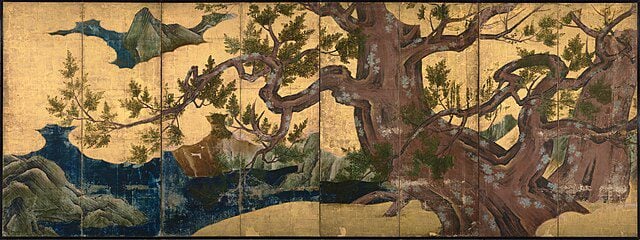
Cypress Trees
attributed to Kanō Eitoku
1590
(At our Empty Moon Zen Rohatsu retreat at the end of the year there were several outstanding talks on our intimate way. I’ve asked the speakers if I could reprint them at my blog, and each graciously agreed. Here I offer the last of these, this from Thomas Wardle, a Dharma Holder within our Zen lineage.)
The Case:
The priest Xiangyan (Kyogen) said, “It is as though you were up in a tree, hanging from a branch with your teeth. Your hands and feet can’t touch any branch. Someone appears beneath the tree and asks, ‘What is the meaning of Bodhidharma’s coming from the West?’ If you do not answer, you evade your responsibility. If you do answer, you lose your life. What do you do?”
A Comment:
Even though your eloquence flows like a river, it is all to no avail. Even if you can expound the Great Tripitaka, it is also of no use. If you can really answer it, you will revive the dead and kill the living. If, however, you are unable to answer, wait for Maitreya to come and ask him.
The Verse:
Xiangyan is just blabbing nonsense;
His poisonous intentions are limitless.
He stops up the monks’ mouths,
Making his whole body a demon eye.
Gateless Gate, Case 5
Zen is a great experiment, one of the longest-running in human history, and each of you are active participants.
Zen is an experiment in awakening, in what it means to live this strange human life, and the koan literature we inherit from our ancestors are field notes in this experiment. Each case is a story of awakening and an invitation to experience that awakening for ourselves.
Awakening is just an experience, and like all experiences, it is fleeting, so it can be useful to practice remembering what it is like to be in that place where the veil becomes thin, down becomes up, empty full, and the separation between you, me, and all beings falls away. Koan invite us to find awakening again and again, first right here, then over there, then from underneath a rock, atop a mountain, or in this case, dangling precariously from a branch, high up in a tree.
If you are not already practicing koan but are interested, first seek stability in your own practice. As James often reminds us, awakening is an accident, and our practice makes us accident prone. So build a practice for yourself, and I would encourage you to start small. Five minutes a day is a good beginning. Do not punish yourself. Instead, nurture it and let it grow naturally, over time. Participating in community is also an important part of practice, so I encourage you to seek out other practitioners and join together in the grand experiment that is Zen. Find a teacher and speak to them about koan. You may have several such opportunities during this retreat. Please don’t miss them.
Koan are invitations to intimacy. Our way is to study a curriculum of koan, but historically it was perhaps even more common to spend one’s whole life working with a single case. Their depths are bottomless, just like yours, and while we all have our affinities for certain koan over others, each case is a complete path, so I invite you to get curious whenever a koan seems flat or thin to you.
This case invites you to find your life in a tree and in a question, but honestly it asks a pretty weird question: “What is the meaning of Bodhidharma coming from the West?”
Well, what the hell does that mean? You could be forgiven for feeling it is a bit abstruse, but listen again, listen to the heart-longing, to the desperate sincerity of the asker: “What is the meaning of Bodhidharma coming from the West?”
This koan comes to us from China by way of Japan, and as such, it is translated from languages radically different from our own. A translation of a translation in fact, passed from mouth to mouth through centuries, traversing thousands of miles just to reach you.
Translation is more art than science, and it can be helpful sometimes to look at different translations. David Hinton renders this question as “That ch’i mind Bodhidharma brought from the West: what is it?” Perhaps that is helpful to you, but don’t let this become an intellectual exercise or one of definitions. I invite you to make the question your own. The words don’t matter too much. In the end, there is really only one question, and the whole world asks it. It is beyond words, but if you listen carefully, your heart will hear it.
Do you hear?
Good. Now, who hears?
The question is critically important, and we must explore the matter deeply, but this case first puts us up a tree. Dangling by our teeth with no limbs in reach, we are stuck. Trapped. This is an example of a “No Way Out” case, and you best get used to it, because it is a common device in koan. And koan are just microcosms of our lives, the whole universe reduced to a short story, small but complete unto itself, reflecting the very essence of our lives. Indeed our lives are just like this: no way out.
The invitation of koan is to awaken, and the theme of this retreat is Awakening to the World. Sounds nice, doesn’t it? Sounds sweet. So easy to imagine a happy ending from there: wake up and live happily ever after. But what about awakening to a world that seems overflowing with hurt? To a world fraught with uncertainty? To a world full of very good reasons to be afraid? When I think beyond the walls of this retreat center, these are many of the feelings that arise for me. We live in what are in many ways very scary times, and recent events give us a great many reasons for fear. So what do we do when awakening to a world that seems so out of sorts? That is so far from how we wish it to be?
Stuck up a tree, dangling from our teeth. No way out.
A natural reaction to fear, uncertainty, or a threat is to seek a way out, but today I would like to explore the interesting possibility of what can happen when we stop trying to escape.
Stuck up a tree, dangling from our teeth. No way out.
It is easy to think that this moment in history is unique or special, or perhaps more dire than any that have come before. We are prone to this way of thinking, that this moment is somehow special, that we are ever on the cusp of history. Lewis Carrol called it “chronological snobbery”, but Buddhism invites us into an alternative perspective. In the First Noble Truth, our founding teacher observed that the nature of existence is suffering. Speaking of translations, I’ve always found that one to be a bit… depressing. Saying that life is suffering comes across as one sided, heavy handed, and often unhelpful. In the original Pali, the word used is dukkha, and it is much more nuanced than “suffering.” Dukkha is perhaps better translated as “disquiet,” and etymologically it refers to a wheel with an axle that is slightly off center.
Take a moment and imagine the ride.
Whether you think of it as dukkha, suffering, or disquiet, the observation here is that life is inherently uncomfortable. It is always changing and rarely, if ever, lives up to our expectations, and that is a very important observation. It means that things aren’t personal, and though we may tell stories about it, life defies our explanations about cause and effect. We may point to a host of circumstances in the world today as explanations for our pain, our fear, or why things are completely fucked, but ultimately explanations are just a sophisticated way of trying to escape. We are using our most powerful tool, our minds, to create something solid in the roiling sea of causation. It is just another way of trying to get out.
Please, if only for a moment, stop.
Stuck up a tree, dangling from our teeth.
The things of the world are as they are. This is what we have to take responsibility for. Don’t speak of better days or how you wish it were.
You are completely trapped.
No way out.
Stuck up a tree, hanging by your teeth.
Now what?
When we stop trying to escape, new possibilities emerge, and if we pay attention, we may discover that things are not as we think them to be.
I studied for many years with Bernie Glassman, founder of the Zen Peacemakers, and I continue to find his teaching of the Three Tenets profoundly useful, especially in fraught times such as these. Perhaps you will, too.
The first tenet is Not Knowing. As we often say in Zen, not knowing is most intimate. Our minds perceive patterns in the world, we think, form opinions, tell stories. And the more we do so, the farther away we are from what is right under our feet. The chant we use to introduce dharma talks says “The unsurpassed, profound, and wondrous dharma is rarely met with, even in a hundred, thousand, million kalpas.
Ok.
It is also met with every damn moment of every damn day, mundane and profound in equal proportion, and right up in our faces. If we pay careful attention, we just might notice it.
The dharma leaves nothing out.
I say again: the Dharma leaves nothing and no one out.
I am a great admirer of the feminist film maker Cassie Jaye. She built her career on powerful films about women’s issues and LGBTQ rights (which are human issues and human rights), and after her early success, she began making a documentary about the men’s rights movement. She found the very concept offensive and intended her film as an expose of bigotry and ignorance at work in our society. She interviewed more than 40 men involved in such groups, and what she heard from them appalled her. She found these men to be ignorant and misogynistic, exactly the sort of men who create so many problems in the world today, particularly for women. Then one day while editing the interviews, she realized something profound: she hadn’t been listening. When she went back and reviewed the recordings, she discovered that actually none of these men had said anything particularly offensive, but she had heard misogyny in their words because she expected to hear it. She felt that by talking about men’s issues, these men were inherently denying the importance of women’s issues, as if it were some kind of contest about what was more important. When she listened again, she found instead that while she didn’t agree with everything they said, these men were raising serious and legitimate issues about what they experience in today’s world. Hearing the interviews again, she experienced the power of listening openly and trying to see the world through another’s eyes. What she discovered is the Second Tenet: Bearing Witness.
When we bear witness, it is not just bearing witness to others or that which is outside of us. It is critical that we also bear witness to ourselves, to what arises within us, to how we respond to our experience of the world. We must meet all of this as openly as we can, responding with as much compassion to what arises within as well as to what arises without. And here I would add a small etymological note because I love language and I’m a bit of a pedant: compassion literally means “to suffer with”.
There is a wonderful line from our ancestor, Tung-shan Liang-chieh:
He is the same as me
Yet I am not he
Consider this carefully.
So the first two tenets are not knowing and bearing witness. Fine. But then what? What do I actually do?
Buddhism is not a complacent path, and just as we must respond to the koan, so to must we respond to our lives. In fact, there is no difference. The third tenet guides us in how we respond, and it invites us to loving action.
A great hero of mine is Daryl Davis, a black man who has gotten hundreds of people to leave the Ku Klux Klan simply by befriending them. Notice that I said “gotten” and not “convinced.” That is important. His story is truly extraordinary, and you can learn more about him on YouTube or in the documentary “Accidental Courtesy.” His first experience of racism as a ten year old boy left him with the question, “How can they hate me if they don’t even know me?” and he has held on to that question throughout his life. Asking that question allowed Daryl to respond with kindness when a white man paid him a back-handed compliment after a concert Daryl had performed in, and holding that question in his heart helped Daryl find the strength to befriend that man despite his membership in the Ku Klux Klan. That friendship eventually led to others, and after a time, Daryl found himself attending Klan rallies as the personally invited guest of the Grand Dragon of Maryland, a man who would later become the national leader of the Klan. After 16 years of friendship with Daryl, that man left the Klan, as have literally hundreds of others Daryl has befriended over the years. Each time, the work was done through friendship and kindness, despite very legitimate reasons Daryl should have feared for his very life. Amazingly, Daryl actually says that some of the things he heard from these men he agreed with, and some things he did not agree with. This just amazes me. A black man in America saying about the Ku Klux Klan that some of what they said I agreed with…
If Daryl Davis can find it in his heart to weather the ignorance of Klansmen and call them friends, then perhaps I can find it in mine to think kindly of the ten year old boy on my flight to Seattle Wednesday who was wearing a Trump hat. It was sorely tempting to react with disgust and judgement, to go on some internal tirade about how appalling it was for his parents (clearly the source of the problem) to teach him that Trump is a man worthy of the young boy’s admiration. Part of me wanted to follow that with broad, sweeping generalizations about what is wrong with our fractious society and the world today, or predict dark futures based on that simple scene.
But actually, that little boy was charming, well behaved and polite as he sat next to an older couple he did not know, his father several rows in front of him on a sold-out flight.
Hanging from a tree by my teeth…
There is no escape from the circumstances we are in, no escape from our neighbours, even our family members who hold different views from our own and practice different politics. We are stuck with them and we are stuck with ourselves. So what will you do?
Hanging from a tree by your teeth with nothing to hold on to, a passerby asks you an urgent question.
Here now, this moment just like that: how will you answer to save your life?
New Visions
Previous Post
February 15, 2025
The Buddha’s Last Words: A Light to Guide the Way
Next Post

March 1, 2025 Two Robots Discuss James Ishmael Ford's Intimate Way of Zen
Recent Comments
"Allowing anger to contaminate one's hard disk can be detrimental to one's holistic well being. ..."
Hot Anger: Meeting Anger in Zen ..."
"I love this koan. every which way you turn it bites you, Thirty years on ..."
Nanquan Cuts the Cat: A Jesuit ..."
"As a substitute for religion, Zen is probably better than taking drugs. However, it can ..."
The Selling of Zen at the ..."
"Craving and aversion are detrimental to one's peace and happiness. Easter is a wake up ..."
Easter: A Zen Buddhist Appreciation
Browse Our Archives
Select a Category A Christmas Carol Abolitionist African-American Ahmadiyya Alan Watts Aldous Huxley Allen Ginsberg Amedkar Jayanti American politics American Zen Anaheim Zen Sangha Anglican Annie Besant April Fool Armageddon Art and Religion artificial intellegence Atheist Awakening B R Ambedkar Barlaam & Josaphat Beatnik Between Bhagavad Gita Bible biography birthday bodhisattva Bodhisattva Precepts Book burning Book of Common Prayer Book of Mormon Brahmo Samaj Buddha Buddhism Buddhist Buddhist Lord's Prayer Butterflies Calendars cartoons cat ChatGPT Chicken Tortilla Soup choices Christian atheism Christian mysticism Christian origins Christian Science Christian Zen Christianity Christianity and Buddhism christmas Christmas Truce Christopher Isherwood Church of Later Day Saints Cinco de Mayo circus covenant critical thinking culture D. T. Suzuki Dalit Buddhism Daniel Defoe Desert Fathers and Mothers dharma talk Dogen Donald Trump Dongshan's Five Ranks Dorothy Day dream Duty Easter ecology Edwin Arnold emptiness Empty Moon Zen Network Episcopal Church Eternal Now Ethics evolution existentialism Faith fantasy Fathers Day film film review fire Five Ranks Folk music food Form and emptiness Four Seals Francis of Assisi Francis Xavier Free thinker friendship George MacDonald Gerald Heard Glenn Taylor Webb God Good Friday Gospel of Gospel of Mark Gospel of Thomas grace Graduate Theological Unioin Graduate Theological Union Guanyin H R Blyth Hakuin Ekaku Hanamatsuri Hanukkah Harada Yasutani Zen Heart Sutra Henry David Thoreau Hermann Hesse Hinduism History and Religion history of religion Holy Spirit home Hospitality Icon Ides of March Isaac Newton Islam Islamic mysticism Jack Kerouac James Luther Adams Jiddu Krishnamurti Joan of Arc Johannes Gutenberg John Donne joke Judaism justice karma kensho King James Bible koan Koun Yamada Kyoto School Lewis Carrol Liberal Christianity Liberal Religion Life Plan Community Liminal literature Literature and Religion Liturgy Lord's Prayer Love Mahatma Gandhi Mahayana Martin Luther King Jr Mary Baker Eddy Mary Magdelene Mary Oliver Mayflower Compact Meditation memories memory metaphor money money and religioin Mormons Mother's Day movie review mysticism mythic Neighborhood Unitarian Universalist Church New Thought Nichiren Buddhism Nonduality not knowing Omar Khayyam Pacific School of Religion pagan Palm Sunday Passover peace Pentecost perennialism Phantastes Philip Kapleau philosophy Pilgrimage poetry Poetry and Religion politics Prayer Precepts Printing Press prophecy prophetic spirituality psychology Pure Land Queer religion queering religion Quietism Ram Mohan Roy rebirth recipe Relationships and religion religion religion and history Religious syncretism Resistance Retirement Retreat review Rissho Kosei Kai Ritual Robert Aitken Roshi Robert Ingersoll Rohatsu Romani religion Rosie the Riveter saints samadhi SanboZen Sangha Satyagraha science science and reigion science and religion science fiction seminary sermon Sesshin Sex and Religion Shinran Sikh Sikh tradition silence Social Justice Socially Engaged Buddhism Society and religion Soto Zen soul spiritual community spiritual practice Spirituality Sufism Suicide superstition Taoism Television Teresa of Avila Thanksgiving theological schools Theosophy Thomas Merton Time Transcendentalism Transcendentalist Trinitarian Trinity Uncategorized unitarian Unitarian Christianity Unitarian Universalist Universalism Vajrayana Vedanta Walking war Willa Cather William Ellery Channing wisdom women and religion women in religion World Teacher Writing zazen Zen Zen Center Zen inspired retriement zen meditation Zen Precepts Zen women
Select a Month September 2026 August 2026 July 2026 June 2026 May 2026 April 2026 March 2026 February 2026 January 2026 December 2025 November 2025 October 2025 September 2025 August 2025 July 2025 June 2025 May 2025 April 2025 March 2025 February 2025 January 2025 December 2024 November 2024 October 2024 September 2024 August 2024 July 2024 June 2024 May 2024 April 2024 March 2024 February 2024 January 2024 December 2023 November 2023 October 2023 September 2023 August 2023 July 2023 June 2023 May 2023 April 2023 March 2023 February 2023 January 2023 December 2022 November 2022 October 2022 September 2022 August 2022 July 2022 June 2022 May 2022 April 2022 March 2022 February 2022 January 2022 December 2021 November 2021 October 2021 September 2021 August 2021 July 2021 June 2021 May 2021 April 2021 March 2021 February 2021 January 2021 December 2020 November 2020 October 2020 September 2020 August 2020 July 2020 June 2020 May 2020 April 2020 March 2020 February 2020 January 2020 December 2019 November 2019 October 2019 September 2019 August 2019 July 2019 June 2019 May 2019 April 2019 March 2019 February 2019 January 2019 December 2018 November 2018 October 2018 September 2018 August 2018 July 2018 June 2018 May 2018 April 2018 March 2018 February 2018 January 2018 December 2017 November 2017 October 2017 September 2017 August 2017 July 2017 June 2017 May 2017 April 2017 March 2017 February 2017 January 2017 December 2016 November 2016 October 2016 September 2016 August 2016 July 2016 June 2016 May 2016 April 2016 March 2016 February 2016 January 2016 December 2015 November 2015 October 2015 September 2015 August 2015 July 2015 June 2015 May 2015 April 2015 March 2015 February 2015 January 2015 December 2014 November 2014 October 2014 September 2014 August 2014 July 2014 June 2014 May 2014 April 2014 March 2014 February 2014 January 2014 December 2013 November 2013 October 2013 September 2013 August 2013 July 2013 June 2013 May 2013 April 2013 March 2013 February 2013 January 2013 December 2012 November 2012 October 2012 September 2012 August 2012 July 2012 June 2012 May 2012 April 2012 March 2012 February 2012 January 2012 December 2011 November 2011 October 2011 September 2011 August 2011 July 2011 June 2011 May 2011 April 2011 March 2011 February 2011 January 2011 December 2010 November 2010 October 2010 September 2010 August 2010 July 2010 June 2010 May 2010 April 2010 March 2010 February 2010 January 2010 December 2009 November 2009 October 2009 September 2009 August 2009 July 2009 June 2009 May 2009 April 2009 March 2009 February 2009 January 2009 December 2008 November 2008 October 2008 September 2008 August 2008 July 2008 June 2008 May 2008 April 2008 March 2008 February 2008 January 2008 December 2007 November 2007 October 2007 September 2007 August 2007 July 2007 June 2007 May 2007 April 2007 March 2007 February 2007 January 2007 December 2006 November 2006 October 2006 September 2006
Follow Us!
TAKE THE
Religious Wisdom Quiz
What is the last book of the Old Testament?
Select your answer to see how you score.
Malachi Haggai Zechariah Micah
Related posts from Monkey Mind

Keizan Jokin: The Zen Master Ancestor You Don't...

What Zen Practice Actually Does With Anger

Nanquan Cuts the Cat: A Jesuit commentary on...

On Taking Refuge in the Dharma
TRENDING AT PATHEOS Buddhist

Letters on Living the Faith by C.S. Lewis
Most of us met C.S. Lewis as a public intellectual. Mere Christianity....

When Halloween Unmasks Married Hearts
Written by Dr. David K. Ewen from Eternal Truth Bible College Behind...

Aristotle. He’s been called the father of logic, the father of the...

Methodist Central Hall and Westminster Abbey
Situated on the same square is Methodist Central Hall and Westminster Abbey. ...

57th Dove Awards Honor Dolly Parton, Crown New...
On gospel music’s biggest night, the 57th annual GMA Dove Awards honored...

The First Eucharistic Controversy: Christ’s Real Presence
For Catholics, the Eucharist is the source and summit of the Christian...
view all Buddhist blogs
What Are Your Thoughts?leave a comment
Ad-Free & Subscriber Log-In Subscription Support
- About Us
- 2026 Calendar
- Videos
- Podcasts
- Library of World Religions
- Faith In Media Tracker
- Advertise With Us
- Write for Us
- Privacy Policy
- Terms of Service
- Do Not Sell My Data
- Contact Us
- Radiant Digital
- Manage Newsletter Subscriptions
- Unsubscribe From Notifications
- Sitemap
Copyright 2008-2026, Patheos. All rights reserved.
Subscription Support Ad-Free & Subscriber Log-In
Follow Patheos