
BuddhistCatholicContemplativeEvangelicalGeneral ChristianHinduJewishLatter-day SaintMuslimNew VisionsProgressive Christian
Beliefs
- Buddhist
- Catholic
- Contemplative
- Evangelical
- General Christian
- Hindu
- Jewish
- Latter-day Saint
- More Voices
- Muslim
- New Visions
- Pagan
- Progressive Christian
Topics
- Religion News
- Food and Religion
- Sports and Religion
- Religious Art
- Religious Music and Entertainment
- Religious Events
- History and Religion
- Style and Religion
- Politics and Religion
- Women in Religion
- Recreation Outdoors and Religion
- Business Finance and Religion
- Careers Workplace and Religion
- Education and Religion
- Family Parenting and Religion
- Health Fitness and Religion
- Home and Religion
- Relationships and Religion
- Technology and Religion
- Travel and Religion
Columnists
- Buddhist Columnists
- Business Finance and Religion Columnists
- Careers Workplace and Religion Columnists
- Catholic Columnists
- Contemplative Columnists
- Education and Religion Columnists
- Evangelists Columnists
- Family Parenting and Religion Columnists
- General Christian Columnists
- Health Fitness and Religion Columnists
- Hindu Columnists
- History and Religion Columnists
- Home and Religion Columnists
- Jewish Columnists
- More Voices Columnists
- Latter Day Columnists
- Muslim Columnists
- New Visions Columnists
- Nonreligious Columnists
- Pagan Columnists
- Politics and Religion Columnists
- Progressive Columnists
- Recreation Outdoors and Religion Columnists
- Relationships and Religion Columnists
- Religion News Columnists
- Religious Art Columnists
- Religious Events Columnists
- Religious Music and Entertainment Columnists
- Sports and Religion Columnists
- Style and Religion Columnists
- Technology and Religion Columnists
- Travel and Religion Columnists
- Women in Religion Columnists
Resource Library
- 2026 Calendar
- Library of World Religions
- The 100 Most Holy Places on Earth
- Patheos Answers
- Podcasts
- Videos
- Faith Leaders Database
- Anglican Episcopalian
- Bahai
- Baptist
- Buddhism
- Christianity
- Confucianism
- Eastern Orthodoxy
- Hinduism
- Holiness and Pentecostal
- ISKCON
- Islam
- Judaism
- Lutheran
- Methodist
- The Church of Jesus Christ of Latter-day Saints
- New Age
- Paganism
- Presbytarian and Reformed
- Protestantism
- Religion Behind the Scenes
- Roman Catholic
- Scientology
- Shia Islam
- Sikhism
- Sufism
- Sunni Islam
- Taoism
- Zen
- See all religions
Research Tools
 Ad-Free & Subscriber Log-In Subscription Support
Ad-Free & Subscriber Log-In Subscription Support
Follow Patheos 

- Trending:
- Forgiveness
- |
- Marriage
- |
- Consciousness
- |
- Death Penalty
- |
- Election
- |
- Halloween

- Home
- Buddhist
- History and Religion
- Recalling the complex spiritual life of T. S. Eliot
Recalling the complex spiritual life of T. S. Eliot
Last updated on: January 4, 2025 at 6:00 am by James Ford
Recalling the complex spiritual life of T. S. Eliot 2024-12-14T08:51:56-08:00 James Ford
Patheos Explore the world's faith through different perspectives on religion and spirituality! Patheos has the views of the prevalent religions and spiritualities of the world.
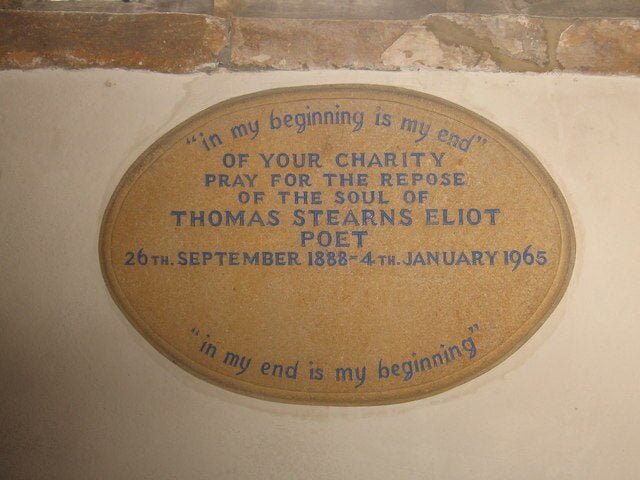
T. S. Eliot’s Memorial at St Michaels, the East Corker church where his ashes are interred.
We shall not cease from exploration
And the end of all our exploring
Will be to arrive where we started
And know the place for the first time.
Through the unknown, unremembered gate
When the last of earth left to discover
Is that which was the beginning;
At the source of the longest river
The voice of the hidden waterfall
And the children in the apple-tree
Not known, because not looked for
But heard, half-heard, in the stillness
Between two waves of the sea.
Quick now, here, now, always—
A condition of complete simplicity
(Costing not less than everything)
And all shall be well and
All manner of thing shall be well
When the tongues of flame are in-folded
Into the crowned knot of fire
And the fire and the rose are one.
T. S. Eliot “Little Gidding”
T. S. Eliot died on the 5th of January, in 1965.
He was a very important person in my life. Should say is. From time to time I notice either his birth or his death, and over the years I’ve reworked what follows, my appreciation of the master, a bit or a lot, and then share it anew. I guess I’m hoping eventually to get the darned thing right. Here you go with my latest.
In my formative years “J. Alfred Prufrock” caught my imagination. The “Wasteland” gave voice to my anxieties. “Ash Wednesday,” the plays Murder in the Cathedral and The Cocktail Party, and most of all the “Four Quartets” informed and gave images as well as turns of phrase to my developing spirituality.
I think of him and his spiritual quest quite a bit.
Thomas Stearns Eliot was born in St Louis, Missouri, on the 26th of September, 1888.
Raised Unitarian, there was then brief flirtation with Buddhism, about which I know frustratingly little. Finally he embraced Anglicanism’s spiritual comprehensiveness.
Eliot’s unlikely journey from America to England also hints volumes at the mutability of our lives both as individuals and where we’re going. That going, I believe, is leading irresistibly toward the universal longing.
If anyone can claim to come from Unitarian aristocracy, it would be Eliot. His great grandfather William Greenleaf Eliot, Sr, was one of the founders of the Unitarian church in Washington D. C. His grandfather William Greenleaf Eliot Jr, was the founding minister of the Unitarian church in St. Louis, where he would also be a founder of Washington University. One of his uncles, Thomas Lamb Eliot would be the founding minister of the Unitarian church in Portland, Oregon. While his cousin Frederick May Eliot would become president of the American Unitarian Association. At least one UU church is named for this family.
His father was not clergy, although the family were active members of the church that his father’s father founded. Rather his father was a successful businessman. Eliot’s mother, was a former schoolteacher, an intellectual, and I believe significantly, a poet. Eventually he would attend Harvard College, where incidentally his third cousin William Eliot was president. Unitarian aristocracy…
My colleague the Reverend Roger Fritts wrote a substantive biographical sermon about Eliot, to which I owe a considerable debt for this small reflection. In addition Roger succinctly describes the early twentieth century version of the faith into which Eliot was born and raised.
“Unitarians (at that time) believed that human life was on the verge of great advances in which science, reason, education and democracy were going to eliminate poverty, hunger, war and sickness. There was little talk of sin or tragedy or evil. There was much talk of progress, efficiency and well-being.”
There was also lots of attention to moral cultivation. As Roger points out the young Eliot “was taught to keep his feelings to himself, to remain rational, orderly, and self-contained.” While obviously admirable traits, this personal reticence also had terrible shadows. As an adult Eliot famously could not bring himself to buy candy, feeling it an “example of needless self-gratification.”
He was, as best I can tell, an antisemite.
So, many threads to his character. Not all of them attractive.
After earning an undergraduate degree as well as a master’s in English Literature at Harvard, all within four years, Eliot decamped for Europe. Here he wrote his first famous poem, “The Love Song of J. Alfred Prufrock.” A sample.
Do I dare
Disturb the Universe?
In a minute there is time
For decisions and revisions which a minute will reverse.
For I have known them all already, known them all –
Have known the evenings, mornings, afternoons,
I have measured out my life with coffee spoons;…
And I have seen the eternal Footman hold my coat, and snicker,
And in short, I was afraid.
He returned the States and Harvard, studying Sanskrit and Eastern Religions, working toward a doctorate when he was offered a fellowship at Merton College in Oxford. England would become his home. He wouldn’t even return to the States to defend his doctoral thesis. While at Merton he met and was mentored by Ezra Pound. He also met Vivien Haigh. I think revealing a recurring part of his heart, the coupled married quickly, and in secrecy. Not much later while staying with Bertrand Russell, Russell first had a brief affair with Vivien and then warned the young Eliot that his wife was mentally unstable. Whatever this incident might say about Russell, he was right about Vivien.
Eliot took a job with Lloyds Bank, where he would stay for eight years. During this time Vivien’s mental and physical condition deteriorated. He slipped into depression. Perhaps there are echoes of this in the Waste Land.
April is the cruelest month, breeding
Lilacs out of the dead land, mixing
Memory and desire, stirring
Dull roots with spring rain…
What are the roots that clutch, what branches grow
Out of this stony rubbish? Son of man,
You cannot say or guess, for you know only
A heap of broken images, where the sun beats,
And the dead tree gives no shelter, the cricket no relief,
And the dry stone no sound of water…
If there were water
And no rock
If there were rock
And also water
And water
A spring
A pool among the rock
If there were the sound of water only
Not the cicada
And dry grass singing
But sound of water over a rock
Where the hermit-thrush sings in the pine trees
Drip drop drip drop drop drop drop
But there is no water
Eliot was thirty-four years old in 1922 when this poem was published. With it he was established as a major poet. Three years later he would leave Lloyds to work at the publishing house Faber and Gwyer, later Faber and Faber.
In 1927 Eliot renounced his American citizenship, becoming an English subject. He also, although at first in secret, again that secret thing, was baptized into the Anglican Church. He would fall into the Anglo-Catholic wing of that comprehensive faith.
In 1932 he left Vivien, although he continued to support her. During this time he wrote “Ash Wednesday.”
And pray to God to have mercy upon us
And I pray that I may forget
These matters that with myself I too much discuss
Too much explain
Because I do not hope to turn again
Let these words answer
For what is done, not to be done again
May the judgment not be too heavy upon us.
Six years later Vivien was committed to a mental institution, where she would die. When, nine years after her commitment she had died, and Eliot was notified, his public reticence collapsed. He wept in front of everyone.
Also, from when he left Viven Eliot’s productivity began to flower. He wrote both Murder in the Cathedral and the Cocktail Party during this time. Plays that deeply marked me in my own faith formation.
Roger writes how “in 1957, at the age of 68, T. S. Eliot picked the romantic setting of his publishing office to propose marriage to his thirty-year-old secretary, Valerie Fletcher.” She accepted. “In keeping with Eliot’s wish for secrecy and privacy the church service was held at 6:15 on a January morning in 1957. In the years after the marriage, friends said Eliot’s nervous appearance and his look of illness vanished, replaced with the light of joy in his eyes. He declared that there had been only two periods of his life when he had been happy – during his childhood, and during his second marriage.”
He died eight years later, in 1965.
So, what to say here? What does this life mean for us?
First, Eliot, I believe, saw the shadow of the dominant current of early twentieth century Unitarianism. Particularly the lack of attention to sin or tragedy or evil, focusing instead on progress, efficiency and well-being. Much later the great Unitarian Universalist theologian James Luther Adams would point to this problem, and did much to help us to reclaim a sense of the tragic and of evil, if not of sin, at least in the sense of offending a deity.
But this isn’t the most important thing. At least I don’t think so. There was something else in Eliot that I find truly compelling. You could say it is the positive shade of his private heart, of his penchant for secrecy. The words occult and mystic both mean secret. And we can go in two directions in pursuit of the secret heart, one I think less healthy, the other the source of all health. For Eliot it is the mystical, the longing for the soul to know God, or if you prefer less theistic language, our longing for our source and end, for true intimacy within the dance of life and death. In Eliot’s secret heart something deep and true happened. In his quest for certainty, he walked into the great desert. This is the same desert any of us will encounter if we look for the purpose and meaning of our lives. And out there, something happened.
Those of us who have thrown our lives into the spiritual enterprise, the way of deep consideration, of truly looking, whatever school to which we adhere, whether we are Unitarian or Anglican, Christian or Jew or Muslim, Buddhist or Hindu, rationalist or pagan, we find ourselves stepping out into the desert, into the unknown country. And there, whatever we thought, however we were led into that place, we lose the certain and instead move into a subtle and vast not knowing, of opening our minds and vastly more important, of opening our hearts. Here we find that famous well with its life giving waters. And Eliot, twisted though his heart might have been, and in that good news for the rest of us, with our own wounds and twists, seems to truly have encountered that ground, or, maybe it is a well, what some would call God. His later poems do appear to bear witness to that moment. And, in such as the “Four Quartets,” he points the way for all of us who are looking for the heart of love, to find the well at the center of the desert.
Here I find myself thinking of that closing part of “Little Gidding,” the culmination of his “Four Quartets,” for me the most sublime of all his work. And of that poem, one phrase in particular, “And all shall be well and/All manner of thing shall be well.” Eliot is, of course, not the author of that phrase. He lifted it from Dame Julian of Norwich. All good poets are in part thieves of the heart, as this way has no originality within it, we all belong to it, we are all owned by it, we all take our every breath from it.
This is the well that Eliot found, and the well, we too, can find, and we too can drink from.
We shall not cease from exploration
And the end of all our exploring
Will be to arrive where we started
And know the place for the first time.
Through the unknown, remembered gate
When the last of earth left to discover
Is that which was the beginning;
At the source of the longest river
The voice of the hidden waterfall
And the children in the apple-tree
Not known, because not looked for
But heard, half-heard, in the stillness
Between two waves of the sea.
Quick now, here, now, always—
A condition of complete simplicity
(Costing not less than everything)
And all shall be well and
All manner of thing shall be well
When the tongues of flame are in-folded
Into the crowned knot of fire
And the fire and the rose are one.
New Visions
History and Religion

About James Ishmael Ford
James Ishmael Ford's latest book is the Intimate Way of Zen. It is available from the publisher Shambhala, your local bookstore, or via any online retailer. You can read more about the author here.
Previous Post
December 28, 2024
A Zen meditation in the middle of Hanukkah
Next Post
January 11, 2025 The Twelve Steps and Our Spiritual Journey
Recent Comments
"Allowing anger to contaminate one's hard disk can be detrimental to one's holistic well being. ..."
Hot Anger: Meeting Anger in Zen ..."
"I love this koan. every which way you turn it bites you, Thirty years on ..."
Nanquan Cuts the Cat: A Jesuit ..."
"As a substitute for religion, Zen is probably better than taking drugs. However, it can ..."
The Selling of Zen at the ..."
"Craving and aversion are detrimental to one's peace and happiness. Easter is a wake up ..."
Easter: A Zen Buddhist Appreciation
Browse Our Archives
Select a Category A Christmas Carol Abolitionist African-American Ahmadiyya Alan Watts Aldous Huxley Allen Ginsberg Amedkar Jayanti American politics American Zen Anaheim Zen Sangha Anglican Annie Besant April Fool Armageddon Art and Religion artificial intellegence Atheist Awakening B R Ambedkar Barlaam & Josaphat Beatnik Between Bhagavad Gita Bible biography birthday bodhisattva Bodhisattva Precepts Book burning Book of Common Prayer Book of Mormon Brahmo Samaj Buddha Buddhism Buddhist Buddhist Lord's Prayer Butterflies Calendars cartoons cat ChatGPT Chicken Tortilla Soup choices Christian atheism Christian mysticism Christian origins Christian Science Christian Zen Christianity Christianity and Buddhism christmas Christmas Truce Christopher Isherwood Church of Later Day Saints Cinco de Mayo circus covenant critical thinking culture D. T. Suzuki Dalit Buddhism Daniel Defoe Desert Fathers and Mothers dharma talk Dogen Donald Trump Dongshan's Five Ranks Dorothy Day dream Duty Easter ecology Edwin Arnold emptiness Empty Moon Zen Network Episcopal Church Eternal Now Ethics evolution existentialism Faith fantasy Fathers Day film film review fire Five Ranks Folk music food Form and emptiness Four Seals Francis of Assisi Francis Xavier Free thinker friendship George MacDonald Gerald Heard Glenn Taylor Webb God Good Friday Gospel of Gospel of Mark Gospel of Thomas grace Graduate Theological Unioin Graduate Theological Union Guanyin H R Blyth Hakuin Ekaku Hanamatsuri Hanukkah Harada Yasutani Zen Heart Sutra Henry David Thoreau Hermann Hesse Hinduism History and Religion history of religion Holy Spirit home Hospitality Icon Ides of March Isaac Newton Islam Islamic mysticism Jack Kerouac James Luther Adams Jiddu Krishnamurti Joan of Arc Johannes Gutenberg John Donne joke Judaism justice karma kensho King James Bible koan Koun Yamada Kyoto School Lewis Carrol Liberal Christianity Liberal Religion Life Plan Community Liminal literature Literature and Religion Liturgy Lord's Prayer Love Mahatma Gandhi Mahayana Martin Luther King Jr Mary Baker Eddy Mary Magdelene Mary Oliver Mayflower Compact Meditation memories memory metaphor money money and religioin Mormons Mother's Day movie review mysticism mythic Neighborhood Unitarian Universalist Church New Thought Nichiren Buddhism Nonduality not knowing Omar Khayyam Pacific School of Religion pagan Palm Sunday Passover peace Pentecost perennialism Phantastes Philip Kapleau philosophy Pilgrimage poetry Poetry and Religion politics Prayer Precepts Printing Press prophecy prophetic spirituality psychology Pure Land Queer religion queering religion Quietism Ram Mohan Roy rebirth recipe Relationships and religion religion religion and history Religious syncretism Resistance Retirement Retreat review Rissho Kosei Kai Ritual Robert Aitken Roshi Robert Ingersoll Rohatsu Romani religion Rosie the Riveter saints samadhi SanboZen Sangha Satyagraha science science and reigion science and religion science fiction seminary sermon Sesshin Sex and Religion Shinran Sikh Sikh tradition silence Social Justice Socially Engaged Buddhism Society and religion Soto Zen soul spiritual community spiritual practice Spirituality Sufism Suicide superstition Taoism Television Teresa of Avila Thanksgiving theological schools Theosophy Thomas Merton Time Transcendentalism Transcendentalist Trinitarian Trinity Uncategorized unitarian Unitarian Christianity Unitarian Universalist Universalism Vajrayana Vedanta Walking war Willa Cather William Ellery Channing wisdom women and religion women in religion World Teacher Writing zazen Zen Zen Center Zen inspired retriement zen meditation Zen Precepts Zen women
Select a Month September 2026 August 2026 July 2026 June 2026 May 2026 April 2026 March 2026 February 2026 January 2026 December 2025 November 2025 October 2025 September 2025 August 2025 July 2025 June 2025 May 2025 April 2025 March 2025 February 2025 January 2025 December 2024 November 2024 October 2024 September 2024 August 2024 July 2024 June 2024 May 2024 April 2024 March 2024 February 2024 January 2024 December 2023 November 2023 October 2023 September 2023 August 2023 July 2023 June 2023 May 2023 April 2023 March 2023 February 2023 January 2023 December 2022 November 2022 October 2022 September 2022 August 2022 July 2022 June 2022 May 2022 April 2022 March 2022 February 2022 January 2022 December 2021 November 2021 October 2021 September 2021 August 2021 July 2021 June 2021 May 2021 April 2021 March 2021 February 2021 January 2021 December 2020 November 2020 October 2020 September 2020 August 2020 July 2020 June 2020 May 2020 April 2020 March 2020 February 2020 January 2020 December 2019 November 2019 October 2019 September 2019 August 2019 July 2019 June 2019 May 2019 April 2019 March 2019 February 2019 January 2019 December 2018 November 2018 October 2018 September 2018 August 2018 July 2018 June 2018 May 2018 April 2018 March 2018 February 2018 January 2018 December 2017 November 2017 October 2017 September 2017 August 2017 July 2017 June 2017 May 2017 April 2017 March 2017 February 2017 January 2017 December 2016 November 2016 October 2016 September 2016 August 2016 July 2016 June 2016 May 2016 April 2016 March 2016 February 2016 January 2016 December 2015 November 2015 October 2015 September 2015 August 2015 July 2015 June 2015 May 2015 April 2015 March 2015 February 2015 January 2015 December 2014 November 2014 October 2014 September 2014 August 2014 July 2014 June 2014 May 2014 April 2014 March 2014 February 2014 January 2014 December 2013 November 2013 October 2013 September 2013 August 2013 July 2013 June 2013 May 2013 April 2013 March 2013 February 2013 January 2013 December 2012 November 2012 October 2012 September 2012 August 2012 July 2012 June 2012 May 2012 April 2012 March 2012 February 2012 January 2012 December 2011 November 2011 October 2011 September 2011 August 2011 July 2011 June 2011 May 2011 April 2011 March 2011 February 2011 January 2011 December 2010 November 2010 October 2010 September 2010 August 2010 July 2010 June 2010 May 2010 April 2010 March 2010 February 2010 January 2010 December 2009 November 2009 October 2009 September 2009 August 2009 July 2009 June 2009 May 2009 April 2009 March 2009 February 2009 January 2009 December 2008 November 2008 October 2008 September 2008 August 2008 July 2008 June 2008 May 2008 April 2008 March 2008 February 2008 January 2008 December 2007 November 2007 October 2007 September 2007 August 2007 July 2007 June 2007 May 2007 April 2007 March 2007 February 2007 January 2007 December 2006 November 2006 October 2006 September 2006
Follow Us!
TAKE THE
Religious Wisdom Quiz
What is the title of the leader of the worldwide Anglican Communion?
Select your answer to see how you score.
President Archbishop of Canterbury Pope Patriarch
Related posts from Monkey Mind

The Suchness of Crows: The Zen teachings of...
Yogi Chen & Chinese Vajrayana: A Personal Account
Zen and the Dance of Not Knowing

Zen, Unitarian Universalism, and a Writer's Life
TRENDING AT PATHEOS Buddhist

Swimfan: Forgotten Aughts Pleasures
This is a recovery effort. In 2002, My Big Fat Greek Wedding...

Top Three Anti-Catholic Lies About Catholicism
This is my initial transcript for the video, "THE 3 WORST...

Pope Leo Celebrates Mass for Nurses & Docs...
I don't have any idea how he did it, but Pope Leo...

The Sermon on the Mount, Part I: Matthew...
The Sermon on the Mount, Part I (Matthew 4:12-5:12) St. Matthew moves...

What's up from Crossway: Reviewing some of their latest A few weeks...

Janie Learns the Way of the Cross: A...
Teaching children about Jesus' Passion can be challenging. Many parents and educators...
view all Buddhist blogs
What Are Your Thoughts?leave a comment
Ad-Free & Subscriber Log-In Subscription Support
- About Us
- 2026 Calendar
- Videos
- Podcasts
- Library of World Religions
- Faith In Media Tracker
- Advertise With Us
- Write for Us
- Privacy Policy
- Terms of Service
- Do Not Sell My Data
- Contact Us
- Radiant Digital
- Manage Newsletter Subscriptions
- Unsubscribe From Notifications
- Sitemap
Copyright 2008-2026, Patheos. All rights reserved.
Subscription Support Ad-Free & Subscriber Log-In
Follow Patheos