
BuddhistCatholicContemplativeEvangelicalGeneral ChristianHinduJewishLatter-day SaintMuslimNew VisionsProgressive Christian
Beliefs
- Buddhist
- Catholic
- Contemplative
- Evangelical
- General Christian
- Hindu
- Jewish
- Latter-day Saint
- More Voices
- Muslim
- New Visions
- Pagan
- Progressive Christian
Topics
- Religion News
- Food and Religion
- Sports and Religion
- Religious Art
- Religious Music and Entertainment
- Religious Events
- History and Religion
- Style and Religion
- Politics and Religion
- Women in Religion
- Recreation Outdoors and Religion
- Business Finance and Religion
- Careers Workplace and Religion
- Education and Religion
- Family Parenting and Religion
- Health Fitness and Religion
- Home and Religion
- Relationships and Religion
- Technology and Religion
- Travel and Religion
Columnists
- Buddhist Columnists
- Business Finance and Religion Columnists
- Careers Workplace and Religion Columnists
- Catholic Columnists
- Contemplative Columnists
- Education and Religion Columnists
- Evangelists Columnists
- Family Parenting and Religion Columnists
- General Christian Columnists
- Health Fitness and Religion Columnists
- Hindu Columnists
- History and Religion Columnists
- Home and Religion Columnists
- Jewish Columnists
- More Voices Columnists
- Latter Day Columnists
- Muslim Columnists
- New Visions Columnists
- Nonreligious Columnists
- Pagan Columnists
- Politics and Religion Columnists
- Progressive Columnists
- Recreation Outdoors and Religion Columnists
- Relationships and Religion Columnists
- Religion News Columnists
- Religious Art Columnists
- Religious Events Columnists
- Religious Music and Entertainment Columnists
- Sports and Religion Columnists
- Style and Religion Columnists
- Technology and Religion Columnists
- Travel and Religion Columnists
- Women in Religion Columnists
Resource Library
- 2026 Calendar
- Library of World Religions
- The 100 Most Holy Places on Earth
- Patheos Answers
- Podcasts
- Videos
- Faith Leaders Database
- Anglican Episcopalian
- Bahai
- Baptist
- Buddhism
- Christianity
- Confucianism
- Eastern Orthodoxy
- Hinduism
- Holiness and Pentecostal
- ISKCON
- Islam
- Judaism
- Lutheran
- Methodist
- The Church of Jesus Christ of Latter-day Saints
- New Age
- Paganism
- Presbytarian and Reformed
- Protestantism
- Religion Behind the Scenes
- Roman Catholic
- Scientology
- Shia Islam
- Sikhism
- Sufism
- Sunni Islam
- Taoism
- Zen
- See all religions
Research Tools
 Ad-Free & Subscriber Log-In Subscription Support
Ad-Free & Subscriber Log-In Subscription Support
Follow Patheos 

- Trending:
- Forgiveness
- |
- Marriage
- |
- Consciousness
- |
- Death Penalty
- |
- Election
- |
- Halloween

- Home
- Buddhist
- Relationships and Religion
- Casting our Net into the Great Night: a Zen Meditation
Casting our Net into the Great Night: a Zen Meditation
Last updated on: November 2, 2024 at 1:22 pm by James Ford
Casting our Net into the Great Night: a Zen Meditation 2024-11-02T13:22:28-07:00 James Ford
Patheos Explore the world's faith through different perspectives on religion and spirituality! Patheos has the views of the prevalent religions and spiritualities of the world.
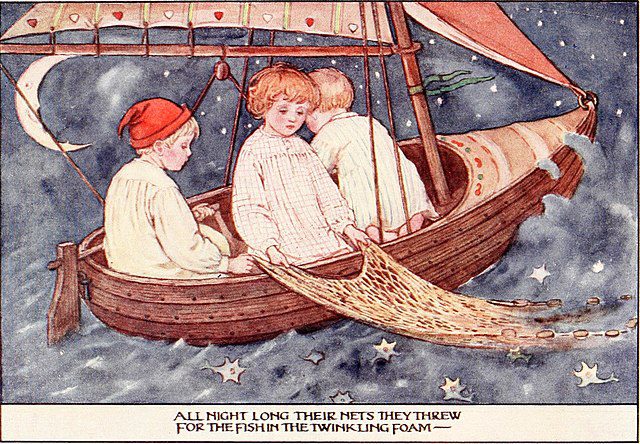
Wynken, Blynken, and Nod throw out their net
(At our half day sit with Empty Moon Zen today, our guiding teacher Roshi Edward Sanshin Oberholtzer gave the dharma talk. He unveils the miracle promised in Dongshan’s Five Ranks, a promise which reconciles the absolute and relative, the essential and the contingent, form and emptiness. I asked if I could reprint it at my Monkey Mind blog and he graciously agreed. Well worth a read…)
In philosophy departments the pre-Socratics are often treated as precursors to the philosophical greats, Plato, Aristotle and on through a progression, from Hume to Kant, to Hegel, to Russell and others, culminating in the present day. But I prefer to see the Pre-Socratics as they are sometimes viewed in Classics departments, as shadowy representatives of a shamanistic past, the often irrational side of that Apollonian view of Greek civilization so treasured by our rational present. My favorite of these somewhat ghostly figures from a time at the dawn of letters, sages known only through scraps of quotes in later writers, my favorite is Heraclitus, who is remembered, if at all by the public and by Zen practitioners, for having prefigured Shunryu Suzuki’s famous one sentence summation of Buddhism “Everything changes”. Well over two and a half millennia before Suzuki, Heraclitus said “Panta Rei” – Everything flows.
But it’s not this seeming flirtation, accidental or otherwise, with a summation of the Dharma that interests me today. Rather it’s another of his statements, “hodos ano kato mia kai houtei” or, the road up down one and the same. I was reminded of this recently when going back to study again Dongshan’s Five Ranks. The Austrailian Zen teacher Ross Bolleter likes to group the Ranks together with the First and Second Ranks as a pair. We can easily see why that is so – the First Rank examining the particular within the essential, the second the essential within the particular; the road up, the road down, one and the same.
Dongshan’s poem for the first Rank runs:
Sho Chu Hen (J: the particular within the essential)
When the third watch begins, before the moon rises,
don’t think it strange to meet and not be conscious of meeting,
yet still somehow recall the beauty of ancient days.
The vast darkness of the night sky studded with twinkling stars, with the dust of planets, of asteroids, of meteors, with the occasional bat or owl flitting across the firmament overhead. The deep shadows of your house at midnight when, as you stumble out of bed, searching for the bathroom light, you stub your toe on that very particular, very solid coffee table lurking there in the darkness.
And our view, but only in our view and not in the road itself, our view of that upperward tending road now turns downwards as Dongshan himself turns from the particular within the essential to the essential within the particular, and to that sensation you have when, having stubbed your toe there in the dark, you find a whole world, a whole universe of sensation, of pain just there in what, up until a moment ago had been, perhaps, the most insignificant of body parts, your little toe, which now overwhelms you, which now consumes you in that vast all encompassing world of pain, the toe itself becoming a world which obliterates every other thought.
Dongshan’s illustrative poem, the poem that forms his second set of koanic points, goes:
2. Hen Chu Sho (J: the essential within the particular)
An old woman, oversleeping at daybreak, meets the ancient mirror,
so bright and clear, face to face, no special reality.
Stop searching for your head and don’t take shadows for reality.
Who among us hasn’t met that ancient mirror, perhaps at the end of stumbling through a darkened bedroom late at night after stubbing our toe on misplaced and mysterious furniture strewn there in the dark by some malefactor, probably you yourself. Or perhaps just at dawn like the old woman, standing before that mirror, cracked and dust ridden or fogged with the morning shower’s steam but still, revealing there through its particularity, through its very thusness, the absolute in all its bright clarity. You are not it, but in truth, it is you.
And Dongshan continues with an echo of that old Halloween tale of the headless horseman galloping along the roadways of the Hudson Valley in Washington Irving’s retelling, searching for his head in among the shadows of Sleepy Hollow. It’s enough, for us at least, to reach up our hands and grasp the head that was there all along, heeding Dongshan’s admonition to stop searching for your head and not take shadows for reality.
We might replace Dongshan’s poem with one a bit more current, if only a couple of centuries old. William Blake’s Auguries of Innocence begins, of course, with four lines that easily evoke the essential within the particular.
To see a World in a Grain of Sand
And a Heaven in a Wild Flower
Hold Infinity in the palm of your hand
And Eternity in an hour
But we needn’t turn to nature, to the sand stewn beaches or the flower bedecked meadows. Open your eyes and look into another’s face. There, in that single instance, in that one moment of the actual, you’ll find all of the Dharma, all of creation, a universe of pain, of joy, of wonder; heaven, yes; infinity, yes; eternity, yes; but also the simple, the mundane, the everyday, a universe of the everyday, an eternity of the simple. As we walk down the sidewalk, each person we meet, each person we nod to, each person we smile at, even, perhaps especially, each person we ignore and don’t see, each has a life as complex, as full, as astounding as our own. Each an instantiation of the particular, each blooming forth a whole world, there if we could just see it. Each the absolute within the particular.
As we travel down Dongshan’s road, we sense the intimacy that comes with this interplay of the essential and the contingent, the absolute and the particular. The Buddha stepping forth from beneath the Bodhi tree and announcing that “Today, I and all beings are awakened together”, is the same movement that sees the sadness in the face of the Virgin Mary holding her dead son in Michelangelo’s Pieta, the same recognition one sees in the grief of Emmit Till’s mother standing with his casket, refusing to let the world turn away from what it had done to her child, the same hope we find in a young family making it to the other shore of the Rio Grande, the same joy in the face of a friend finding a long lost friend. Today, you and I and all beings feel that sadness, that grief, that hope, that joy.
As we travel down Dongshan’s road the very pebbles, the puddles, the cracks and crevices blossom forth with potential, each containing the whole of creation, the vast mystery. A nineteenth century English clergyman walking the cliffs of Dover and finding, there in a fossilized crustacean just lying out there on the beach, a whole new world. A squirrel, rummaging through the grass in my backyard, finding a treasure of hidden acorns. A child gazing up at the night sky in wonder finds in that moon, in those stars, all of the universe, the great unknown. And we hear this in Eugene Field’s children’s poem, which I hope you’ll forgive a grandfather for reciting:
Wynken, Blynken, and Nod one night
sailed off in a wooden shoe —
Sailed on a river of crystal light,
into a sea of dew.
“Where are you going, and what do you wish?”
the old moon asked the three.
“We have come to fish for the herring fish
that live in this beautiful sea;
Nets of silver and gold have we!”
said Wynken, Blynken, and Nod.
I can’t help but call to mind the net of Indra, cast into that sea of dew, each cross link knotted and bejeweled with a crystal whose facets reflect all of the other jewels and all of the rest, the river of light, the sea of dew, the old moon, the herring swimming in that sea.
The old moon laughed and sang a song,
as they rocked in the wooden shoe,
And the wind that sped them all night long
ruffled the waves of dew.
The little stars were the herring fish
that lived in that beautiful sea —
“Now cast your nets wherever you wish —
never afraid are we”;
So cried the stars to the fishermen three:
Wynken, Blynken, and Nod.
That old moon, risen after the third watch now, for what child hasn’t woken up in the middle of the night, who among us has not stirred before or after the third watch, stumbling through the dark, fumbling for the light switch, encountering the particularity of that coffee table, perhaps even more acutely the particularity of that lego brick painfully and amusedly under foot. Just this, just this.
But the children are not yet done:
All night long their nets they threw
to the stars in the twinkling foam —
Then down from the skies came the wooden shoe,
bringing the fishermen home;
‘Twas all so pretty a sail, it seemed
as if it could not be,
And some folks thought ’twas a dream they’d dreamed
of sailing that beautiful sea —
But I shall name you the fishermen three:
Wynken, Blynken, and Nod.
And here, here is the particularity out of which the universal arises:
Wynken and Blynken are two little eyes,
and Nod is a little head,
And the wooden shoe that sailed the skies
is a wee one’s trundle-bed.
So shut your eyes while Mother sings
of wonderful sights that be,
And you shall see the beautiful things
as you rock in the misty sea,
Where the old shoe rocked the fishermen three:
Wynken, Blynken, and Nod.
But here’s the miracle promised in Dongshan’s Five Ranks, a promise which reconciles the absolute and relative, the essential and the contingent, form and emptiness. Deep within the particularity of those two little eyes, of that little head, lies that growing child, the Dharmic being given birth to on those misty seas. We have all been there. We all come from there. Whether the road we take goes up or down, this reconciliation is here, in each of us, in each of you, nothing special and yet so very precious.
As that old woman found,
“So bright and clear, face to face, no special reality.”
New Visions
Relationships and Religion
History and Religion
Previous Post
October 29, 2024
Conclave: A Zen Buddhist reviews a sort of Christian movie
Next Post
November 8, 2024 Hugo Enomiya-Lassalle: the First Christian Zen Master
Recent Comments
"Allowing anger to contaminate one's hard disk can be detrimental to one's holistic well being. ..."
Hot Anger: Meeting Anger in Zen ..."
"I love this koan. every which way you turn it bites you, Thirty years on ..."
Nanquan Cuts the Cat: A Jesuit ..."
"As a substitute for religion, Zen is probably better than taking drugs. However, it can ..."
The Selling of Zen at the ..."
"Craving and aversion are detrimental to one's peace and happiness. Easter is a wake up ..."
Easter: A Zen Buddhist Appreciation
Browse Our Archives
Select a Category A Christmas Carol Abolitionist African-American Ahmadiyya Alan Watts Aldous Huxley Allen Ginsberg Amedkar Jayanti American politics American Zen Anaheim Zen Sangha Anglican Annie Besant April Fool Armageddon Art and Religion artificial intellegence Atheist Awakening B R Ambedkar Barlaam & Josaphat Beatnik Between Bhagavad Gita Bible biography birthday bodhisattva Bodhisattva Precepts Book burning Book of Common Prayer Book of Mormon Brahmo Samaj Buddha Buddhism Buddhist Buddhist Lord's Prayer Butterflies Calendars cartoons cat ChatGPT Chicken Tortilla Soup choices Christian atheism Christian mysticism Christian origins Christian Science Christian Zen Christianity Christianity and Buddhism christmas Christmas Truce Christopher Isherwood Church of Later Day Saints Cinco de Mayo circus covenant critical thinking culture D. T. Suzuki Dalit Buddhism Daniel Defoe Desert Fathers and Mothers dharma talk Dogen Donald Trump Dongshan's Five Ranks Dorothy Day dream Duty Easter ecology Edwin Arnold emptiness Empty Moon Zen Network Episcopal Church Eternal Now Ethics evolution existentialism Faith fantasy Fathers Day film film review fire Five Ranks Folk music food Form and emptiness Four Seals Francis of Assisi Francis Xavier Free thinker friendship George MacDonald Gerald Heard Glenn Taylor Webb God Good Friday Gospel of Gospel of Mark Gospel of Thomas grace Graduate Theological Unioin Graduate Theological Union Guanyin H R Blyth Hakuin Ekaku Hanamatsuri Hanukkah Harada Yasutani Zen Heart Sutra Henry David Thoreau Hermann Hesse Hinduism History and Religion history of religion Holy Spirit home Hospitality Icon Ides of March Isaac Newton Islam Islamic mysticism Jack Kerouac James Luther Adams Jiddu Krishnamurti Joan of Arc Johannes Gutenberg John Donne joke Judaism justice karma kensho King James Bible koan Koun Yamada Kyoto School Lewis Carrol Liberal Christianity Liberal Religion Life Plan Community Liminal literature Literature and Religion Liturgy Lord's Prayer Love Mahatma Gandhi Mahayana Martin Luther King Jr Mary Baker Eddy Mary Magdelene Mary Oliver Mayflower Compact Meditation memories memory metaphor money money and religioin Mormons Mother's Day movie review mysticism mythic Neighborhood Unitarian Universalist Church New Thought Nichiren Buddhism Nonduality not knowing Omar Khayyam Pacific School of Religion pagan Palm Sunday Passover peace Pentecost perennialism Phantastes Philip Kapleau philosophy Pilgrimage poetry Poetry and Religion politics Prayer Precepts Printing Press prophecy prophetic spirituality psychology Pure Land Queer religion queering religion Quietism Ram Mohan Roy rebirth recipe Relationships and religion religion religion and history Religious syncretism Resistance Retirement Retreat review Rissho Kosei Kai Ritual Robert Aitken Roshi Robert Ingersoll Rohatsu Romani religion Rosie the Riveter saints samadhi SanboZen Sangha Satyagraha science science and reigion science and religion science fiction seminary sermon Sesshin Sex and Religion Shinran Sikh Sikh tradition silence Social Justice Socially Engaged Buddhism Society and religion Soto Zen soul spiritual community spiritual practice Spirituality Sufism Suicide superstition Taoism Television Teresa of Avila Thanksgiving theological schools Theosophy Thomas Merton Time Transcendentalism Transcendentalist Trinitarian Trinity Uncategorized unitarian Unitarian Christianity Unitarian Universalist Universalism Vajrayana Vedanta Walking war Willa Cather William Ellery Channing wisdom women and religion women in religion World Teacher Writing zazen Zen Zen Center Zen inspired retriement zen meditation Zen Precepts Zen women
Select a Month September 2026 August 2026 July 2026 June 2026 May 2026 April 2026 March 2026 February 2026 January 2026 December 2025 November 2025 October 2025 September 2025 August 2025 July 2025 June 2025 May 2025 April 2025 March 2025 February 2025 January 2025 December 2024 November 2024 October 2024 September 2024 August 2024 July 2024 June 2024 May 2024 April 2024 March 2024 February 2024 January 2024 December 2023 November 2023 October 2023 September 2023 August 2023 July 2023 June 2023 May 2023 April 2023 March 2023 February 2023 January 2023 December 2022 November 2022 October 2022 September 2022 August 2022 July 2022 June 2022 May 2022 April 2022 March 2022 February 2022 January 2022 December 2021 November 2021 October 2021 September 2021 August 2021 July 2021 June 2021 May 2021 April 2021 March 2021 February 2021 January 2021 December 2020 November 2020 October 2020 September 2020 August 2020 July 2020 June 2020 May 2020 April 2020 March 2020 February 2020 January 2020 December 2019 November 2019 October 2019 September 2019 August 2019 July 2019 June 2019 May 2019 April 2019 March 2019 February 2019 January 2019 December 2018 November 2018 October 2018 September 2018 August 2018 July 2018 June 2018 May 2018 April 2018 March 2018 February 2018 January 2018 December 2017 November 2017 October 2017 September 2017 August 2017 July 2017 June 2017 May 2017 April 2017 March 2017 February 2017 January 2017 December 2016 November 2016 October 2016 September 2016 August 2016 July 2016 June 2016 May 2016 April 2016 March 2016 February 2016 January 2016 December 2015 November 2015 October 2015 September 2015 August 2015 July 2015 June 2015 May 2015 April 2015 March 2015 February 2015 January 2015 December 2014 November 2014 October 2014 September 2014 August 2014 July 2014 June 2014 May 2014 April 2014 March 2014 February 2014 January 2014 December 2013 November 2013 October 2013 September 2013 August 2013 July 2013 June 2013 May 2013 April 2013 March 2013 February 2013 January 2013 December 2012 November 2012 October 2012 September 2012 August 2012 July 2012 June 2012 May 2012 April 2012 March 2012 February 2012 January 2012 December 2011 November 2011 October 2011 September 2011 August 2011 July 2011 June 2011 May 2011 April 2011 March 2011 February 2011 January 2011 December 2010 November 2010 October 2010 September 2010 August 2010 July 2010 June 2010 May 2010 April 2010 March 2010 February 2010 January 2010 December 2009 November 2009 October 2009 September 2009 August 2009 July 2009 June 2009 May 2009 April 2009 March 2009 February 2009 January 2009 December 2008 November 2008 October 2008 September 2008 August 2008 July 2008 June 2008 May 2008 April 2008 March 2008 February 2008 January 2008 December 2007 November 2007 October 2007 September 2007 August 2007 July 2007 June 2007 May 2007 April 2007 March 2007 February 2007 January 2007 December 2006 November 2006 October 2006 September 2006
Follow Us!
TAKE THE
Religious Wisdom Quiz
Who became jealous and tried to kill David several times?
Select your answer to see how you score.
Samuel Saul Abiathar Abner
Related posts from Monkey Mind

Keizan Jokin: The Zen Master Ancestor You Don't...

What Zen Practice Actually Does With Anger

Nanquan Cuts the Cat: A Jesuit commentary on...

On Taking Refuge in the Dharma
TRENDING AT PATHEOS Buddhist

57th Dove Awards Honor Dolly Parton, Crown New...
On gospel music’s biggest night, the 57th annual GMA Dove Awards honored...

The First Eucharistic Controversy: Christ’s Real Presence
For Catholics, the Eucharist is the source and summit of the Christian...

What a Stop Sign Can Teach Us About...
How to Make a Decision When You Can't Hear God Main point:...

Archdiocese Hosts Military Marriage Retreat in Germany
RASTATT, Germany — The transient military lifestyle, with its frequent deployments and...

Nearly every morning, I make the drive to Detroit with my high-school-age...

The Real AI Story Is Adoption Without Trust
Artificial intelligence has crossed a political threshold. It is no longer a...
view all Buddhist blogs
What Are Your Thoughts?leave a comment
Ad-Free & Subscriber Log-In Subscription Support
- About Us
- 2026 Calendar
- Videos
- Podcasts
- Library of World Religions
- Faith In Media Tracker
- Advertise With Us
- Write for Us
- Privacy Policy
- Terms of Service
- Do Not Sell My Data
- Contact Us
- Radiant Digital
- Manage Newsletter Subscriptions
- Unsubscribe From Notifications
- Sitemap
Copyright 2008-2026, Patheos. All rights reserved.
Subscription Support Ad-Free & Subscriber Log-In
Follow Patheos