
BuddhistCatholicContemplativeEvangelicalGeneral ChristianHinduJewishLatter-day SaintMuslimNew VisionsProgressive Christian
Beliefs
- Buddhist
- Catholic
- Contemplative
- Evangelical
- General Christian
- Hindu
- Jewish
- Latter-day Saint
- More Voices
- Muslim
- New Visions
- Pagan
- Progressive Christian
Topics
- Religion News
- Food and Religion
- Sports and Religion
- Religious Art
- Religious Music and Entertainment
- Religious Events
- History and Religion
- Style and Religion
- Politics and Religion
- Women in Religion
- Recreation Outdoors and Religion
- Business Finance and Religion
- Careers Workplace and Religion
- Education and Religion
- Family Parenting and Religion
- Health Fitness and Religion
- Home and Religion
- Relationships and Religion
- Technology and Religion
- Travel and Religion
Columnists
- Buddhist Columnists
- Business Finance and Religion Columnists
- Careers Workplace and Religion Columnists
- Catholic Columnists
- Contemplative Columnists
- Education and Religion Columnists
- Evangelists Columnists
- Family Parenting and Religion Columnists
- General Christian Columnists
- Health Fitness and Religion Columnists
- Hindu Columnists
- History and Religion Columnists
- Home and Religion Columnists
- Jewish Columnists
- More Voices Columnists
- Latter Day Columnists
- Muslim Columnists
- New Visions Columnists
- Nonreligious Columnists
- Pagan Columnists
- Politics and Religion Columnists
- Progressive Columnists
- Recreation Outdoors and Religion Columnists
- Relationships and Religion Columnists
- Religion News Columnists
- Religious Art Columnists
- Religious Events Columnists
- Religious Music and Entertainment Columnists
- Sports and Religion Columnists
- Style and Religion Columnists
- Technology and Religion Columnists
- Travel and Religion Columnists
- Women in Religion Columnists
Resource Library
- 2026 Calendar
- Library of World Religions
- The 100 Most Holy Places on Earth
- Patheos Answers
- Podcasts
- Videos
- Faith Leaders Database
- Anglican Episcopalian
- Bahai
- Baptist
- Buddhism
- Christianity
- Confucianism
- Eastern Orthodoxy
- Hinduism
- Holiness and Pentecostal
- ISKCON
- Islam
- Judaism
- Lutheran
- Methodist
- The Church of Jesus Christ of Latter-day Saints
- New Age
- Paganism
- Presbytarian and Reformed
- Protestantism
- Religion Behind the Scenes
- Roman Catholic
- Scientology
- Shia Islam
- Sikhism
- Sufism
- Sunni Islam
- Taoism
- Zen
- See all religions
Research Tools
 Ad-Free & Subscriber Log-In Subscription Support
Ad-Free & Subscriber Log-In Subscription Support
Follow Patheos 

- Trending:
- Forgiveness
- |
- Marriage
- |
- Consciousness
- |
- Death Penalty
- |
- Election
- |
- Halloween

- Home
- Buddhist
- History and Religion
- Shinran Sings a Great Mystery
Shinran Sings a Great Mystery
Last updated on: September 4, 2024 at 11:23 am by James Ford
Shinran Sings a Great Mystery 2024-09-04T11:23:00-07:00 James Ford
Patheos Explore the world's faith through different perspectives on religion and spirituality! Patheos has the views of the prevalent religions and spiritualities of the world.
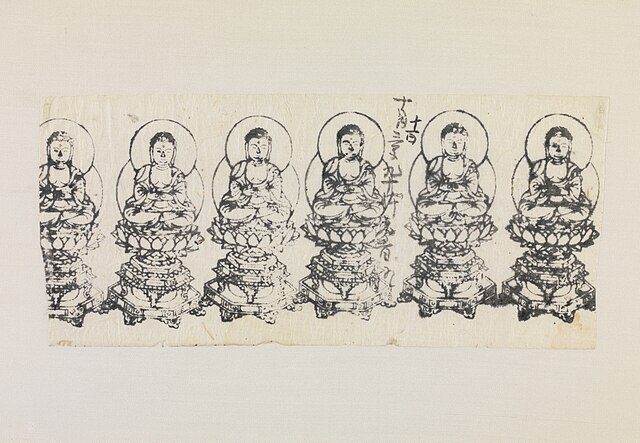
Six Amida Buddhas
15th century
I’ve been thinking a lot about Shinran Shonin of late
He was one of those signal figures in the development of Japanese Buddhism. He has been compared to Martin Luther on occasion. Without the bad parts.
Shinran was born into Feudal Japanese nobility in 1173. However, like many spiritual figures throughout history he was visited with suffering early in his life. First his father died when he was four, then his mother when he was nine.
Driven by grief and the burning questions of life and death he entered the monastic life, joining the Tendai sect and practicing on the holy Mount Hiei. He practiced intensely for twenty years, but was unable to resolve his doubts.
Then in 1201 he met Honen. Also originally a Tendai monk, Honen studied the Pure Land scriptures and came to believe that all one needed do was call upon the Buddha’s name to be saved. He left the mountain and moved to Kyoto and began to preach. He soon had a wide following, especially among ordinary people.
Honen taught that we live in the last age, where it is no longer possible to achieve liberation on one’s own. So, all upayas, all skillful means such as meditation and charity and, well, all of it no longer worked.
However, Honen quickly added, there is an escape hatch. All one need do was chant the nembutsu, calling upon Amida Buddha.
This caught Shinran’s heart.
Shinran studied for several years with Honen. After the first year Shinran experienced his great awakening called shinjin. In the following years, while he did not disrobe, Shinran began to eat meat, and married Eshinni. They would have seven children. He was officially defrocked by the Tendai sect, and with it stripped of his original monastic name. However, he refused to be laicized. He declared he was in fact “neither monk nor lay,” and renamed himself Gutoku, “foolish, bald headed one.”
(Within a few hundred years that “neither monk nor lay” clerical model would become the secret heart of Japanese Buddhist ordination across all the schools. But that’s for another reflection.)
Shinran wrote of his own experience, “I, the Bald-Headed Fool Shinran, abandoned forever the provisional path of manifold practices and good work, and separated myself once and for all from birth in the forest of the twin śāla trees. I turned to the true path, the basis of virtue and good, and gave rise to the aspiration for birth [in the Pure Land] that is difficult to comprehend. But now I have utterly abandoned the expediency of the true path, and have converted to the ocean-like vow singled out [by Amitabha Buddha]. I have separated myself straightaway from the aspiration for birth that is difficult to comprehend, and I long to attain birth that is difficult to fathom…”
While he honored Honen for his guidance, his teachings began to vary from his teacher’s. Shinran not only stepped away from traditional monastic expectations, his teaching became ever simpler. For instance sometimes complex practices for entering the Pure Land were abandoned, instead he taught relying solely on faith in the vow of Amida Buddha. It’s not hard to find those comparisons with Luther’s justification by faith alone.
Shinran died at the age of ninety, leaving the care of his community to his youngest daughter Kakushinni. Through his daughter and others Shinran’s teachings would spread, and eventually become Jodo Shinshu, among, if not the largest of the Buddhist schools in Japan.
Here are some of his teachings in an early English translation of the Sanjo Wasan.
WHEREIN WITH LAMENTATION I MAKE MY CONFESSION
Though I seek my refuge in the true faith of the Pure Land,
Yet hath not mine heart been truly sincere.
Deceit and untruth are in my flesh,
And in my soul is no clear shining.
In their outward seeming are all men diligent and truth speaking,
But in their souls are greed and eager and unjust deceitfulness,
And in their flesh do lying and cunning triumph.
Too strong for me is the evil of my heart. I cannot overcome it.
Therefore is my soul like unto the poison of serpents,
Even my righteous deeds, being mingled with this poison, must be named the deeds of deceitfulness.
Shameless though I be and having no truth in my soul,
Yet the virtue of the Holy Name, the gift of Him that is enlightened,
Is spread throughout the world through my words being as I am.
There is no mercy in my soul.
The good of my fellow-man is not dear in mine eyes.
If it were not for the Ark of Mercy, the divine promise of the Infinite Wisdom,
How should I cross the Ocean of Misery?
I, whose mind is filled with cunning and deceit as the poison of reptiles, am impotent to practise righteous deeds.
If I sought not refuge in the gift of our Father, I should die the death of the shameless.
It is a token of this evil age that in this world the priests, together with the people,
In secret serve strange gods,
While bearing the appearance of the devout sons of Buddha.
Sad and corrupt is it that the priests and people, following after the superstitions of auspicious times and days, seek sooth-saying and festivals
And worship the gods of heaven and earth.
Though I have heard that the names of priest and monk are honourable,
Yet now are they held as light as the five shameless precepts of Devadatta.
Being of one accord with the many minds of the heathen,
They bow in worship before devils,
While yet wearing the robe of the Buddha.
Sad and sorrowful is it that all the priests and people now in the land of Yamato should worship the devils of heaven and earth, in the name of the holy mysteries of the Buddha.
It is a mark of the downward way of this evil age that men despise the name of priest or monk as a mean thing, considering them like unto slaves.
May they yet bring offerings with homage unto the priests, even as you do unto Saliputra or Mahamonugalyayana, those two great servants of the Lord; though they are priests but in name and without discipline, for this is the time of degeneration and of the last days.
Though sin hath no substance in itself, and is but the shadow of our illusion, and soul is in itself pure, yet in all this world is there no sincere man.
Great sorrow is it that, in the wicked world of this age now so near its end, the high priests who are born in the palankin, and the monks who bear it now in Nara and Mount Hiyei, desire high secular rank as the greatest honour.
That they consider the monk and nun as their slaves, and mock at the honourable title of priest and minister, even as at the mean name of slave, gives testimony that they despise the teaching of the Buddha.
For the whole text
Title Page
Table of Contents
Introduction
Lauding the Infinite One
Of Paradise
Concerning the Great Sutra
Concerning the Sutra of the Meditation
Concerning the Lesser Sutra
Of the Many Sutras Concerning the Infinite One
Concerning the Welfare of the Present World
Of Thanksgiving for Nagarjuna, the Great Teacher of India
Of Thanksgiving for Vasubandh, the Great Teacher of India
Of Thanksgiving for Donran, the Great Teacher of China
Concerning Unrighteous Deeds
Concerning Doshaku-Zen
Concerning Zendo-Daishi
Concerning Genshin-Sozu
Concerning Honen Shonin
Of the Three Periods
Concerning Belief and Doubt
In Praise of Prince Shotoku
Wherein with Lament
New Visions
History and Religion
Previous Post

August 25, 2024
A small meditation on not knowing as a spiritual discipline
Next Post

September 6, 2024 Wandering Close to Home: Reviewing a new Zen book
Recent Comments
"Allowing anger to contaminate one's hard disk can be detrimental to one's holistic well being. ..."
Hot Anger: Meeting Anger in Zen ..."
"I love this koan. every which way you turn it bites you, Thirty years on ..."
Nanquan Cuts the Cat: A Jesuit ..."
"As a substitute for religion, Zen is probably better than taking drugs. However, it can ..."
The Selling of Zen at the ..."
"Craving and aversion are detrimental to one's peace and happiness. Easter is a wake up ..."
Easter: A Zen Buddhist Appreciation
Browse Our Archives
Select a Category A Christmas Carol Abolitionist African-American Ahmadiyya Alan Watts Aldous Huxley Allen Ginsberg Amedkar Jayanti American politics American Zen Anaheim Zen Sangha Anglican Annie Besant April Fool Armageddon Art and Religion artificial intellegence Atheist Awakening B R Ambedkar Barlaam & Josaphat Beatnik Between Bhagavad Gita Bible biography birthday bodhisattva Bodhisattva Precepts Book burning Book of Common Prayer Book of Mormon Brahmo Samaj Buddha Buddhism Buddhist Buddhist Lord's Prayer Butterflies Calendars cartoons cat ChatGPT Chicken Tortilla Soup choices Christian atheism Christian mysticism Christian origins Christian Science Christian Zen Christianity Christianity and Buddhism christmas Christmas Truce Christopher Isherwood Church of Later Day Saints Cinco de Mayo circus covenant critical thinking culture D. T. Suzuki Dalit Buddhism Daniel Defoe Desert Fathers and Mothers dharma talk Dogen Donald Trump Dongshan's Five Ranks Dorothy Day dream Duty Easter ecology Edwin Arnold emptiness Empty Moon Zen Network Episcopal Church Eternal Now Ethics evolution existentialism Faith fantasy Fathers Day film film review fire Five Ranks Folk music food Form and emptiness Four Seals Francis of Assisi Francis Xavier Free thinker friendship George MacDonald Gerald Heard Glenn Taylor Webb God Good Friday Gospel of Gospel of Mark Gospel of Thomas grace Graduate Theological Unioin Graduate Theological Union Guanyin H R Blyth Hakuin Ekaku Hanamatsuri Hanukkah Harada Yasutani Zen Heart Sutra Henry David Thoreau Hermann Hesse Hinduism History and Religion history of religion Holy Spirit home Hospitality Icon Ides of March Isaac Newton Islam Islamic mysticism Jack Kerouac James Luther Adams Jiddu Krishnamurti Joan of Arc Johannes Gutenberg John Donne joke Judaism justice karma kensho King James Bible koan Koun Yamada Kyoto School Lewis Carrol Liberal Christianity Liberal Religion Life Plan Community Liminal literature Literature and Religion Liturgy Lord's Prayer Love Mahatma Gandhi Mahayana Martin Luther King Jr Mary Baker Eddy Mary Magdelene Mary Oliver Mayflower Compact Meditation memories memory metaphor money money and religioin Mormons Mother's Day movie review mysticism mythic Neighborhood Unitarian Universalist Church New Thought Nichiren Buddhism Nonduality not knowing Omar Khayyam Pacific School of Religion pagan Palm Sunday Passover peace Pentecost perennialism Phantastes Philip Kapleau philosophy Pilgrimage poetry Poetry and Religion politics Prayer Precepts Printing Press prophecy prophetic spirituality psychology Pure Land Queer religion queering religion Quietism Ram Mohan Roy rebirth recipe Relationships and religion religion religion and history Religious syncretism Resistance Retirement Retreat review Rissho Kosei Kai Ritual Robert Aitken Roshi Robert Ingersoll Rohatsu Romani religion Rosie the Riveter saints samadhi SanboZen Sangha Satyagraha science science and reigion science and religion science fiction seminary sermon Sesshin Sex and Religion Shinran Sikh Sikh tradition silence Social Justice Socially Engaged Buddhism Society and religion Soto Zen soul spiritual community spiritual practice Spirituality Sufism Suicide superstition Taoism Television Teresa of Avila Thanksgiving theological schools Theosophy Thomas Merton Time Transcendentalism Transcendentalist Trinitarian Trinity Uncategorized unitarian Unitarian Christianity Unitarian Universalist Universalism Vajrayana Vedanta Walking war Willa Cather William Ellery Channing wisdom women and religion women in religion World Teacher Writing zazen Zen Zen Center Zen inspired retriement zen meditation Zen Precepts Zen women
Select a Month September 2026 August 2026 July 2026 June 2026 May 2026 April 2026 March 2026 February 2026 January 2026 December 2025 November 2025 October 2025 September 2025 August 2025 July 2025 June 2025 May 2025 April 2025 March 2025 February 2025 January 2025 December 2024 November 2024 October 2024 September 2024 August 2024 July 2024 June 2024 May 2024 April 2024 March 2024 February 2024 January 2024 December 2023 November 2023 October 2023 September 2023 August 2023 July 2023 June 2023 May 2023 April 2023 March 2023 February 2023 January 2023 December 2022 November 2022 October 2022 September 2022 August 2022 July 2022 June 2022 May 2022 April 2022 March 2022 February 2022 January 2022 December 2021 November 2021 October 2021 September 2021 August 2021 July 2021 June 2021 May 2021 April 2021 March 2021 February 2021 January 2021 December 2020 November 2020 October 2020 September 2020 August 2020 July 2020 June 2020 May 2020 April 2020 March 2020 February 2020 January 2020 December 2019 November 2019 October 2019 September 2019 August 2019 July 2019 June 2019 May 2019 April 2019 March 2019 February 2019 January 2019 December 2018 November 2018 October 2018 September 2018 August 2018 July 2018 June 2018 May 2018 April 2018 March 2018 February 2018 January 2018 December 2017 November 2017 October 2017 September 2017 August 2017 July 2017 June 2017 May 2017 April 2017 March 2017 February 2017 January 2017 December 2016 November 2016 October 2016 September 2016 August 2016 July 2016 June 2016 May 2016 April 2016 March 2016 February 2016 January 2016 December 2015 November 2015 October 2015 September 2015 August 2015 July 2015 June 2015 May 2015 April 2015 March 2015 February 2015 January 2015 December 2014 November 2014 October 2014 September 2014 August 2014 July 2014 June 2014 May 2014 April 2014 March 2014 February 2014 January 2014 December 2013 November 2013 October 2013 September 2013 August 2013 July 2013 June 2013 May 2013 April 2013 March 2013 February 2013 January 2013 December 2012 November 2012 October 2012 September 2012 August 2012 July 2012 June 2012 May 2012 April 2012 March 2012 February 2012 January 2012 December 2011 November 2011 October 2011 September 2011 August 2011 July 2011 June 2011 May 2011 April 2011 March 2011 February 2011 January 2011 December 2010 November 2010 October 2010 September 2010 August 2010 July 2010 June 2010 May 2010 April 2010 March 2010 February 2010 January 2010 December 2009 November 2009 October 2009 September 2009 August 2009 July 2009 June 2009 May 2009 April 2009 March 2009 February 2009 January 2009 December 2008 November 2008 October 2008 September 2008 August 2008 July 2008 June 2008 May 2008 April 2008 March 2008 February 2008 January 2008 December 2007 November 2007 October 2007 September 2007 August 2007 July 2007 June 2007 May 2007 April 2007 March 2007 February 2007 January 2007 December 2006 November 2006 October 2006 September 2006
Follow Us!
TAKE THE
Religious Wisdom Quiz
Where did God tell Moses to remove his shoes because it was holy ground?
Select your answer to see how you score.
Mount Sinai Red Sea At the burning bush Egyptian palace
Related posts from Monkey Mind


A Zen Buddhist Response to this Moment


The Suchness of Crows: The Zen teachings of...
TRENDING AT PATHEOS Buddhist

Swimfan: Forgotten Aughts Pleasures
This is a recovery effort. In 2002, My Big Fat Greek Wedding...

Top Three Anti-Catholic Lies About Catholicism
This is my initial transcript for the video, "THE 3 WORST...

Pope Leo Celebrates Mass for Nurses & Docs...
I don't have any idea how he did it, but Pope Leo...

The Sermon on the Mount, Part I: Matthew...
The Sermon on the Mount, Part I (Matthew 4:12-5:12) St. Matthew moves...

What's up from Crossway: Reviewing some of their latest A few weeks...

Janie Learns the Way of the Cross: A...
Teaching children about Jesus' Passion can be challenging. Many parents and educators...
view all Buddhist blogs
What Are Your Thoughts?leave a comment
Ad-Free & Subscriber Log-In Subscription Support
- About Us
- 2026 Calendar
- Videos
- Podcasts
- Library of World Religions
- Faith In Media Tracker
- Advertise With Us
- Write for Us
- Privacy Policy
- Terms of Service
- Do Not Sell My Data
- Contact Us
- Radiant Digital
- Manage Newsletter Subscriptions
- Unsubscribe From Notifications
- Sitemap
Copyright 2008-2026, Patheos. All rights reserved.
Subscription Support Ad-Free & Subscriber Log-In
Follow Patheos